Sources: strings in bulk
General mountain dulcimer or music discussions
Yes, I have used Folkcraft also. I use them for tuners as well. Great people to work with also.
Yes, I have used Folkcraft also. I use them for tuners as well. Great people to work with also.
I use Strings by Mail. Always had rapid, reliable service. All brand name strings for any instrument.
Kevin, that's very interesting. I'm anxious to read the up coming relies. I remember the first dulcimer I ever saw was at Disney Village in Orlando. that was in the early 70's. I wish I paid more attention to the material used of those that were on sale.
Dusty, do I see a trip to Italy for some Norway lumber in the near future?  If the violins sell for $23M it seems you could ask a measly $1M for a new dulcimer made from the same wood. I'll stick to teak, oak or cherry for mine since I have a nice supply of each.
That growth pattern is unique. I'm going to experiment with some of my own wood. My next one will be some New Zealand Pine. Not sure why they call it pine. It is very dense wood with no sap. Dries nice and clean. The grain pattern is beautiful.
OK, I see it on there now. I was just there looking for a way to do paste, looks like you beat me to it. Thanks, Strumelia, for the suggestion. Maybe there are some that have built them and can toss in some suggestions or even need some assistance.
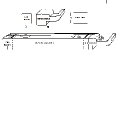
Here are my plans for the Scheitholt or Zither, of course, not to scale. Let me know if you see any changes I need to make. as it's easy to change. I did it all on "Paint Brush".
Good morning Ken. I'm back with some Q's about your Zitter build. I am looking at the pics you posted and I have a few design questions. It's not my intention to make one just like yours but I do want to keep it as authentic as possible.
1. Are 5 strings typical or a personal choice? I am finding several models with various number of strings.
2, I see the tuners are straight peg and not reared, are the unfretted strings tuned like a dulcimer or all the same? I guess that would make them all drone strings.
3. I see the tuners are located at the end of the fret board and not on the custom head stock. Is that typical or can I make mine part of the head stock. I believe this design would be considered a "chordophone" style. Some of the models I find have multiple strings, some fretted and some not. Some don't even have a head stock at all.
4. Did you add any interior braces? With the small sound box I figured braces may affect the resonance. I could use just some curfer moldings on top and bottom of top and lower panels.
5. I am finding different length and width measurements. Can I assume that is also the builders choice?
I will attach a design drawing for you to view and let me know if it is close enough to call it a Zitter, Scheitholt
Yes, I read that the other day. Great article and full of interesting facts. It appears you put a lot of time in research.
Sure, that would be great. I may add a few ideas of my own to personalize the plans if that's ok too. Email sent to your private message.
I hope everyone had a good Memorial Day with friends and family. I thought I would have some string time but I was in charge of the smoker. This is a great thread to follow. I get to express my lack of knowledge and gather a lot of smarts from others. Here's to a fresh beginning to DAA tuning
Ken, I will be working on plans for a Scheitold. I will pass it on to you before going into the build since you have already built one, if that's OK.
Walley, Strumelie, John, thanks for the input also. Lets keep this thread strumming. 
Humm! I like that too. Even slot the wood and use the same Teak wood as the fret board. OOPs! here I go again. The BCRC ("bic cap reverse capo") is a good antidote for my Dulcimer Acquisition Syndrome.
Well, that's simpler than what I was about to do. I was going to turn a piece on my lathe and flatten the bottom to get the exact height I need. Maybe I'm over killing it like I have a tendency to do at times.
Wow! this is another reason I love this Site. It's 6:30 AM and I have put this old brain in a scramble already. Here's my plan, Ken, All the different tunings you mentioned brings me to change my home made tear drop to CGG. I changed it from DAD a while back because It's too high for my bass voice to sing. I play all three strings on several of the songs I play and now, with CGG, I find more variation from the melody to the bass (but less from harmony to bass)
Strumelia, What a great post on the advantages of DAA. I am familiar with the modes playing guitar. (started playing late in life with that too  ). Since we're skinning cats, I too, will have some fun with the "false nut" suggestion. Obviously it should be just a hair higher than the permanent nut. I have to admit, at 6:30 AM I had to read some of it several times between sips of coffee. I have saved the post in my Music folder as I am sure I will refer to it often.
Ken, you are fortunate to have groups to join, I have tried to get a few folks around here in Central Florida. The closest group has fallen apart, the others are an hour away. My guitar friends would have started earlier but the guitar wouldn't fit in their crib.
What's the advantage of DAA rather than DAD? It seems it would loose some tone variation when using the bass string. Never tried it, Hummm! I could tune the Hughes to DAA and see what it sounds like.
I read that note in the article but it didn't make sense to me. So if I understand it correctly, the hook holds the string down on the fret as a continual note change and only that string is raised. Oh! my real name is Paul.
At present, I am busy making a John Deere tractor for the wife's doll house. They (daughter) have a collection of old stores and shops with a lot of stuff in them. A whole new story in itself but unrelated to dulcimers.
The Scheitholt article is very interesting (log, fire wood) I guess that means a person could use what ever is at hand for the material. . From the pic of several instruments you singled out #8. From the measurement at the lower/left the instrument must be about 48". Your is made from pine with 4 strings. I'm assuming you made the staple frets. pretty cool.
Number 1 looks very interesting (longest one in the pic). It appears to be about 7 ft. Looks like another easy build except for the string arrangement. That may be difficult to set up unless there is a good diagram somewhere. That would not be good if it turns out to be a "piece of junk" (not sure of the German translation for that)
So what appears to be the fret board is actually the sound box or body. The frets appear to be staples as are the originals from what I read. Nice job on the tuners. What kind of wood did you use? I'm thinking it may sound similar to my strum sticks since there isn't much reverberation in the small box. Volume-wise, my strum stick is probably have that size box but I made the sound hole larger.
I saved the pic in my "Music File" for future reference if that's OK.
Hey John, Ha!, good point about the move. She may want to add more space to her craft work area. There goes my "dul- ci-more space.
Hey Ken, pictures would be great. I am especially interested in the zithers and the scheitholt, (Wow, spell check didn't like those words at all). Since I am not familiar with those instruments I am on my way to Google for some education.
It appears the fret board is similar to a dulcimer without any 1/2 frets on the Scheithold. Only one or two strings are fretted as the rest a drones. When it's tuned, are all the unfretted strings tuned alike? Looks simple to build, I may make that my next project, but I may need a go-to for some info
The Zither looks complicated, I have played on a Hammered dulcimer before and the zither looks similar.
I believe you may have some FolkCraft dulcimers in your collection too.
I only have 5 and have a couple favorites when I take a trip or even play at home. I can't imagine trying to decide which one to take or play from a large collection. Sometimes I like to take a strum stick for accompaniment. They sound like banjos, in a way, but much easier to play.
I have to ask, which ones are your favorites?
23? wow! I will save this post to show my wife the next time I make or purchase another one. In the meantime I will consider making plans to build an addition to the den.
Here it is, I thought I dumped it. One can hardly refer to this one as a "Lap Instrument"
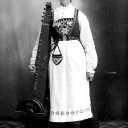
Ken, a while I posted a picture of a very large lady holding an instrument. the site I was following labeled it Dulcimer. Yes, a far cry from what we think of today.
Ha! love all the comments. Yes, John, clear out some space. Ken, Walley, Now you've done it, every time I tune my instruments I will think "Directly About Diatonic".
I believe DAS is Dulcimer Addiction Syndrome or something like that. I believe there are many acronyms out there for most every thing. I am a fossil hunting guide and when someone brings a rock for an identity check I tell them is a "leaverite", which means, "leave'er right there". There are a multitude of instruments out there in attics, storage sheds and places not conducive for the delicate construction. A "card carrying" DAS keeps a sharp eye out for them.
Thanks Canard, I have posted this a couple times just after I finished it. It seems to smile every time I play it. Well. sort of if a person has a great imagination.
Canard, (sorry, about the impersonal address since I'm not familiar with your name). I purchased a Hughes dulcimer on line. sight unseen. When I received it I realized it was truly "a sight" not to be shown off. It was later, labeled as a "wall hanger". The frets appeared to be what a youngster installed in the dark. The sound hole reminded me of the cartoons where the mouse ate it's way through the wall. The long and short of it, Its no longer a wall hanger. After removing the fret board, planing the frets down and cutting new fret slots. I added new frets and tuners. The mouse had to find another place of refuge and it plays like a song. Yes, there should never be a wall hanger. It was crafted to play, not to view as a relic decor. Hughes built the instrument and had his own "fishtail" design which, to me, Is his way of adding identity to an instrument that should bring melody to a silent world.
Thank you John, Very interesting comments. I am pleased to read the idea of adding some info to the inside label. When I built my Cedar Creek kit I added some notes as to where I purchased the kit and when I build it. All my homemade dulcimers have my own comments. The date is as important as the builder. I did all this for my kids and grand kids never giving a thought to other owners years down the road. I'm glad they have an identity now.
Ha! Don't we all do that at times
Dusty, Good reply. When a person uses the 1-2-4 chord and centers the 2 is certainly an option. I find it makes a bit of a "humming" note. I am sure if a person plays by themselves it wouldn't matter. I would have difficulties going from one instrument to another trying to center the one note.
Good point on the capo on the 7th fret.
Sid, I always enjoy questions like yours because I learn from it also. There are several dulcimer players that have the right answers. Dusty is one of them.
Hello Sid, If I'm understanding your correctly you are having difficulty reaching the frets that are next to the added frets. Someone correct me if I'm all wet here but adding 1/2 frets anywhere on the board shouldn't change the position of any of the other frets. From the photo it appears the distance between the 3rd and 4th fret is too wide. It should not make a difference how the instrument is tuned. Tuning it to DAA or DAD is all accomplished by string tension, not fret position. I tune mine DAD and CGC. and able to play the same chords just in a lower key. I built two stick dulcimers and use the same fret pattern as the others I built. I find it easier to play my stick like my guitar. A capo would help if it is placed above the 4th fret making it an octave higher. My tear drop is CGC because I cannot sing many songs in DAD, too high for my.
Looking forward to more comments to verify my response on the issue.
Have a blessed Easter to everyone from the ShopDad house hold as well.
I have found Richard Ash's book "Fret positioning fret guide" a tremendous help cutting fret slots. I have made several fret boards and repaired a few that weren't cut properly. The distance between two frets is important but the slots must be perfectly vertical. Hand cutting is fine but must be done when a person has the time to do it right. You are correct, Wally, the distance of each fret from the nut is crucial. Mr. Ash makes it clear in his book. He checks fret distance, over all distance and distance to nut. I'll admit, I'm a bit OCD, as its called, when cutting my fret boards. If the individual slots are off, by the time you get to the last cut it can be off enough to make a difference. With all this being said, let's not neglect string quality and cleanliness. As pointed out in earlier posts the type of wood is important too. Oh, Keep sound hole size and location in the formula too. Ha! I built a "CanJo" using a 1 Gal. lacquer thinner can. I never thought I would hear so much resonance come out of an old can. Anyone is welcome to let me know if all this is off the subject of temperament, but, from what I have learned since this thread began it all helps.
Yes, I just did some research on temperament and really got a head full of information. Yes, much is over my head, but very interesting. I'll just stick to my tuning method and enjoy what I love, .the sweet song of the dulcimer. Going back and forth from guitar to dulcimer keeps me on my toes. Keeps the cobwebs cleared from the old grey cells
OK, now you guys have spurred my interest. It's time for some deep diving into temperament. Thanks Dan, all this is helping and explains a bit more each time. How long have you guys been dealing with this? Do makers of all string instruments understand the temperament. Skip, I use the note frequency on my instruments rather than just an eyeball on the balance point. I try to get the frequency as close as possible. Yes, the material in which the instrument is made is definitely a factor. I am careful not to install too much bracing inside just for that purpose. The tone/resonance on my homebuilt tear drop is about the same as the kit made from walnut. My next build will be another hourglass design so I may reopen this discussion with you. Maybe I'll have more knowledge about it and not sound as ignorant with my statements and questions :) Here's a pic of the kit walnut Cedar Creek and my handmade teardrop mostly poplar and some oak bracing, Hand carved eagle head stock is also oak.
I haven't noticed any difficulty tuning my guitar. Totally different even if same note as Dulcimer. I chalk it up to the resonance of the guitar vs, the dulcimer. Diatonic to chromatic I guess.
That makes sense. I don't believe I have perfect pitch. Mine is more like "pitch the perfect" and depend on my tuner. That's when I get fussy. I believe that also explains why some of the notes that show up when I do a pull off sound a bit off. I only hear it in certain chords or songs. Probably just some 83 year old ears too.
Wow! every time I think I'm making progress something new pops up. This is very interesting Wally. Let me see if I'm in the right thought pattern of this information. I have 5 dulcimers I have one tuned CGC so I can sing the music in the lower key. Two of my dulcimers are DAD. Even though the instruments are tuned differently (one C and One D) I would believe they should be the same bass on my cell phone tuner. They are very close but off enough if it were the same instrument I would tune to the correct note. My question is, does this fall into what you are discussing in the video? Oh! its ok if I'm "all wet" on this comment. This may help too. The DAD is a Cedar Creek kit build and the other tear drop is homemade and tuned CGC. I'm what you may call "OCD" when it comes to cutting my fret boards and it shows up when I tune them. It just bothers me when I, for instance, tune the bass string one on D, Shouldn't it be as close when I use tuner on the "C" on my tear drop? If it were the same instrument going from one string to the other I would be correcting it on my tuner. Hope this makes sense.
Some music I want to learn on the Dulcimer is not available except for piano or guitar and seldom for dulcimer. I have found it easier to tabulate the song myself. It takes a few minutes but I am able to add harmony and bass to it as i learn the basic melody.
Welcome Drew, I'm rather a newbie myself. This site has been a great help to me. The folks here are eager to help. Seems like someone is available to assist with every issue or question. Tell us about your new Dulcimer and what other instruments you play.
I like that Nate. I think I found out how cool it sounds by accident. Now it seems natural in some arrangements. Same with pull offs. Just sounds natural and comes easy on certain notes on the melody string. Not to mention, it's fun.