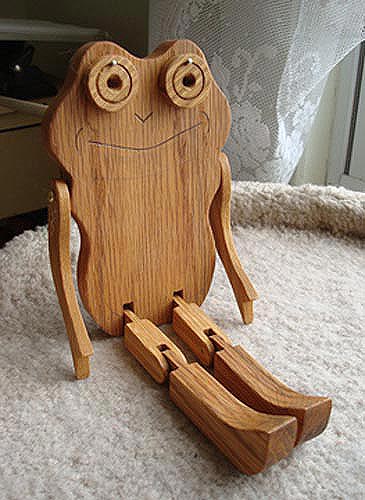
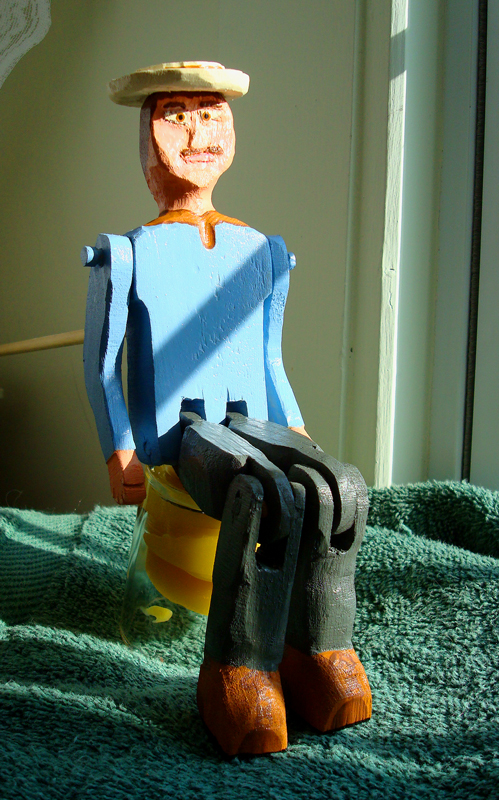
Here are my other two limberjacks, my Frenchman and Mr.Pig, I've been practicing regularly, but still need to get better at it. :)
Keltia, try thinking of the bowed psaltery more like a piano rather than a dulcimer.
You pick a range of the piano keys you want on your psaltery- usually between 1 and 3 octaves somewhere. Then you will have all the notes within that range. There is one string for every note. Each string will only play its one note- just like on a piano.
On a dulcimer or guitar, each string plays many notes through fretting it- therefore you can choose 'tunings' based on the kind of fingerings you are going to use.
a draw showing what note is what string could be fine.
Here are a few different tuning charts. Your string notes really depend on what high/low range you would like, on the size of the psaltery in terms of string length, and on how many strings you want:
http://www.juneappledulcimers.com/pages/BowedPsalteryTuningChart/
http://www.apsimplepsaltery.com/tuning_scheme.JPG
http://i153.photobucket.com/albums/s225/nigelum/Hodge-Podge/Psaltery_tuning_chart_resized.jpg
http://tuckasee.com/howto1.jpg
http://www.dulcimershofar.com/skin1/images/psal_notes.gif
As you can see there is no one correct way to tune a bowed psaltery, as they are all different depending on what strings they have.
A 25 string tenor like you show would be a nice typical psaltery. 25 or 32 strings or so, you'd be able to play various types of music on it. I would suggest you get at least 1 1/2 octaves to start with.
Keltia said:
Well, true... XD
My questions are about the whole....
1 - strings name/tuning?
2 - specific stuff to do/not do with (to know) ?
3 - hows big is the difference between one from a luthier & one from industry for that instrument (Indeed i wonder for that one) I'd like to hear both & see the differencies but I can dream about...
4 - Where to find tabs about ?
I think those questions are the common ones for any instr. heh Quite normal when yr pretty new at a new instrument... But I thought it was a thread about bowed psaltery but sure as I said: I'll dig more that
psaltery website later.
Keltia, yes your questions are normal for any new instrument, but they require a lot of in depth answers that could easily take days of typing. Donna suggests correctly that all this information is already there for the reading on her site totally dedicated to bowed psalteries- no need to try to explain everything about BP's here. This is a good place for discussing a few specific questions and for having fun comparing our BP experiences here, from the standpoint of being mountain dulcimer players. I do recommend that anyone who wants to learn about bowed psalteries in an in depth way would do well to look at Donna's comprehensive site http://psalterystrings.com/ .
But to try to address some aspects of your questions:
1 - strings name/tuning?
Psalteries can have varying numbers of strings, all tuned to various notes. Mine has 32 strings and is approximately 2 1/2 octaves. Basically, there is a string for every note. I won't name all 32 notes/strings on my psaltery here, but if you like I can point out an online chart for tuning a 32 string psaltery. You do not fret any strings to make notes, you just bow each open string. There are some people who use specific 'tunings' to achieve effects that are not the norm, but mostly the strings are not tuned in 'tunings'- they are just an array of notes (whole and half steps) going up the scale.
2 - specific stuff to do/not do with (to know) ?
To do : practice a lot, concentrate of getting a smooth sound from your bow and a light touch. learn a simple melody line.
Not to do : saw away on it roughly with a heavy hand which produces unfortunate sounds. Be impatient. Try to play 1-3-5 chords.
Not really sure what you mean by this question, but tried my best to answer it. If I'm missing what you meant by your question, please specify and clarify further what you are wanting to know.
3 - hows big is the difference between one from a luthier & one from industry for that instrument (Indeed i wonder for that one) I'd like to hear both & see the differencies but I can dream about...
On Donna's site there are quite a few descriptions and comparisons from various people owning psalteries amde by different people. She also lists some of the makers on the left column of her site, you can look at their sites and what they offer- most of them make nice psalteries that are good quality. Many of their sites offer photos and sound clips. Donna's site also has LOTS of videos of people playing thier psalteries, and you can watch and compare them.
Much depends on how many strings you want - that largely determines what size psaltery you would like to buy. Some are very small with less than a dozen strings- others have over 30 strings. Some have a high sound, some have longer strings and a lower sound. If you want to play very simple tunes then a smaller one with fewer strings might be fun to try. There is no one single type that is best for all people- just like with mountain dulcimers, a lot depends on what kind of music you are wanting to play- knowing that can help others make recommendations. Naturally larger psalteries with many strings are more expensive than small psalteries with only one octave of strings or less.
4 - Where to find tabs about ?
There are some tabs on Donna's site that you can find (Donna can point you to them perhaps).
But TAB is not as useful or applicable for bowed psalteries as it is for mountain dulcimers. Why?- because there is no fingering/fretting involved . No fingering positions to indicate, so basically any tab for the bowed psaltery consists mostly of just indicating which strings to play for each note in the melody. In a way, I feel it's just easier to pick out a simple tune by ear and practice playing it until you 'know' the tune on the psaltery. Once you can play one very simple tune, you can build on that and slowly play other tunes and get better.
In my view, TABs are mostly useful for instruments with fingerings and fingered fretted notes and chords - like mountain dulcimers, guitars, banjos, etc. Otherwise, you can simply use standard notation or else just learn the tune by ear. Start simple .
Hope this helps?
Sue, be sure to join http://psalterystrings.ning.com/ ....where you can drool over b.psalteries to your heart's content!OMG , The Bowed Saltery is such a Beautiful Instrumment. I had the oppertunity to play one last week and Just fell in love with it ! Just a beautiful sound and now I want a new toy ! Maybe Christmas
I picked it up a couple of nights ago, dreading how i might sound. But NO!- after about five minutes of shaking out the cobwebs, I was almost back where I had left off. What a kind and forgiving instrument it was!I happily played my favorite practice tunes for an hour, and I seem to have wound up pretty much back where I was again. What a relief. Now hopefully I can get back into more regular practice.
Ooooh, I would love that too! Your psaltery is very very beautiful!Have you ever been able to see or try a 3 octave psaltery? Are they around? Are they too awkward to play?I feel truely blessed to be able to get together almost every Wednesday & play music with my other psaltery friends.
The Jeffreys I test drove a few months ago was a lovely thing- normal scale length but quite shallow, lightweight, and smallish box compared to what we usually see being made today (so many boomy 'dreadnought dulcimers' these days...lol!). The main reason I didn't buy it was that the fretboard was only 1/2" high and that made it very awkward to play with a noter. There was not sufficient room for my hand or knuckles while sliding up and down, didn't seem to matter how I held the noter. This was an odd feature for a diatonic dulcimer which naturally favors traditional playing styles. It wouldn't be an issue if someone only played by fretting with the fingers on the melody string (fingerdancing). At the time I wondered if all his fretboards were low like that, and it also made me wonder if he himself had any experience in playing with a noter.
I have a different view on it. After all, a good chunk of Bluegrass music is from old-time songs, tunes, and ballads but played in a more modern bluegrass style. I don't think of it as 'old-time' music then- it's then bluegrass music, derived from old-time music sources. If someone played Shady Grove in Latin salsa style, it wouldn't be old-time music. And it wouldn't be bluegrass then either.Thus, I think of old-time music as being both the material (due to its age and other very distinctive characteristics) and the style in which it is played. It certainly can be a shadowy defining line between things sometimes though. Sometimes things are hybrids of two styles or two sources, etc.Carson, I'm going to say that "Old Time Music" is definitely more that just a core of basic tunes and songs. It is by this time developed into a genre of music with it's own sound coming from a basic cultural core but spiced with a variety of other cultures musical ingredients.
You can play the core of music without the sound that is now associated with "Old Time Music"
I don't know about guitars, but....The old european bowl back mandolins fell out of favor in America once mandolins began to be used in american style stringbands around 1920 and on. As I myself have found, they are very difficult to hold still against your stomach or chest while standing to play, as in a stringband setting on a stage. They slide and tilt too much because of the round back, not that they fall (since they have a shoulder strap). Sitting with one in your lap was not as much of a problem.European dulcimer ancestors were more often played on a table. Americans seem to have developed a preference for playing the early american dulcimers in their laps. I have equal difficulty keeping hourglass, teardrop, and galax eliptical dulcimers on my lap while playing fast fiddle tunes- I need a strap. The 'balance' effect of mirrored bouts doesn't seem do a thing for me to keep the instrument stable on my lap to play, i'm afraid. I seldom strum in the strum hollow- I find further up to give the best 'bounce' and tone. Usually about at the halfway point between the bridge and wherever I am currently fretting. I do the same with banjo.Now having the fretboard in the middle of the instrument might indeed make it easier to play on the lap. It would also make it easier to bow I'd think, though weren't some of the european ancestors/relatives bowed on a table, such as the Langeliks?It will be interesting to me to see how this works itself out when I get my 'traditional' style epinette des vosges next Spring. I'll report back here if I can remember. :)Anyone remember those round back guitar from the 70's? They fell out of your lap like a drunken cheerleader at a frat party!
Berimbau
Hi Berimbau,Can you explain why you feel this is so?thanks!Again it's far easier to strum a faster tune on an Appalachian dulcimer than it would be on a sheitholdt or other earlier zither form Berimbau
Wow, so that's like about the same size as a regular mountain dulcimer! Pretty big.The Epinette des Vosges I am having made for me will have a scale length of somewhere around 19". =8-oI imagine the two instruments will sound very different from each other!Deborah measured the VSL - 27 inches.
Here's some individually wrapped leftover Halloween candy -- not everybody on FOTMD is so @#$% healthy...
Sorry, I ate the last ones. Have a pickled egg instead.no problem.. here's your cider... pass the cookies please...
Thank you. :)Friends of the Mountain Dulcimer is growing slowly but surely (I think it's about four months old now).The best thing is that so many of our members are actively participating and really seem to enjoy being part of our little community. FOTMD is vibrant and full of bright enthusiasm!When I created it, I envisioned a place where both advanced players and brand new beginners could learn and grow side by side, and feel equally at home. A place that would appeal to advanced players yet have its highest goal be that of encouraging beginners. It amazes and delights me that FOTMD seems to be fulfilling that vision exactly. Its members are what make FOTMD special and successful ....it is each one of YOU who should be thanked the most! :)300 this morning!
Break out the bubbly.Congratulations, Strumelia. Thanks for creating the FOTMD site.Michael
In case y'all aren't counting, it's almost time for the 300-member international picnic and dulcimer jam.
Pickles and cookies, hmm... what else would be good with that?I have some home made apple sauce!Dick
Gosh, it seems like just yesterday when we hit 200!
Ok Rod, I see those hot dog buns in the background.... yer holdin' out on us, aren't you ?!Oh...wait...11/04/2006...? Think I'll pass on those cookies! =8-oOnly 2 left ta go.... so here are my cookies ready for the party... sorry didn't have the the stuff for no bakes... so we have banana nut cookies...
Yer making me blush now, 'Mo'.OK so yesterday I made the pickled beets and the bread&butter pickles already for the virtual block party 200 member celebration :
Who else is bringing what?Jim Fawcett- how about some of your pure home raised honey?Anyone else got something to bring?Mo, can you bring something besides your wheat-a-pix this time?- last time they got my innards all gummed up and I was stuck in mixolydian for a week! =8-oLet's see some pictures of what folks are bringing to the imaginary FOTMD Big 200 !.... :DAnd who will be our surprised 200th member? Give them a party hat and a noisemaker!
Interesting postings about incorrect fret placement or sharping up the finger board. As a luthier with 28 years behind me I've never heard the argument that string gauge effects intonation. You may be pressing too hard or sharping by bending but more likely your frets are incorrectly spaced.
Maybe string gauge does have something to do with sharp notes but this is the first place I've ever heard it!Just my thoughts on this very early Monday morning.