Dulcimer Challenge
General mountain dulcimer or music discussions
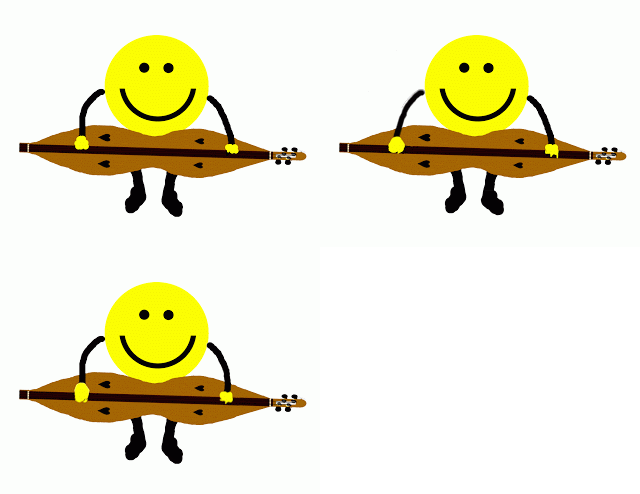
The first is hourglass, the second teardrop. Or the other way around. I'm sure of it.
The first is hourglass, the second teardrop. Or the other way around. I'm sure of it.
Those who took part in this forum discussion might be interested in a live radio tribute to Pete Seeger to benefit the Woodstock Day School and the Hudson River Sloop Clearwater. The event is hosted by Jay Ungar and Molly Mason.

 Hear the broadcast online at WAMC.ORG .
Such a sage comment from a sage woman.
Robin Thompson said:
Life can be just plain hard sometimes and making music or sharing music can help along the way.
Here's another story from the New York Times thatcompiles excerpts from interviews with other musicians (Bruce Springsteen, Bonnie Rait, Steve Earle, etc.) talking about Pete Seeger. Perhaps the most moving to me is the story of Pete watching television footage of the cleanup after 9-11, and the soundtrack they used was Bruce Springsteen singing Pete'ssong "We Shall Overcome." Pete commented that if all he had done was provide that song for that moment to help people heal, he would have lived a full life.
I heard a funny story in an interview Pete did onFresh Air with Terry Gross that was re-broadcast today. He was describing when he first met Woody Guthrie, who taught him how to hop trains and play in taverns. Woody basically told him which songs would get him a nickel or two when he played. And Woody explained how to wait on the outskirts of town where the trains would just start to pick up speed and then jump on. But he never explained at first how to get off. So the first time Petetried to get off, he fell, rolled down a hill, skinned both knees and both elbows and, more importantly, broke his banjo. He was traveling with a camera at the time, which he hocked to get enough money to buy a cheap guitar. He only knew a few chords at first, but played well enough to earn some nickels in the taverns until he could afford another banjo.
You can hear Pete tell the story yourself here .
We know most of those riding the rails were not doing it for fun, but it must have been quite an experience, just jumping railroad cars and traveling to wherever the trains went. What else would you expect from a guy who dropped out of Harvard to ride a bicycle across the country?
Here is the NPR Obituary . It includes links to stories on Pete and some of his music.
Here is the album I refer to in the introductory comments above.
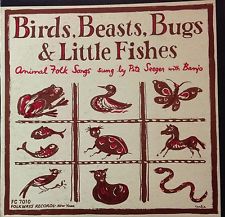
I had forgotten, but it was a 10" LP. Does anyone remember those?
A personal musical tribute:
If you listen carefully, you can hear my voice breaking up.
Pete on music and participation:
"I've never sung anywhere without giving the people listening a change to join in . . . I guess it's kind of a religion with me. Participation. That's what's going to save the human race."
Once upon a time, wasnt singing a part of everyday life as much as talking, physical exercise, and religion? Our distant ancestors, wherever they were in this world, sang while pounding grain, paddling canoes, or walking long journeys. Can we begin to make our lives once more all of a piece? Finding the right songs and singing them over and over is a way to start. And when one person taps out a beat, while another leads into the melody, or when three people discover a harmony they never knew existed, or a crowd joins in on a chorus as though to raise the ceiling a few feet higher, then they also know there is hope for the world.
Pete Seeger just died. He was 94. Maybe when my emotions are easier to put aside I'll post some comments about his place in American folk music history, but how can you sum up the importance of someone who sang with the Weavers, led protest marches, and sang children's songs? He lived the assertion that music was a joyful tool intended tobring people together. (And it was on his TV show that Jean Ritchie and her dulcimer were introduced to the television audience.)
You can read the New York Times obituary here .
There is no way to choose a representative song to post here, but perhaps this one will do. He is playing with others and singingfor peace.
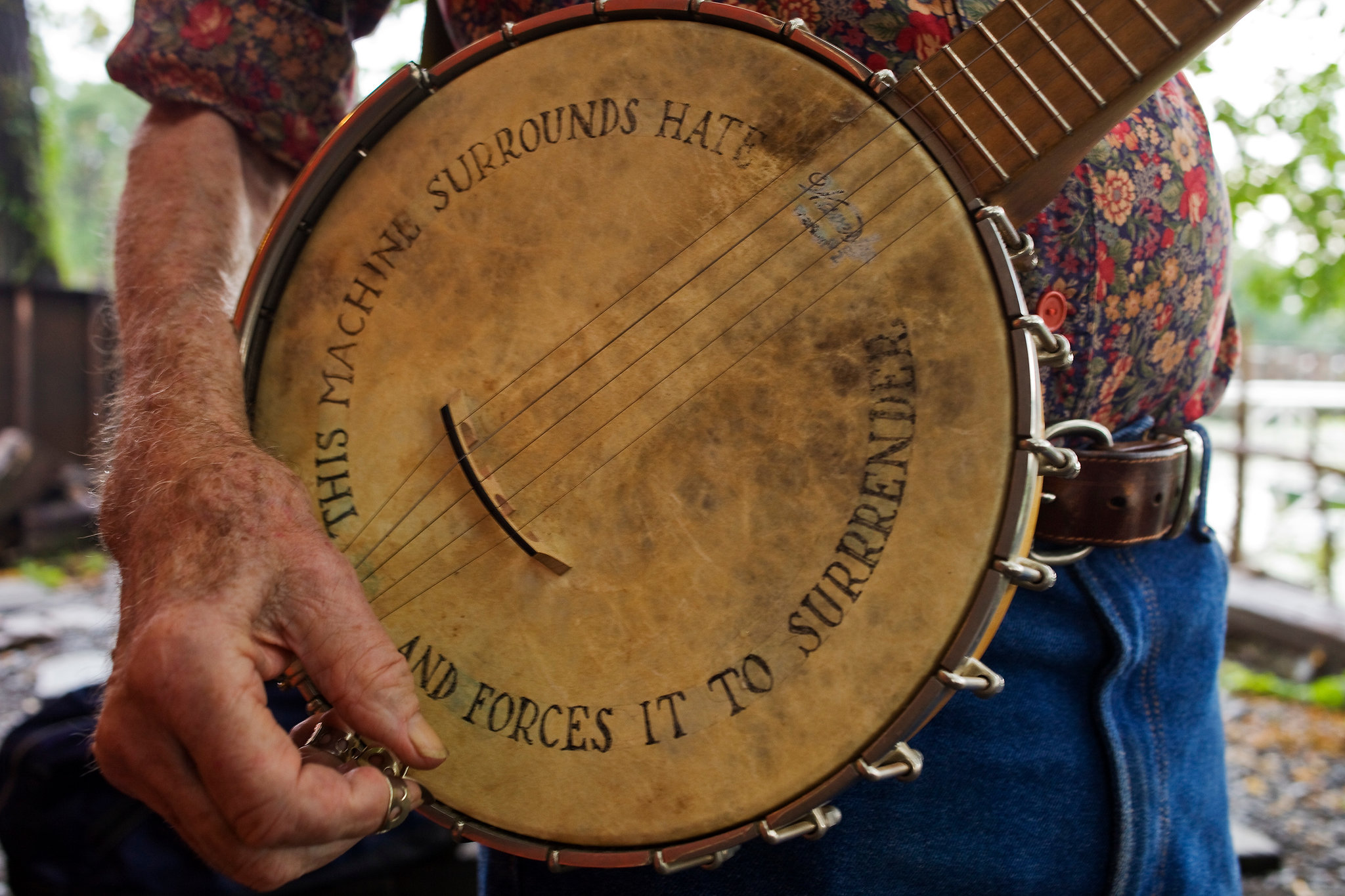
Thefirst record albumsI remember, from when I was just a few years' old, were Woody Guthrie's Songs for a Mother and Child to GrowOn andPete Seeger's Birds, Beasts, Bugs, and Little Fishes . I am sure I know every one of those songs by heart, and I have since I was able to talk. When I get depressed, I put on a Beatles album. But if that doesn't work, I go right to Pete Seeger. His voice is as comforting to me as my own mother's, and is indistinguishable in some ways since my earliest memories in life are sitting on my mother's lap listening to that album.
I used to wonder why I am drawn to acoustic music. I grew up in suburbia in the northeast, after all. And I spent many years listening to rock, blues, and jazz. But I've always felt at home with someone singing a simple song while plucking some strings, and I'm sure that is because of the early influence of Pete Seegerin my life.
I only met Pete Seeger once--at an anti-nuke rally in New York about 30 years ago--so I never really knew him. But I feel as though I've lost an uncle, a best friend, a mentor, and a security blanket all rolled into one. I honestly can't imagine who I would be today had Pete Seeger's music not been a part of my life.
Thank you, Mr. Seeger, for sharing the joys of music and modeling a life devoted to the improvement of one's community. Rest in peace.
John's reference to Wayne's blue earring concerns a photo Wayne posted with a blue Snark tuner attached to his ear. He titled it "Tuning by Ear."
I probably shouldn't post here. I honestly don't care how people dress. I don't think anyone should feel they have to dress up to perform, so jeans and a t-shirt works for me, if that's what makes you comfortable. Years ago I saw Gilligan Welch at the Freight and Salvage in Berkeley. At intermission, the woman I was with (a young lawyer from San Francisco) commented that Gillian's outfit was just "so frumpy" and someone needed to teach her how to dress. I had not even noticed how she was dressed, but I probably could have recited the playlist in order. It was funny, though, when Gillian added in her between-song repartee that she had started a database to list what outfit she wore at each show because she was giving a concert and someone pointed out that she had worn that same outfit the previous time she played that venue. Everyone laughed, of course. My date was horrified to learn that Gillian was thinking about her outfit and still dressed "so frumpy." I was sad that someone with so much musical talent had to waste her time thinking about her outfit. You know what I mean, like supposedly Einstein wore the same outfit everyday because he didn't want to waste time thinking about the mundane, insignificant details of daily life.
Dress in whatever way makes you most comfortable. If part of that comfort is your perception of how you look, then wear an outfit that you think makes you look good.
As a middle-aged man, I can confess that I am less worried about the clothes I'm wearing than the fact that the dulcimer does not hide my beer belly the way a guitar does. No one needs to see the jiggle in my middle.
Guys, I think part of the confusion here is that in dulcimer circles, modes are often conflated with drone playing. The assumption is that traditional music involves modes to be played over drones whereas modern music involves chords.
I think we all understand that a mode is nothing but a scale, and as long as a melody is restricted to the notes of a mode, it is modal music, whether or not drones or chords accompany the melody. After all, there is a lot of other modal music that incorporates chord structures (Miles Davis's Kind of Blue album is often celebrated as a study in modal jazz, for example, and Coltrane's "My Favorite Things" is famous for a long improvisation in the dorian mode).
Let me point out that the original question here had nothing to do with modes but asked about keys and how to use a capo. The only reason modes were mentioned was because the first person to respond, Rob, accurately pointed out that on a diatonic fretboard, the use of a capo changes the mode as well as the key. I fear all this discussion about modes is just overwhelming to beginners, especially those who are not playing drone style and don't really need to understand modes for any practical purposes.
Larry, what's nice about using the capo is that you can use the same fingerings and play the same songs you are used to. The only difference is that you are in a different key (and you have to navigate around the 6+ fret). So the same fingerings you used for D in DAD will be a G when the capo is at the third fret. The fingerings for your G and A chords will be C and D with the capo at the third fret. Does that make sense?
I seem to post this video whenever anyone asks about how to use capos, but check out this Bing Futch video. He teaches Hangman's Reel in DAD and then shows you how to play it in G with the capo at the 3rd fret and and in A with the capo at the 4th fret. Then, if you listen as the closing credits roll by, you'll hear a "spooky" version in Em, which he gets by putting the capo at the first fret and playing the same song.
Larry,
As Rob explains capos do not work on dulcimers the way they work on guitars or banjos because the dulcimer is fretted diatonically, so some notes are not available to you. As the posts above indicate, using a capo will change not only the key, but the mode. I can't talk modes, but I am comfortable with capos.
If you tune CGC you can play in F with the capo at the 3rd fret or G with the capo at the 4th fret.
If you put your capo on the first fret you will be in the key of D, but the notes available to you will be D minor.
What I suggest is tuning to DAD and using the capo at 3 for the key of G and 4 for the key of A. Then you can quickly tune down one note to CGC for the key of C. Those four keys -- C, D, G, and A -- are the most common keys in bluegrass and old timey jams.
Larry Ross said:
Thnaks for all the input and the total confusion. I guess the answer is...... tuning to the Key of C and putting a Capo on Fret one does not result in the Key of D
You deserved some good news for a change, Phil. And yes, there are some wonderful people here at FOTMD.
Phil, I know you've had a string of bad luck, but at least pneumonia is something they can deal with. Take it easy until you're better.
Another way of envisioning the relationships among strings is by scale positions.
Ionian tuning (DAA or CGG, for example) is also referred to as 1-5-5, meaning the middle and melody strings are tuned to the fifth scale position starting with the bass string. Then all you need to know to tune your dulcimer is how to count to 5.
open = 1
1st fret = 2
2nd fret = 3
3rd fret = 4
4th fret = 5
Since the middle and melody strings are tuned to the fifth, you tune them to the bass string at the 4th fret.
Mixolydian tuning (DAd or CGc, for example) can also be referred to as 1-5-8, meaning the middle string is tuned to the fifth and the melody string is tuned to the octave (the 8th). Again, all you have to do is count.
open = 1
1st fret = 2
2nd fret = 3
3rd fret = 4
4th fret = 5
5th fret = 6
6th fret = 7
7th fret = 8
So for a 1-5-8 tuning, tune your middle string to the bass string at the 4th fret and your melody string to bass string at the 7th fret.
[You can also tune the melody string to middle string. Since the open string is the 5th, the first fret is the 6th, the second fret is the 7th, and the third fret is the 8th or octave. So once you tune the middle string to the fifth tone of the bass string (the bass string at the fourth fret), you can tune the melody string to the middle string on the third fret. Now you can double check it all, since the bass string at the 7th fret, the middle string at the 3rd fret, and the open melody string should all be the same note in any 1-5-8 tuning.]
I won't bother going through this for other tunings such as the 1-5-7 tuning, but hopefully you can see the advantage to thinking in terms of scale positions. The scale positions themselves tell you how to tune your dulcimer. The counting you learned from Sesame Street is all you need to know.
Wait, we switched from cassettes to CDs? When?
CDs are already obsolete now since everything is just 1s and 0s.
If you want to see a demonstration of how to use a capo, check out this Bing Futch video: . He teaches the fiddle tune "Hangman's Reel" and then shows how you can play it in the key of G with a capo at the third fret or A with a capo at the 4th fret. And if you listen to the music playing over the closing credits, you will hear a "spooky" minor version of the song which he gets by playing it in Em with the capo at the first fret.
That's all too funny. You can tune a piano but you can't tunafish.
And don't forget about all the different kinds of dulcimers there are: mountain dulcimers, lap dulcimers, fretted dulcimers, etc. Most of us just want to find one instrument we can play OK. And what in the world is an Indian walking cane and what does it have to do with dulcimers?
Notice the picking comes first. Then the jamming. You have to get the berries off the vine before you can cook 'em up with sugar.
Ellen, when we're done laughing at your humor, some of us will take off our fingerpicks (the ones that aren't flat) and type answers to any real questions you have. But if you just want to keep making us laugh, we're OK with that, too.
That's kind of you to share. I haven't tried to play it yet, but it looks like there are lots of arpeggios involved.
Thanks so much.
William,
First of all, in common parlance, what you are calling the "tenor" string is referred to simply as the middle string. "Tenor" makes sense to me, but that is not common practice.
Second, strumming in will accent the melody string only if your strum moves downward rather than upward. It may be that you are too new at playing to be able to fully control your strums in this way, but in the same way that Ken described how to strum out in such a way as to de-emphasize the bass, you can do the same thing strumming inward. In other words, strumming inward per se does not stress the melody notes. It is your specific method of strumming inward, and as you progress you will gain greater ability to alter your strumming in nuanced ways.
Third, notice that you refer to "principle" strum. Although some folks only strum in one direction, most players eventually begin strumming in both directions. The key is to keep a steady strum, with your principle strum occurring on the down beats and your other strum occurring on the up beats. So if your principle strum is in, the as you count 1-&-2-&-3-&-4-& you will strum in on the numbers and out on the &s. If your principle strum is out (as is mine) then you reverse that, and you strum out on the numbers and in on the &s. But melodies are not limited to down beats, so as you begin playing more and more advanced melodies, you will have to play melody notes when not strumming in the direction of your principle strum.
In short, the long-term solution to your problem cannot simply be to strum in instead of out. You will eventually develop the technique to emphaize certain strings in either direction. Admittedly, de-emphasizing the middle string is a problem.
How new are the strings? I would suggest putting all new strings on and getting slightly heavier melody strings and bass strings. Why not try .024 on the bass and .012 on the other strings. That change alone will emphaize the bass and melody strings more than they are now inyour current set-up. And if the strings are old, they might indeed have aged differently. Wound strings can sometimes go dead or flat faster than unwound strings, and since you finger the melody strings, the oil from your skin might have encouraged the melody strings to age faster than the middle string which remains untouched. Both new strings and changing the gauges might help with the problem you have.
Finally, if changing string gauges does not help, try changing the tuning a tiny little bit. Every dulcimer has a tone that finds extra responsiveness in the wood. Some players and luthiers sing into the sound holes of their instruments to find what that tone is and then they tune accordingly. It is possible that the A note of your middle string is simply more resonant in your dulcimer than other notes. What if you tuned CGG instead of DAA? You will still be able to play all the same songs in all the same fingerings that you've already learned, but it's possible that getting the middle string off the A note will bring it back in line with the volume and sustain of the other strings.
Good luck. And let us know how things go.
William, Ken has given you good advice about how to alter your strumming to either stress the melody strings more than the drone strings. You may not be able to master strumming technique right away, but keep working at it.
You should also not be afraid to change string gauges as you suggest. Although you might not want to go smaller than .020 on the bass string, especially if you are tuning to DAA, you might as well try .012 on the melody strings. That will increase the volume of the melody string a little bit.
I can't believe it's been three years. Wow. Rod was the first one to welcome me to FOTMD. He was a generous and kind soul. One reason I don't join the dulcimer club on Paltalk much anymore is because his absence there--even after three years--is so palpable it makes me sad.
I like that image of him teaching angels to play the dulcimer.
Ellen, I was just about to suggest the same thing as Randy. You will get a cleaner sound if you use one melody string. Try it and see if the dulcimer sounds better to you.
Garland, thanks so much for the advice. I just checked out weebly and it appears to work about the same as webs.com, which I am using now (see the link in my original post). It is certainly easy. The problem for me, though, is that while these web hosting sites allow the quick setup of a site, the prefabbed templates also limit what you can do and maybe I'm too much of a control freak. I have a vision of what I want a page to look like and get frustrated if I can't get exactly that. I think I am more likely to find another web hosting site that supports Wordpress. A couple are specifically designed for Wordpress and have one-click installs. When things slow down at work (erhaps over the holidays) I'll probably junk the website I just set up a couple of days ago, register my domain name, and set something up from scratch, probably using WordPress.
Thanks for your suggestions. And Byron, I will definitely check out Luna Pages. How is their customer support?
Thanks, Lois. I guess it's about time I figured this stuff out, huh? If I do go the Wordpress route, I will certainly choose a host that is designed for WordPress so that I get the extra support. We'll see.
Wow, Kevin Y., thanks for all those links. That will save me a lot of time. The more I ponder this the more I think I am going to use wordpress and take control of the whole process rather than continue with the pre-fabbed stuff that is quick and easy but not necessarily what I am looking for. Plus, I should probably learn moremore web designfor work, so I can sort of justify whatever time it takes. I may indeed contact you with questions down the line!
Kevin M., thanks for the encouragement. I've found it pretty easy to just plug content into the templates at webs.com but I end up with pages that don't look exactly the way I want them to. I think I'm going to abandon that site you were looking at and start over. Once I do that we could definitely link between our sites. The main purpose of the River City Dulcimers site is for our local group to have a resource to find tablature, information on our meetings, and so forth, but I still find myself fielding questions about luthiers and instructional materials, so even our local group would benefit from links to people like you.
Thanks, Kevin and Tom.
Kevin, the link I provide above is to the beginnings of a website on webs.com. I can see why people would like it. My only objection is that I'm limited to certain templates that can't be altered. And I am unsure if I want to continue with them or switch. It's good to know their customer support is good.
Tom, thanks for the encouragement. I do use pieces of HTML coding in courses that I design, so I'm not afraid of it, but starting from scratch still seems a bit much. It's good to know it isn't that hard. I could probably get a free web desing class where I teach if I really wanted to put that much time into it.
Strumelia, that seems like good advice. The fact is that what I want to do with the website is pretty simple, but that does not mean I'm happy with the generic design elements of these prefabbed websites.
I took a look both at the website you and Brian did and the wordpress site, and it looks like it might be a good plan. At this point I'm leaning to wordpress and one of the web hosts that are designed specifically to integrate with it.
Thanks for the suggestion.
Thanks, Kevin. That is helpful information about the <header> section. The link above is to a webs.com site, which I used only because I was able to give it a try without paying anything. Now that I want to register a domain name and develop a more permanent website, I am not sure webs.com is what I want. Among other things, it does not let you code in HTML on your own. I guess I'm still searching for a web host.
I do indeed do some instructional design, but I am not an instructional designer. I teach online classes, and over the last few years I've found it easier to design my own courses than try to give the "content" to someone else and have them do it. For similar reasons, although I would love to have one of your students design a website for me, I really need to learn to do it myself. In the past we've had people who found a really nifty way to present some content in a course, but then 10 months or a year later we want to make some changes only to find that individual has moved to a different job and no one knows what they did.
Anyway, thanks for your response. I may have some specific questions for you as I get more into this.
Thanks, Bobby. You confirm that webs.com is a reasonable site. At least they let you built a website before you decide if you want to upgrade and start paying. The other cheap web hosting sites out there want you to pay upfront before you start building a website.
I hadn't explored the podcast app, but I'll look into it. I did add an audio file to the home page.
I guess what I find frustrating is that you have to choose a backdrop for every page based on the pre-fabricated templates. I would like one template that is just a blank page so that I can customize that backdrop. I did make myself a banner. It is in .jpg formate and I can resize it to any size. But I can't seem to make that banner part of the backdrop of the pages. I am stuck with webs.com templates.
One final question for you: have you ever used customer service at webs.com? I am curious how responsive they are on the phone or through text messaging or whatever.
Hey folks, I seek advice about how to start a website.
I want to find acheap web hosting service that will allow me set up a basic website for my local dulcimer group so I can keep a page of tab for the songs we play, a list of local events, some pictures, and so forth.
I started using one free web service that offers dozens of basic templates for the website, but I really want more flexibility. I don't know HTML code, but I do design online courses, so I have some experience with this stuff. The problem is that I have a vision of what I want for each page and am frustrated stuck in the pre-fab templates the web service offers. I would much prefer something with blank pages that allows me to just move items (pictures, text, audio files, etc) to where I want them and resize them at will.
For example, this is what I have so far: http://rivercitydulcimers.webs.com/ . But I want to be able to put my banner (that image with the Sacramento River and skyline with the words overlaid) on the top with the tabs for the different pages underneath that, as well as customize the rest of the page. This free web service has me locked in to one prefabbed format or another. It seems to me that what I seek is pretty unsophisticated and basic.
Before I pay to register a domain name and to get some kind of medium amount of customer service, I want to make sure I have a web host that will let me do what I want.
Any advice you can offer would be most appreciated.
Yum. Blue Lion. Yum. Inlay. Yum. Rosewood. Yum.
Stephanie Stuckwisch said:
I bought my dream dulcimer a few years ago - Blue lion rosewood hourglass w /custom inlay.
Why do you ask, Mike? Are you going to surprise me with a Christmas present this year?
A chorus of dulcimers?