Happens to the best of us! (and to me as well, lol)
--
Site Owner
Those irritated by grain of sand best avoid beach.
-Strumelia proverb c.1990
Happens to the best of us! (and to me as well, lol)
Great sleuthing and great logic, Dusty!
@johnnyb, I am pretty sure that C5 is a typo. It is supposed to be D above middle C, not C above middle C. If you look at the arrangements for that tuning (Welladay, O Mistress Mine, All in a Garden Green, Now Robin Lend Me Thy Bow) the tab clearly says ADD for the open strings.
Additionally, she details exactly what string gauges she uses, and the lightest is .009. You could probably still use a .010 if you wished.
(I didn't even remember that I had this book squirreled away in a file cabinet, but there it was!)
The string calculator referenced suggested a string diameter of .005".
Just because a string calculator suggests a thin or heavy string doesn't mean it would be practical. The calculators are useful, but they have no actual brain or hands. A string calculator might theoretically suggest a .000001 string to reach some impossibly high note... even though such a string is not even for sale. Or it would suggest a wound string as heavy as a double bass might use to reach some crazy low note... and such a string would be too heavy to even install on a dulcimer, much less play.
I have found that melody strings any thinner than .009 tend to break very easily... so much so that i won't go thinner than .009 anymore.
And even with that, if my instrument's vsl scale is anything longer than 26.5", I personally will not put on a string thinner than .010 . That's not due to any scientific calculation son my part, but simply because i have broken several .009 melody strings that way, and it gets downright annoying. 
Is that for the C5?
I have to admit that I was getting dizzy trying to make sense of all those tunings. I don't think we can fully answer your question without knowing the VSL of your dulcimer. You might consult the Strothers String Gauge Calculator to determine the ideal string gauges.
A string should be able to tune one whole note up or down, so I would suggest establishing the ideal string gauge for G#3 for the bass, D4 for the middle, and C#4 for the melody. With gauges established for each of those, you should be able to tune to the other tunings. With one exception. That c5 may indeed need a different string. I don't believe a string can be adjusted for a whole octave.
And it's always a good idea to have extra strings on hand and to wear protective goggles when you retune  .
.
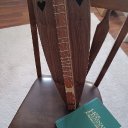
I recently picked up a copy of Lorraine Lee Hammond's Barley Break: An Elizabethan Songbook with Arrangements for Appalachian Dulcimer.
In this book (and The Magic Dulcimer) she uses four different tunings. I will list them in order from bass to treble using the scientific notation (as in D4 A3 d3):
Tuning I
G3
D4
d4
Tuning II
G3
D4
c4
Tuning III
A3
D4
c5
Tuning IIII
A3
D4
c4
The question: In order to not repeat the first mistake I made, tuning up from D3A3d4 to D3A3a4 (instead of tuning correctly to D3A3a3) and breaking the thinnest string, what would be the best way to actually tune these? It doesn't have to be in a specific key- they would be tuned to each other.
The bass strings in all tunings go down, so not an issue.
The middle strings all go up from A3 to D4, which is only 3 notes.
The treble strings stay the same or go down except for Tuning III, where it goes up to C5, which is a 6-note increase.
Can the middle strings handles going up 3 notes?
Tuning III scares me...