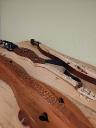
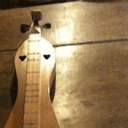
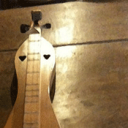
Chet Hines “dulcimore”
Instruments- discuss specific features, luthiers, instrument problems & questions
Nice looking dulcimore Paula. I know you enjoy it immensely.
Hi all, it’s been a while since I posted here. We moved to to Portugal several years ago and I has sold my dulcimer before we left. (I seriously had to this the herd!)
im getting ready to have a visit back to Texas and that led me to taking a look on eBay to see if there might be an interesting MD to pick up to bring home with me when I return to Portugal.
i ended up bidding on (and winning) this “dulcimore” by Chet Hines. I think at some point I had borrowed a copy of his book “How to Make and Play the Dulcimore” (1973) from the library. He was also the founder of the Mountain Dulcimer Society in Dayton, Ohio.
other than that I haven’t been able to find a huge amount about him or his instruments. I’m assuming my dulcimer is from the ‘70s.
Any additional information anyone might have would be appreciated. I haven’t actually picked up the dulcimer yet. I’ll be retrieving it from my in-laws in Texas in April.
thanks,
paula
Price drop to $420.
Listed locally, too.
The MD is a ' Modal ' based instrument, not a ' key ' based one. I think theory has 'diatonic scale' [and its naming conventions] being based on the Ionian Mode and the remaining modes being a reordering of the the Ionian mode. The nut/zero fret sets up the Mixolydian pattern. Fret three sets up the start of the Ionian pattern. Each fret sets up another mode.
This leads me to conclude that, basically:
CDEFGABC is a diatonic scale with its attendant naming conventions, and
DEFGABCD is a modal scale [Dorian] without the naming conventions. I'm wrong probably, but it keeps things simple for me.
Addition of the 6 1/2/13 1/2 permits the Ionian mode to start at the nut/0 fret.
"3 mm is ok., 2,8 or 2,9 mm too."
Adding the metric measurement is good. We should remember that "The Appalachian Dulcimer" covers the world today, and that we should routinely mention both American and SI units.
Many of us are used to thinking 1/4 inch plywood is 6mm and 3mm ply is 1/8 inch. Actually 1/8 inch is 3.175 (3,175) mm, so "by eyeball" we are talking about the same dimension, making 2,8 mm a bit narrow for some of us.
"3 mm is ok., 2,8 or 2,9 mm too."
Adding the metric measurement is good. We should remember that "The Appalachian Dulcimer" covers the world today, and that we should routinely mention both American and SI units.
Many of us are used to thinking 1/4 inch plywood is 6mm and 3mm ply is 1/8 inch. Actually 1/8 inch is 3.175 (3,175) mm, so "by eyeball" we are talking about the same dimension, making 2,8 mm a bit narrow for some of us.
I just reread this 2 year old thread from the beginning- it's got so many wonderful points of view and insights from knowledgeable folks. A good read!
3 mm is ok., 2,8 ou 2,9 mm too.
If too large between the 2 strings, they can move away from each other when playing
@overdrive, please note that your description of frets and scale positions only holds true if the open string is the tonic. In traditional dulcimer playing, different tunings are used for different modes, and the tonic changes depending on the tuning. So yes, in DAd (mixolydian) the tonic is the open string. But in DAA (ionian) the tonic is found at the 3rd fret. In DAC (aeolian) the tonic is found at the 1st fret. Basically, the pattern of whole and half steps in the scale or mode determines where on the fretboard you find the tonic.
I suspect that the 6+ fret was added so that you could get the two "major" sounding modes (ionian & mixolydian) out of a single tuning (1-5-8 or DAd). I doubt people started tuning more in DAd than DAA simply because they wanted to play a small number of mixolydian tunes all the time.
And as people started playing chords and fretting across all the strings, DAd offers a greater melodic range (three notes worth!) out of a single chord position than does DAA. Chording in DAA sounds more concise and coherent to my ear, but it requires a lot more hand movement to play in a basic chord/melody style.
I've been thinking about the fret numbers we use as it relates to the diatonic tuning that comes on a dulcimer.
Each fret is essentially a scale degree, so the nut is 1, tonic, not zero. "Fret 1" is the major second. "Fret 2" is the major third, "Fret 3" is major fourth, and so on. A "6.5 Fret" gives us the major seventh of the Ionian. Our "Fret 6" is the flat seventh for Mixolydian.
Is it too late to rename the frets? Why was Mixolydian the standard scale? Because Old Joe Clark? Has anybody fretted up a dulcimer as a dedicated Dorian instrument? That would be a beautiful thing! The extra fret would make it work for Aeolian tunes.
I guess a lot also depended on what tuning the person liked to use... as to whether a 3.5 fret would be useful? We can't just assume they tuned 1-5-8 or 1-5-5.
A 3+ fret might have been used to play ancient or Eastern European tunes which have different ascending and descending scales. I think I've run across tunes where either a 3+ or 4+ was needed in DAA. Dulcimers can be highly individualized, and a "one-off" by a home builder is a possibility..
Additional photos....
(Plus there's one more photo in My Photos under my user profile here.)
I'm selling my beautiful McSpadden all walnut dulcimer!
I ordered it made new in 2018. It is in excellent condition (both the dulcimer and the case). It comes from a smoke-free, humidity-controlled home. I have been playing stringed instruments since 1973. I have always been meticulous in the use and care of all my instruments. I've sold and shipped many instruments over the years, so it will be well-packed.
- $450, which includes FREE UPS ground shipping CONUS, with tracking and insurance
- 4FH26WW-M (Jim Woods)
- 26" VSL
- flat head, set up for 4 strings (currently strung with 3 strings)
- Micarta fretboard
- McSpadden blue gigbag included
- 2 new sets of McSpadden Squeakless 26" VSL strings included
- 1-1/2 fret, along with the standard 6-1/2 fret; but NO 8-1/2 fret
- PayPal friends and family
- no returns
- see additional photos in second post to this thread
Everyone can SEE he's Sharp.......couldn't resist......
Looks like a nice purchase!
You should keep in mind that your 1970s dulcimer is diatonically fretted. Many modern dulcimers have an 'extra' fret or two... most commonly a 6.5 fret. Yours does not have a 6.5 fret (which is not too difficult for a luthier to add for you if you want). This simply means that if you tune to DAd and expect to follow dulcimer tabs written for DAd tuning, you may find you are 'missing' a needed note for using that tab.
There are ways to work around that. However for now I'd suggest the easiest method is to tune to DAA instead and use tab written for DAA tuning... which usually does not call for using a 6.5 fret. Or just tune DAA or CGG and start picking out simple tunes by ear. Have fun!
Thank you for the clarification on the fretboard. Dad thought it had the 6.5 fret.
Regarding your possum board. Some members have used a piece of 3/4" shelf board cut to width and length. I have always preferred to use 1/4" solid wood, usually poplar I find at the local building supply store in the craft wood section. I generally trace the dulcimer onto the board and cut the board to the shape of the dulcimer. Then I make a fitted block at each end to secure the tail piece and head stock. To avoid scratches I pick up some adhesive backed felt at the local craft store and put that on the end blocks for protection. Then as you say strap buttons on the possum board. With the feet on your dulcimer that arrangement should really sing.
So glad your Dad is joining you on this dulcimer journey. What wonderful and special memories will come from this.
A gentle warning: Dulcimer Acquisition Disorder (DAD) may come knocking at your door. It is not fatal nor debilitating. The symptoms can temporarily be treated with the addition of another dulcimer to your collection. But in time, in my experience anyway, the symptoms tend to recur, some times multiple times over the course of the months and years.
Best wishes to you and your Dad on your dulcimer journey.
I'm fully aware of Acquisition Disorder in a couple of other hobbies (Hunting, Fishing, Blacksmithing/knife making...). Thank you for the warning.
Good advice so far. I have always had good results with Howard Feed N Wax, especially with older wood that might have dried out a bit.
Thank you for the feedback.
Hmmm...I was wondering if I should install a 6 1/5 before I offer it for sale. nah. Perhaps I'll just offer the option.
SO many options for such a simple instrument.
Thanks Dusty!
Good advice so far. I have always had good results with Howard Feed N Wax, especially with older wood that might have dried out a bit.
John's suggestions for strings are good. Here is another string calculator. https://www.strothers.com/string_choice.html It tends to suggest strings on the light side which you will see if you use it.
Ken
"The dulcimer sings a sweet song."
@john-petry, normally I would say that that would be a good question for the I Have Extra Frets Group , but I see that @jan-potts asked that question 13 years ago and no one answered.
In a DAd tuning, the Ab you get on the melody string at 3+ is the same note as the middle string at the 6+ fret, so I don't see a huge need for it. Maybe you could play the B part of Ash Grove without having to go so high up the fretboard. Then again, on a dulcimer without a 6+ fret, that could be the answer. I use that 6+ on the middle string pretty often. You need that note for an E major chord, after all.
Kinda' related to the 6 1/2.... Pulled out what I think is an old Hughes kit dulcimer...it doesn't have a 6 1/2, but it DOES have a 3 1/2..Why?
Any ideas?.....asking for a friend...
https://wahiduddin.net/calc/calc_guitar_tension_from_size.htm
Here is a good string calculator, that also shows what percentage of breaking strength you get into with different sizes and type of strings [plain/wound etc]. I used a different one to show "whole instrument" tensions for you. For the different tuning of DAAA and DAdd you can see how the melody strings vary from about 25% breaking strength at A3 to 42% at d4.
I tend to play with these tools more when I'm trying to replace the odd missing strings on harps, but it can get to be fun trying to see what can work with different VSL s ...
Short answer.... .012 .012 .014..and a wound .024 should work fine....
Great job! I assume you got the case too. Easily worth twice what you paid. Seems to be in fine shape as well.
Just about everything that goes out my door is strung with 2x .012 melodies [d] 1x .014 [A] and 1x .024 [D] .
Cleaning "should" be about the same as your guitar, but I suspect the finish is shellac, so be careful with anything alcohol based as it will dissolve the finish. 000/0000 steel wool for the frets and fingerboard, a bit of oil if it seems dry.
You've got a nice piece of history to care for now, [oh how I wish they could talk] , welcome to the adventure............
There's really no need to post the VSL as you have learned from the builder what was on it to begin with. I would go with that. The configuration the builder used makes it very easy to change tuning from DAA to DAd without breaking the melody string.
With regard to cleaning. For years I've used Martin's Guitar Cleaner/Polish on my dulcimers without any problems.
Ken
"The dulcimer sings a sweet song."
John and Ken,
After talking more with my dad, he did not get the actual string gauges. The maker provided a "guestimate" of what she thought they put on the instrument.
With that in mind, the VSL is 25 and 1/8 inches (from the fretboard side of the nut to the front edge of the bridge). What would be the proper string gauges?
Thank you Ken for the information. I will report back here with updates as we make progress.
There's really no need to post the VSL as you have learned from the builder what was on it to begin with. I would go with that. The configuration the builder used makes it very easy to change tuning from DAA to DAd without breaking the melody string.
With regard to cleaning. For years I've used Martin's Guitar Cleaner/Polish on my dulcimers without any problems.
Ken
"The dulcimer sings a sweet song."
Regarding your possum board. Some members have used a piece of 3/4" shelf board cut to width and length. I have always preferred to use 1/4" solid wood, usually poplar I find at the local building supply store in the craft wood section. I generally trace the dulcimer onto the board and cut the board to the shape of the dulcimer. Then I make a fitted block at each end to secure the tail piece and head stock. To avoid scratches I pick up some adhesive backed felt at the local craft store and put that on the end blocks for protection. Then as you say strap buttons on the possum board. With the feet on your dulcimer that arrangement should really sing.
So glad your Dad is joining you on this dulcimer journey. What wonderful and special memories will come from this.
A gentle warning: Dulcimer Acquisition Disorder (DAD) may come knocking at your door. It is not fatal nor debilitating. The symptoms can temporarily be treated with the addition of another dulcimer to your collection. But in time, in my experience anyway, the symptoms tend to recur, some times multiple times over the course of the months and years.
Best wishes to you and your Dad on your dulcimer journey.
Thank you to each of you that replied.
Thank you for the information on tuning to DAA or CGG.
I checked my guitar cleaning stuff and I’ll have to pass on them. I read somewhere in this site that people use Howard’s Feed and Beeswax for cleaning and polishing???
My dad was able to have a conversation with Ellen Yeoman today. Bryan Mumford connected them. She said it was originally strung with .010, .012 and .024. However, I will run with the suggestion from @john-petry unless there is an obvious reason otherwise.
The base string pin has developed a slightly oblong hole and with the string off is a tad loose. I am considering using woodworking glue and mahogany dust to fill and re-drill the hole. Again, unless there are other recommendations.
Next step will be to look for or make a possum board to make it easier for dad to hold and also avoid drilling holes for strap buttons on the body.
I will post the string length later tonight or tomorrow.
I am not familiar with Ellen Yeoman or the Mixolydian Musical Woodworks. That probably because I live on the opposite side of the country. It looks to be a nice dulcimer typical of the 1970s. Whatever you use to clean and polish your guitar should be fine. As Richard noted any product using silicone should be avoided as it makes repairing cracks and finishes difficult. Let us know the vibrating string length from the fret board side of the nut to where the strings come in contact with the saddle and we can offer suggestions for string gauges. Strumelia's suggestion to start with DAA or CGG is good; especially if you want to play noter style. Again, welcome.
Ken
"The dulcimer sings a sweet song."
Looks like a nice purchase!
You should keep in mind that your 1970s dulcimer is diatonically fretted. Many modern dulcimers have an 'extra' fret or two... most commonly a 6.5 fret. Yours does not have a 6.5 fret (which is not too difficult for a luthier to add for you if you want). This simply means that if you tune to DAd and expect to follow dulcimer tabs written for DAd tuning, you may find you are 'missing' a needed note for using that tab.
There are ways to work around that. However for now I'd suggest the easiest method is to tune to DAA instead and use tab written for DAA tuning... which usually does not call for using a 6.5 fret. Or just tune DAA or CGG and start picking out simple tunes by ear. Have fun!
Congrats on your new to you dulcimer. It is interesting to note that it has feet on the back. That was somewhat standard in Appalachia long ago. Many people played with the dulcimer on the table standing as they played. The table top acted as a sound board and rendered a louder sound. Some people use bamboo or river cane for a noter. The strings likely need changing. Regarding care for the dulcimer, the advice I have always received and followed is to avoid any product with silicone in it. John's suggestion of string gauges is a great starting point. Enjoy your dulcimer.
Great job! I assume you got the case too. Easily worth twice what you paid. Seems to be in fine shape as well.
Just about everything that goes out my door is strung with 2x .012 melodies [d] 1x .014 [A] and 1x .024 [D].
Cleaning "should" be about the same as your guitar, but I suspect the finish is shellac, so be careful with anything alcohol based as it will dissolve the finish. 000/0000 steel wool for the frets and fingerboard, a bit of oil if it seems dry.
You've got a nice piece of history to care for now, [oh how I wish they could talk], welcome to the adventure............
On Monday I purchased a mountain dulcimer at a local antique store. I was able to find a little information on the make and model, but I was hoping to find a bit more here.
The label indicates it was made by Ellen Yeoman of Mixolydian Musical Wood Works in Summerland, CA, in 1978. I did a quick Google search and found an old page connected to Bryan Mumford, which also included a phone number. Amazingly, Bryan Mumford answered the phone, and I was able to send him some pictures. He confirmed it was one of the ones they made and that it has a solid spruce top with Mahogany back and sides (the the back appears to be plywood).
He did not remember what size strings they used on these instruments and was uncertain of the value. Since it was the first used one I had seen locally, I took a chance, bargained a bit, and purchased it for $120.
Here are my questions:
1. Was my purchase price in the ballpark?
2. What size strings would be appropriate for this instrument?
3. It needs a cleaning, and since I play guitar a bit, would using those products be safe?
I've already poked around this site a bit and have some ideas for a noter and picks (I can make those). I've also found some ideas for tuning, but I'm still open to suggestions for the easiest method.
The plan is to learn to play it. My 86-year-old dad also wants to learn, so we are going to embark on this together. Both of us have interests in Appalachian, Bluegrass, and folk music. He also makes and plays Native American-style flutes.
The more I dig around this site it appears it has a plethora of information and friendly folks.
I tune mine a half step lower due to my vocal range
Well it looks like I was a little premature in posting my question a friend of mine just informed me that Yamaha now makes a CD player with a integrated USB port and it will also work with my "Teac amplifier" for those who remember the 1980s, Oh happy happy joy joy Sorry for wasting everybody's time reading this post. I'm trying to keep up with technology, sometimes it can be frustrating
4 strings are easier to play if they're a little bit thinner.
General Music Discussion i quess
Well it looks like I'm being slowly pushed into the present and that's where I am having a problem. Can everybody's out there help. I enjoy sitting in the front room sipping a cup of coffee and listening to Music on my CD player through my stereo receiver. And here's where the problem lies: it looks like more and more artists are no longer selling their music on CDs and forcing you to download their files. The problem is I'm not really big on listening to music on my laptop. Laptops no longer have CD players so you can't even burn a CD anymore. and I do prefer to listen to the music through my stereo receiver. I can always put the files on a thumb drive USB but then the only way I know would be able to play the music is through my Blu-ray player through the television which means the TV is on all the time and the quality of the stereo is not as good as going through my stereo receiver. Any ideas out there how to solve this problem I also must say that my receiver does have the old RC jacks on it. and yes I finally did get rid of my rotary telephone smile. oh for those who are not familiar with that type of phone you'll need to Google it, we used to use those back when there were typewriters smile Any suggestions out there on how to solve this problem
I would like to sell my Sunhearth which W.Martin created in 1976. Inside soundhole is signed and numbered. Original box and paperwork included. A well know luthier familiar with vintage and rare Sunhearth instruments estimated the value at $2000. If interested please contact me.
I take weekly group lessons with Don Pedi and play noter style in all tunings Don plays in .