Forum Activity for @jim-hedman

Jim Hedman
@jim-hedman
04/01/18 12:36:04AM
25 posts

Charity Case Pt.2: Side Crack and High Action


Instruments- discuss specific features, luthiers, instrument problems & questions


notsothoreau, Assuming that the melody strings were not replaced prior to re-tuning this would be expected because you lowered the melody pitch five semi-tones in dropping the melody string(s) from "d" to "A", thus lowering string tension significantly.  A typical string set for a D-A-AA tuning would be 22w-14-14,14 gauge strings ("w" meaning wound string and gauge meaning x/1000").  String tensions would lie approximately within the range of 13.5 to 16.5 pounds.  If the melody strings in this set up were raised from an "A" to a "d" you can appreciate that the tension would rise above the optimum, making it harder to fret (with a perceived "higher" action) and given that the sectional density of  the string is above its optimum it would not "sound right" (part of that would be the tension's affect on intonation relative to the middle string of the same gauge being under a lesser load).

If by "action" you mean the physical properties of string to fret crown gaps, it may be that your dulcimer's action is not at all that bad and the perception of "high action" in D-A-dd is due to the out-of-spec tension increase of the melody pair.  Your re-tuning of the melody strings to "A" for a D-A-AA tuning did not affect the tension of the middle and drone strings, thus the perception of improved action rests solely on the lowered tension of the melody pair.

There's nothing wrong with a D-A-AA tuning.  Many use nothing else.  About the only downside is that D-A-dd has become more popular in general - meaning tabs and sheet music are more readily available (nevertheless there is ample material for the more traditional tuning).

Should you decide at a future date to give D-A-dd another go, consider changing the melody strings to 12 or even 10 gauge.  The melody string tension will be close to what you have with the current 14 gauge strings tuned to "A" so the 10 or 12 gauge "d" strings should ring better than before.  You still have the option of tuning melody strings down from "d" to "A", but this time around the tension will be the lowest you've experienced so far, with the downside being a loss of volume and tonal balance (whether or not that is "significant" is primarily a matter of individual perception).

I hope this has been helpful to you and that I did not lose you in trying to explain some of the physics of the issue.  No problem at all with your chiming in here.  In fact, you brought up another aspect of things affecting action and intonation which pretty much has been the topic of this thread.


updated by @jim-hedman: 04/01/18 12:36:45AM
notsothoreau
@notsothoreau
03/31/18 07:58:44PM
46 posts

Charity Case Pt.2: Side Crack and High Action


Instruments- discuss specific features, luthiers, instrument problems & questions

I am a rank beginner so probably should not chime in here. But my Dulcimer Factory dulcimer has high action and is a bit uncomfortable to play in D-A-d. I just convinced myself to tune it to D-A-A and it's like it is a different instrument. It's much easier to play.
Jim Hedman
@jim-hedman
03/31/18 07:28:04PM
25 posts

Charity Case Pt.2: Side Crack and High Action


Instruments- discuss specific features, luthiers, instrument problems & questions


Matt, thanks for adding your "two cents" (man, that cracked me up!).  Your comments on nut and bridge material were interesting and your advice may come into play on an intonation nightmare project I've been working on, off and on, for a while. In this case I had to fill in the fixed bridge slot and fashion a floating bridge to remedy a VSL issue and replace the nut with one fabricated with a rounded back-sloping crown to correct for insufficient spacing between the nut and first fret.  In both cases the material used was walnut, which is aesthetically pleasing and made a remarkable intonation improvement.  Eventually, I may follow your suggestion for use of bone to see if the tonal quality can be improved after some other issues are resolved.  I'd love to go into more detail but I don't want to hijack Stewart's thread and this particular instrument really deserves a dedicated post.  As best I can, I've tried to stick to action and various intonation issues, pointing out that more than one issue can simultaneously be in play and that the interplay can be confusing enough to drive you up the wall! shrugger

Stewart, I'm glad to see you've made some progress!  Now that  you're getting the VSL matter nailed down you may wish to evaluate fret spacing.  There are at least two ways to do this.

First, you can use your electronic tuner to check for pitch error (in cents) at each fret for as high as you care to go.  Record those errors on paper and look for a pattern.  If the sharp/flat pattern follows a consistent trend you may be able to address it.  If it is random, you may end up having to live with what you've got.  At least you'll know where the "sweet spots" are on the fret board.  Errors of three cents or under are generally considered tolerable.

Second, try this fret position calculator page: http://www.liutaiomottola.com/formulae/fret.htm#mozTocId169477 - in particular, the one entitled "Calculating Fret Spacing for All Frets".  Bear in mind that the fret numbers there refer to a chromatic instrument - like a guitar, so they are really semi-tones.  Thus, the first fret on a "standard" dulcimer is at two semi-tones, the second fret at four semi-tones, the third fret at five semi-tones etc.  Input the VSL you have settled on then compare the resultant calculated nut to fret measurements to what exists on your fret board.  If the discrepancies are random you're more or less "SOL" and will be forced to look for a compromise that considers the "sweet spots" as described above.  In the quest for this compromise you can input trial VSLs and look for a better overall agreement of calculated versus actual values then verify with your tuner - or in other words you may get a feel for the VSL that the builder cut the frets slots for.

So much for random pitch errors. Now lets consider a more consistent pattern.  With both approaches if the first fret is flat according to the tuner (or short-measure according to the calculator) and the error diminishes as you progress to the seventh fret, the nut to fret intervals are too small (though progressively better as you approach seventh fret).  The cause is the nut being too close to the bridge/saddle relative to the fret layout.  I had this problem x2 (a courting dulcimer) which was resolved by fabricating a new nuts with rounded crown and built in back slope favoring the peg box side.  I don't know if the issue was builder error or shrinking of the fret board over time.  As the builder has some notoriety, all my modifications to date have been totally reversible so I can return the instrument to its "as found" state - but that would relegate it to a "wall hanger" due to those serious intonation issues.

For the opposite case, decreasing sharpness, you'd need to move the nut towards the bridge/saddle. You could test this out by fabricating a shim to be placed against the nut on the fret board side (conceptually, sort of a "zero fret").  The required thickness of the shim being determined by trial and error.  If you find an adequate correction you could craft a nut that fit the nut groove, but had a projection that duplicated your shim correction. Or, of course, you could re-route the groove to widen it by taking off material from the fret board and use a standard nut profile - but this would not be a reversible measure, so I would not go there unless I was sure there was no collector value to the instrument.  Well, I guess I've beat that horse enough for now.

=====

Update:  I should have noted that changing the nut to first fret distance also has a corresponding effect on the open string VSL.  Therefore, make about half the nut adjustment you think you need, readjust the bridge position and recheck for pitch errors.  You just may nail it on the first try.  If not rinse and repeat until the sequential pitch errors disappear into the random fret errors (which will most always be present - its just matter of degree).

=====

Randy, I feel your pain, but think of the nickle as an impromptu 0.077" feeler gauge. As you approach that target mark the nickle becomes more stable.  And this is more of an adjustment by feel rather than a visual event. As for the feeler gauge for first fret clearance, what I'm looking at is more of a general purpose flat-blade set of 17 gauges.  Although this set covers standard spark plug gaps it is not truly a spark plug gauge which would typically have at least one end of the handle equipped with bent wire gauges and, in general, fewer blades. I found my candidate on the O'Reilly Auto Parts page ( https://www.oreillyauto.com/shop/b/tools---equipment-16488/tools-17919/mechanics-tools-16816/feeler-gauges-17312/c5e524a4a742) shown as "Performance Tool Mini Thickness Gauge".  I've considered feeler gauges in the past but until my exchange with Ken, I had not taken the time to dope out what the dime as used in the nickle/dime method translated to in terms of actual string to fret crown gap. Knowledge is empowering.


updated by @jim-hedman: 04/01/18 01:48:04AM
Randy Adams
@randy-adams
03/31/18 10:43:02AM
126 posts

Charity Case Pt.2: Side Crack and High Action


Instruments- discuss specific features, luthiers, instrument problems & questions

I've never understood how to balance a nickel on the 7th fret and look under there and see some measurement.
Jim your 'spark plug' feeler gauge is a great idea!
Stewart McCormick
@stewart-mccormick
03/31/18 08:53:06AM
65 posts

Charity Case Pt.2: Side Crack and High Action


Instruments- discuss specific features, luthiers, instrument problems & questions

I messed with it to about 12, but I'm going to be gone for most of the weekend! It may be a combination of the fret pattern too. I did get it to play by flattening the the melody string... For 40.00, I'm not looking for miracles haha! I will look back at everyone's advice this week and see if I can work on it.
Matt Berg
@matt-berg
03/31/18 08:37:25AM
107 posts

Charity Case Pt.2: Side Crack and High Action


Instruments- discuss specific features, luthiers, instrument problems & questions

The nickel dime method works with the medium fret wire from Stewmac or C. Gitty reasonably well,...,except when I build a bass dulcimer.  Higher action is needed with heavier strings.

Matt Berg
@matt-berg
03/31/18 08:34:43AM
107 posts

Charity Case Pt.2: Side Crack and High Action


Instruments- discuss specific features, luthiers, instrument problems & questions

When moving from a fixed saddle/bridge to a movable saddle/bridge, I have found that a standard (using the term loosely, Jim) acoustic guitar nut works very well.  If you use a true bone nut, you will be quite surprised by the improved tone of your instrument over any type of wood or plastic used.  Depending on the manufacture, you may need to lower the action on the new saddle/bridge.

I would say that is my two cents worth, but maybe I should kick in a nickel or a dime?

Volha
@volha
03/31/18 07:17:44AM
3 posts

Advice on crack repair


Instruments- discuss specific features, luthiers, instrument problems & questions

Hi Barb!

Yes, I was very careless and didn't hydrating my instruments. Dulcimer was here for 3 years and we had dry air all this time, but this winter became crucial for dulcimer :( It's a good lesson for me.

Jim Hedman
@jim-hedman
03/31/18 06:34:54AM
25 posts

Charity Case Pt.2: Side Crack and High Action


Instruments- discuss specific features, luthiers, instrument problems & questions


Stewart, now that you've got a "brute force" floating bridge, were you able to adjust it for a true octave at seventh fret? If you have, experiment by playing a harmonic tapping above the seventh fret. If you don't get a true ring, slightly change the point where you tap with your finger until you find it.  Now compare the point of the best harmonic with the position of the seventh fret.  The difference between the two, if present, is primarily due to the effect of the high action.

In setting the bridge according to a fretted seventh fret you are actually adjusting for the midpoint of the open string VSL with compensation for the string stretch caused by fretting pressure.  Aside of playability, the point of improving action is to minimize the amount of compensation required (less stretch = less compensation).

If you followed this, I'll add that some would advise setting the bridge position at the point where the mid-string harmonic and the position of the seventh fret agree. If you do this, a fretted seventh fret will go sharp to a degree correlated with the action.  In effect this method sets the bridge position without compensation for fretting pressure.  Thus, good action minimizes the stretch error.  I have no issue with this method, but in the end both methods should be understood as you may end up with the best compromise between the two as suggested by your own ears.


updated by @jim-hedman: 03/31/18 07:00:10AM
Jim Hedman
@jim-hedman
03/31/18 05:44:39AM
25 posts

Charity Case Pt.2: Side Crack and High Action


Instruments- discuss specific features, luthiers, instrument problems & questions


Ken, the purpose in my previous post was not to belittle you, much less foment an argument.  But since, in so many words, you clearly implied that I don't have a clue I find myself pretty much forced to revisit what I said and see if we can maybe end up on the same page.

Firstly, I am in no way confused about the nickle and dime set-up method - not in the slightest.  I, in fact, understand it well enough to see an issue with using a dime as described; although I acknowledge that in most cases it will work - especially with vintage instruments built in an era when fret profile options were probably more limited.  But there are exceptions to most every rule and I'd hate to see you blamed, after the fact, for giving bad advice.

When setting a dime on the fret board adjacent to the first fret the actual "gauge" in effect is the thickness of the dime minus the peak height (or more properly: the crown height) of the fret.  That's the rub: there is no universal crown height.  Using StewMac as an example reference, their fret wire recommendation for a modern dulcimer would be the following profile: width=0.080", crown=0.040", tang=0.062".  However, who knows what fret convention (if any) was in effect over 30 years ago, and builders of any era are in many cases going to use what is readily available and/or go with their own personal preference - even staples.  Again, using StewMac as a readily available reference, their fret wire crown height options range from 0.036" to 0.074".  While the more extreme heights are recommended for electric guitar and bass, if rules can be broken then certainly recommendations can (and will) be ignored.

Now, bear with me, the thickness of a dime is 0.053". Therefore, using 0.040" as a "standard" dulcimer fret wire crown height, the effective "gauge" of a dime-on-a-fret board is 0.053"-0.040"=0.013".  In the "it won't work" example that I provided in my prior post, the crown height slightly exceeds 0.053" (thickness of a dime), and yes - the fret is properly set.  Clearly, in this particular case the nickle and dime method would be inappropriate for a nut adjustment.  Were I the newbie you portray me as, and blindly followed your advice, I would be screwed!  I will credit you as now being able to understand that.

Lastly, please pardon me for answering your "chest thumping", but I've been into a variety of stringed instruments for over 60 years, know a bit about "set-up" - up to and including complete fret jobs on guitars. In the final 21 years of my career I was a metrologist (that really IS a word meaning, briefly, "one who measures"), a legislative liaison and was responsible for state petroleum law enforcement - so I do know a bit about measuring things and rules and adversarial relationships. My intent here, and in my prior post, was in no way meant to belittle you.  I'm truly sorry you took it that way. However, my concerns about the nickle and dime method stand - they are justified.  I must say that your rebuttal was beneficial inspiration for additional research yielding such things as the thickness of a dime, information about fret wire profiles, and the availability of suitable feeler gauges to use between the string and first fret.  I found that a 17 blade feeler gauge set covering a range of 0.010" to 0.035" is available for $3.99 at an auto parts store within a mile of my home. Your effective target gauge of 0.013" is in that set and overall will be a valuable tool in determining the string-to-fret-gap in dulcimers that have what I perceive as good action as opposed to those that do not.  Until now I've been squeamish about messing with nut adjustments on my more prized dulcimers but your kick-in-the-butt has, though somewhat inadvertently, given me considerably more confidence. For that I thank you!

===============================================

UPDATE: I caught an error in my previous post which the forum daemon will not allow me to edit (I gather because it is too dated), so I will acknowledge it here. The symptom described in the second sentence following the quote is related to improper fret setting - not a low action adjustment at the nut.  An action set too low would be characterized by open string fret buzzing (duh!). No excuse for the misinformation other than a mind that drifted off while trying to meaningfully organize a plethora of intonation symptoms and causes. Note to self:  Don't multitask whilst writing technical material.

===============================================

Jim


updated by @jim-hedman: 04/01/18 01:14:03AM
Dan
@dan
03/31/18 05:21:37AM
210 posts

Charity Case Pt.2: Side Crack and High Action


Instruments- discuss specific features, luthiers, instrument problems & questions

Ken Hulme:

Jim, I've been using the Nickel & Dime action set for nearly 40 years, and so have lots and lots of other people.  You aren't fretting or strumming while the coins are in place, simply using them as a gauge for the height of the action.


If you have "fret peaks" higher than a dime at the first fret, then the first fret probably needs to be re-set.

...and in the "traditional" world there is pillow case and bed sheet! Yes that is a high action.....


Stewart McCormick
@stewart-mccormick
03/31/18 12:04:27AM
65 posts

Charity Case Pt.2: Side Crack and High Action


Instruments- discuss specific features, luthiers, instrument problems & questions

I just tuned the melody string slightly lower. My pre-revival also is a little sharp so I'm pretty much used to it! Not that hard considering I use thumb/finger pick technique.
Ken Hulme
@ken-hulme
03/30/18 10:36:16PM
2,157 posts

Charity Case Pt.2: Side Crack and High Action


Instruments- discuss specific features, luthiers, instrument problems & questions

Jim, I've been using the Nickel & Dime action set for nearly 40 years, and so have lots and lots of other people.  You aren't fretting or strumming while the coins are in place, simply using them as a gauge for the height of the action.

If you have "fret peaks" higher than a dime at the first fret, then the first fret probably needs to be re-set.

Stewart McCormick
@stewart-mccormick
03/30/18 10:35:30PM
65 posts

Charity Case Pt.2: Side Crack and High Action


Instruments- discuss specific features, luthiers, instrument problems & questions

The bridge was glued down, so I popped it off... Now I'm just sanding it and checking the intonation in various positions. Good thing it's Friday night and I'm a home body, haha!
Black Dog Bess
@black-dog-bess
03/30/18 09:43:39PM
18 posts

Advice on crack repair


Instruments- discuss specific features, luthiers, instrument problems & questions

Thanks for bringing up this topic. This winter in Western Pennsylvania has been a tough one on wooden instruments. One inexpensive little guitar with a very thin top developed 3 cracks and the whole top started to sink. I thought it was toast but my guitar tech just laughed and advised me to aggressively hydrate it and then glue the remaining cracks. I was dubious but it is actually working and I haven't even glued them yet!

Moral of this story is believe what they all say about hydrating your instruments and never give up without giving it a try. As my tech says, "The trees just want to go back to the forest!"

Barb


John C. Knopf
@john-c-knopf
03/30/18 09:25:48PM
453 posts

John Tignor dulcimer rework


Instruments- discuss specific features, luthiers, instrument problems & questions

Thanks, everybody.  

Dan, the existing holes were carefully tapered with a violin reamer, and the new pegs shaved to fit with a violin peg shaver. Ken, I think they are old banjo planetary tuners, as you said.                                                                                        Jim, the planetary tuners were installed slightly cockeyed, with large external-tooth lockwashers.  I'm quite sure that John Tignor originally equipped his dulcimers with the walnut pegs I reproduced here.  And whoever restrung this dulcimer put 3 wound steel strings on it.  When the correct strings were mounted, the action was very high throughout.  The string spacing is consistent with the old J. E. Thomas and Amburgey noter/drone dulcimers.  They put the drones close together, at the far side of the fretboard, so it would be easier to play the melody string alone.

Ken Longfield
@ken-longfield
03/30/18 09:03:53PM
1,356 posts

John Tignor dulcimer rework


Instruments- discuss specific features, luthiers, instrument problems & questions

Nice new pegs John. The old ones look like planetary banjo tuners.

Ken

"The dulcimer sings a sweet song."

Jim Hedman
@jim-hedman
03/30/18 08:38:09PM
25 posts

Charity Case Pt.2: Side Crack and High Action


Instruments- discuss specific features, luthiers, instrument problems & questions


Ken, are you sure about suggestion #3 in your post below?  You say:

Quote: 3.  Lower the action down to what we call the Nickel & Dime position.  Set a dime alongside the 1st fret and lower the nut until the strings just touch it.  Set a nickel on top of the 7th fret and lower the bridge until the strings just touch the coin.

However, fret profiles vary with regard to the peak height above the fret board.  In some cases, laying a dime on the fret board next to the fret could leave next to no allowance for the string to vibrate and gauging this way could cause the second fret to buzz when fretting the first fret, the third fret to buzz when fretting the second fret, etc.  I have one example where the fret peak is in fact a tad higher than a dime's thickness.

Another consideration is that, due to age or builder error, the setting of frets may vary somewhat from note to note, causing another source of fret peak variance and susceptibility to fret buzz.  This condition would of would be exacerbated with lower action adjustments - especially when performed at the nut. Frankly I opt for using a dime on top of the fret as a starting point and work from there.  Ideally, there must be a better top-of-fret gauge for determining nut depth cuts.

I appreciate you passing on conventional wisdom Ken, but I hope you appreciate my caveats to gauging with a dime as you described.  I'd hate to see someone trade better action for a fret resetting job or worse.

Having said that, Ken correctly points out that conventionally the mechanics of dulcimer action are evaluated at the first and seventh frets. I'll add that floating bridge placement is evaluated as relative intonation at the seventh fret versus its open string.


updated by @jim-hedman: 03/30/18 08:50:55PM
Jim Hedman
@jim-hedman
03/30/18 07:36:31PM
25 posts

John Tignor dulcimer rework


Instruments- discuss specific features, luthiers, instrument problems & questions

John, I like what you did in fabricating those wooden pegs.  Personally, I prefer more of paddle shape for grips but if your fine efforts replicate an original pattern I'd opt for the same.

While your peg refit is aesthetically more pleasing than the "as found" set-up, I find those mechanical tuners quite intriguing. I've never seen anything quite like them.  While I wouldn't call myself an expert on mechanical key designs, I have done more than a little research into what's out there.  They definitely have an "old-timely" look.  Maybe your photos don't tell the whole story, but to say the mechanical tuners were "inexpertly mounted" may be a disservice.  After all, they were installed such that re-conversion to violin style pegs was pretty straightforward.  It is possible that they were installed by the maker - notwithstanding the "drilled through" peg box.  A number of builders employ drilled through peg boxes even though the finished product ends up with mechanical friction or geared tuners (e.g. McSpadden, May etc.).  I would definitely keep those unmounted mechanical tuners with the instrument as part of its provenance and availability for re-conversion should the owner not have the patience for violin-style friction pegs.

While I was glad to hear that the action was improved by simply deepening the string slots, I would hope that you did it with a 10 to 12 gauge melody string in mind because the high action could have simply been a matter of a 22+ gauge string in a 12 gauge cut - if you get my drift.

I really had to do a double-take on that string layout.  Namely the wider spacing between the melody string compared to the drones.  With that, and staples for frets, the builder apparently had optimizing noter/drone playing style in mind.  I'd probably go for a DAA string set with this.

Dan
@dan
03/30/18 07:15:39PM
210 posts

John Tignor dulcimer rework


Instruments- discuss specific features, luthiers, instrument problems & questions

John C. Knopf:

Here are before and after photos of the Tignor pegs:


Tignor before.JPG Tignor after.JPG


Did you standardize the taper?

Volha
@volha
03/30/18 04:14:39PM
3 posts

Advice on crack repair


Instruments- discuss specific features, luthiers, instrument problems & questions

Thank you very much for your quick answers! I was very sad and I feel much better now. I showed your advices to my luthier friend and he'll do as you say.

Robin Thompson
@robin-thompson
03/30/18 03:58:10PM
1,569 posts

Advice on crack repair


Instruments- discuss specific features, luthiers, instrument problems & questions

Volha, you have been given excellent advice!  

I have a cherry dulcimer made by Rodney Hensley that looks just like yours and it, too, sounds wonderful. 

Dan
@dan
03/30/18 03:54:05PM
210 posts

Advice on crack repair


Instruments- discuss specific features, luthiers, instrument problems & questions

Hot hide glue and fiddle clamps, let sit over night. Clean it up the next morning with a warm wet cloth and go back to playin'!

DAN

www.dulcimore.com

Kusani
@kusani
03/30/18 03:53:47PM
134 posts

Advice on crack repair


Instruments- discuss specific features, luthiers, instrument problems & questions

I agree with John, and might even do a 'pre-clamp' for practice.  That would help you also be sure you have a sufficient number of clamps; keeping your clamps as close as possible to avoid 'unclamped' areas.

John C. Knopf
@john-c-knopf
03/30/18 03:48:16PM
453 posts

Advice on crack repair


Instruments- discuss specific features, luthiers, instrument problems & questions

Volha, that's a very beautiful dulcimer!  And a very big crack, too!

If the wood is still all there, it can be glued with Franklin Titebond wood glue (or a similar woodworking glue) and clamped well.  It shouldn't be a difficult repair to accomplish, even though it looks very bad right now.

Hope it goes well with you and you once again have a wonderful instrument!  Happy Easter.


Volha
@volha
03/30/18 03:26:06PM
3 posts

Advice on crack repair


Instruments- discuss specific features, luthiers, instrument problems & questions


Hi guys,
I have one great sounding dulcimer of Rodney Hensley made of cherrywood and it got some cracks on the side. As I see, this one was construted without kerfing.

I have a friend who is guitar luthier, he has no experience of dulcimer repairment but has the tools and experience of woodworking and electric guitars making.
Extremely need your advise - what operations he has to do to fix the cracks and which glue to use better for this operation not to loose this great sound.
Side is little bit going out of the body shape in the crack place.

Mr. Hensley's site is down and I can't ask him directly for advice.

Thanks in advance, Volha


JgN7JvrVEv8.jpg JgN7JvrVEv8.jpg - 95KB

updated by @volha: 10/27/19 12:02:25PM
Ken Longfield
@ken-longfield
03/30/18 09:50:27AM
1,356 posts

John Tignor dulcimer rework


Instruments- discuss specific features, luthiers, instrument problems & questions

John and Jim, I'm glad to hear that both of these fixes worked.

Ken

"The dulcimer sings a sweet song."

John C. Knopf
@john-c-knopf
03/30/18 08:44:41AM
453 posts

John Tignor dulcimer rework


Instruments- discuss specific features, luthiers, instrument problems & questions

Great story, Jim.  There are several ongoing mysteries about dulcimers and their builders.

I called the owner of the Tignor, and he said it would be OK for me to deepen the existing string slots, so I did, and it was a big improvement. That dulcimer sings sweetly now with a normal playing touch.  He has yet to pick it up from me, but I'm sure he'll love it now.  I'm sure the late John Tignor would approve as well.

Stewart McCormick
@stewart-mccormick
03/30/18 08:16:54AM
65 posts

Charity Case Pt.2: Side Crack and High Action


Instruments- discuss specific features, luthiers, instrument problems & questions

Hi Ken! There is faint cursive pencil inside that says:
Philip Marks(?) 1971

He must have been a steady with decent wood working skills. It is super light weight, and the scroll, violin body edging, and tuners were carved out with a pocket knife.

The blob is probably my clip on LED tuner haha!
Ken Hulme
@ken-hulme
03/30/18 08:06:11AM
2,157 posts

New Charity Case


Instruments- discuss specific features, luthiers, instrument problems & questions

BOTH of you really need to show up for the second-First Berea Traditional Dulcimer Gathering, that several of us here are hosting  May 16-19, 2019 (yes, that's next year)  The ONLY dulcimer event dedicated to traditional instruments and traditional playing styles.  

See the articles about  Hindman in Exile and the Event listing here by David Bennett, KenWL and myself.

Ken Hulme
@ken-hulme
03/30/18 08:00:48AM
2,157 posts

Charity Case Pt.2: Side Crack and High Action


Instruments- discuss specific features, luthiers, instrument problems & questions

Is there any provenance for this dulcimer?  A maker's label or name inside?  What IS that dark blob around the off-side upper soundhole???  If it is old -- pre-1970 -- you might want to think carefully about restoration.

1.  That crack isn't going anywhere.  I would carefully fill it with superglue after putting painters tape close around.  That will stabilize it just fine.

2.  As mentioned check the location of the Bridge if it is a floating bridge (not set in a tight-fitting slot).  The crest of the Bridge should be the same distance away from the 7th fret as the 7th fret is from the Nut.  That being correct, then

3.  Lower the action down to what we call the Nickel & Dime position.  Set a dime alongside the 1st fret and lower the nut until the strings just touch it.  Set a nickel on top of the 7th fret and lower the bridge until the strings just touch the coin.

4.  Finish -- Many of the J.E. "Uncle Ed" Thomas replicas are painted black, and look quite nice (I own and play one).  The thought is that he did exactly what you indicate -- painted the instrument to hide bland wood.  I've also recently seen several old traditional dulcimers that appear to have been stained or painted a reddish-black that is quite attractive.  

Stewart McCormick
@stewart-mccormick
03/30/18 07:46:02AM
65 posts

Charity Case Pt.2: Side Crack and High Action


Instruments- discuss specific features, luthiers, instrument problems & questions

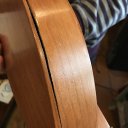
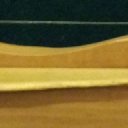
Thanks Matt and Jim! I think I will take a fine bristled, little paint brush and maybe put a small, light coating on the inside of the crack. Like I said, it doesn't push out when I apply pressure. But the action is off the fretboard by, at least, 1/2 to 5/8 by the bridge/tailpiece. Pictured below is open A and fretted A. Kind of shows how sharply it progresses. I have just tuned it slightly, flat so I can do some noter drone playing till I can get to Menards for supplies...


20180330_063556-1.jpg 20180330_063556-1.jpg - 42KB

updated by @stewart-mccormick: 03/30/18 08:18:13AM
Jim Hedman
@jim-hedman
03/30/18 06:39:43AM
25 posts

Charity Case Pt.2: Side Crack and High Action


Instruments- discuss specific features, luthiers, instrument problems & questions


Given the age, the crack probably didn't happen yesterday.  If there's no body buzz, it's probably stable (especially if the sidewall/bottom junctions have inner linings) and I'd opt to do as little as possible except perhaps use glue to add stabilization and dress any sharp edges.  I don't pretend to be a repairman so don't take this as the final word.

Intonation issues due to high action due to a high bridge are characterized by increasingly sharpness as you move up to higher registers because, upon fretting, the distance the string is depressed (and is consequently stretched) increases accordingly. If the nut is also high (not the usual case) the pitch changes are moderated to some extent.  Your side view photo does give the appearance of lousy action.

It looks like you may have a floating bridge.  If so, it could be too close to the nut. Your seventh fret (one octave above an open string) should be located at one-half your VSL. If your bridge is too close to the nut, the bridge to nut seventh fret VSL is shorter than the open string VSL, thus too sharp. A quarter interval correction would be rather large however.  Assuming you have a tuner, check again and give us the sharpness error in cents (1/100ths of an interval).  There are many sources detailing how to determine correct bridge placement but if you are stumped let me know and I can go into it here.

Bridge height and placement are the most common problems resulting in intonation issues, and remember, both can be in play at the same time.  Other possibilities are nut placement and height or poorly laid out fret placement.

I'm sure not gonna throw any advice your way about painting a dulcimer... except YUCK!

Update: Corrected VSL statement as shown.


updated by @jim-hedman: 03/30/18 07:42:56PM
Matt Berg
@matt-berg
03/30/18 06:26:39AM
107 posts

Charity Case Pt.2: Side Crack and High Action


Instruments- discuss specific features, luthiers, instrument problems & questions

Is the action high because the nut or the bridge is too high?  Sounds like the bridge position needs adjustment.

The crack looks old, if you agree, just let it be.  Adds character to the instrument.  If it truly bothers you, GENTLY, try pressing it back into shape.  If it goes back into place, you can try putting a very thin layer of glue in the crack and GENTLY clamp it back into shape.  Use a clamp with rubber protectors to avoid flattening the final product. (Even better, cut out a caul the shape of the instrument where you plan to clamp.) Immediately take the clamps off once or twice to wipe up excess glue (if any) then clamp and let sit for a couple days.  Not my first thought, but you asked.

No comment on the finish.


Jim Hedman
@jim-hedman
03/30/18 05:33:39AM
25 posts

John Tignor dulcimer rework


Instruments- discuss specific features, luthiers, instrument problems & questions


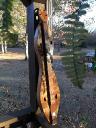
Awhile back I bought this thin sided walnut teardrop. A pretty little piece but basically unplayable due to intonation issues (namely it got progressively sharper as you fretted higher up a string) and the string pressure required to fret was outrageous.  Clearly, the fixed bridge was way too tall.  The fit of the bridge in the fretboard was so exact and tight I elected not to try to remove it, but cut it down where it sat.  To do so I removed all but the middle string, then loosened the middle string such that I could pull it to the side of the bridge, moving it up and down to gauge how much material had to be removed (which was conservatively about a third of its height).  I removed the last string, then fashioned a hardwood shim to the height of where I wanted the bridge to be.  Laying the shim alongside the bridge I used it as a guide to carefully cut down the bridge with a fine hacksaw blade. I followed up with files and sandpaper to dress the new top of the bridge, then using the piece of bridge I cut off as a template, I cut new string slots.

I could hardly believe the result; the intonation is right up there with the best of my current crop of 8 dulcimers.  What baffles me is how the builder could have released a dulcimer, that overall was a really nice piece of work, with that crippling bridge.

One might argue my approach would reduce the collector value of a piece, but I consider it simple "set-up" that transformed a "wall hanger" into a quite playable instrument.

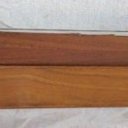
The photos below show the dulcimer "as received".


Brew - Side.jpg Brew - Side.jpg - 26KB

updated by @jim-hedman: 03/30/18 05:38:47AM
Stewart McCormick
@stewart-mccormick
03/29/18 09:35:13PM
65 posts

Charity Case Pt.2: Side Crack and High Action


Instruments- discuss specific features, luthiers, instrument problems & questions


After moving cattle panels and discing all day, I came home to find my pawn shop treasure on the porch! :D 

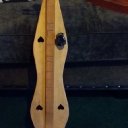
I realize that the bottom gap was not actually damage, like the guy claimed, but was a cut soundhole. But several things need to be addressed...

1. There is a crack in the side, probably happened while the builder was bending the sides. The date inside says 71', which was a good year... Because Led Zeppelin. I pushed against it with my finger but it didn't move. Should I shore it with glue or thin piece of spruce, like on a violin?

2. The super high action is causing intonation problems. If tuned DAA, the melody string is sharp by a quarter note all the way up the scale. Since it is always about a quarter, does that mean the frets are ok?

3. It has a thin wax finish that has several drops of walnut varnish spotting here and there. The pine or poplar is not eyecatching by any means. And the side crack damage. Maybe a black milk paint job is in order? Help? 


20180329_195126.jpg 20180329_195126.jpg - 66KB

updated by @stewart-mccormick: 10/27/19 12:02:25PM
  345