
Various Tunings
General mountain dulcimer or music discussions
I also found this table somewhere in my research. Pretty much the same but there are some differences between this and my earlier chart.
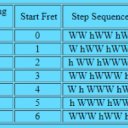
updated by @skip: 04/18/22 06:05:16PM
I also found this table somewhere in my research. Pretty much the same but there are some differences between this and my earlier chart.
You will probably need a chromatic or use temporary frets [paper clips about .040 or tooth picks may work], tmp frets 0+, 4+, no capo [DAd. Can capo at 3 [DAd] by adding a temp fret at 7+ also.
I wouldn't worry about 'audio quality' right now [you already know what it sounds like], you're just trying to archive the tune.
If you have, and can mostly use, either program you can try entering the note name and matching that with the approximate count of the length of the note played. Just enter the notes/matching count length and see what the app does. Probably use a count of 1-and-2-and-3-and-4-and for normal [4/4] [each count is an 1/8th note, 1-and = a 1/4 note] or '1-and-2-and-3-and' for a waltz beat [3/4].
I have absolutely no background in writing music, but, I think your 1st step is to make 2-3 recordings. then determine the average note length, just counting 1-2-3-4 or 1-2-3, 1 and 2 and 3 and, etc., You're working backwards plan. You may be able to make a rough guess by counting as you play. Then see if you can find a timing pattern to fit 3/4, 4/4 etc., to set up the measures. I think using a metronome may be too restrictive.
'Block or street gathering [party] day' for dulcimers on an annual basis.
@dan  Or 'MD Day".
OK for me although 'Appalachian' sounds a bit 'puffed up'. Reason, I'm used to referring to it as a mountain dulcimer . Baaaaaa
{No need for a poll.}
Turn them over and make new notches. If it uses a 0 fret just open the slots so he bass string fits will usually work since the nut is for lateral string positioning. Or, you could just play the bass string as the melody [DAd] like a friend did.
@richard-streib Any date that is usually mild in both hemispheres.
Length of day/night [equinox] is irrelevant and is assuming everyone can, or will, take time figure out the right date. It's easy to mark a consistent date, or day, on a calendar.
I'm really the right one to talk about dates [sarcastic], I usually remember about an event the next day or forget about them entirely. 
How about the last Saturday in March? It's not a normal work day and is early spring.
This could whole thing could result into some really interesting posts.
"I'm going to a Dulcimer Fest on ADD [Appalachian Dulcimer Day]. I'm taking a class from a instructor who wants everyone to bring a CAD [Chromatic Appalachian Dulcimer]. He says he uses a LD [Lap Dulcimer] with all the frets. I'm going to bring my matching MD [CMD] and a friend is going take their AD and tape on some toothpicks".
When I was introdued to the instrument, it was 'Mountain Dulcimer'. I still think of it that way [or MD]. The other names came later, in some cases, much later. Bill will always be be Bill, not William.
I kind of feel there is too much overthinking going on. Much of the time it is called an MD, or Dulcime[o]r on this site. On the old ED, MD, or Mountain Dulcimer vs HD, or Hammered Dulcimer. I think most general references in news articles, Mountain Dulcimer is most commonly used [probably wrong, but ].
].
If we commonly refer to it as a MD or Mountain Dulcimer internally [ FOTMD], why use a different name for a special day in it's honor?
Although it would probably be nicer to have it sometime during the late spring to early fall.
No on the tunings, yep on random, just pick any day, the 3rd friday of any month, 2nd blue moon, or any other random day. Don't bother trying to make some kind of association with the dulcimer, that's not relevant.
I feel associating a particular date with a primary purpose of celabrating the overall appreciation of the MD is kind of restrictive. Almost all of the posts refer to subsets of the main subject, the MD. Just picking a random date [the 164 day of the year] and calling it 'Dulcimer Appreciation Day' or something makes more overall sense. Then all of the things expressed are valid subjects for inclusion.
'Jean Ritchie Day'.
Why tie it to some specific dulcimer event which could be the name anyway? Like 'Jean Ritchie Day' or 'Kentucky Dulcimer Day', etc.
The 'why' the day was selected is irrevelant, just as long as a day is identified and observed consistently.
I suggest the same day as 'play music on the front porch day'.
Aug 1 is 'Uncommon instrument Awarement Day'. 
It could be that the MD is particularly resonant to B, which makes that note 'stand out' more. Since you are trying to play the tune in Aeolion [capo at 1] mode it may work to try tuning to DAc.
Sorry, I forgot to say to set the bridge to the same measurement as fret 1 to fret 8.
You could try tuning the bass string to C on the 7th fret, position a nut, then tune the melody open to the bass 7th.
Fixed 'do' and movable 'do'.
Fixed,'do' always = C.
Movable, 'do' depends on scale used.
To be clear; The notes for DAd are D3A3d4, much higher the strings break.
Another source of strings;
https://www.stringsbymail.com/
I've used both
Here is a short video about tempered tuning that may be of interest, especially to those of us in the learning mode. It was presented on another site [autoharp] and I'm 'borrowing' it.
A floating bridge is one that can be moved across the top of the fretboard. The other bridge style fits into a slot. Since you're asking I would think you're MD is set up for a floating bridge. Use your tuner to adjust it to the proper location. Tune the open note, check it at the 7th fret, if sharp, move the bridge away from the nut and repeat
It's not necessarily a kit. It may be a modified kit, made from scratch or with made from a variety of purchased parts.
I think I would check the tuning before doing anything. Check using the 0 fret as the starting point then using the nut as the starting point. The frets should only be correct using one or the other. There is a significant difference in string length there. It may have been set up to use a slide, as in dobro style
Lower left corner of the post is a thumbs up icon.
I always carry a pencil, and paper is usually available, and do a rough sketch [for a lot of things]. I would say to most folks that it sounds something like the more treble side of an acoustic guitar [sorry about that ] with less volume and sustain, because that's probably what most can relate to.
It's interesting to see that many folks have more instruments than just mountain dulcimers.
In addition to my dulcimers, I have a bodhran, half a dozen or so diatonic harmonicas, a chromatic harmonica, several pennywhistles, a full size keyboard, and 5 autoharps [three chromatics, two 2 key diatonics, FC and GD] and a 15/16 hammered dulcimer I made and still have. I've tried guitars and a banjo but they didn't, physically, work for me.
I guess I have IAD, but music is such a fascinating subject and has so many facets and challenges it's easy to overindulge! Especially for a non-music oriented retiree [no music instruments at all before retiring].
A piece of wire [paper clip] or wood [tooth pick] or ---- taped in place [tape parallel to the strings] in one of the wide spaces. Frets are usually approximately .040" -.045" or so high. Use your tuner to position the temp fret for the appropriate note.
Multiple dulcimers and their use as tools are really good points.
I should add that of the 2 the I use the most, one is fully chromatic, mostly for practice, and one is modern diatonic [1+, 6+, 8+, and 13 +], practice and with others. My bass is fully chromatic and the rest split between the two.
Thinking about the basic question, I suppose that the fact I have, and use, extra frets can be seen that I do feel limited with a pure diatonic setup. That even extends to the harmonicas I mess around with as I have both, chromatic and diatonic.
There are a few more things that can help; temporary frets, and 4 equidistant string/chromatic tunings [ie. DAA#D]. I choose to go full chromatic which allows me to have the accidentals when needed without changing the MD sound. But I don't do noter/drone style playing either, the extra frets, without being extra careful with noter pressure, put a 'bump' in the music flow when N/D playing.
Eleven: Folkcraft Resonator, 5 string Blue Lion Jam strung as a 3 string bass, Bonnie Caroll, Black Rose, McSpadden Kit [my first MD], six I made, including one made from Koa, and a travel MD only 4" wide, a Banjimer, and a TMB that I later modified into a double bass using bass guitar tuners and strings.
The Folkcraft, Blue Lion, travel, and the Koa are the ones I use the most.
It seem to me the 'when' needs a lot emphasis, like a larger text font, in color, no abbreviations and possibly other attention gathering techniques. It may help to include a link to a time conversion site. The 'when' is probably the most important piece of information I use to plan things.
Derik, you need to start at the third fret to get the scale you are expecting. The reason is the frets [excluding any half or plus frets] are laid out in mode patterns. In other words, each set of 8 consecutive frets [including the nut/0 fret] form a series of tones/semi tones [steps half steps]. This allows or supports. listing the eight notes in an octave to begin with each of the the notes in turn, eg., ABC#DEF#G [mixolydian pattern] or DEF#GABC# [ionian pattern], etc, each series being a different tone/semi tone order.
The most critical thing is getting their attention in the first place.
Dusty;
I kinda think you identified one of the primary sources of beginners in your original post, current dulcimer players interacting with potential players. It seems there is a need to motivate us to point new folks to appropriate 'sites. 