>>> "When I discovered my fret board (also called the finger board) was badly warped..."
A dulcimer FRET BOARD is not a FINGER BOARD, as used on most other string instruments.
On violins, guitars, banjos, etc. the fingerboard is attached to the neck of the instruments and is sloped above the body. It is a separate piece. There is air between the fingerboard and the body. The bridge is a separate piece tounching the strings and body. It may, or may not, be fretted.
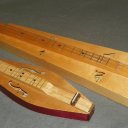
A dulcimer fret board is attached directly to the body (sound box) and is always fretted. If an overlay is used, it is glued in place, and the fretboard becomes a one-piece composite structure.
Fingerboards are frequently arched in transverse section, but this is not a requirement. Our fret boards are typically flat in cross section.
I am one of those who believe that a traditional dulcimer must have a one-piece fretboard, with the bridge and nut mounted directly in slots in the fretboard. In that case the bridge does not contact the body, but vibrations are transmitted through the fretboard.
Leveling of the fret tops lets us compensate for slight imperfections in the finger or fret board straightness, but, of course a straight board is always best, and it should never be warped.
I usually build with guitar fret wire, but have also used the melody-string-only staples.