Wow....that's funny Ken......I do a very similar thing: when I'm in bagpipe tuning, I take an uncut cap, and slide it under both drone strings which gives me aeolian and dorian.
Eaa Tuning

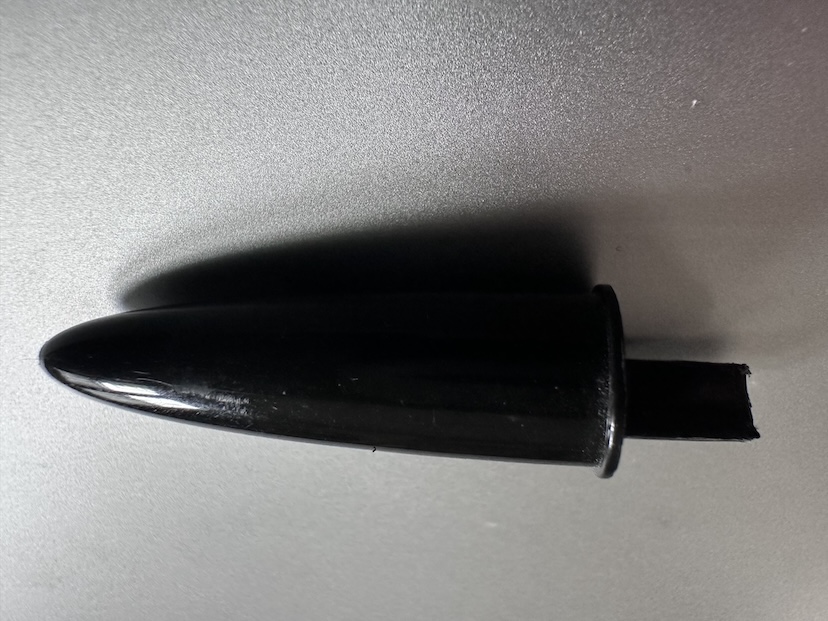
While I don't play in the key of often, there are few tunes that do play in A. When I do I use a reverse capo to raise the D string to E. I've attached a photo of the capo. The shadow distorts the image, but you may recognize it as a BIC pen cap. I cut the stem of the cap so that it only goes under the D string. I just slip it over the first fret and under the D string. Instant EAA tuning out of DAA.
Ken
"The dulcimer sings a sweet song."


I'm not so sure it is " not more popular with traditional players". I've used the 'reverse' often.
It's really just a slight variation of an open tuning, which is always popular with traditional music players on clawhammer banjo and fiddle (AEAE). For me, I view it as just an open tuning that avoids string breakage.
I see you already know about modes and are comfortable with retuning instruments. 
--
Site Owner
Those irritated by grain of sand best avoid beach.
-Strumelia proverb c.1990
I had an afterthought that's kinda related: I'm most often tuned Bbb bagpipes tuning, which allows me to play either ionian or mixolydian without retuning. The only non-traditional thing I do, (since I don't use a noter) is pick up a note or two on the bass string when necessary. Also, I can drop my melody string down a step and play either aeolian or Dorian.
I don't have occasion to play with others, so the actual key I'm in in unimportant. Usually I'm tuned Ebb, so I just drop the first and middle strings to a. My question was more regarding why it's not more popular with traditional players rather than the music theory side of things.
You seldom go wrong if your tuning contains both the tonic/key note (note "1" in your scale) and the 5th note of your scale. So if you are playing in the key of A and A is "1", then count A(1) ,B(2),C(3),D(4), E(5th) -- thus EAA or EAe or AEa are all tunings which give you the tonic key note A plus its 5th interval note (E) when strummed open. Notes 1 + 5 in a scale always sound sweet!
I hope I have not simply added confusion here. 
--
Site Owner
Those irritated by grain of sand best avoid beach.
-Strumelia proverb c.1990
Dusty gave a great explanation of your 'reverse' tuning Tony. One thing I'd like to add is that one reason people use it is because it helps avoid having to tune the bass string to A if going to Aea or Aee (the low A would be too floppy if not a baritone dulcimer, the higher A might break the bass string).
As Dusty said of EAA tuning, "If you are normally tuned DAA or DAd, you can quickly switch to the key of A using that "reverse" tuning." You can also go to EAe tuning easily from DAd... which gives you the very versatile ionian tuning for the key of A. (with your home A note on the third fret of the melody string).
--
Site Owner
Those irritated by grain of sand best avoid beach.
-Strumelia proverb c.1990

Hey @tonyg, I assume the E is your bass string. If so, that would be considered a "reverse" mixolydian tuning because you are in the key of A but the bass and middle strings are reversed. It's basically the same as AEa, which is sometimes how I tune my baritone dulcimer. If you are normally tuned DAA or DAd, you can quickly switch to the key of A using that "reverse" tuning.
--
Dusty T., Northern California
Site Moderator
As a musician, you have to keep one foot back in the past and one foot forward into the future.
-- Dizzy Gillespie