Recommendations on capos
Dulcimer Resources:TABS/Books/websites/DVDs
Check out the capo FOTMD member @martin-oesterle made to play this fun tune.
There are at least a couple of builders who do not glue the fretboard to the soundboard at all. My octave dulcimer by David Beede has the fretboard screwed into the dulcimer with three metal dowels, but it sits entirely about 1/4 inch above the soundboard. His logic is that the top is free to vibrate that way. And I think FOTMD member @bob-stephens also makes dulcimers with floating fretboards. In this discussion he specifically says that his "fretboards don't touch the top." I think he also uses metal bolts to attach the fretboard to the dulcimer and allow it to sit above the soundboard.
Terry's capo is a modification of the Spider capo. And he offers a version with a D'Addario tuner attached to it. It's a nice idea, especially if you have room left of the nut to leave it attached when you're not using it. That way you have a tuner and capo always available. If I didn't already have a bunch of capos and a bunch of tuners I would probably get one.
I've heard of tactile position markers on the back or top of the neck on guitars, so that you can feel with your hand where you are on the fretboard, but I've never seen anything like that on the fingerboard itself.
Yes, you can have fancy decorative inlay work on a fretboard. And you can also have fret markers. Those are clearly two different things.
Obviously, decorative fretboards are pretty. (Don't we all love that long-stem red rose on the Blue Lions?) And if the decoration varies up and down the fretboard, then it might serve the purpose of fret marks, but only for the owner. Anyone else grabbing that instrument for the first time would have no idea what's going on. That's why there are standards. The standard fret marking pattern of 3, 5, and 7, means that I can borrow anyone's instrument--or switch among the several that I own--and know at a glance where I am on the fretboard, even if there are one or two extra frets. That obvious advantage cannot be overstated. If one of my instruments were marked at 3, 5, and 7 and another at 2, 4, and 6, and another at 1+, 3, and 4, those fret markers would lose their purpose and would have to be ignored altogether. They would confuse rather than clarify.
So that brings us back to the original post, which was about the proper placement of fret markers, not decorative inlay. An individual player can request fret markers anywhere s/he wishes. Fret markers do not change the sound of an instrument. But anything other than the standard pattern would confuse anyone else. I would strongly urge luthiers to either use no fret markers or use the standard pattern, unless, of course, they are responding to a specific request for a custom dulcimer. And again, for a diatonic fretboard, there is no need for fret markers anyway since the pattern of whole and half steps tells you exactly where you are on the fretboard.
I personally would not be able to play with raised fret markers at all. As you slide from one chord position to another, you need the fretboard to be as smooth as possible. And even when not sliding, you want your touch on one fret to be identical to the touch on another fret. There would be no way to play with any speed with an inconsistent touch on the fretboard. There is a reason why everyone uses inlay both for fret markers and for decoration.
I once spent over $60 on a fancy brass capo that works almost as well as the $20 ones Ron Ewing has been selling for decades. No one said logic was my strongest attribute.
True, Ken. Those are the octaves of the 3 and the 5.
I, too, find it interesting that there is no 8+. I understand not adding the half frets on smaller scale instruments, since the frets get so small, but on a full-size dulcimer most people want the second octave to mirror the first. There is a 13+ fret, after all.
Yes, that dulcimer has frets at 1+ and 6+. But notice that the fret markers are still at 3, 5, and 7.
Sad news indeed. Ralph's knowledge of the evolution of the dulcimer far surpassed that of any else living or dead. We will be forever in his debt for his publications on dulcimer history.
One could possibly come up with a reason to put a position dot anywhere. But since the point is to quickly recognize where you are on the fretboard, standardization is a benefit. Since 3, 5, 7, & 10 are the most common places for such markers, anything else would risk confusion.
The fact is that with a diatonic fretboard there is no need for fret markers since the fret pattern clearly tells you where you are. I have some dulcimers with no fret markers and have no trouble. I have some marked at 3, 5, 7, & 10, and have no trouble. But I woundn't even considering buying a dulcimer with frets marked elsewhere as that would just be confusing.
Glad it worked out, traildad!
Nuts and bridges can be made from hard woods, bone, or the hard plastic resins such as Bakelite. Nowadays, the hard plastics used are usually Tusq, Nubone, or Micarta. Maybe there are some other proprietary names of which I am unaware. In general, people assume bone to be the best, and it's probably the most expensive, but some of my dulcimers use other materials and I have no complaints.
You might consider posting in the Dulcimer Making Group for specific advice about tools and materials.
The "normal" tuning for a standard dulcimer tuned to a 1-5-8 pattern in C would be C3 G3 C4 since we usually list the tunings from the bass note to the melody note. (I don't know who made up that rule, but it's as logical as anything, I suppose.)
I would not assume that someone putting a .005 string on a dulcimer actually knew what they were doing. It could have just been whatever strings they had lying around or perhaps someone thinking lighter strings would be easier on their fingers. The strings that @nathina suggests from John Pearce are within a normal range for a full-size dulcimer (though still light for my preferences).
Indeed. It looks from the notches in the bridge that it is set up for 4 equidistant strings and a double melody. But those of us who want a three string set-up would have to make some adjustments.
Nice job, Nathina. That dulcimer is really shining.
Now that I see the placement of the bridge, though, I fear there is insufficient room for those fine tuning beads.
This is my recommendation. Record yourself playing in DAA. Listen to it every time you eat really good food. You will slowly train yourself to drool equally out of both sides of your mouth. Get yourself a bib and the problem is solved!
But at least you have your stage name: Drooly Don Grundy. It has a ring to it, doesn't it? I would pay to see a band called Drooly Don Grundy and the Doughnut Holes, wouldn't you?
I heard a radio conversation with a physicist whose wife was a cellist. He said that when he is working hard, his right arm pit sweats more than his left arm pit. But when his wife is working hard, it is the other way around. The theory is that he was using the more analytic side of the brain, which controls the right side of the body, and his wife was using more the creative side of the brain, which controls the left side of the body. Maybe you are experiencing something similar.
Actually, I suspect Strumelia is correct. Because you are concentrating on what you're doing, you are not swallowing as often as you normally would. I have the bad habit of holding my breath for really tough parts of a tune, and then you can hear me exhale deeply right afterwards. I've had to delete a lot of recordings for that reason.
That's a great description of both the design and function of these things, @ken-longfield.
@nathina, since you don't have a model to copy as Ken did, you might make a prototype out of some material that is easy to mold and re-mold. Then when you get the precise design of something that should work, make final versions out of ebony or some hard wood.
Nathina, a small number of luthiers used fine tuning beads on their dulcimers. One was Keith Young. Here is a discussion of someone replacing a missing one. You can see that they require no serious modification of the instrument at all yet make those friction tuners a lot easier to use. I think I remember a couple of other discussions here about fine tuners. If I can dig them up I'll edit this comment and add the links.
EDIT:
Here's another discussion about fine tuner beads .
And here's another in which I share a picture of an autoharp my uncle made with metal fine tuners for each string. It was a prototype and we joked that it looks like the autoharp has braces. On his new builds he puts a nice piece of wood on a swivel that covers the fine tuners.
That's definitely a cool project, Nathina. I second the motion to make sure you take some "before" pictures so we can see the work you do.
While it is true that few people today enjoy friction tuners, you might pause before replacing them with modern geared tuners. Once an instrument is "vintage" there is certainly an interest in maintaining it's original construction. Then again, if you want to play the instrument regularly, by all means make it your own. A compromise might be to install fine tuners behind the bridge if the design allows.
I don't think I can answer the original question posed, but I am not sure there is a clear answer. You can tune a dulcimer however you want, but that doesn't mean that there is an official name for the tuning. The Canadian dulcimer player Rick Scott has written lots of tunes in strange tunings. He doesn't have names for them; he just tells you what notes he is tuned to.
There are basically two ways we name tunings. One is by the mode that is available on the melody string (assuming there are no half frets and the melody is played only on the melody string). In that nomenclature, we do not have a choice about the drone strings. They have to be the 1st and 5th notes of the scale, although they can be reversed. DAA is ionian and ADa would be a reverse ionian. DAC is aeolian and ADC would be reversed aeolian. What is reversed is simply the order of the drones. The tuning of the melody string has nothing to do with whether we call a tuning "reversed" or not.
The second way of naming a tuning is simply by labeling the strings according to their scale position. DAA is 155, as is GDD and so forth. DAC is 157, FAC is 135, etc.
(For what it's worth, I much prefer naming tunings according to scale position since it avoids the obfuscating modal names and is easier to transpose from one key to another. Additionally, since many of us have extra frets and fret across all the strings, we are not limited to a single mode in any given tuning, making the modal names technically incorrect and certainly misleading.)
So one way to label your tuning would be to establish the key and then determine the scale position of the strings. If @strumelia is correct, and you are playing Emma's Waltz in G aeolian (and the song is certainly in aeolian) then your Bb is the m3, the G is the 1, and the F is the 7. So we could say simply that you are tuned m3-1-7. But we cannot call that an aeolian tuning because the drones are wrong. I think perhaps the reason it sounds OK is that the minor third is one of the notes--and one of the defining notes--of the aeolian mode, so it sounds reasonable.
If you were to tune the bass string to D, so that you were in DGF, that would be a true reversed aeolian tuning.
Those look gorgeous, too. It never occurred to me to grow my own sprouts. I just buy those little plastic containers at the green grocer. I sometimes get the spicy broccoli sprouts, too, but I'm the only one in the house who likes 'em.
Those fresh red clover sprouts look so light and delicious!
Sorry, Nathina, I have no idea. You might contact him directly. Luthiers are usually delighted to hear their old builds are still out there being played.
Jim's been making dulcimers under the Mastertone name for probably several decades. Every one I've ever seen had 5 strings. I've never played one, but Jim has a good reputation.
Lois, I think your observation is correct. The activity in any most groups tends to come in waves. Nothing for some time and then a cluster of activity around a certain topic.
I also think people don't think of the groups often enough and just post in the General Mountain Music Forum or the Beginner Forum rather than finding a group that fits their post better.
Thanks, @susie. I failed to click the "read more" to get the full story. I was wondering about lacewood since I have a lacewood Modern Mountain dulcimer, but portions of that Rizzetta looked like it was glowing a bit more.
Interesting that the frets are mean-tempered.
Certainly a unique and beautiful-looking dulcimer.
Wow, that's a beautiful and unique dulcimer. It looks like the strap button on the lower bout is also a pickup jack, but that placement is kind of weird. The angle just looks like a strap could come off it pretty easy. Do you think the wood is koa? It has that translucent, hypnotic look.
Anyway, if someone wants to buy me that dulcimer for Christmas, I would gladly accept it! Or, if that's too much, just get me one of Bob Stephens nylon-string dulcimers and you can save $7000. See how I'm looking out for your finances?
@traildad, you're full of inspiration:
I went down to the orchards,
The most plentiful in all of the land.
But instead of basket of fruit
I just got a bucket full of sand.
Down at the local tavern
The barmaid carried pints in her hand.
But when she brought me my order,
It was only a bucket full of sand.
I got to play the Ol' Opry,
Joining Dolly Parton and her band.
But the roadie didn’t give me my Martin,
He handed me a bucket full of sand.
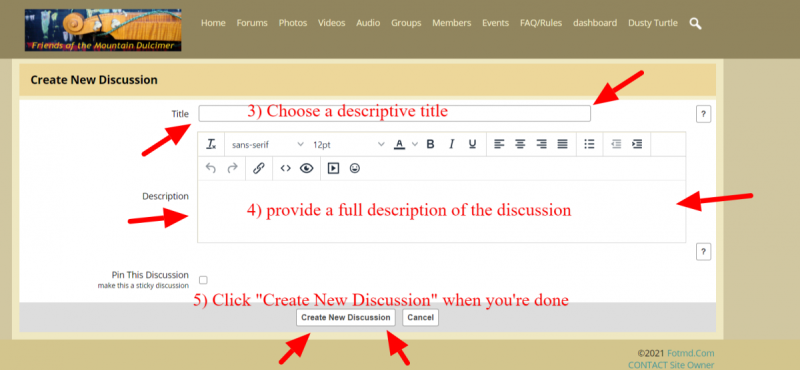
@traildad, remember, as is explained in the link that Strumelia posted, that you can choose to "follow" discussions both in the Forums and in the Groups, and then you can choose to receive an email notification when someone posts. That way you don't need to check in to the site and look at "latest activity" to see if someone has added something. You can also choose to receive a notification when someone creates a new discussion in a Group to which you belong or in a Forum topic area that interests you.
Nathina, it's really hard to comment on dulcimers without seeing and hearing them. And what one person thinks of as bright or mellow might not be what your ears here. I would suggest listening to dulcimer music posted here and on YouTube and Soundcloud. Most of us indicate the dulcimer we are playing and the tuning we use, and if we don't, ask. Then you can hear for yourself which luthiers make instruments that appeal to you.
For what it's worth, I have never played or even seen a Gardener, but I own two Ewing dulcimers. However, neither is a full-size instrument. One is an octave dulcimer and one a 3/4-size instrument that Ron calls a "baritone dulcimette." I love both of them for their balanced and clear tone and the responsiveness of the fretboard. Ron's dulcimers are of very high quality and his baritones in particular enjoy a fine reputation.
I agree with Robin, Nathina, that these kinds of comparisons are hard to make. Not only is there something subjective about one's preference for a particular builder or another, but with older instruments so much depends on the condition of the specific instrument.
To illustrate how subjective this can be, I bought a used Blue Lion at a very reasonable price because the person who owned it didn't like the sound. She played mainly in a drone fingerdancing style and found the bass string was too loud and drowned out the melody. But that loud, bassy sound is exactly what so many of us love about Blue Lion instruments. (And now I have three dulcimers even louder than that one!)
@paulpossinger, to reply to a post someone left in a discussion, such as that regarding your beautiful Keith Young dulcimer, you do not want to comment on their profile page. Instead you want to click the link in the email that takes you to that discussion. It should say something like "To see and respond to the new post, click ...."
That link will take you to the discussion itself, such as your Keith K. Young Concert Model . Once in the discussion you can post in the comment box or, if you want to respond to something specific someone said, you can click the little speech bubble icon in the upper-right hand tools in their comment, and that will quote their comment in the new comment box, where you can add your commentary.
I hope that helps. It's easier to do than to explain.
Howard Rugg is a member here. I would contact him directly. He kept very meticulous records.
I don't think you can draw conclusions about vintage Capritaurus instruments based on his newer work, though.
One thing to keep in mind is that Capritaurus used to sell kits, so it's possible someone else made a dulcimer from a Caprituarus kit. Again, Howard would be able to explain the differences and maybe even identify an kit Capritaurus from a photo.
Good question, @traildad. There is obviously a field for "style or instrument" but no way to edit that field. We'll have to wait for @strumelia to chime in. Most of us upload audio files to Soundcloud first, which has a different set of fields, all of them editable.
Nathina, some others here would know the story better than I, and Howard Rugg himself is a member here and can fill in the details. My understanding is that the Rugg brothers started making dulcimers under the Capritaurus name and then the dulcimer renaissance happened in the Santa Cruz area, so to keep up with demand, they separated Capritaurus from Folk Roots. The Folk Roots dulcimers by Rugg and Jackel used some plywood and other techniques to keep costs lower and production higher. The still had the same design, though, as the large-bodied Capritaurus dulcimers that were probably the first dulcimers made with a larger box to get more volume. Eventually they sold Folk Roots to Folkcraft, as you know.
So are they good instruments? Yes. But they are probably do not compare to the high-end instruments made today, which cost a lot more and have been built on some of the design principles that the Ruggs pioneered.
If you have a question about a specific instrument, you might ask Howard. He still has records on most of the instruments they made and can often tell you the specific woods used, whether that 6+ fret was made by them or added afterwards, and more.
My understanding is that the Folk Roots line of dulcimers made by Folkcraft are made of solid wood with no ply, but they honor the large box design of the original Folk Roots dulcimers by Rugg and Jackel. The main advantage to buying one new is that you could get exactly the features you want. On the other hand, Howard Rugg resurrected Capritaurus Dulcimers and is making instruments again, so if the Rugg design interests you, you might see what he is offering.
P.S. I moved this discussion to the Forum on specific instruments and specific luthiers since that seemed a better fit and would be easier to find by others later on.
@don-b, Are you having a problem with your McCafferty or did you just try to test it with the nickel and dime trick? It sounds like the only buzz you are getting is from improperly fretting the strings, meaning user error. I have a McCafferty, too, and have no problem with the action or the fretwork. If you are getting a buzz (and it's not from your own faulty fingering), then contact Terry. He will make it right. In general, the action on his dulcimers is very low, since flatpickers generally want low action which is conducive to fast playing, but the fretwork is impeccable, and you should not have a buzz from faulty workmanship. I contacted him recently because the pick-up jack in my dulcimer has come loose and rattles around, and I will be sending the dulcimer to him very soon, not only to fix the jack (which he has started to glue in but only after he made my dulcimer), but also to have a custom bridge made. He is very friendly and takes his craft very seriously.
@nathina, many years ago I started a discussion here called " Dulcimer Gender Studies " asking exactly why so many people give their dulcimers female names. No one thought to examine the reproductive process of the trees from which the wood came.
It's remarkable how long ago I wrote that original piece. And after all this time, I am even more grateful for the camaraderie we have created here at FOTMD. (I wonder if Strumelia knew what a community she was creating back when she first had that brilliant idea to develop this site.)
I hope you can all enjoy Thanksgiving safely this year.
And yes, @don-grundy, let's all play our dulcimers and express thanks that we have such a fulfilling hobby, something needed these days more than ever. Like a true companion, my dulcimer helps me celebrate when days are bright and lament when they're gloomy.