
Blackbird
General mountain dulcimer or music discussions
Hey I just remembered that Butch Ross also has a book of Beatles tunes. Since I know he has played "Blackbird" on the MD, I bet that tune is there.
Hey I just remembered that Butch Ross also has a book of Beatles tunes. Since I know he has played "Blackbird" on the MD, I bet that tune is there.
JP, if you contacted someone privately, that would be OK. But if we make those kinds of connections on the public discussions at FOTMD, even if the actual exchange happens elsewhere, the site is still legally implicated.
Soooo all the cover bands we go see at the local pubs are in violation of the copyright laws?
so if i learn this song on my own and tab it out am i in violation of CR law.... how about if i gave a
copy to a friend....
JP, performing and distribution are two different things. You can perform a cover at a formal venue because in all likelihood that venue has paid an annual fee to ASCAP. And even if they didn't, the legal burden is on the venue and not the performer to ensure they are in compliance with copyright tunes.
You can play at home and for your friends and family any copryighted music you want. That is legal. It is also legal to tab out for your own purposes a copyrighted song. And you can even share it with a friend. That's all legal.
But you cannot distribute that material without paying for a license to do so. And the Napster court case affirmed that online sharing constitutes illegal distribution. Because FOTMD is free and open to the public, we cannot exchange copyrighted materials.
Most of the stuff on those guitar tab sites is illegal. Plain and simple. There are also tons of YouTube videos of people playing covers of copyrighted tunes. That's all illegal, too.
Neal Hellman published a book of Beatles tunes arranged for the MD, but I don't think "Blackbird" is in there. The only dulcimer player I can think of who has played the tune is Butch Ross.
The second way to incorporate a photo is to embed it as I did the screen shot in both of these responses to you. In that case you choose the "embed local media" icon, which looks like a piece of film strip and is the second-to-last icon on the tool bar above the text box.
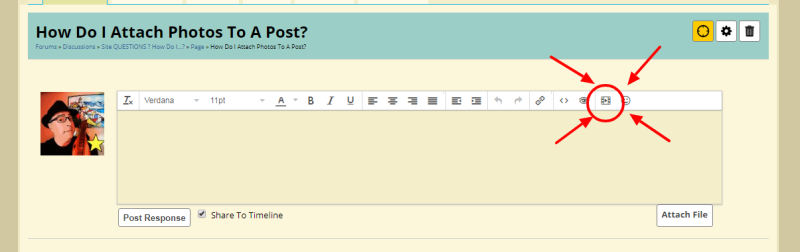
When you click the embed local media icon, a screen will appear asking you what size you want the photo to be and where the photo is located.
Jimmy, there are a couple of different ways to incorporate a photo into a post. One is to use the "Attache File" button just below the text box on the right. As in this screen shot below.
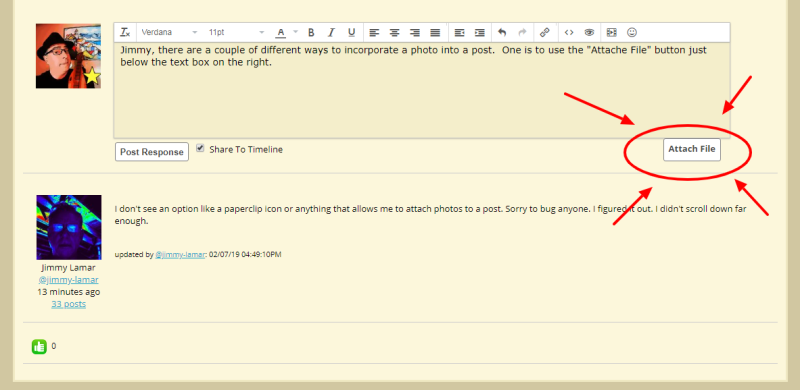
When you "Attach File" it appears as a small icon below your text, with a download link to the right, as in the case below.
You don't need a strum hollow. You can strum or pick anywhere you want. I usually tell beginners to strum wherever their hand and arm feel most comfortable. Eventually, as you have discovered, you will learn to move toward the bridge to get a sharper tone and tighter strings and toward the middle of the dulcimer to get a warmer tone and looser strings.
Adding a strum hollow will not change the tone of your dulcimer. The only exception would be if you use a flatpick and sometimes hit the fretboard, creating a clicking sound. (I sometimes have that issue, unfortunately.) Good technique can avoid that problem, and strumming over the strum hollow does as well, obviously.
It sounds like you are off to a great start. My advice would be to eventually begin strumming both in and out, alternating in a steady pattern, but don't worry about that right away. Take your time.
There's always one comedian in the crowd. 
Barbara, my baritone dulcimette is about 28.5" long and 7" wide at its widest along the lower bout. If your local music store is worth anything, they might be able to order a viola case from one of their suppliers. You could then bring in your Ginger and determine whether it would fit or not. If not, they should be able to return it no problem. It's worth talking to them.
You will have to adjust the inside of the case to adapt it to the dulcimer, but you should be able to see how to do that when you see them both together.
Very cool photo, Charles. I was going to say something similar to Strumelia's comment (though I certainly couldn't identify the date of the photo by the clothing -- wow!. Bluegrass was invented in the 1950s, so these guys were some kind of string band. Think of Charlie Poole and the North Carolina Ramblers, although that trio used a banjo instead of a mandolin.
If you want to hear what they might have sounded like, Columbia Records put out a 2 CD compilation of stuff that was originally released on old 78s from the mid 20s to the mid 30s. The CD is called White Country Blues. I highly recommend it.
@Victorsings, I think I remember reading somewhere that Larry Barringer turned his luthier business over to Terry McCafferty, who is currently making excellent dulcimers out of Houston. You might consider contacting Terry.
Hi Barbara. I used a viola case for my baritone dulcimette by Ron Ewing. It is about the same length as a Ginger. You can see a picture here . I just cut away the part of the case that holds up the neck. I didn't do a particularly good job, but the case works really well. It's small enough to easily fit in the overhead compartment of airplanes and the hardshell case offers peace of mind.
I suggest taking your Ginger into a music store, not a Guitar Center but a store that deals with a variety of instruments such as those that serve school orchestras. The will have lots of types of cases to check out.
There are also gun cases with customizable foam that could be form fitted around your dulcimer, but TSA would definitely notice those!
Don, you've gotten some good advice here. As Robin has pointed out, the main keys for folk music are C, D, G, and A, and Skip has explained how to figure out the important I, IV, and V chords in those keys. You can use any chord chart, such as those Stephen Seifert makes available , to learn how to play those chords. You should also be aware of how versatile the barre chord is. I assume you can count to 7 and you know the alphabet.  If 000 is a D chord, then 111 is an E chord, 222 is an F (really F#) chord, 333 is a G chord, 444 is an A chord, 555 is a B chord, and 666 is a C chord. Then we start over with D again at 777. Until you learn more chord voicings, those are safe places for you.
Personally, I prefer to approach this by using a capo, which enables me to play in D, G, and A out of a DAd tuning, and then tuning down a step to CGc to play in C. Then I only have to learn the chord positions for one key but they will work in the others. What I mean by that is that 002 is a D chord when tuned DAd, a G chord with the capo at 3, an A chord with the capo at 4, and a C chord when tuned CGc. So I consider that a I chord rather than remembering four different chord names. The same with the 013. That's a G in DAd, but a C with the capo at 3, a D with the capo at 4, and an F when tuned CGc. I could memorize all that or I could just think of it as a IV chord. I could go on, but hopefully you see my point.
I explain this approach in a document I've attached which was written for a different but related question, and also includes a transposition chart for the major keys. And you can see me demonstrating how to use a capo to move to the keys of G and A this video here .
If by "standard" you mean a guitar capo, yeah, that won't work. Ron Ewing in Ohio makes great dulcimer capos for about $22 or $23. He usually ships really fast, too. If you're pretty handy on the workbench you can make one of your own. It's worth having one around even if you don't use it for this tune.
Congratulations, Jimmy. Now that you're so good at changing strings, I have an old autoharp . . .
Hey, I do have one tip for you which I learned from Butch Ross and can't believe I never though of. As you found out, it can be hard to keep the loop ends on until there is enough tension on the string. But you can use a capo to do that for you, which frees up your hands. So put the loop end on, pull the string taut, and put a capo on to hold it in place. Then go ahead and wind the string around the tuner. It's so simple I'm embarrassed that I was changing strings for years and never thought of it.
And don't worry; the 45 minutes will be reduced to 5 or 10 in no time.
How about this ?
Patricia, maybe that was the one Wayne posted some pictures of. I remember that ribbon binding.
I have one too and I love it! Howard called her "Lil Sweetheart". She made an appearance in our film (Hearts of the Dulcimer). :-)
Patricia, I wasn't aware that Howard had started building again when you guys were making the film. I thought he started afterwards, perhaps as a result of renewed attention the film brought it! And I think I remember Wayne posting some pictures of a small dulcimer that Howard was building for him several years ago. Perhaps that was a prototype.
Lisa, the danger buying most of the cheap dulcimers out there is that they are not really instruments but "dulcimer-shaped objects" intended to be hung on a wall somewhere rather than played. A lot of them have really high action, making them hard to play, and many don't even have correct intonation, so you will sound off even if you are playing correctly.
Bill Berg and David Lynch are two reputable luthiers who make "student" dulcimers for less than $150. They are real instruments and will encourage you to play. However, they are not really small travel dulcimers. The small dulcimers don't really cost less than the big ones since they involve basically the same amount of work. One option for you might be a cardboard dulcimer. Folkcraft sells some that you can either put together yourself or buy pre-assembled. I played one at a festival a couple of years ago and was amazed how well it sounded, although obviously it did not have extraordinary volume.
But I should also say that I own several really nice small dulcimers, including octave dulcimers by Ron Ewing and David Beede. They are small enough to fit in a decent-sized backpack or under the seat in front of you on a plane and yet they both have a really charming tone. They don't have a lot of sustain, but they stand out in a group of dulcimers because of the higher pitch. They are not really cheap, but they are delightful instruments that maintain their value pretty well.
Almost every day, I am sitting playing the dulcimer and my wife smiles lovingly and then closes the door to whatever room I am in. I get the hint.
Oh my! I could just kiss you, @Maddie-Myers!  I've been looking for that book for years and I don't know why it never occurred to me to post a note here. I'll send you a personal message right away. You're the best!
For several years I've been searching for the book of dulcimer tablature that accompanies Randy Wilkinson's album on Kicking Mule records called Elizabethan Music for Dulcimer. The book came out in 1982, I believe.
Does anyone have a copy kicking around that they'd be willing to part with?
Muchas gracias!
Adrian, I can only compare my McCafferty with the other fine dulcimers I own: Blue Lion, Modern Mountain Dulcimers, and Probst, the latter of which I currently have strung as a baritone.
My 25" McCafferty has a superior balance, very warm tone, and exceptional volume. It is not as bass dominant as my Modern Mountain Dulcimer, but is better balanced. Compared to my Probst, the McCafferty does not have as much sustain, but don't get me wrong; the sustain is very good, just not quite as infinite as the Probst. And the sustain might be a function of the shorter VSL. I have a feeling that the sustain of a 28" McCafferty would be just as remarkable as the Probst.
The action is also wonderful. It takes very little pressure from your fingers to fret a string. I also find it equally beautiful flatpicked or fingerpicked. Prior to buying the McCafferty, I used my MMD for flatpicking and my Blue Lion for fingerpicking, but the McCafferty excels in both. However, I found the strings a bit too far apart for fast flatpicking and moved the melody and bass strings in a little bit so that they are about 1" apart.
I don't know much about electronics, but I love the pickup Terry uses. It is a Twin Spot pickup by K & K Sound. I plug right into my Fishman Loudbox mini with no pre-amp and no equalizer and the sound is just what you'd want: an amplified but warm, acoustic tone.
I bought my McCafferty before Terry started making radiused fretboards, so I can't speak to that feature.
In general, I cannot imagine a competent player looking for a high-end dulcimer with a big, round, warm sound being dissatisfied with a McCafferty instrument. There might be a detail or two (such as the distance between strings) that would have to be customized, but Terry knows what he's doing. His dulcimers are really nice. Two members of my local dulcimer group contacted him for their own the first time they heard mine. A few days after I received my dulcimer from Terry I played in a kind of round robin on a stage with three other dulcimer players. We took turns playing tunes. Afterwards, a professional player in the audience (he was actually the main act who followed us) told me that the tone of my dulcimer really stood out among the others. He didn't say my playing stood out, but was only talking about the tone of the dulcimer!
I use something called Metronome Beats. It can be programmed in any number of ways. I particularly like the visual display options.
Adrian, there is no way to really answer that question. I have a McCafferty dulcimer and love it. Obviously, it was worth it to me. But I don't know how anyone can quantify the variables that add value to a dulcimer. Sound is one issue. So is comfort. And the visual appeal might be another factor.
My advice would be that if you have to ask if it's worth it, you should probably play for a while before making an investment in your dream dulcimer. With a McCafferty dulcimer you are paying for some variables that might not be important to you. Do you want an ebony overlay on the fretboard? That adds significant cost. Do you want an internal pickup? Do you want a radiused fretboard? Those options probably amount to a third or so of the cost of the instrument. If you don't want those, then you should not buy a dulcimer with them. If you don't know if you want those options, then wait.
It took me several years of playing to determine my own preferences. If you are a beginner or have only played a couple of dulcimers, I would suggest not even thinking about spending more than a few hundred dollars for a dulcimer until you have played long enough to know exactly what you want. (That is, unless you have loads of cash. If you have loads of cash, go ahead and buy a McCafferty. In fact, buy two, and send me one! And I'll take a David Beede dulcimer, too, while you're at it.  )
)
Seriously, though, there is no rush. Attend some dulcimer festivals and pay attention to the dulcimers that sound good to you. Ask if you can try them. You will have the opportunity to try some nice dulcimers and you'll have a better sense of how they differ, what your personal preferences are, and what dulcimers might be best for you.
And don't forget to check the For Sale forum here. McCafferty has sold a lot of dulcimers over the past couple of years. I bet we start seeing a few used.
Lots of good albums out there, but also lots of free stuff on YouTube and SoundCloud. I learned my first dozen songs or so from watching YouTube videos. With the videos you can see people play as well as hear the music, so its a great teaching tool. Just a YouTube search for "mountain dulcimer" will lead you on a never ending but very enjoyable journey.
Well at least we can say that we play an instrument with one of the oldest names for musical instruments.
My understanding, Terry, is that what is referred to as a "dulcimer" in the Book of Daniel was probably closer to a bagpipe than the fretted zither that you and I play, which has much more recent origins, as we know. The KJV was an English translation from Aramaic and Hebrew, so to really investigate specifically what instrument was meant by the term, we'd need to know those languages.
There are a handful of references to something called a "dulcimer" in literature, but again, our lap dulcimer was probably not what the authors had in mind.
One of the most well known is Samuel Tayler Coleridge's "Kubla Khan":
A damsel with a dulcimer
In a vision once I saw:
It was an Abyssianian maid
And on her dulcimer she played
Singing of Mount Abora.
Jimmy, when the chat is open, there are four controls on the lower left. The bottom one will minimize the chat.
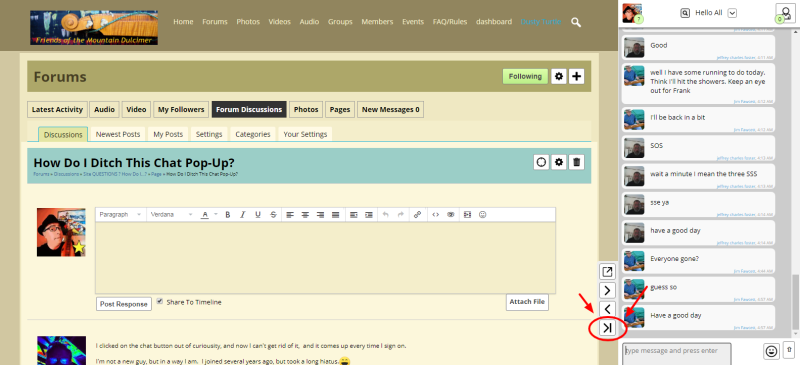
Once it's minimized it stays on the screen off on the lower right-hand corner.
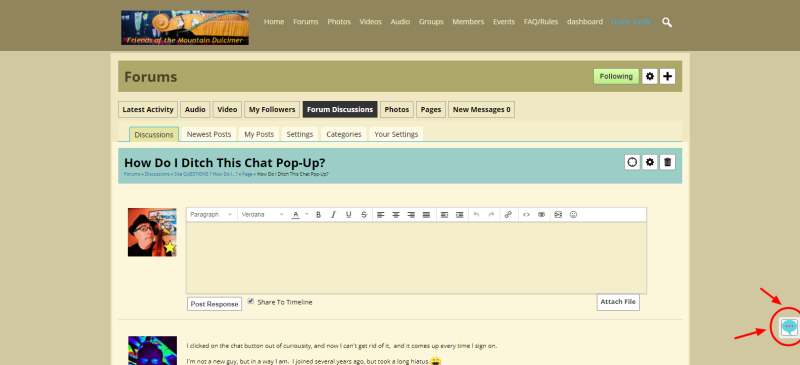
Jimmy, you get the same speech bubble icon on your phone or tablet.
In other words, how do I copy someone’s post, so that I can comment about it?
You use the speech bubble icon that appears in the upper right-hand corner of message you want to copy when you move your cursor over it.
I have nothing to add that Ken and Ken have not already stated, except to point you to our group here on Dulcimer Care and Maintenance .
@John-Dunn, have you tried asking @Ken-Hulme for a copy? It used to be publicly accessible at Everything Dulcimer, but I'm sure Ken can post a copy.
Yes, I'm thankful as well that Jeannie has emerged from the ashes of Paradise even if she lost her home and nearly everything they owned.
"Oh my" is not my reaction to that price. My first thought was "no &^R#ing way!"
I like Howard and his dulcimers as well, but I've never seen a price even close to that for a Capritaurus.
@D-Chitwood and @Brian-G, in addition to a radiused fretboard, Aaron O'Rourke's dulcimers also have what he calls a "reversed flare." The strings are 1" apart at the nut but .8" apart at the bridge. That might compensate for what Brian refers to as the difficulty fretting on a radiused fretboard up high.
Dusty,
I need another dulcimer/instrument, like I need a hole in my head. That said (haha), I've told myself, if I were to get one, it would be a McCafferty. I'm happy to see your response, that that would be your choice. Can you post a pic of yours? He makes beautiful dulcimers!
Susie, if someone asks how many dulcimers you need, the right answer is "one more."
I don't want to go too far astray from the original goal of this thread, but it seems reasonable to ask what someone likes about the one dulcimer they identified in response to this forum question.
I bought my McCafferty before he was making radiused fretboards, so I can't speak about that attribute. Terry's dulcimers all have a loud, round, well-balanced tone. The tone resembles a guitar more than the high silvery sound of a traditional dulcimer. The action is excellent and the intonation is superb. One feature of McCafferty dulcimers that I love is the extended strum hollow. Most of us end up strumming over the upper end of the fretboard, and that extended strum hollow allows us to pick and strum there without clacking against the fretboard. Terry uses K & K Sound twin spot pickups inside, and although I don't have too much experience with this stuff, I find them to be phenomenal pickups that provide plenty of amplification without distorting the acoustic tone of the instrument.
Mine is the shortest of the three options Terry offers. The body of all his instruments are the same size, but he makes three different VSLs: 28", 26.5", and 25". I think it is inevitable that you lose a little sustain with a shorter VSL, and were I to buy the instrument now, I might get a 26.5" model. On the other hand, I've already gotten use the shorter VSL and have arranged a few tunes that require stretches I wouldn't be able to make on longer fretboards.
I did have to make one adjustment to the instrument before I felt comfortable flatpicking. The strings are pretty far apart. that works well for fingerpicking and for playing slow tunes, but I found it difficult to flatpick with any speed. I use a single melody string, and the first thing I did was to move that single string to the inside groove on the nut. I then made an extra groove for the bass string that was the same distance away from the middle string. My bass and melody strings are now about 1" apart. I have thought of making a new nut and bridge with grooves that are even closer than that, but for the moment I am doing OK with that distance.
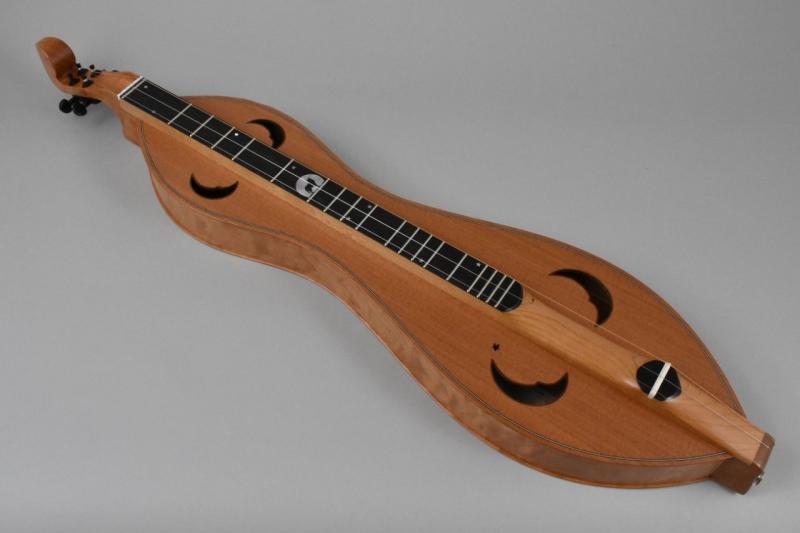
If you go to my video page , you'll see that five of my last six videos were made with my McCafferty dulcimer. And here's a picture of the top. The back and sides are figured cherry and the top is redwood. The inlay is a wolf in front of a full moon with little stars for position dots.
Dana, I was just going to respond to your personal message, but I saw this forum, so I'll respond here instead.
More and more luthiers (including Folkcraft as an option) are making radiused fretboards, but the truth is that unless you barre with a single finger like Aaron O'Rourke or Stephen Seifert, it doesn't really offer an advantage. Then again, if more of us had radiused fretboards, perhaps more of us would barre with a single finger!
I bought a dulcimer from Terry McCafferty, but it was before he started offering the radiused fretboard as an option.
If the Ewing capo works, then you have your solution. The Spider Capo should work once you get the hang of it. Ideally you would want a capo with the exact same radius as the fretboard.
David Beede provides a radiused capo with his models that have radiused fretboards, so you might contact him and find out if he can sell one separately, but unless the radius is exactly the same as the Bella, I am not sure it would work. According to the website, Bella dulcimers have a 12" fretboard radius. Terry McCafferty used to sell capos that matched his dulcimers in design, but I don't know if he's started making radius capos. You might send an email to both of those luthiers and see if they can help you.
This is all pretty new. If more luthiers begin making radiused fretboards and that exact radius becomes standardized, then I'm sure someone will start making radiused capos to match.

 strumming in various keys out of DAd tuning.pdf - 22KB
 Yesterday alone I played three different dulcimers and two different guitars.