I use what might be thought of as hybrid tunings-- tuning a wound bass and a doubled drone course to the same note yet an octave apart (as one would for Bagpipe tuning) then tuning the melody string as one would for straight Ionian or Dorian scales.
Tuning/playing in C ?
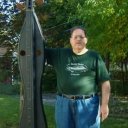
That would be me also, guys! 


Those are all good points, Dusty. Whenever I try to explain some of those things to our dulcimer group their eyes gloss over and their faces go blank.
Ken
"The dulcimer sings a sweet song."

I wish tuning to C were the norm, for that would simplify explaining music theory on the dulcimer since we wouldn't have to deal with sharps and flats.
So far, people have cited two reasons for playing in C: because the specific dulcimer sounds good in that pitch and because it is easier to sing some songs in that pitch.
Both of those reasons make sense. Once upon a time luthiers would tune their dulcimers to whatever pitch resonated most profoundly on that particular instrument. They would "hoo in the hole," meaning sing into the soundhole and identify the most resonant pitch and then tune the instrument to that one. And as for singing, there are indeed some songs that I can't sing in D because the melody ends up too high, but I can in C. However, the opposite is also true. And sometimes I have to sing in G or A. It all depends on the range of each particular song. (Look up the words "authentic" and "plagal" if you care about the official terms.) The fact is all twelve keys exist in whatever my limited range is, but for any given melody only a few might fit.
Let me offer two other reasons. I find on a standard dulcimer I can tune as high as E or as low as C without changing strings. When I fingerpick slow tunes, I prefer tuning down to C or C# because of the extra "give" in the strings. It allows your picking fingers a bit more control and creates a softer tone. But when I flatpick faster tunes, I tune up to Eb or E because the tighter strings are more responsive to the pick.
And secondly, one of the professional dulcimer players confided in me that when he plays in the instructor concerts at festivals when several people all play short sets, he tunes down to C or C# so that his dulcimer seems richer and warmer compared to all those who came before. I do think there is something to this. Play a tune in D a few times and then tune down a step or half step and play it again. It will seem deeper and richer to your ears in comparison.
--
Dusty T., Northern California
Site Moderator
As a musician, you have to keep one foot back in the past and one foot forward into the future.
-- Dizzy Gillespie
Gentleman, maybe. Illustrious, haha. That's the Thomas dulcimer I'm holding in my avatar.
Ken
"The dulcimer sings a sweet song."
updated by @ken-longfield: 10/28/26 10:16:55PM
May I concur with the illustrious gentlemen preceding me here: my historic reproduction dulcimores really like Jean Ritchie's traditional CGG. It's how I learned to play many years ago, and I like it.
I have a dulcimer made by James Edward (Uncle Ed) Thomas in 1931 at Bath, KY. I keep it tuned CGG. It seems to like that tuning.
Ken
"The dulcimer sings a sweet song."

I have a Thomas replication built by Dulcimore Dan that really likes CGG. It is a joy to play it. The tone sounds so traditional.

I watched a YouTube video with Bing Futch and he gave me some pointers a few years back. I have always sang bass in college and youth group sessions. All those old songs are available for the dulcimer, except ..... too high for a bass voice. When I built my teardrop dulcimer I love the deeper sound with the larger box. But the amazing part was tuning to CGC. I still have 4 other dulcimers tuned DAD and DAA. I found the CGC is better for me as it made it more comfortable to sing.
The diatonic Jean Ritchie model Blue Lion I have shines in C. It's a Kentucky hourglass shape, the top is Spruce, and at 23 years old it has aged nicely and is a joy to play. I came by it 'used' in '07, I think-- diatonic dulcimers were falling out of favor with lots of players at the time. I feel lucky to have it.
I play out of different tunings so it's not unusual for me to play out of *whatever* sounds good to my ear. 

Our club in Franklin NC started tuning to CGC about a year ago. We like the warmer sound and it is better for singing. You will likely have to adjust your string gauge to allow for the looser strings, but the sound is so much better in my opinion.

Our esteemed member Robin recently posted a beautiful clip of her tune Fallen Leaves Lullaby , where she tuned her dulcimer in C to lovely effect.
Most folks tend to tune and play their dulcimer to D as a home base these days, but dulcimers were also commonly tuned to the key of C many years ago.
I'd like to hear about other members' experiences in tuning to and playing in C-
What reasons made you try it? What dulcimer favored it? What tunes/songs were better in it? Did other people or circumstances influence your trying it? Do you still do it, and why/why not?
Share with us your thoughts and experiences in playing in C!
--
Site Owner
Those irritated by grain of sand best avoid beach.
-Strumelia proverb c.1990
