Forum Activity for @folkfan

folkfan
@folkfan
05/02/10 12:01:56AM
357 posts


I don't know whose dulcimers you've been looking at, but I have a more diverse collection than you have described.13 dulcimers:Only 2 have heart shaped sound holes and one of those is a none standard heart shape.6 teardrops and 6 hourglass shaped, 1 box dulcimerOnly two intruments are designed for 3 string playing, the rest have 4 tuners even though one isn't used. Though I play only 3 strings, I usually buy an instrument capable of using 4 strings for resale purposes. Finding dulcimers designed for only 3 strings is not easy to do, you almost have to custom order them. So, of course, people who want to play with only 3 strings simply remove a melody string from a 4 string instrument.And, Ken, if you had the problems with your hands that I have with mine, you'd probably be playing on 3 strings too. I can't even hold a noter the way you do. And even when my hands were better, I preferred using 3 strings. Laziness has got nothing to do with it. Personally I can't understand your preference for 4 strings. :-)None of my instruments are tuned DAd, or even tuned DAA. I don't play in the key of D at all. I play Ionian and Aeolian modes predominantly in the key of C, A, B, G. But all in the lower register.All of my instruments have a 6+ fret and all but one have a 13+ fret. The only one with just the 6+ was one that wasn't built with any extra frets and I had just the 6+ added.Though I don't finger pick or flat pick I do know a number of players that use those techniques. And a number of players that use a noter. But as Ken said these are techniques for different hands.Modern Bowed Dulcimers aren't traditional mountain dulcimers, so whether they have diatonic or chromatic fret boards is purely up to the buyer. Bowing a dulcimer is an old tradition, but it was done on the standard dulcimer of the day.2 of my instruments are baritones.12 of my instruments have the same VSL. Many have the same depth and body size. The main difference is in the woods. The bodies are mostly cherry, walnut or mahogany, with aspen, WRC, redwood and wormy chestnut for tops. All the fret boards are the same width, except for one and the same depth except for 1.So Gerard, though your observations are mostly correct, you couldn't prove it by my collection of instruments.
Ken Hulme
@ken-hulme
05/01/10 08:08:19PM
2,157 posts


Most of your observations are valid - general as they are. My comments are totally my opinion only, and not particularly tongue in cheek!* hourglass shape - Comes more or less from the Kentucky building tradition and has become the de facto recognizable shape of the dulcimer. There's no accounting for taste!* most dulcimers with 4-strings have a double-melody string spacing. Yep the dulcimer was invented/designed as a 3-course Instrument - Bass, Middle, Melody. You can have more than one string on a course. The dulcimer was not invented as a 4-course instrument* The majority of dulcimer players that play with only three strings normally use a four-string double-melody string dulcimer. Yep! LOTS of people have been convinced by well meaning but lazy other players and teachers, to remove a string to make it theoretically easier to learn to play instead of taking an extra week to get used to doubled melody strings. But they get convinced of this AFTER they've already bought a 4-string instrument! You can tell what I think about this, right!* the majority of dulcimer players seem to favor and play in the DAD tuning (Mixolydian Tuning). Ive even heard that this tuning is considered to be THE DULCIMER TUNING by many. Unfortunately true. Again most often caused by well meaning but ignorant teachers who themselves were taught that DAd is "the only" tuning. They are deluded, but that's their problem. There are a lot of us who use multiple tunings.* Traditional dulcimers normally use the diatonic fret pattern and although fully chromatic dulcimers are available, the majority of dulcimers fret boards are NOT fully chromatic. TRUE. The dulcimer was not invented as a chromatic instrument. It was invented as a diatonic instrument. Only in the late 20th century have people bastardized the instrument by adding extra frets. You can tell I really don't like chromatic or added fret dulcimers, can't you...* The only dulcimer that uses a fully chromatic fret board appears to be the bowed dulcimer but even a few of these do have a diatonic fret board. The Bowed Dulcimer as you see Ken Bloom and others build it, is a totally late 20th century invention. The traditional dulcimer can be bowed, but the Bowed Dulcimer is a different cat altogether.* The majority of dulcimers fret boards have the 6+ or 6 fret added to the diatonic fret pattern. Yep - due to the observation above about people thinking DAd is "the only" tuning.* The majority of dulcimers that Ive seen DO NOT have the corresponding 13+, 13 fret added to the diatonic fret board. You've not been looking at the same dulcimers the rest of us have. Virtually every 6+ dulcimer I've seen has the corresponding 13+ fret.* You normally do not see that many bowed dulcimers, mini-dulcimers, dulcimettes, or octave-higher dulcimers, baritone dulcimers, or bass dulcimers, so the majority of dulcimers seem to be standard sized dulcimers. Duh! Yeah! Otherwise they would be the standard! Of course it all depending on which festivals you've been going to where. Those other instruments are Special Purpose instruments, generally speaking.* The majority of dulcimers seem to have heart-shaped sound holes. Maybe. I see more with round holes than hearts.* The majority of dulcimers seemed to be played using a pick and not with finger-picking or a noter. The dulcimer was invented long before finger-picking - it's a 20th century invention - and with only 3-courses of strings isn't particularly suited for it. More muisc is more suited to flat-picking than finger-picking. The Noter has nothing to do with the right hand. I've been using a Noter and a flat pick for over 35 years.* You don't have to have or spend a lot of money to purchase a good quality dulcimer like you have to do with many other instruments. You can buy a great playing cardboard dulcimer for almost nothing, build a high quality dulcimer with a reasonably priced dulcimer kit or even make your own dulcimer for almost nothing out of scrap and junk. VERY TRUE.* The widest divergence having to do with dulcimers, that Ive seen, are the materials and woods used in building the dulcimer, the dulcimer string lengths, side depths, soundboard widths, etc. Huh? What did you expect? You've just listed all the basic factors that are the dulcimer. What else is there? Shape has almost nothing to do with dulcimer sound. Wood types are actually pretty far down the list too, an generally should just be considered cosmetic. Length/width/depth of the instrument , and the VSL of the strings are the elements that most affect the sound.
updated by @ken-hulme: 02/17/16 06:12:35AM
Robin Clark
@robin-clark
06/14/10 01:06:19PM
239 posts


I've been using a goose quill noter for the past couple of weeks and I'm really impressed with the speed and tone. They are as quick and bright as a hardwood noter but kill the string vibration when moving between frets, so they give very pricise note separation for fast playing. I'm not sure how durable they will prove - I expect I'll probably get through a feather a month. But they are cheap and seem to work really well for my style of playing. I play with a finger-on-top style. A feather noter may not work so well for a thumb on top style. I think that for fast fiddle tunes in Galax style, feather noters are the very best I have tried so far.

Feather noter and strumming quill
Strumelia
@strumelia
06/14/10 12:09:24PM
2,413 posts


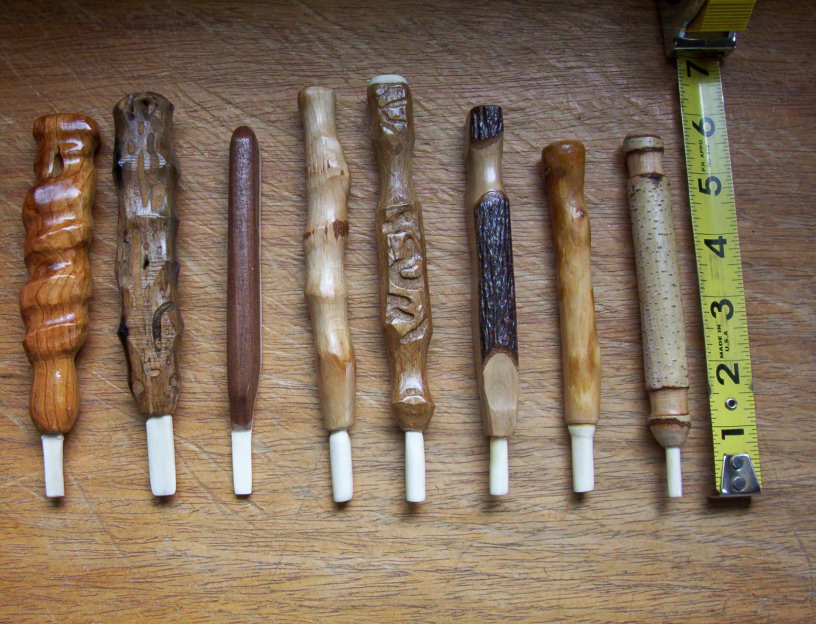
I have 3 noters of ironwood/hornbeam, turned for me about 9 years ago by a wood turner/burl bowl craftsman. The same wood used for axe handles. Though they are indeed nice and hard, they do still get string grooves over time, much like my maple noters do.
razyn
@razyn
06/14/10 11:36:59AM
51 posts


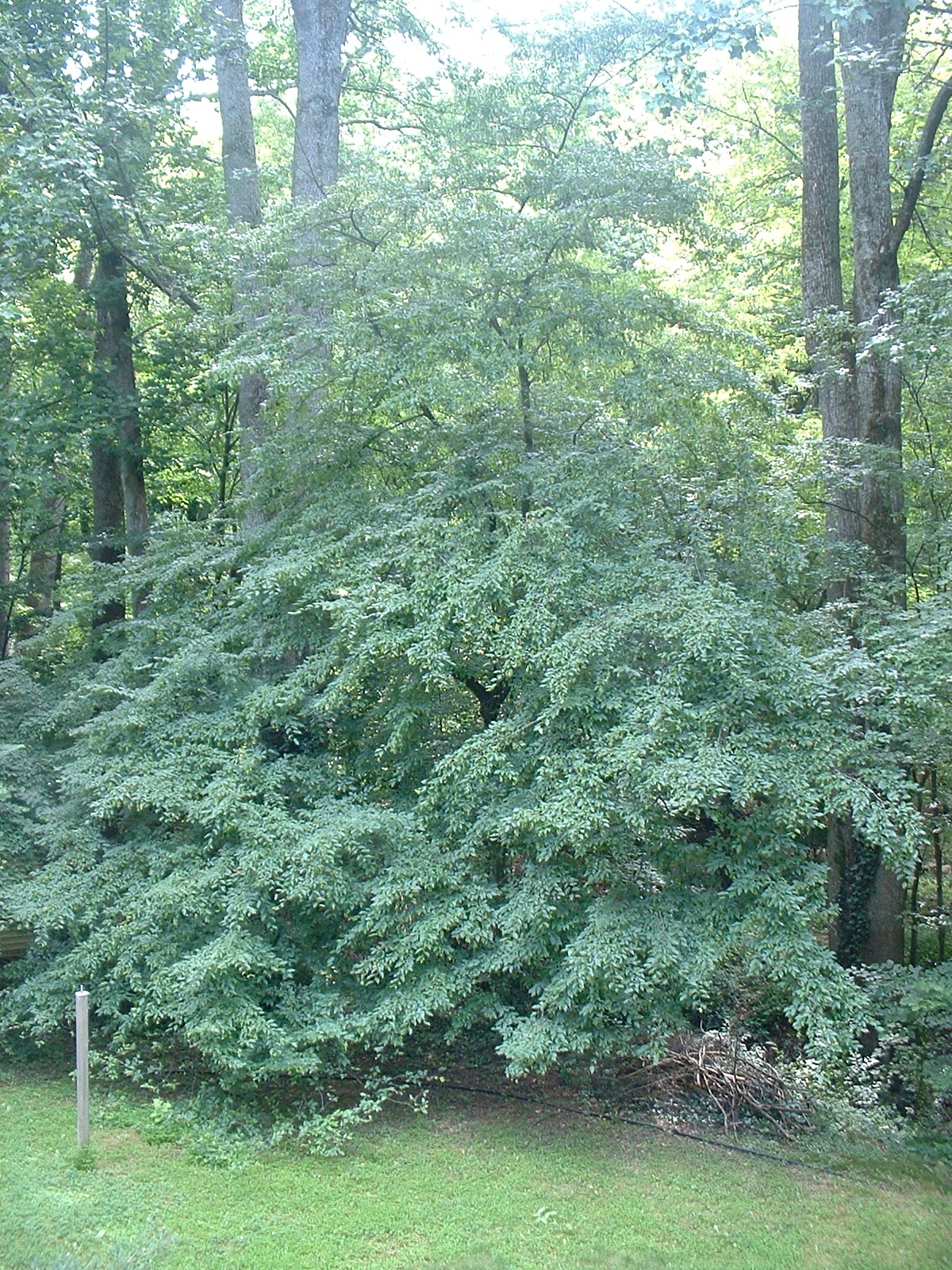
In case anybody wants to see Flint Hill's noter "on the hoof," so to speak -- I have a pretty big American hornbeam tree in my yard. Maybe 30 feet tall, and it's often more like a shrub. The post at left in this photo of it (from my deck) is 5 feet tall, or so.

John Henry
@john-henry
06/14/10 11:22:46AM
258 posts


Robin,see my reply to Dave Kirkpatrick, and contact me pm if you wish?John
John Henry
@john-henry
06/14/10 11:18:53AM
258 posts


DaveI would be quite happy to make you a couple to your spec, as near as possible without seeing what you prefer now (gratis). I have just discovered some odds and sods that were lurking in a dark corner of my workshop I have some beautiful clean and dry 'Box', which has become really hard over the last 25/30 years, a creamy yellow colour, and I also have some 'Bog Oak, (no Robin Thompson, nothing to do with your garden room!) which is very black and hard, and at a conservative estimate must be over a 1000 yrs old, it was dredged from the River Trent about 20 years ago near Shadwell, and similar timber has been carbon dated well in excess of the figure I have quoted. I can of course produce noters from other hardwoods, maple, yew, walnut ect. Just one thing, when I use a wooden noter now I tend not to use a round section, prefer either an elliptical or a just 'off square' section, they are of course, easier to makeregardsJohnH
Robin Thompson
@robin-thompson
06/14/10 10:47:50AM
1,564 posts


Got any for sale? Flint Hill said:
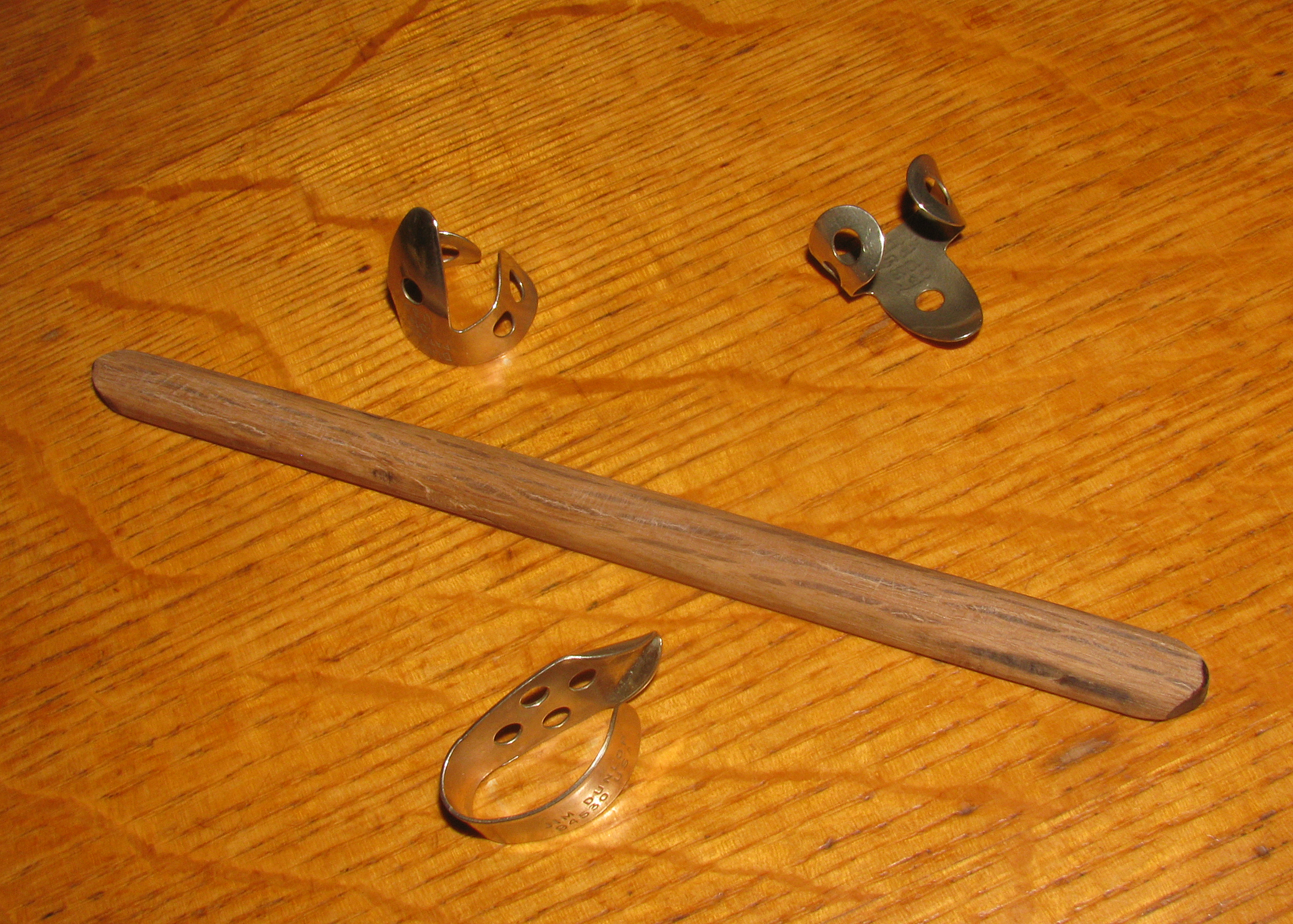
"Ironwood" noter, from a slab collected in East Texas, ca. 1960, by A.L Vawter.

Approximately 6 1/4 x 3/8 x 1/4 in. (15 x 1 x 0.6 cm). "D" cross section.

Dense, extremely hard wood. It sinks in water and is difficult to work.

It made a nice, slick noter that sounds a bit softer than a goose quill.

Probably Big Bend or Eastern Hophornbeam. (Ostrya virginiana var. chisosensis or Ostrya virginiana var. virginiana, 2007)
Flint Hill
@flint-hill
06/14/10 09:22:21AM
62 posts


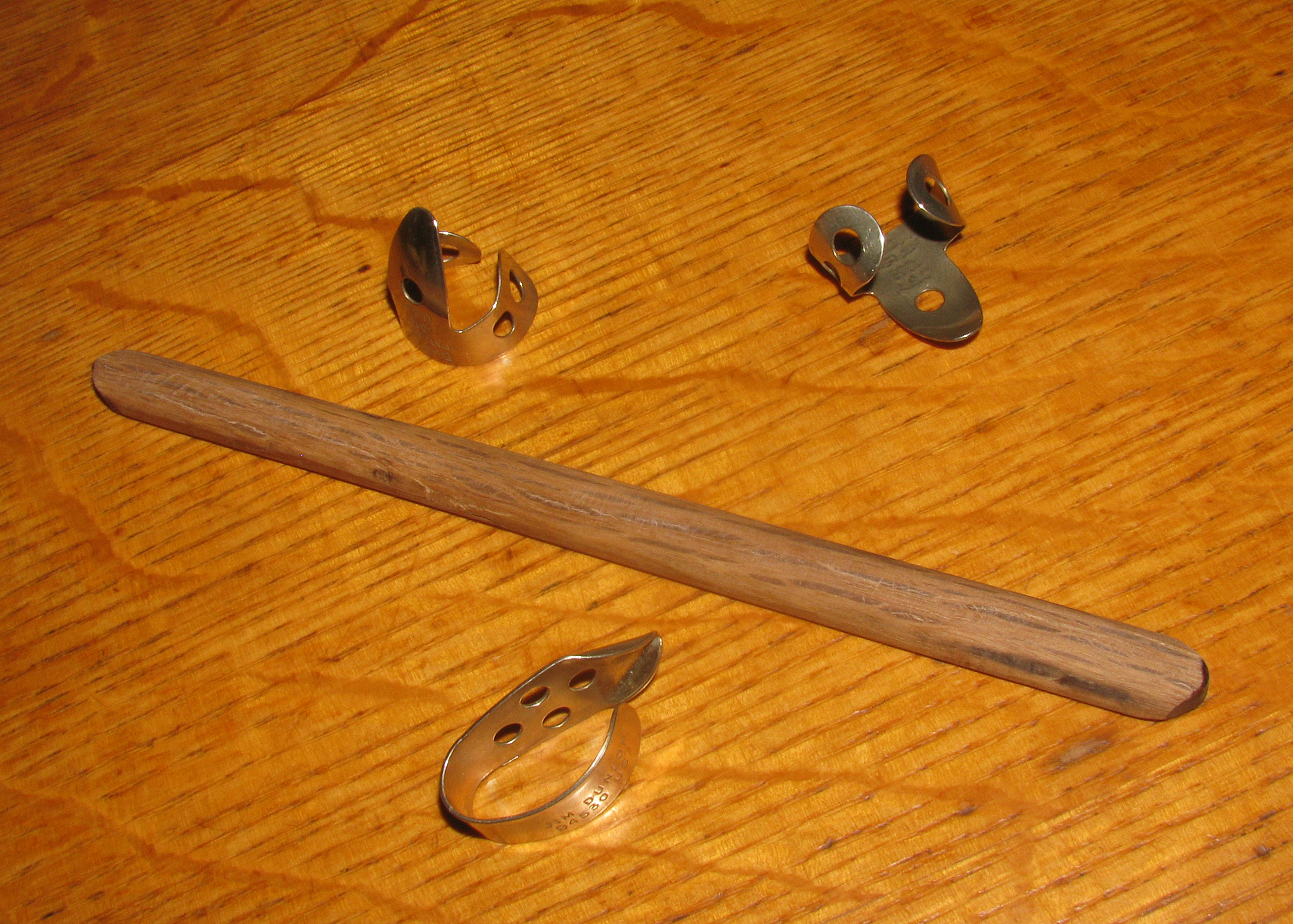
"Ironwood" noter, from a slab collected in East Texas, ca. 1960, by A.L Vawter.

Approximately 6 1/4 x 3/8 x 1/4 in. (15 x 1 x 0.6 cm). "D" cross section.Dense, extremely hard wood. It sinks in water and is difficult to work.It made a nice, slick noter that sounds a bit softer than a goose quill.Probably Big Bend or Eastern Hophornbeam. (Ostrya virginiana var. chisosensis or Ostrya virginiana var. virginiana, 2007)
Ken Hulme
@ken-hulme
05/05/10 02:18:26PM
2,157 posts


DJ - that's what we call the Thumbelina style. Not trad, but not bad...
Ken Hulme
@ken-hulme
04/27/10 03:13:33PM
2,157 posts


Fretless dulcimers are a special order instrument. Most builders will do one. Some actually cut the fret slots and inlay wood so that you have fret markers. Others do a completely bare fretboard.
Jim Fawcett
@jim-fawcett
04/27/10 08:16:02AM
85 posts


I have three type of bone noters that I got from Randy Bretz. They are holding up rather well. I did have to sand down one of them, but it's just like new. I also made one from some old bamboo I had here at the house. It works well. I like the different sounds given between the bone and the bamboo noters.
Robin Clark
@robin-clark
04/27/10 03:19:18AM
239 posts


Hi Carson,Have a look at Randy Adams videos to see fretless dulcimers - Here's one
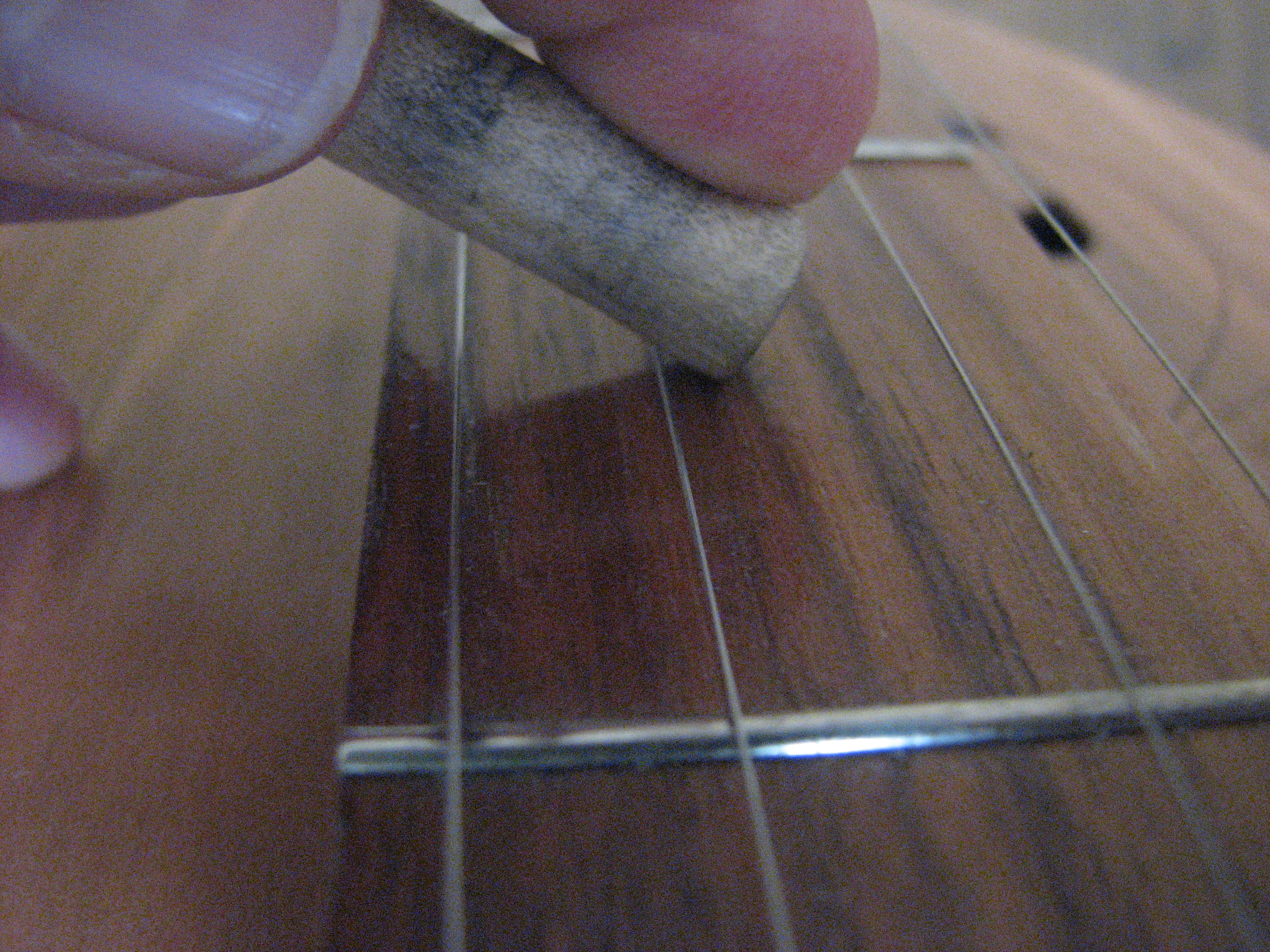
He makes cigar box fretless MDs and uses a 4 string set-up plus a multitude of old banjo tunings. The strings are sounded not by depressing them to the fingerboard but by placing the tip of the noter onto the fingerboard and touching the string. Like this photo of the technique on a fretted MD:

Note that the string is not touching the frets - it is vibrating against the noter and the vibrations are transfered into the fretboard and instrument by the tip of the noter.A hard noter, such as snakewood, gives a very clear sound when doing this. And I use the technique on my fretted MD to play the missing semitones and occasional accidentals that some folk tunes have, or to change key. For example, when playing in d,d,d,d galax style I can capo at the 1st fret and play in both A minor and A major by playing the G# of A major using this technique - a very handy skill at sessions! With a bit of practice you can rock the noter up onto its tip really fast. You can see me snatching the G# accidental by rocking the noter up onto its tip and sounding the string between the G and A frets in the B part of St Annes Reel (key of D) on this video.
Robin Carson Turner said:
Robin Clark said:
I also think it would be a excellent wood for a fretless set-up

Fretless dulcimer? We have that option? I'm intrigued, who makes these?
B. Ross Ashley
@b-ross-ashley
04/26/10 07:15:55PM
59 posts


I got a nice rosewood one from Carrot Creek last year when I got my dulcimer, it is showing signs of wear now but not so bad as Strumelia's maple one! Probably means I need to play more often.
Randy S. Bretz
@randy-s-bretz
04/26/10 04:13:09PM
8 posts


My bone tipped noters hold up very well and if they do get scratched from use you can sand them down to a smooth finish. The bone tip goes 2 1/2" into the handle so they are very strong.

Robin Thompson
@robin-thompson
04/26/10 01:01:05PM
1,564 posts


A toothbrush handle? Now that's something I think I haven't tried! I'm going to, though. . . My bone noters-- got from Randy Bretz-- yield clear tone on the string. For playing fast tunes, I need a noter that's forgiving, so use my homemade ones cut from a hard plastic jar that once held store-bought fruit. Photo can be seen by scrolling down the page just a bit here: http://mountaindulcimer.ning.com/forum/topics/whats-your-favorite-n...
John Henry
@john-henry
04/26/10 10:57:52AM
258 posts


Why John Shaw! I do declare, that's almost a compliment!!!! That particular butt end of a quill which I was using while you were here on Sunday last has been in use for some considerable time now (the Mason's left me some when they visited with us?) and I have that one 'setup' so as I can use either end,those ends being of different thickness, which have the capacity to produce different effects. As you commented, the action is slick and the sound good, IMHO, which is why I choose to use to use it over other noter types. BUT, I am also very fond of a noter contrived from the plastic barrel of a biro type pen, again because of the singular sound given, and I have used and still use on occassion, a wide variety of Hardwoods, not always cylindrical, try an elliptical one (never Ebony or Snakewood Ken H, just a bit beyond my pocket LOL). Ken also mention bamboo, I find this to be particularly 'slick', it fair glides over the fretboard, but , again only IMHO,I would be cautious about using this on anyones instrument except my own; there is always the chance that bad use of a 'hard' noter on a fretboard make of a 'soft' hardwood could lead to scoring of the fretboard. I have seen an example of this!. Which is why whatever the noter material I always remove the arriss from the noter tip, and try to impress on others the need (for the main part) in keeping the noter in the right plane. Long winded reply Dave, ain't it, but as many people on this site have mentioned in the past, try all and everything until you hit on just the right one. Did I ever tell you about the time that I left my bag of odds and sods at home and was forced to use the snapped off handle of my toothbrush? No,well...............regards,JohnH John Shaw said:
Our mutual friend John Henry gets the most wonderful tone from using the thick end of a turkey or goose quill as a noter. This doesn't score all that high on durability, I suppose, although they seem to last him a reasonable time, but it's a great sound and action. John started using them after learning that this is what most of the Galax-style players in Virginia use.
Strumelia
@strumelia
04/26/10 10:30:40AM
2,413 posts


Noters don't last forever if you use them a lot.Here's my noble old hard maple noter, now 'retired'...it sure made a lot of fun music!...

Ken Hulme
@ken-hulme
04/26/10 09:37:39AM
2,157 posts


The harder the wood the more longer lasting. IMHO Walnut is at the low end for hard wood noter. I never recommend Big Box Store dowels because they are Poplar, and too soft. Oak is too soft. Hickory isn't bad. Maple is good, Blue Beech, Hop hornbeam, Manzanita or whatever your local "Ironwood" is called.My all time favorites are Ebony and Snakewood both for their beauty and density. I also like certain species of bamboo, particularly Phyllostachys nigra - Black Bamboo.
Robin Clark
@robin-clark
04/26/10 09:36:39AM
239 posts


Hi Dave,Noters are certainly disposable items - so it's best not to become too attached to them! There is only so much sanding they can take to repair the surface grooves until they are too thin to use.I have snakewood and mahogany noters at present. The snakewood is hard, fast (very fast!!!) and wear resistant. It whistles on the strings and you have to be very accurate if you are using double melody strings as a miss-fretted note will sound as loud off the surface of the noter as a fretted note. For this reason, I perfef to use snakewood for a single melody string set-up. I also think it would be a excellent wood for a fretless set-up (are you listening Randy!) as the tone off the wood so just so clear.The mahogany noters I have are reasonably wear resistant, have a good tone and allow me to get away with murder on a double melody string set-up as they are quieter when played unfretted (with the string just ringing against the noter surface). Because mahogany is a bit "dull" it actually makes for much clearer fretted playing. I would say that a noter made from a very hard wood that is wear resistant can be a bit "lively" and more difficult to handle than a moderate hardwood in most situations - particularly if you use a double melody set-up.I'm certainly keen to keep trying as many materials and shapes as I can get my hands on. The search for the perfect noter is like the search for the perfect wave - even if you do find it the ride ain't going to last for long!Robin
John Shaw
@john-shaw
04/26/10 09:27:17AM
60 posts


Our mutual friend John Henry gets the most wonderful tone from using the thick end of a turkey or goose quill as a noter. This doesn't score all that high on durability, I suppose, although they seem to last him a reasonable time, but it's a great sound and action. John started using them after learning that this is what most of the Galax-style players in Virginia use.
folkfan
@folkfan
04/27/10 11:44:19AM
357 posts

purpose of design features on a MD


Instruments- discuss specific features, luthiers, instrument problems & questions

I like the look of your board, Robin. It looks like it would work quite well.I haven't made one for a specific instrument, as my board is adjustable to fit all sizes, which I have.Figured out that one board for 14 instruments was better than having 14 boards and trying to remember which one fit which instrument. At my age, I'd be all day just matching the critters up. hehehehehee Robin Clark said:
Hi D.T.

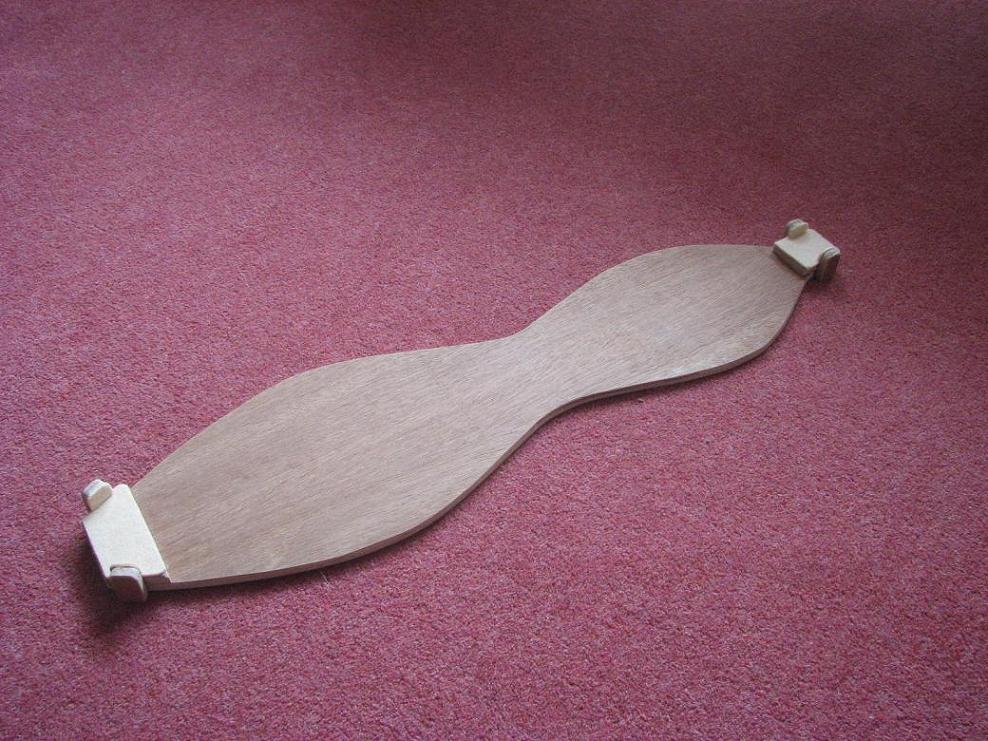
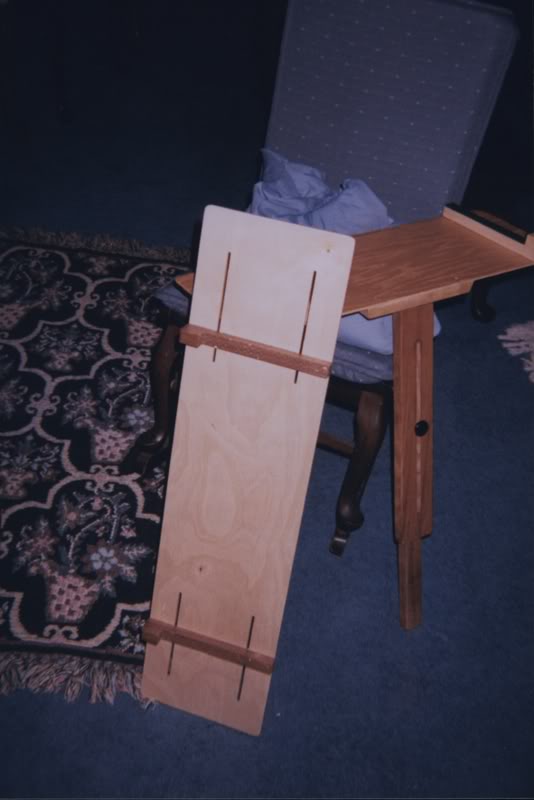
Here are some photos of the board. I simply cut it from a piece of ply. It really only took me an hour or so to build. I didn't put much time into it as I wasn't sure if it would work - but I've been using it every day for the last 9 months!
Dusty Turtle
@dusty
04/27/10 10:29:57AM
1,856 posts

purpose of design features on a MD


Instruments- discuss specific features, luthiers, instrument problems & questions

Great job, Robin! The only possom board I've held in my hands was a large and awkward piece of rectangular wood. I couldn't imagine playing with that on my lap. But yours is clearly tailored specifically for your dulcimer. You've inspired me. Perhaps the next free weekend I get I'll have to fashion one of my own.Thanks for the pictures.D.T. Robin Clark said:
Hi D.T.

Here are some photos of the board. I simply cut it from a piece of ply. It really only took me an hour or so to build. I didn't put much time into it as I wasn't sure if it would work - but I've been using it every day for the last 9 months!

I use a strap on my MD and the board and MD sit together snuggly because of those little flanges at each end.

Robin

Dusty Turtle said:
Robin, might I ask what the dimensions of your possom board are? I had never really thought about using one, largely because I mainly play alone so volume isn't an issue. But your description makes me wonder how my dulcimer would sound with a possom board. I play with a strap and can only imagine putting a small board underneath.

D.T.

Robin Clark said:
I built a simple possum board for my MD and was very surprised at the difference it made. It has given the instrument more volume and a rounder tone. I have a strap on my MD and it holds the MD and the possum board that the MD rests on just fine - I have found no need to attach the two together. Having heard what a possum board can do, I am having a Galax style false back built onto the MD I have presently on order as I want the possum board built-in for ease of use.

Robin
Ken Hulme
@ken-hulme
04/26/10 09:40:46AM
2,157 posts

purpose of design features on a MD


Instruments- discuss specific features, luthiers, instrument problems & questions

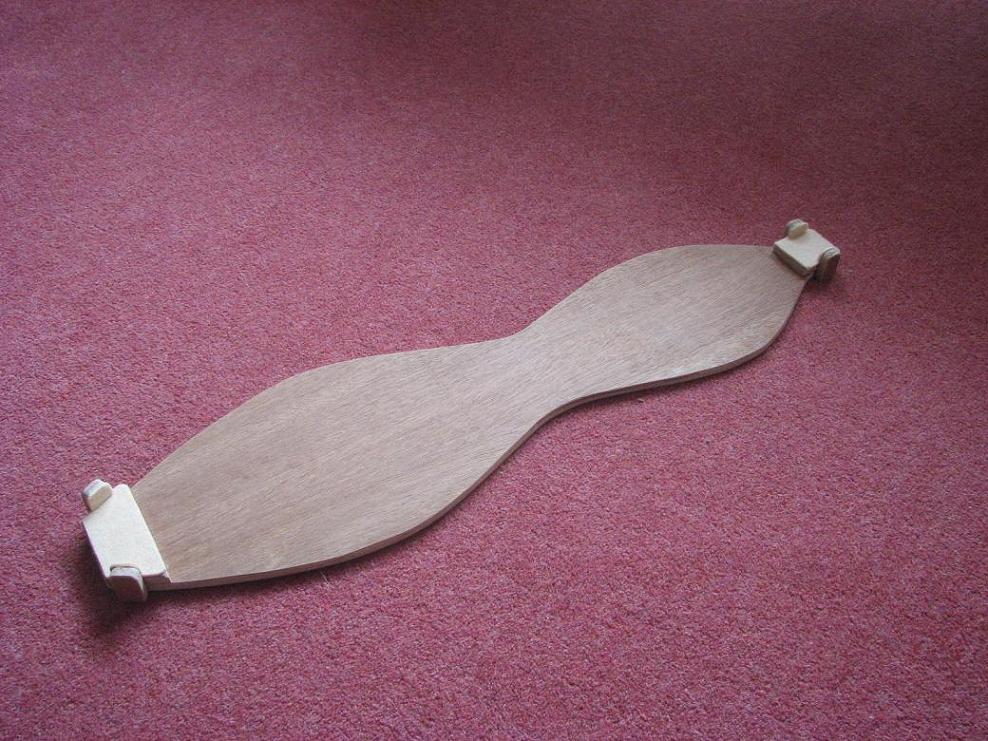
Nice job Robin! The best Possum Boards, IMHO, are those that are built to hold a specific dulcimer, and yours is a great example.
Robin Clark
@robin-clark
04/26/10 03:04:15AM
239 posts

purpose of design features on a MD


Instruments- discuss specific features, luthiers, instrument problems & questions

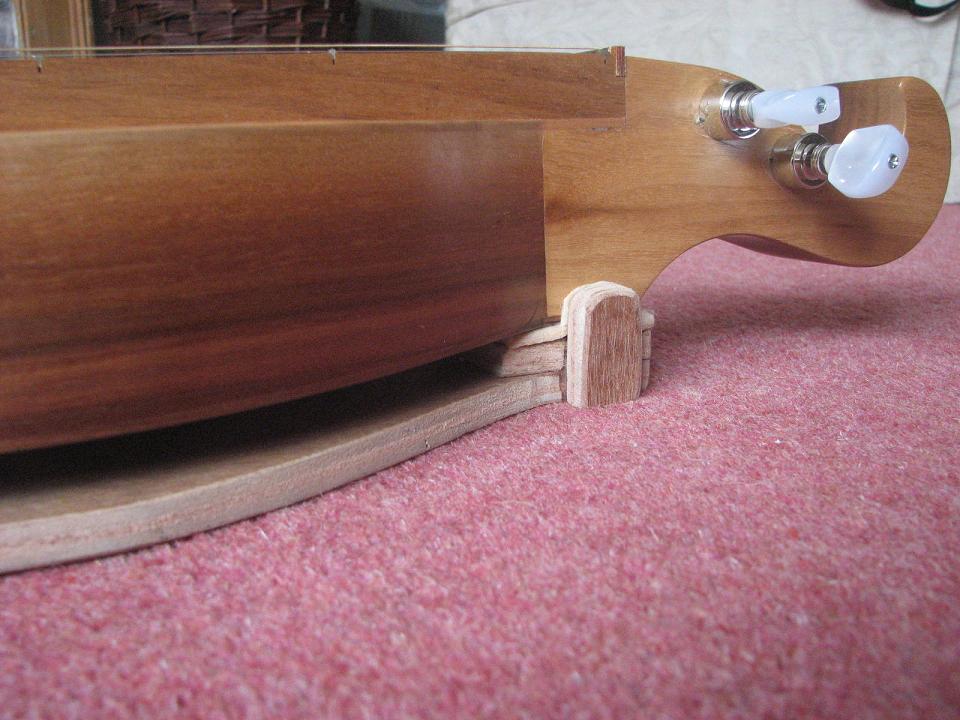
Hi D.T.Here are some photos of the board. I simply cut it from a piece of ply. It really only took me an hour or so to build. I didn't put much time into it as I wasn't sure if it would work - but I've been using it every day for the last 9 months!

I use a strap on my MD and the board and MD sit together snuggly because of those little flanges at each end.Robin Dusty Turtle said:
Robin, might I ask what the dimensions of your possom board are? I had never really thought about using one, largely because I mainly play alone so volume isn't an issue. But your description makes me wonder how my dulcimer would sound with a possom board. I play with a strap and can only imagine putting a small board underneath.

D.T.

Robin Clark said:
I built a simple possum board for my MD and was very surprised at the difference it made. It has given the instrument more volume and a rounder tone. I have a strap on my MD and it holds the MD and the possum board that the MD rests on just fine - I have found no need to attach the two together. Having heard what a possum board can do, I am having a Galax style false back built onto the MD I have presently on order as I want the possum board built-in for ease of use.

Robin
Dusty Turtle
@dusty
04/26/10 01:39:12AM
1,856 posts

purpose of design features on a MD


Instruments- discuss specific features, luthiers, instrument problems & questions

Robin, might I ask what the dimensions of your possom board are? I had never really thought about using one, largely because I mainly play alone so volume isn't an issue. But your description makes me wonder how my dulcimer would sound with a possom board. I play with a strap and can only imagine putting a small board underneath.D.T. Robin Clark said:
I built a simple possum board for my MD and was very surprised at the difference it made. It has given the instrument more volume and a rounder tone. I have a strap on my MD and it holds the MD and the possum board that the MD rests on just fine - I have found no need to attach the two together. Having heard what a possum board can do, I am having a Galax style false back built onto the MD I have presently on order as I want the possum board built-in for ease of use.

Robin
Dusty Turtle
@dusty
04/26/10 01:36:12AM
1,856 posts

purpose of design features on a MD


Instruments- discuss specific features, luthiers, instrument problems & questions

Ken, you are probably right that when I first began playing and had problems with the end of the instrument lifting up it was due to faulty positioning. But our attitudes toward the strap are completely different. Once I attached a strap to my dulcimer and could position it exactly how I wanted to, it really became mine and my playing began to advance. I find it not restricting but liberating since it secures the instrument against your body and allows you to play without having to worry about the instrument moving at all. I think I read on some post at this site Dan Daniels discussing how he holds the instrument by bracing both hands against it while playing so that he can adjust the dulcimer on his lap as he plays. I find playing alone demands all my attention and don't want to worry about my dulcimer develop a sense of wanderlust.Best,D.T. Ken Hulme said:
No reason you can't put a strap on a possum board! Either gravity or a low pressure bungee or rubber band holds the dulcimer on the possum board (sometimes a wooden toggle).

Tail-end lifting when you fret near the head is caused by not having your knees far enough apart and the dulcimer placed incorrectly on your lap. The nut or first fret should be over your left knee, the other end tucked into you right hip. The dulcimer does not naturally sit at right angles to your lap.

Personally I find straps very encumbering and restricting.
Robin Clark
@robin-clark
04/24/10 09:54:00AM
239 posts

purpose of design features on a MD


Instruments- discuss specific features, luthiers, instrument problems & questions

I built a simple possum board for my MD and was very surprised at the difference it made. It has given the instrument more volume and a rounder tone. I have a strap on my MD and it holds the MD and the possum board that the MD rests on just fine - I have found no need to attach the two together. Having heard what a possum board can do, I am having a Galax style false back built onto the MD I have presently on order as I want the possum board built-in for ease of use.Robin
Ken Hulme
@ken-hulme
04/22/10 07:02:04PM
2,157 posts

purpose of design features on a MD


Instruments- discuss specific features, luthiers, instrument problems & questions

No reason you can't put a strap on a possum board! Either gravity or a low pressure bungee or rubber band holds the dulcimer on the possum board (sometimes a wooden toggle).Tail-end lifting when you fret near the head is caused by not having your knees far enough apart and the dulcimer placed incorrectly on your lap. The nut or first fret should be over your left knee, the other end tucked into you right hip. The dulcimer does not naturally sit at right angles to your lap.Personally I find straps very encumbering and restricting.
folkfan
@folkfan
04/21/10 03:18:27PM
357 posts

purpose of design features on a MD


Instruments- discuss specific features, luthiers, instrument problems & questions

Here's a picture of two of my possum boards. The backs of both are covered with a non slip rubber surface so they don't slide. The one with the extending leg allows me to change my leg positions easier as I have arthritis in my knees and sometimes just need to unbend them. The leg acts as a stabilizer when I stretch my legs out. I've never used a strap on a dulcimer, but I do know that people have added straps to possum boards to feel more secure.

Paul Certo said:
I'm new to the possum boards. What keeps them in your lap any better than the bare dulcimer? I have used a strap on everything I play, even my harmonica's are nearly always in a holder.
The zero fret is a manufacturing shortcut, for the most part. To adjust the string height at the nut takes longer, so some makers use a zero fret. I don't mean to imply that it is to be avoided. If the maker uses it, that's fine. What I meant to express was that it was no particular advantage for the player, and not worth adding as an option at extra cost. Frequently, manufacturers ship their instruments with high action, allowing the dealer to adjust it to the preferences of the buyer. I have seen a lot of guitars and other instruments on which the dealer didn't bother to adjust the string height at the nut, leaving the purchaser with an instrument that was hard to play. Some don't have personnel to make these adjustments, and tell you to take it somewhere at your expense.These dealers should be avoided. I shouldn't have said "maker" in my original post, as the problem mostly rests with dealers who don't build instruments. A lot of good dealers are out there, ready to adjust any instrument they sell. I hope I haven't created confusion. One of my dulcimers has a zero fret, but whether there is a sound difference from that, I couldn't possibly say. There are too many differences in my 2 dulcimers to narrow it down to any one factor.Paul
Paul Certo
@paul-certo
04/21/10 02:32:41PM
242 posts

purpose of design features on a MD


Instruments- discuss specific features, luthiers, instrument problems & questions

I'm new to the possum boards. What keeps them in your lap any better than the bare dulcimer? I have used a strap on everything I play, even my harmonica's are nearly always in a holder.The zero fret is a manufacturing shortcut, for the most part. To adjust the string height at the nut takes longer, so some makers use a zero fret. I don't mean to imply that it is to be avoided. If the maker uses it, that's fine. What I meant to express was that it was no particular advantage for the player, and not worth adding as an option at extra cost. Frequently, manufacturers ship their instruments with high action, allowing the dealer to adjust it to the preferences of the buyer. I have seen a lot of guitars and other instruments on which the dealer didn't bother to adjust the string height at the nut, leaving the purchaser with an instrument that was hard to play. Some don't have personnel to make these adjustments, and tell you to take it somewhere at your expense.These dealers should be avoided. I shouldn't have said "maker" in my original post, as the problem mostly rests with dealers who don't build instruments. A lot of good dealers are out there, ready to adjust any instrument they sell.I hope I haven't created confusion. One of my dulcimers has a zero fret, but whether there is a sound difference from that, I couldn't possibly say. There are too many differences in my 2 dulcimers to narrow it down to any one factor.Paul
Dusty Turtle
@dusty
04/21/10 11:58:09AM
1,856 posts

purpose of design features on a MD


Instruments- discuss specific features, luthiers, instrument problems & questions

Hi Folkfan,I was introduced to a possomboard about two weeks after installing strap buttons on my dulcimer, and the strap was such a revelation, I didn't even consider the possom board. You are right that it would allow you to increase the volume on all your instruments, rather than just the one with a double-back, but at this point I'm pretty wedded to my strap. Until I installed the strap, I had enormous problems not only with the dulcimer sliding around my lap, but also with the back end lifting up when I played on the first few frets. Maybe my legs are just to short and small to fully hold the instrument. But getting a strap on there improved my playing immediately and really made the instrument "mine." There might be a way to play with a possom boad and a strap, but something tells me it would be difficult.Anyway, I was initially just looking for clarification that the purpose of a double back was just for volume and not something else.Thanks again,D.T. folkfan said:
D.T. One thing you might want to think about when it comes to a double back is substituting a possum board. You mentioned not playing flat in your lap, so I tried my possum board resting in a more up right angled position. It held my dulcimer securely, and did increase the sound in that position. Usually I play flat across my lap, but with it more at an upright angle it also gave me a place to rest my right arm. And a strap can be attached to the board rather than the dulcimer.

The advantage I see in the possum board over a double back is that with one possum board all my dulcimers can have a freed up bottom for an increase in volume, or not if I don't want or need the extra sound. Just a thought.
Dusty Turtle
@dusty
04/21/10 11:53:47AM
1,856 posts

purpose of design features on a MD


Instruments- discuss specific features, luthiers, instrument problems & questions

Thanks, Strumelia. Your comments about the zero fret echo those of Paul, that a good luthier shouldn't need a zero fret. As for the sound preferences, I'll leave that up to you noter/drone players to figure out.D.T. Strumelia said:
And myself on the other hand- I don't care for zero frets. They give my drones a slightly metallic sound as compared to how they sound with a bone type nut. Regardless of the fretted melody string tone, I still like the drones to sound 'non-fretted', just my own preference.
And I think a well made instrument shouldn't need a zero fret to improve intonation.
folkfan
@folkfan
04/20/10 08:53:34PM
357 posts

purpose of design features on a MD


Instruments- discuss specific features, luthiers, instrument problems & questions

D.T. One thing you might want to think about when it comes to a double back is substituting a possum board. You mentioned not playing flat in your lap, so I tried my possum board resting in a more up right angled position. It held my dulcimer securely, and did increase the sound in that position. Usually I play flat across my lap, but with it more at an upright angle it also gave me a place to rest my right arm. And a strap can be attached to the board rather than the dulcimer.The advantage I see in the possum board over a double back is that with one possum board all my dulcimers can have a freed up bottom for an increase in volume, or not if I don't want or need the extra sound. Just a thought.
Strumelia
@strumelia
04/20/10 07:26:06AM
2,413 posts

purpose of design features on a MD


Instruments- discuss specific features, luthiers, instrument problems & questions

And myself on the other hand- I don't care for zero frets. They give my drones a slightly metallic sound as compared to how they sound with a bone type nut. Regardless of the fretted melody string tone, I still like the drones to sound 'non-fretted', just my own preference. And I think a well made instrument shouldn't need a zero fret to improve intonation.
Dusty Turtle
@dusty
04/20/10 12:22:52AM
1,856 posts

purpose of design features on a MD


Instruments- discuss specific features, luthiers, instrument problems & questions

Thanks, Carson. Your comments about the material of the zero fret make sense. That would imply that it is not so much the existence of a zero fret but the fact that the zero fret and the other frets are the same material. One might conceivably make a nut out of that material to achieve the same purpose. And yes, it would seem reasonable that the difference in tone quality would be much more noticeable in noter/drone style than chord/melody.Most of the dulcimers with the double back also have larger bodies, like the Galax instruments, which would make it hard to isolate the effect of the double back alone on volume.Thanks for your comments.D.T. Carson Turner said:
I've found that having a 0 fret improves/unifies the timbre of the open string compared to fretted strings. That is, the open string has the same sound quality as the fretted strings because the string stop is the same material in both cases compared to fret vs nut material.

I play noter and drone on unison strings though so having a different timbre on two of my strings is a noticeable problem. I suspect if I was a chord style player then I might not notice it as much because the members of the chord would be fretted more often.

I do play Galax style (but don't own a Galax instrument, yet) and the double bottom is traditional in that style. As I understand, the only real purpose is to remove the dampening effect our lap has on the back just as playing atop a resonator box (or table) would. What I wonder though is why, if we're interested in transferring vibration to the back, that we don't use a soundpost in conjunction with that false bottom.
Dusty Turtle
@dusty
04/19/10 10:10:59PM
1,856 posts

purpose of design features on a MD


Instruments- discuss specific features, luthiers, instrument problems & questions

It makes sense, David, that the binding would serve a protective purpose. I had never thought of that. As for the zero fret, I am still confused. I've heard some folks say it creates superior intonation and action, but Paul's comments above imply that a careful and patient luthier shouldn't need to use one. I don't think that will be a major determining factor in my next dulcimer. The scalloped freboard does look nice, I agree, but I'd rather put whatever money I can justify spending on another instrument (I have guitars, mandolins, autoharps, and a few assorted banjo ukes and other oddities as well as my dulcimer) into a better sounding instrument and not just a better looking one. And you are right that even small dulcimer gatherings with no vendors still have dulcimers. I'll just have to be a bit more outgoing and ask to try a few.Thanks for your advice,D.T. David Swanson said:
I won't rehash the good advice others have given you, just add what I have been told:
Binding is said to protect the corner/joint from damage coming from minor impacts, besides its cosmetic function. It is the one "option" that the guy who built my dulcimer really pushed, for that reason.
Scalloped fretboards look really cool when done correctly. That is almost enough to justify them by itself.
I wouldn't rule out a builder just because they do or don't use a zero fret, it is just a differnt way of doing the same thing. I certainly wouldn't ask a luthier to add one if they don't usually use it, or delete one if they do. There are fine instruments around built both ways.
Even if there ae no luthiers at a festival, there are usually people there with a number of different dulcimers that you can see, hear, and often play if you ask nice.

Good luck!
Dusty Turtle
@dusty
04/17/10 11:25:17PM
1,856 posts

purpose of design features on a MD


Instruments- discuss specific features, luthiers, instrument problems & questions

That's good advice, Folkfan. When I bought my dulcimer about 11 months ago I contacted a luthier who I thought was in the area, but it turned out he had moved a few states away (and a few states on the west coast can mean a long distance). But we did speak on the phone a few times and he was nice enough to bring several instruments for me to choose from when we finally did meet as he was traveling through northern California on a kind of working vacation.But back then I had no idea what I was looking for and had never heard a dulcimer played live. And other than the dulcimer I bought, which I like a lot, by the way, I have only heard another dulcimer on one occasion, so I really don't have a good idea about the subtlies of sound that differentiate different designs, different woods, and so forth.If I win the lottery tonight I'll quit my job and apprentice myself to a luthier for a while so I can learn this stuff. Otherwise, I'll have to follow your sage advice and contact one or more of the luthiers I am considering for my MD #2.Thanks again,D.T. folkfan said:
One thing you can do is make some phone calls to some of the builders here and on ED. Talk to them about what you are looking for by way of sound and see if they can build an instrument to your needs. Some builders, like McSpadden or other factory built instruments, don't modify their design as they are looking for a certain consistency of sound. Which is understandable as they do a large wholesale business as well as retail.

Other builders will be more adaptable as to size, depth of body, woods, sound holes designs etc. Talk to them about your wants as a buyer. Let them play a few instruments from what they have in stock and see if you and the builder can come up with a mutual design.

Dusty Turtle said:
Well, I am confused, folkfan, but that's not your fault!

It's apparent that there are a lot of variables involved, which makes me even more nervous about buying an instrument from someone whose work I've never played or heard.

D.T.


folkfan said:
D.T. Remember when it comes to comparing the sounds of wood from a guitar to a dulcimer, there is a great deal more wood sounding on a guitar and the bracing is different as well. Your combination of woods can have both a bright and a mellow tone depending on the size of the instrument and where the bridge is place in relationship to the tail block. A longer VSL can have a tinny sound in the higher octaves if the construction of the instrument narrows the body out under those frets and you have a small strum hollow way out on the end of the instrument. Or you can have a shorter VSL that doesn't sound tinny as the body of the instrument is wide and deep well beyond the end of the VSL. But if the luthier has correctly placed the frets you shouldn't have a drastic sharping or flatting of notes in the higher octave. Even the same VSL can sound different based on the shape of the instrument. Is that clear, or have I just confused you????.
folkfan
@folkfan
04/17/10 08:52:28PM
357 posts

purpose of design features on a MD


Instruments- discuss specific features, luthiers, instrument problems & questions

One thing you can do is make some phone calls to some of the builders here and on ED. Talk to them about what you are looking for by way of sound and see if they can build an instrument to your needs. Some builders, like McSpadden or other factory built instruments, don't modify their design as they are looking for a certain consistency of sound. Which is understandable as they do a large wholesale business as well as retail.Other builders will be more adaptable as to size, depth of body, woods, sound holes designs etc. Talk to them about your wants as a buyer. Let them play a few instruments from what they have in stock and see if you and the builder can come up with a mutual design. Dusty Turtle said:
Well, I am confused, folkfan, but that's not your fault!

It's apparent that there are a lot of variables involved, which makes me even more nervous about buying an instrument from someone whose work I've never played or heard.

D.T.


folkfan said:
D.T. Remember when it comes to comparing the sounds of wood from a guitar to a dulcimer, there is a great deal more wood sounding on a guitar and the bracing is different as well. Your combination of woods can have both a bright and a mellow tone depending on the size of the instrument and where the bridge is place in relationship to the tail block. A longer VSL can have a tinny sound in the higher octaves if the construction of the instrument narrows the body out under those frets and you have a small strum hollow way out on the end of the instrument. Or you can have a shorter VSL that doesn't sound tinny as the body of the instrument is wide and deep well beyond the end of the VSL. But if the luthier has correctly placed the frets you shouldn't have a drastic sharping or flatting of notes in the higher octave. Even the same VSL can sound different based on the shape of the instrument. Is that clear, or have I just confused you????.
Dusty Turtle
@dusty
04/17/10 07:48:46PM
1,856 posts

purpose of design features on a MD


Instruments- discuss specific features, luthiers, instrument problems & questions

Well, I am confused, folkfan, but that's not your fault!It's apparent that there are a lot of variables involved, which makes me even more nervous about buying an instrument from someone whose work I've never played or heard.D.T. folkfan said:
D.T. Remember when it comes to comparing the sounds of wood from a guitar to a dulcimer, there is a great deal more wood sounding on a guitar and the bracing is different as well. Your combination of woods can have both a bright and a mellow tone depending on the size of the instrument and where the bridge is place in relationship to the tail block. A longer VSL can have a tinny sound in the higher octaves if the construction of the instrument narrows the body out under those frets and you have a small strum hollow way out on the end of the instrument. Or you can have a shorter VSL that doesn't sound tinny as the body of the instrument is wide and deep well beyond the end of the VSL. But if the luthier has correctly placed the frets you shouldn't have a drastic sharping or flatting of notes in the higher octave. Even the same VSL can sound different based on the shape of the instrument. Is that clear, or have I just confused you????.
  675