
I have found Richard Ash's book "Fret positioning fret guide" a tremendous help cutting fret slots. I have made several fret boards and repaired a few that weren't cut properly. The distance between two frets is important but the slots must be perfectly vertical. Hand cutting is fine but must be done when a person has the time to do it right. You are correct, Wally, the distance of each fret from the nut is crucial. Mr. Ash makes it clear in his book. He checks fret distance, over all distance and distance to nut. I'll admit, I'm a bit OCD, as its called, when cutting my fret boards. If the individual slots are off, by the time you get to the last cut it can be off enough to make a difference. With all this being said, let's not neglect string quality and cleanliness. As pointed out in earlier posts the type of wood is important too. Oh, Keep sound hole size and location in the formula too. Ha! I built a "CanJo" using a 1 Gal. lacquer thinner can. I never thought I would hear so much resonance come out of an old can. Anyone is welcome to let me know if all this is off the subject of temperament, but, from what I have learned since this thread began it all helps.
Equal temperamant V Just intonation
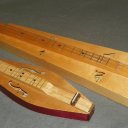
Actually, it should be the distance of each fret from the nut, not the spacing between the frets. Otherwise an error at one fret throws all of the higher notes off.

Well that video is way over my head but if I understand what the guy is talking about is when the instrument maker is setting up the location of the frets on the fret-board,The distance from one to the other in the relationship To each other the distance ???
Yes, I just did some research on temperament and really got a head full of information. Yes, much is over my head, but very interesting. I'll just stick to my tuning method and enjoy what I love, .the sweet song of the dulcimer. Going back and forth from guitar to dulcimer keeps me on my toes. Keeps the cobwebs cleared from the old grey cells

Very nice instruments, Shopdad. I just worry too much about temperament. I follow this philosophy.
Ken
"The dulcimer sings a sweet song."

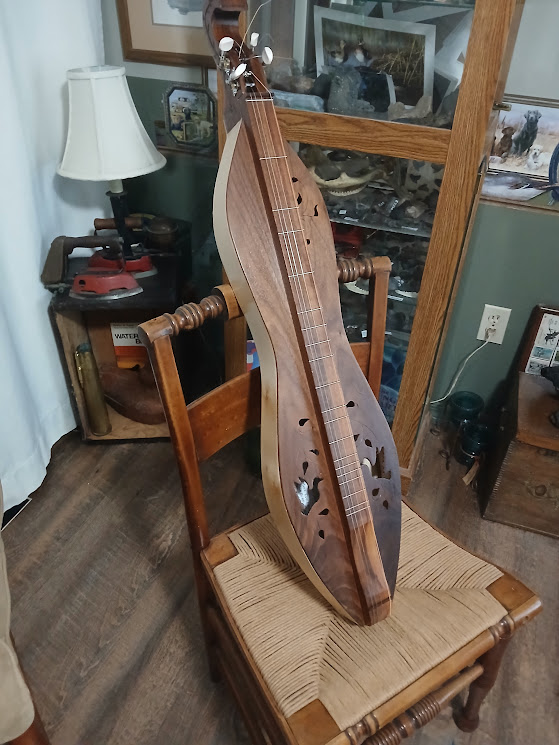
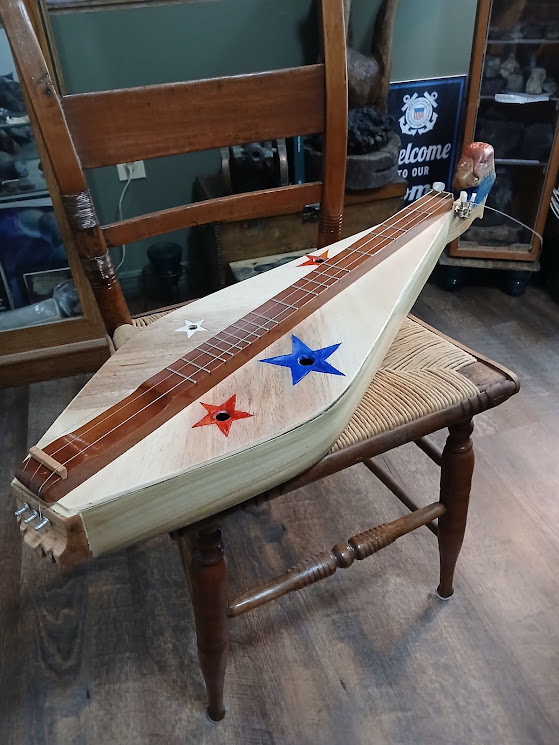
OK, now you guys have spurred my interest. It's time for some deep diving into temperament. Thanks Dan, all this is helping and explains a bit more each time. How long have you guys been dealing with this? Do makers of all string instruments understand the temperament. Skip, I use the note frequency on my instruments rather than just an eyeball on the balance point. I try to get the frequency as close as possible. Yes, the material in which the instrument is made is definitely a factor. I am careful not to install too much bracing inside just for that purpose. The tone/resonance on my homebuilt tear drop is about the same as the kit made from walnut. My next build will be another hourglass design so I may reopen this discussion with you. Maybe I'll have more knowledge about it and not sound as ignorant with my statements and questions :) Here's a pic of the kit walnut Cedar Creek and my handmade teardrop mostly poplar and some oak bracing, Hand carved eagle head stock is also oak.


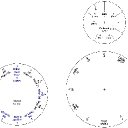
Discussions on temperament can get very involved.
Temperaments are directly related to note frequency, not note names. This is because a notes frequency, for instance 'A', can be an 435 or 445, or larger spreads. In order to set a starting point, the note frequency of 'A' is designated as the base reference point. Another part of temperament is that they define the spacing between adjacent notes in a diatonic scale. There are many more pieces to the temperaments puzzle.
A 'D4' is a 'D4' across all instruments, it may sound a bit different because of the material used to produce the note [frequency]. Just compare the note of the bass 7th fret to the open melody on a DAd tuned MD.
A D4 on an equal temperament MD may not sound/have the same frequency as a D4 on a differently tempered MD.
updated by @skip: 03/26/26 11:22:18AM
That makes sense. I don't believe I have perfect pitch. Mine is more like "pitch the perfect" and depend on my tuner. That's when I get fussy. I believe that also explains why some of the notes that show up when I do a pull off sound a bit off. I only hear it in certain chords or songs. Probably just some 83 year old ears too.
With regard to your tuners vs. your dulcimers, remember that each tuner design uses a mathematical model when making pronouncements. Few, if any, tell you which temperament has been used. The ones with settings for chromatic-guitar-violin-etc. might not use the same model for all of them.
Tune until you are happy, and let the rest of the world roll by.
The question of A=440 or A=437, or Bb = whatever is a separate issue. Traditionally, "real orchestras and bands" tune by ear to whatever the oboe player sounds, not just sticking to some pitch fork or reed used before coming on stage. Having "perfect pitch" can be a real handicap.
"They aint' no perfect intonation" as most of my instruments staples are set by ear. (something close to Pythagorean and sometimes called Diatonic Temperament) Each of your electronic tuners are off by a few cents just as each the temperaments are. Like Wally said the slight "off" gives the over all tone a wonderful depth. If it sounds good to you, it's all good. If memory serves me correctly, the folks on the other side of the pond have a sweet tooth for quarter mean tone?
Wow! every time I think I'm making progress something new pops up. This is very interesting Wally. Let me see if I'm in the right thought pattern of this information. I have 5 dulcimers I have one tuned CGC so I can sing the music in the lower key. Two of my dulcimers are DAD. Even though the instruments are tuned differently (one C and One D) I would believe they should be the same bass on my cell phone tuner. They are very close but off enough if it were the same instrument I would tune to the correct note. My question is, does this fall into what you are discussing in the video? Oh! its ok if I'm "all wet" on this comment. This may help too. The DAD is a Cedar Creek kit build and the other tear drop is homemade and tuned CGC. I'm what you may call "OCD" when it comes to cutting my fret boards and it shows up when I tune them. It just bothers me when I, for instance, tune the bass string one on D, Shouldn't it be as close when I use tuner on the "C" on my tear drop? If it were the same instrument going from one string to the other I would be correcting it on my tuner. Hope this makes sense.
I just took another run through the linked video.
If you primarily play in isolation, this may be something you want to consider.
If you play with others, remember that they will probably be in different temperaments. In addition, using "pulls" and "slides" will change the temperaments. Others may be slightly out of tune by a few cents on one string. Using a electronic tuner for each string will give a different temperament than using the tuner on one and doing the others by ear.
As a former physics major, I find it interesting. When I'm a player, I use the tuner to set my bass string, then go by ear or trust the 4th fret.
I believe that the richness of an orchestral sound comes from the instruments being slightly out of phase and precise frequency.
If you want to re-fret one of your instruments, the spacing can be determined with
Yet Another Fret Calculator
Calculate the fret locations for various stringed instruments using various methods.
https://www.thekimerers.net/brian/YAFCalc/YAFCalc.html
Equal temperamant. vs just intonation.
When I was surfing the web looking for different tunings I stumbled across this thought I would pass it on kind of interesting anyhow take care of everybody