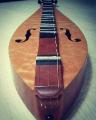
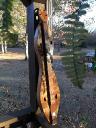
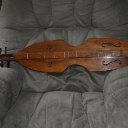
Does anyone recognize this dulcimer?
Instruments- discuss specific features, luthiers, instrument problems & questions
I moved this thread to our forum on specific luthiers' instruments, questions, and instrument issues. 
I moved this thread to our forum on specific luthiers' instruments, questions, and instrument issues.
Jennifer, had I not known the maker's name I would have had a hard time deciphering the signature scrawl up to the "L" in Fleming. I just assumed an abbreviation "Wm" for William but looking at it again I can see the first letter could taken as an "H", but bear in mind the grain of the wood might contort the signing to some extent.
Maybe I was not clear about that "open square". The fingerboard is fashioned from a single piece of wood with a sound hollow routed out from the bottom. The inverse square cornered "U" profile of the fingerboard continues right into the peg box - thus if you look into the peg box towards the nut there should be an opening under the nut. He may have omitted that feature on some of his dulcimers but I would think not as I recall him discussing it with some pride. Of the eight dulcimers I own, only one other has an open ended peg box, which coincidentally (?) is my only other violin-sided 5-string dulcimer.
I agree with your statement about your dulcimer's f-holes being exactly like mine. Small point maybe, but there's a certain distinctive elegance about his pattern that immediately grabbed me when I saw your first photo, telling me "hey, another Fleming!" Everything else you have shown or said amplifies that first impression - well, except for the open peg box (but the jury is still out on that). The signature is the final nail it would seem.
As mentioned in my prior post I have made efforts to garner more information on Bill Fleming, including searches on this site, Everything Dulcimer, checking Dulcimer Players New archives etc. but had not posted a query such as yours. Thus, I am grateful you did post. At least I know Bill was still building in 1972.
As for the buzzing I'd need more information. I know Bill was into floating bridges and his were made of hardwood and triangular in cross section (see my side view photo). My action is on the high side and I intend to make a duplicate bridge with a lower profile (rather than mess with the original which I want to keep intact). I'd guess your bone (or plastic) bridge is a replacement and may have an overly low profile which could, as Ken Hulme suggests set the action too low. Use a nickle as a gauge at seventh fret; it should pass under without putting pressure on the string. If it buzzes on open strings there are other possibilities, like improperly cut string slots in the bridge (or less likely the nut) or a broken glue bond in a brace or lining inside the body of the dulcimer. If you get buzzing only when depressing a string or strings a certain frets the problem is a fret that is too high or too low or (less likely) a warped fingerboard. Most of these issues can be addressed by someone versed in dulcimer "set-up". Warps and un-bonded bracing (or lining) requires someone skilled in repair.
As for tuning a four course, five string set up like ours start with D-A-d-dd. I use D'Addario 5-string banjo stiring sets (23bw-16-12-10,10 gauge, where bw=bronze wound and gauge = x/1,000") you may wish to replace the 12 gauge with another 10 gauge but the slightly heavier gauge does not seem to affect much and makes an alternate D-A-A-dd tuning possible that can be fun to experiment with. Or the 16 gauge A can be dropped one step to a G (i.e. D-G-d-dd) which yields a "New Ionian" (aka Reverse Ionian) in G. I guess some may use a "1-3-5" tunings which are also reachable with that string set, though perhaps not optimal. For example D-F#-A-dd which is 1-3-5 in D or D-G-b-dd which I guess you could call a New Ionian 1-3-5 in G. But again, start with D-A-d-dd as this is the closest thing there is to a standard tuning for your 5-string layout, which makes finding chords and tabs a heck of a lot easier.
Got a little long winded here. Hope it helps.
UPDATE: This post has been revised to correct and or clarify information pertaining to tunings.
It may not be the frets causing the buzzing; could be a combination of the wrong string size(s) and an action set too low.
I hear you, Strumelia! :)
Robin... it's tempting, but no way!
For exotic bowed instruments, I have my jouhikko(tagelharpa), have a little cheap rebec, have my Cretan Lyra, and have a Langspil being currently made. Spreading myself too thin just results in my being a crappy player on all of them! I'm having fun ...but I really don't need to add yet another learning curve instrument to the mix. 
That's a pretty cool discussion. I hadn't started playing the dulcimer again when it took place in 2010. Oh to know several years ago what I know today about older dulcimers and players, etc. I'm ordering my copy of Anne Grimes book today!
Strumelia, go for the erhu! :)
Lynn, probably not good form to jump in on an old thread, but from your description of the deep body and the photos of the peg head and strings, it is pretty apparent you have a five-string, four-course, baritone dulcimer. If the VSL is 28", give or take an inch, a common Mixolydian tuning would be A-E-a-aa (bass to melody-doublet) with corresponding string gauges of 34bw-22bw-14-14,14 (where "bw" = bronze wound and gauge means x/1,000"). With this tuning you can change to a "New Ionian" (aka Reverse Ionian) tuning by lowering that wound middle string from E to D (A-D-a-aa). In doing so you've gone from Mixolydian in A to New Ionian in D.
If the unwound middle string next to the melody-doublet look a tad thicker than the melody strings my guess would be a "1-3-5" tuning, i.e. A-C-E-aa with maybe 16 to 18 gauge for the E. Lots of luck with that unless you've dabbled with 1-3-5 before. I'd stick with the baritone mixolydian described previously and experiment with the quick change to New Ionian.
If you play with someone who is in DAd tuning you can do simple back and forth rounds in keys of A and D while you are in A Mixolydian mode or duets while in D New Ionian mode.
Oh, and Jeff's dulcimer is an old Dennis Dorogi that was given to him. Note that there are no 1/2 frets on it. Also, Jeff told me he never plays in DAd. He uses a lot of tunings, but for some reason that's not one of them.
I build most of my dulcimers with 26" scale. I find it more practical in many ways. Easier fingering and chording are the two best advantages, especially for people with smaller hands. Also your much less likely to break strings.
Many of us play guitar and almost all guitars are universality between 24.75" to 25.5" so transition is easy. Longer scales like 28 to 30" are great for ND but string tension is much greater.
Greater string tension limits a strings ability to vibrant, so a longer scale can actually sound poorer when tuned in D4.
I built a lot of dulcimers and there are many factors affecting tone and volume. First thing a builder learns is what they are and how to build them into a dulcimer. That's the fun part... Robert
Erhu.... another wonderful and exotic instrument that I idly dream of being able to play... 
I agree with you Dusty. I think the shorter vsl must have some effect on the volume and tone. That is why I talked to Jim Woods about it. He even said that, but it would be very slight and probably not even noticable to the player. I'm happy with the end product. I guess my point was that if someone was considering going with the 26, they shouldn't be concerned with sound. It is still the nice, sweet, beautiful sound of a McSpadden.
I have one of their cd's and want to get the other one. The music is captivating.
Dusty, I, too, like Jeff's percussive sounds.
Rob, I wish I could've gone to Jerry's fest in '16 and heard 2/3 of the group.
Wow! This stuff's really good and really interesting. I like Jeff's percussive style of playing the dulcimer.
I don't want to start a big debate here, but how could shortening the VSL not affect the volume? Pluck an open string. Now fret it at the octave. You will clearly see that the longer string has a lot more volume than the shorter one. Or if you think your finger (or noter) on the fretboard is what dampened the sound, fret a string at the first fret and pluck it. Then fret it at the 12th fret. Which is louder?
And even more than volume, shorter strings have less sustain. On a well-made dulcimer such as the McSpadden you might not notice that if you play down near the nut and use a lot of open strings, but in the second octave it will be much more noticeable.
I am not saying any of this to dissuade people from getting dulcimers with shorter scale length, for my current go-to dulcimer has a mere 25" scale length. It is a beautiful sounding instrument, and I made that choice for the same reason Susie did: the ease of playing chords. But there seems to me no doubt that you sacrifice some volume and sustain as you move to shorter VSLs.
They are really good, aren't they? And Jeff (dulcimer) and Susan (banjo) are such nice folks, too. Anyone who gets the opportunity to see them live shouldn't miss it.
I listened to Appalasia's music on my car's cd player this evening. Listening reminded me how much I like their unique blend of instruments and evocative compositions.
Glad you're happy with your new acquisition. FWIW, changing just the VSL on a given size box will never affect the volume.
Enjoy your "new" to you dulcimer. Keep us up-to-date on your progress and don't hesitate to ask for help if you need it.
Ken
"The dulcimer sings a sweet song."
NDD = new dulcimer day
Thumbs up to McSpadden for offering their full sized dulcimer in a shorter 26 vsl. I spoke with Jim Woods about the 26. I was interested to hear if the shorter vsl resulted in a noticable loss of volume and if the tone changed, from their standard vsl. He said I wouldn't notice a difference in volume and there might be a very slight tone difference. I got my new McSpadden and am very happy with it. It is so close to the McSpadden I had a few years ago, but I love the shorter vsl for my chord/melody. I wanted it to be comparable to my Doug Berch and Folkcraft Custom vsl's.
I just wanted to say, if you're considering one, I give it five stars. You probably won't be disappointed.
(I added a pic of it in my photos.)
Richard: "I have found that certain instruments sound better on some tunes than others":
Being an amateur builder I thought it was just me. I have noticed the same thing. Thank you.
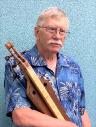
Jennifer, this appears to have been made by Bill Fleming who had a shop in Gatlinburg, TN. I visited his shop in 1970 and had one custom built from a list of several options which included body style (hour-glass and "fiddle-backed" for sure - can't remember if he offered tear-drop or not), tuning keys could be set up as friction keys (like yours), violin pegs or "traditional" hand turned pegs - in hickory as I recall. He had several options to chose from for sound holes, with upper and lower bouts mix or match. There was quite a variety of woods to choose from too.
I opted for a fiddle-back (aka fiddle-sided) in walnut with the "traditional" hand turned pegs. It has f-holes in the lower bout and dogwood flowers in the upper bout (his favorite was the dogwood but he usually recommended against it because of the delicate carving - I went with it anyway). The back is book-matched but not the top (it appears your top is book-matched but not the bottom).
A couple things to look for to confirm the maker: The top and bottom should be "fiddle-edged", i.e. overlapping the sides by about 3/32". The ends of the side pieces making up the waist of the body should abut the sides rather than the other way around. The simple, yet elegant, scroll head is one-piece and not carved through the bottom. Inside the scroll head should be an open square where it attaches to the body - sort of a hidden sound hole. I believe all of Bill's dulcimers had floating bridges (I think they were generally of the hardwood used in the instrument so your bone bridge may be a replacement). Lastly look through the near lower bout sound hole with a pen light - you should see a signature and a date in pencil.
I've searched for information on Bill Fleming from time to time but until I came across you post I've come up empty. Bill Fleming was a contemporary of Bill Davis and there may have been some cross influence one way or the other. Their "fiddle-backs" are similar but with distinctive differences. For example, Davis scribed his name on the back of his dulcimers, the overlap on his "fiddle-edges" was greater (about 5/32"), the key pegs were of a slightly different style and the scroll head was flat sided with carving. Also, the waist side pieces cover the ends of the side pieces (opposite of Fleming's set up).
I'll take some pictures so you can compare the two, but there's little doubt in my mind that you have a Bill Fleming Dulcimer.
UPDATE: The signature on my dulcimer appears to read "Wm Fleming", i.e. he abbreviated his first name William. Under the signature is the date "11-5-1970". I've attached some snapshots for the sake of comparison with what you have.
Looking forward to hearing from you and anyone who has some information on Bill Fleming.
@notsothoreau -- tuning trick to keep from "popping" a string... Never try to tune a string unless it's "singing". Pick a string to tune and get hold of the tuner you think is 'right'. Strum the string and give the tuner a quarter turn. If the string does not change pitch up or down, STOP. You're got the wrong tuning knob. Try again.
Invest $15 or $20 for an electronic tuner which shows you which octave the notes are in. We tune dulcimers to D3 A3 d4
An ordinary set of strings will easily tune to DAA or DAd (the d is an octave higher than the D). That same set can go up to EBB/EBe and maybe as far as FCC/FCf, but the bass string will probably break trying to get to GDD/GDg. On the low side it can go down to CGG/CGc easily, and maybe BFF/BFb before the strings are too floppy.
I will plan on it!!
Hey, I'd love to get to meet you and play some tunes someday, Stewart! I'm a full-time caregiver for my folks but am, I hope, in the waning months of this. (Make no mistake-- I love my parents. But my life has revolved around theirs for some years. . . ) When you have an OH trip planned sometime, drop me a PM!
Wow, Stewart, my home is in WayneNF-- in the southern Perry County section! And my husband taught in Morgan County, right next door to Washington County. Small world.
That's good thinking, @notsothoreau. I always advise people to play for a year or more before indulging in what they think will be their dream dulcimer. There are just so many variables (scale length, fretboard width, fretboard overlay, wood types, extra frets, bright tone vs mellow tone, internal pickup, and more) that until you play for a while and develop your preferences, you can't know what kind of dulcimer you will really want. Get a decent, playable, and affordable dulcimer at first and give yourself some time to discover what options you would want on your dream dulcimer. (Of course, if you're like many of us, you may find that you have several dream dulcimers!)
It's part of the reason that I'm not ready for a custom dulcimer yet. I don't know what sound I want to hear, but I am starting to get a better idea of it. I think this particular dulcimer was designed to be used noter style and that's something I want to check into anyway.
I know about acquistion disorders. I have five treadle sewing machines in this room and two in another! Fortunately, I have all the machines on my bucket list. I suspect there are at least two dulcimers in my future, maybe more if I happen across any old instruments.
notsothoreau
Congratulations on your first dulcimer. I know you are excited. Best wishes on your dulcimer journey.
By the way, the DAD (dulcimer acquisition disorder) may strike at any moment. The cure is easy. Get another dulcimer. Trouble is the malady has a way of recurring at intervals. I have found that certain instruments sound better on some tunes than others and some dulcimers seem to "prefer" one mode or tuning. Explore and have fun.
I can finally add a story! Way back in the day, I bought a kit teardrop dulcimer. I believe it was mahogany. I could play it, but it wasn't the best instrument. I have no idea what happened to it. Recently, I got a wild hair that it might be fun to try this again. I'd tried guitar and mandolin but just couldn't seem to do much with either. I knew that I wanted a good quality instrument at some point, but thought I might check what is available locally.
Well, I found a dulcimer on the Facebook marketplace. It seemed like a student quality from the picture, so I thought I might be able to use it for awhile. Contacted the seller last week and he said it was available. Asked when we could get together and he said Wednesday after we got off work. I tried to contact him Wednesday and nothing. Later that night, he messaged me and said he'd be available Thursday, Friday or Saturday. Said we'd try again Thursday. Same thing. It turned out he was driving between Portland, OR and Eugene for his job! He apologized and said we would get together for sure on Saturday at noon. He'd let me know where we could meet. Saturday came and went. I got a message from him that night with the Steve Martin excuse "I forgot"!
I'd pretty much given up at this point, but it seemed sad to have a decent dulcimer sitting unplayed. I gave him one more chance today. And this time, he and his wife did show up! I believe this is from 1997. It has a decent sound but I can't really check it out yet. I popped the bass string while tuning it and my new strings are still on the way. I was able to pick out "I'll Fly Away" on two strings and expect to have more fun in the future. It will do for now. Even my husband is enjoying this hobby.
And, I do have something in the works to get that quality dulcimer. More on that, as I get further along on the plan.
Stewart, I was just in Marietta yesterday, taking my folks on a day trip. About 1.5 hour drive from their house. (My home is closer to Marietta than is theirs.)
You boys can rest easy tonight.