Possum Board
General mountain dulcimer or music discussions
Nate, I am experimenting with different heights off the possum board. I'll let you know if my ears can tell a difference in tone.
I like that Nate. I think I found out how cool it sounds by accident. Now it seems natural in some arrangements. Same with pull offs. Just sounds natural and comes easy on certain notes on the melody string. Not to mention, it's fun.
Sliding between frets is one of my favorite things about playing the dulcimer. I like to use the side of my thumbnail for long slides up and down the melody string.
When I build one with a double back, I usually only give it about 1/8th of an inch gap.
I suspect that the size of the gap would have a subtle impact on how the sound waves interact with eachother. To some extent, the space between the bottom of the instrument and the possum board or false bottom could be considered a separate "soundbox" that will produce some amount of resonance on it's own, and most likely affects the tone in a small way. It may be useful to set your dulcimer on a couple of chunks of wood that are sitting on a board as a simulated "possum board" and see if you notice a difference in tone at different heights.
I personally have noticed that when the instrument is closer to the board, it affects the high end of the instrument tone and can make the sound more "nasally" whereas a larger distance between the dulcimer and possum board has less of this effect.
A double-back is a permanent part of the instrument, whereas a possum-board is a temporary, removable part that the instrument can be set on.
What is the difference between a double back and a possum board?
My Galaxes have about a 1/4" spacing between backs, but you could even get by with 1/8" if you wanted to.
Jon, we're actually in a period of radical change in terms of electric music, and your original question here is evidence of that. It used to be that if you wanted different sounds (distortion, chorus, wah-wah, etc,) you had to buy a separate foot pedal to achieve each one. But now there are "modeling" amplifiers that can do it all. They can mimic the sound of a telecaster going through a distortion pedal into a Marshall amp, and you don't have to have a telecaster, a pedal or the Marshall amp! Everything can be altered electronically. McCafferty's fanciest dulcimers are equipped with a midi synthesizer. You can play your dulcimer and it can sound like a trumpet or a violin or a piano or anything you want. Of course, you have to have the computer software to do all that.
People adept at the technology
can make fully-produced recordings with rhythm sections and horns and back-up singers and everything, just using their one instrument.
Then again, I just play my dulcimer and hope that it sounds, well, like a dulcimer. Steel strings resonating in the wooden body of a dulcimer still make the most beautiful music to my ears.
I agree with John.
Ken
"The dulcimer sings a sweet song."
Thanks Robin. I started out using a noter but watched so many videos on picking and strumming I got away from it. When I was young my uncle was the musical therapist at the mental institute in Pontiac, Michigan. Each visit to Florida he would bring a different instrument so we could learn to play. One year he brought a steel guitar. I played around with it but never mastered it. Playing the dulcimer with a noter reminded me of the sliding technique on that instrument. It brought back fond memories.
Well after Ken's and Dusty's explanation I went over to Terry McCafferty web site and Under support And found some interesting information on going Electric. all I can say is wow going Electric is really complicated. All the equipment and filters and pedals it's all bid overwhelming. I don't think I'll make it in my lifetime. I'm getting way ahead of myself. But I guess that's part of the fun about learning things.
Thanks John. What is the spacing on a Galax double back?
Don't overthink it, Richard. I have not run across any standard spacings myself. I'd say a space of anywhere from 1/4" to 3/8" would be fine. You don't need more than that.
Thinking about a possum board, Does anyone know if there are any standards for how much space between the dulcimer and the possum board? Any science to it?
I have seen what seems to be general recommendations for 3/8:" to 1/2" spacing.
What are your thoughts?
Well kids thanks for getting back to me with all the good information a little bit over my head.
I must say it sounds like it could be fun I guess. a little abstract to say the least.Also one might start to think why bother practicing to make a good clean note. Thanks Ken thanks Dusty
Hey Jon. Ken has more experience with Garage Band than I do and explains the basics well. You are correct that it is not a physical amp. In the analog world, a clean amp is just an amp that provides a very clean sound (meaning with no distortion) that is best for use with guitar pedals. In the digital world, it is more like a setting you choose for the virtual amp you use with Garage Band. And people do indeed plug into computers, but not directly. In between you use a digital audio interface that converts the audio signal of a guitar, dulcimer, or other instrument into a digital signal that can be mixed by a computer. I have little experience with this--and my digital audio interface has been sitting in the closet for years--but I assume you would want a clean amp in Garage Band for the same reason you would in the analog world: to start with a really clean sound that you could then play with, adding different effects.
Garage Band is an app that comes with Apple computers, iPads, and iPhones. As far as I know Clean AMP is a way to process your recording in the app. I use Garage Band to record (using a microphone) but haven't used any of the amp modeling for processing the signal. There are so many different settings in Garage Band it is often difficult to decide how to proceed. I took a course in Garage Band many years ago offered by our Guitar Center. That was a 130 mile round trip for six weeks. Luckily a friend and I shared the driving and cost of gas. The course was free. Garage Band has gone through so many changes since then that I hardly recognize it anymore.
Ken
"The dulcimer sings a sweet song."
Well I'm scratching the top of my cranium trying to figure out what the Is this thing? Garage Band Clean AMP?
I came across this when I was surfing YouTube and never could find anything that gave any really detailed information. I'm getting the impression that it is not a real amp, meaning a physical object.
I understand how a real amp works and for example a Looper pedal you plug the instrument into it and the looper records what you're playing as far as a Looper pedal goes. So if this thing Garage Band Clean AMP? is just a piece of software not a real amp then I don't get how it works I mean you can't plug your instrument into your laptop and you can't really plug it into your iPhone or Etc. Anyone out there know anything about this thing and how does the thing work
I guess I need to clarify the blue lion instrument price. the price of the instrument by itself is $850 I would think shipping would range anywhere from $100 to maybe $200 depending on insurance and how far away from California if you didn't need to ship it then $850 hopefully that makes more sense thanks all
I only know how to play mountain dulcimer with a noter, which is all about the slide. :) Hammer-ons and pull-offs with a noter can also be used to give slightly different flavors to tunes.
Very cool. I saved the sites on line. I belong to an airboat club here in central Florida. I have been the club Historian for several years. A few of the members play guitar. I see a Historian report on "music on a string" in my future. I listened to some of the recordings on the Psalmodikon. I also see here is a site for plans to make one and even an available kit. I was not aware that the Diddly bow went back that far in history. I already have so much info I may have to make it a two-part presentation.
the pic is my boat, powered by a 220 Lycolming GPU.
The single string monochord with which I am most familiar is the psalmodikon. It is a Swedish instrument. Here is a website: http://www.psalmodikon.org/nap_items/index.htm . Here is the Wikipedia site on Diddley bow: https://en.wikipedia.org/wiki/Diddley_bow#:~:text=The%20diddley%20bow%20is%20a,single%20string%20of%20baling%20wire . Probably more than you want to know about either instrument.
Ken
"The dulcimer sings a sweet song."
wally, that's why I enjoy this site. I was corrected once when I mentioned fret board. Now I understand the difference. thanks
Ken, I saw something at the lower end but couldn't figure it out. The article I read said it may be the forerunner of our modern dulcimers.
When I see something I don't quite understand I like to research it. Problem is, often there is a multitude of opinions. All I can do is try to make sense of it all and settle on one that aligns with the subject. A college professor called it "word smithing". Ken, are those one string instruments what they call "diddly bow" if I have the spelling correct.
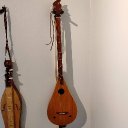
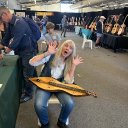
It appears that the instrument in the photo with the woman is resting on a stool. She appears to be holding a pick of some sort in her right hand. I think it would fall in to the humle or langleik family of zithers.
Wally, I agree with you regarding the distinction between fret board and fingerboard.
Ken
"The dulcimer sings a sweet song."
>>> I have been known to use slides to cover up mistakes!
Me too, particularly when playing by ear.
>>> "When I discovered my fret board (also called the finger board) was badly warped..."
A dulcimer FRET BOARD is not a FINGER BOARD, as used on most other string instruments.
On violins, guitars, banjos, etc. the fingerboard is attached to the neck of the instruments and is sloped above the body. It is a separate piece. There is air between the fingerboard and the body. The bridge is a separate piece tounching the strings and body. It may, or may not, be fretted.
A dulcimer fret board is attached directly to the body (sound box) and is always fretted. If an overlay is used, it is glued in place, and the fretboard becomes a one-piece composite structure.
Fingerboards are frequently arched in transverse section, but this is not a requirement. Our fret boards are typically flat in cross section.
I am one of those who believe that a traditional dulcimer must have a one-piece fretboard, with the bridge and nut mounted directly in slots in the fretboard. In that case the bridge does not contact the body, but vibrations are transmitted through the fretboard.
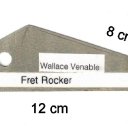
Leveling of the fret tops lets us compensate for slight imperfections in the finger or fret board straightness, but, of course a straight board is always best, and it should never be warped.
I usually build with guitar fret wire, but have also used the melody-string-only staples.
I knew Ron, he not only built a few instruments for me, but we met for lunch and often corresponded regarding number of topics including his time as Chet Hines’ apprentice. He was always kind and generous and great conversationalist. I’m saddened that he has passed.
I have been known to use slides to cover up mistakes!
I found the pic of the Dulcimer type instrument. History reveals these instruments from 1700s to 1800s. Dates and tradition are questionable and I would not choose to argue with the women pictured.
If you look at some of the old dulcimers by J.E. Thomas and Charles N. Prichard you will see that they only had frets under the first string.
Ken
"The dulcimer sings a sweet song."
If a person enjoys playing different types of music and want to "kick it up a notch" , try using the tree techniques of hammer-ons, slides and pull-offs. I whole new enjoyment scale awaits.
If you are successful with any or each of them. I would love to hear your experience. Suggestions are always invited and of course funny and interesting stories would make a great subject of conversation.
Without a doubt Ken. I find it very interesting that some of the oldest dulcimer type instruments dating back even into the early 1800s all had a similar fret arrangement. One I read about had one string with frets and the rest were all open. It appeared to me to be 4 or 5 feet long. I wish I kept the article. Thanks to all of you on FOTMD and other sites I frequent, I have learned a lot about the dulcimer and what separates quality from simple.
I think the fret board is the most important part of a mountain dulcimer.
Ken
"The dulcimer sings a sweet song."
I never met Ron, but I do know that he was a tremendous asset to the dulcimer community. He will be sorely missed as a builder, player, and innovator. RIP, Ron.
Ken
"The dulcimer sings a sweet song."
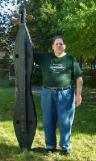
Last summer I had the honor of being invited to Dulcimer Week in the Wallowas. At the faculty concert, I played one or two tunes on the dulcimette before switching to a full-size dulcimer. People in the back could not see the little instrument, so I was asked to hold it up for them, and happily, someone snapped a pic:
From past experience, if frets are not level or all the same height off the fret board there is potential vibration in certain notes played. Adjusting the nut and bridge is important but if the frets are at different heights it will affect the quality of the note. When I discovered my fret board (also called the finger board) was badly warped I smoothed out the high spot and replaced the frets. In my effort to fix the problem previously, without fixing the board, I filed down some of the frets to compensate for the bad board. The result was disastrous. I replaced all the frets and aligned them with a framing square. Before the repair, playing anything on the first two frets was difficult because of the distance between the string and the fret board. I couldn't lower it because the frets in the center would touch the strings.
Sad news indeed. The Aorell I own has the most wonderful tone and sound.
Sad news. He contributed so much to the mountain dulcimer community. I contemplated many times ordering a dulcimette. I kinda wish I had. RIP Ron. 😔
I played one of Ron's baritone dulcimettes when I won the National Dulcimer Contest at Winfield in 2016. I was introduced to Ron by Sandy and Caroline Paton. I bought my first dulcimer from him in the early 1980's, and we became friends and especially enjoyed playing French tunes together. I don't think anyone made better small instruments than Ron. Intonation and tone quality were always spot on. He was a great innovator and a fine musician and will be sorely missed.
Oh that is awful news! Ron was such a nice guy! His dulcimettes are wonderful instruments x