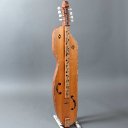
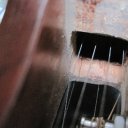
Dulcimer repair question, slight separation .
General mountain dulcimer or music discussions
I say that this "slight separation" isn't enough to worry about. Just enjoy playing her. aloha, irene
I say that this "slight separation" isn't enough to worry about. Just enjoy playing her. aloha, irene
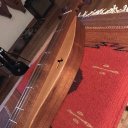
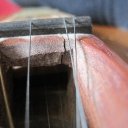
Greetings! Some time back I picked up an Edd Presnell 6 string,the wood was in good shape but there were separation issues on the tail, crack on the back, yada, yada ,yada, have it nicely fixed up. I still have not tried to fix the seam separation right where the neck meets the top surface. There is also a slight indentation right where it is separated.
2 questions,
Should I try "lifting" the area that has dropped? And if so how do I do it safely.
second, What would you suggest for gluing the seam without a big mess? I have considered an exact o knife or scalpel blade to clean up the separated area, but as to applying glue, what is the best, cleanest way to do that.
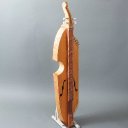
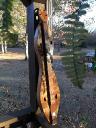
Attached pictures, let me know what you think. Thanks everyone.
And thank you, Marc, for that article. I hope you don't kind that I downloaded a pdf copy for my own purposes. I also greatly enjoyed your more recent DPN article on "Partons la mer est belle."
Thanks, Lois, for your work in helping us find this hidden material. Much obliged! 
Is that a hollow fret board with four strings above and four inside it?
I would put some super glue in the crack and use a clamp to see if the crack closes up and glues together. Actually I'd try the clamp first and if the wood moved with the clamp then I would remove the clamp, put glue in the crack, and then clamp it. A little accelerator sprayed on the crack after it is glued and clamp will harden it up quickly.
Ken
"The dulcimer sings a sweet song."
That's a crack in the headstock, not the fretboard. They are two separate pieces. So there should be no danger of the crack spreading into the actual fretboard.
As Matt describes, carefully add drops of thin superglue to fill up the crack. Then you'll be able to tell if the crack is spreading.
Dusty brings up a common problem in deciphering tunes; embellishment! Getting a clear melody is difficult at best in so many arrangements. Most tunes are out of reach for me as I hear different from most folks. If the tune doesn't "speak" to me I'm even more lost. Finding a tune in an old Hymnal is wonderful as they are generally broken down to the syllables of the lyrics and translate a pure tune! As for the others, studying several versions is the way to go......
@dulcimerjones I'm always working at developing a better ear. And learning the instrument-- what I think I can do with the mountain dulcimer within my playing capabilities. It's a lifelong journey, I think. :)
Figuring out a tune can take me months. Most often, I prefer to work from a fiddle version(s) or a banjo version(s) of a tune to figure out the essence of a tune and how the tune will lay-out on the fretboard of a mountain dulcimer.
Very interesting article.... thank you!!!
The builder did a wonderful job of putting together a unique instrument. Eight strings on a thin scroll head is a lot of pressure. The sides of the head are perhaps a tad thin for that many strings.
Every instrument has the danger of cracking. An instrument as detailed as yours needs continuous care, especially to maintain constant humidity. It cracked once and could crack again. If you know a luthier nearby, ask them to look at the crack.
I am so glad to hear some of your experienced players talk about working on a tune for years. After 4 short years of playing mtn. dulcimer, I begin to realize I can't learn every song in a few days, or weeks. When something seems out of reach, I put it down for a while & inevitably when I return to it, I find there is more to the tune than I previously thought. I understand now that it's not the tune, but me who's changed-learned more, sharpened skills, etc. Wow, still feels like magic to me!
Hopefully this is as far as I need to explain it. https://web.archive.org/web/20040330202706/http://dulcimersessions.com:80/ for Feb '04 issue was scanned on March 30 '04. If you go up to the top of the Wayback Machine where the little lines of scan are, you can also see blue arrows pointing forward and back in time. Just click those to work your way through what was saved.
Woops! Missed Oct. '03 as those little lines are hard to catch. https://web.archive.org/web/20031007042119/http://www.dulcimersessions.com:80/
Are you clicking the lines at the top of the page of their captures? This is what I found for the earliest shown:
https://web.archive.org/web/20030801132250/http://www.dulcimersessions.com:80/ gives July '03
https://web.archive.org/web/20040124023510/http://www.dulcimersessions.com:80/ = Dec. '03
https://web.archive.org/web/20040330202706/http://dulcimersessions.com:80/ = Feb '04
Since these are Mel Bay posts of earlier issues, I let myself hop down to Oct. 4, 2006 https://web.archive.org/web/20061004025712/http://dulcimersessions.com:80/
There I again see her with working links & this time it's actually the October of 2006 issue.
Hi Dusty,
What I was able to find a lot of the time was an individual article on some Business site that may have been re-posting it, but try this one https://web.archive.org/web/20160325051242/http://dulcimersessions.com/ which seems to come straight from Mel Bay and shows Lois Hornbostel, complete with working links. I had earlier just seen the article on "Home-Middle-Outside", so this looks more complete.
Sorry it's clunky, but it's dependent on their scanning.
Lois, I've been playing with the Internet Archive site, but I seem to only find information about when copies were made of the Dulcimer Sessions site. I can't find any actual pages. I'll keep trying and let you know if I'm successful.
Go to the "Wayback Machine" at http://Archive.org and at the top of the page you will see "enter URL or keywords", put in http://www.dulcimersessions.com/ and hit ENTER. Working my way back through the "snapshots" usually does it. The most recent snapshot was 9/29/17. At first it didn't look promising, but scroll through the other articles down to "Welcome to the June/July 2010 Issue of Dulcimer Sessions" which has a posting date of Nov. 30, 2016. Click "Read More" and it looks like you have access to other earlier issues. I clicked Mountain Dulcimer Tunes and was able to reach that. If there is more you should be access and can't, I'd go back to those other "snapshots" until you get a thorough one. I'm not (yet) familiar with it, so those of you who know it will be a better judge.
Something I just discovered is Archive.org has been dumping some sites for lack of viewing, so the more people view it, the more it stays alive. Had this happen recently with storyteller's site. Supposedly it wasn't there, yet I noticed in the middle of the page it looked like a link. Clicked it and got it!
The "Wayback Machine" is a great service when a long-running site is no longer active. Use it to keep it going.
Shucks, I would have let y'all known that 2 years ago. I've been using it to scarf up Roger Nicholson arrangements and articles from the old days of DPN to use in my fingerstyle workshops. Thanks Roger's widow & daughter for giving me permission to use his material in classes about his style.
Lois, once upon a time it was http://www.dulcimersessions.com/ .
Speaking as another Lois who has found Lois Hornbostel's arrangements worth seeking out, I'd like to ask if anybody has the address of the old site. As a librarian I know a few tricks for navigating back into the internet after a website goes down, but will need to know that address.
I'm happy to see this back online!
Not too light.... a bit light. But since you're playing bare finger chording and bare finger strumming, and are just getting started, the slightly reduced string tension will help your fingers. I play Noter & Drone style, and would probably use a .022, .014 and .012 strings. With experience you'll discover which strings work best for you. Strings are cheap, and finding which strings work best for your style of play is part of learning the art of the dulcimer.
That .020 should be a wound string; the others should be plain steel. The only other thing you need to know to buy or order strings is what kind of ends the existing strings have -- brass ball ends or plain loops.
Thank you, Ken! Great advice on trying different strings... I had one of those "I should have had a V-8!" moments when I read that! Of course! I'll pick several different ones and try them out. Figured out the loop or ball part too! Thank you so much!
The strings recommended could be considered light so you could go to .022/023-.013/.014-.011/012. The lighter strings are easier to press down at the expense of a little volume. It doesn't really pertain to experience, but more to how the feel to your fingers and personal preference.
Selah, you are getting good advice and the members here are very knowledgable and have help me tremendously. From a personal perspective, I don't really care for the 'twang' or ''buzzing'/'squeal' you get when using a wound string. It is a matter of personal preference.
Not too light.... a bit light. But since you're playing bare finger chording and bare finger strumming, and are just getting started, the slightly reduced string tension will help your fingers. I play Noter & Drone style, and would probably use a .022, .014 and .012 strings. With experience you'll discover which strings work best for you. Strings are cheap, and finding which strings work best for your style of play is part of learning the art of the dulcimer.
That .020 should be a wound string; the others should be plain steel. The only other thing you need to know to buy or order strings is what kind of ends the existing strings have -- brass ball ends or plain loops.
The strings recommended could be considered light so you could go to .022/023-.013/.014-.011/012. The lighter strings are easier to press down at the expense of a little volume. It doesn't really pertain to experience, but more to how the feel to your fingers and personal preference.
Thanks for the link, Ken. I was looking for this a while back and couldn't find it.
Go to www.strothers.com and enter your VSL -- the distance between nut and bridge. Then enter the basic tuning that you are using -- DAA or DAd (not DAD or you'll get the wrong string size) one at a time -- and the calculator will do all the work for you.
Brand is irrelevant -- there are a literal handful of companies in the world which make music wire of various gauges, and they sell boxcar loads of the stuff to Martin, D'Addario, D'Arco and other string "manufacturers" who put on the ends (ball or loop), cut the string to various lengths, and put them in packages. It's all the same wire, regardless of the name on the package.
Personally I buy strings from www.juststrings.com because I can buy sets of strings for under $3 per set instead of the $5 to $8 you pay for brand name strings from a music shop.
When it comes time to replace the strings, only remove and change one string at a time. If you remove them all, you stand a chance of moving the location of the bridge, which can really mess up how your dulcimer sounds...
Thank you, Ken! I did go and use the calculator... results were 0.20 / 0.13 / 0.10 for DAd Skip mentioned below that the results may be too light. Any thoughts? I appreciate all your help!
This will help. The results are a bit light so you can increase the size a couple of sizes. You should be aable to find single strings at a local music shop.
http://www.strothers.com/string_choice.html
Thank you, Skip! That helps a lot... Can you help me to understand your comment about the strings being light? Are you saying a thicker string would be better as a newbie? or just in general. (totally green here!) thanks!