Waiter’s tray stand
General mountain dulcimer or music discussions
I have one of Gary Sager's dulcimer stands. Beautiful oak and has multiple adjustments available to customize to your needs.
I have one of Gary Sager's dulcimer stands. Beautiful oak and has multiple adjustments available to customize to your needs.
MP3 is always good. I think what most members seem to do is to add their audio file to the site's audio section, and then they just post a link to the audio clip as it appears on FOTMD.
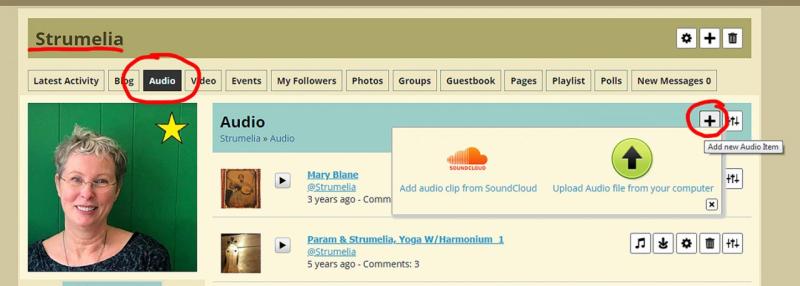
To add an audio to your site content on FOTMD, follow these simple steps:
Any audio or video files you add to your profile page sections/tabs will appear and be searchable in FOTMD's Audio or Video collections, as seen in the top navigation bar for the site.
Thanks, Lisa. I was able to download the file after you changed the setting. I had to delete the "dms" at the end and add the "." before the mp3 to get it to play in "iTunes".
David, you did a good job in restoring the Keith Young dulcimer. It sounds great. Thanks for sharing your work with us.
Ken
"The dulcimer sings a sweet song."
1- go to your Profile Page (by clicking right on your NAME itself at top right of any page on FOTMD).
2- select the appropriate TAB in your profile page (Video or Audio, etc) (see my screenshot below)
3- then click the PLUS+ button at upper right to add a new audio item, and choose whether to upload a file from your computer, or to select one of your existing SoundCloud files. Enter the info required for your new Audio file or Video. Be sure you are complying with site rules on copyright etc.
Remember- you can go directly to your profile page from anywhere on FOTMD by simply clicking right on your name at top right link.
Well I was able to play the song with little trouble. The dulcimer sounds great, Dave. It's got a nice deep voice.
I say "little" trouble because Windows first asked me what software to use to open the file (shouldn't that be automatic?) and then claimed the file extension was unrecognizable, but when I told it to play the file anyway, it worked fine.
Ken, can you please try that again? I've changed an audio setting on the site.
Dave... sounds wonderful! If he were alive, Keith Young would be super pleased at how you've brought his dulcimer back to how it was when it was first completed... perfect, gleaming, and brand spanking new.
When I try that Lisa, I get a message that says "mp3 files are restricted to streaming only." Is that just a Mac problem? I tried a drag and drop and got this message from https://fotmd.com/forum/download/forum_file/32795/Baby-O%20Audio%20recording%202018-11-02.mp3 Error: offsite media downloads are blocked
Ken
"The dulcimer sings a sweet song."
Irene, I had a little trouble with the soundbite too. But it worked when i did this: click on the text instead of the picture icon, which actually downloads the file to your computer. Then RENAME the file so that it ends in .mp3 (nnot just mp3 without the . ) After renaming, my usual music programs will open and play the file on my computer.
TOTALLY BEAUTIFUL. however, the sound bite can't be heard, maybe send another way? Thanks for posting so much on this dulcimer as it taught me a lot too about restoration of old dulcimers. aloha, irene
Thanks for the recommendations. I'll look into those. Our local music store didn't have any electronic metronomes. So for now I'll try the apps.
I'm using Soundbrenner on an Android phone at present (just the free app not the gadgets that can go with it). It is OK and easy to use.
Most importantly, I searched for one with a 'tap' button - and I use that all the time to set the speed. It means I can hum a tune and easily tap in exactly the speed I want to play it at.
It's finally back together - with no glue on the nut or bridge and new strings. I'm really happy with the results.
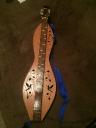
I've attached an 'after' picture also of the whole instrument, and a pretty rough around the edges sound sample.
I'm grateful to everyone for the sound advice (pun intended) and the encouraging words. This has been a good experience.
I use two. Both free. MetroTimer and Pro Metronome. Why two? Because I am lazy. The MetroTimer is always left in 4/4, Pro Metronome is always left in 6/8. I play a lot of Irish music but it takes several keystrokes to convert either metronome from 4/4 to 6/8. If you really want to use just one Pro Metronome seems easier to adjust and set up. I often convert it to 9/8 for slip jigs and hop jigs. I may simply think it is easier because I change it more. MetroTimer has been in 4/4 from day one.
MertoTimer has an easier timing function, if you want to set it for two minutes or three minutes or whatever. That might be more useful for a drummer. Pro Metronome does have a timer and it works, it simply takes a couple more keystrokes to invoke it.
Oh my goodness I thought I was the only one who's pets react to playing an instrument.It is very odd I have two cats one loves music the other one loathes it.I also play Piano and accordion.When I play any of those instruments along with the Mountain Dulcimer my one cat goes crazy to the point of my having to stop playing.
We got him as a kitten from the pound about 7 years ago he was badly abused.I am wondering if his previous owner played an instrument bringing back bad memories for him causing him to act this way.Or maybe my playing is really bad...gee..never thought of that. lol
@davesterino Vizsla is sophisticated! :)
I love my waiter's tray stand! I like to stand and play and the tall one is a comfortable height for me. Like Ken said mine will hold two dulcimers which is nice when you like a couple tuned to different keys. Another reason is underneath makes a good place for your case or another instrument.
Our vizsla barks, growls, and gives me some distance when I play ukulele or penny whistle. She doesn't seem to mind at all when I play dulcimer though!
You did a great job making a new fine tuner!!
I too personally suggest you not use any glue on the nut or bridge when putting them back in. As long as you don't remove all strings at once, you'll never have to worry about them moving around or getting lost. String pressure hold them in beautifully. It's handy to be able to easily remove them if needed, without the risk of them cracking due to stubborn old glue.
"Best" is what works for you. There are a number of stands, as Dusty mentions. I found a waiter's tray table works 'best' for me. There are several height sizes available, you can usually find them locally at restaurant supply houses, and they don't have premium prices usually associated with niche goods.
As far as securing the dulcimer, it will depend on the stand, how firmly it holds the instrument in place, and how 'active' you are while playing. Some folks need a small bungee or strap or two; some just need a rubber pad. I don't need anything to hold different dulcimers in place; in fact I often have two on the stand for a 'hot swap' of different tunings.
Don, check out this video by @Christine-Shoemaker. She is using a stand by Gary Sager of Prussia Valley Dulcimers. It looks fully adjustable. Something like that would probably be the best option.
Other good options are keyboard stands or even an ironing board.
I would like to stand up more. I’m not an exercise buff.
When you use a stand, how do you secure your dulcimer?
Is a waiters stand best?
Thank you.
David D
Great job on the fine tuners.
James Jones sells a great hard case. Here is the link.
https://www.jamesjonesinstruments.com/appalachian-dulcimers-ac
Personally I would not put any glue on the nut or bridge. String pressure alone will hold them in place. I would not have taken all the strings of at once either, but again, that's just me; I remove and replace one string at a time so that things stay together.
Case -- making a wooden case is easy using 1/4" poplar "hobby wood" from Home Depot or Lowes, or thin plywood. I use simple ballistic nylon straps to hold the lid on mine, rather than mucking about with hinges and thin wood. Bob Gerard, one of the members here, makes beautifully painted wooden cases. A cloth gig bag is also easy to make, or the ultimate protective cloth bags are made by The Dulcimer Bag Lady -- dulcimerbaglady.com
So it turns out i do have two original fine tuners, and managed to make two more this evening. Also picked up some strings at lunch, so hopefully tomorrow I can string it and see how it will sound. My other dulcimer is a bit smaller and I'm curious at this point to compare.
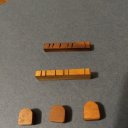
Attached a pic of the tuners (originals on the left), the bridge, and the nut. The nut actually has a spot of glue on it, and I assume it was fastened in when new. I have some titebond original and titebond hide - either would work i suppose to refasten the nut? Or something else?
Great advice on the tuners!
Any suggestions as to a case for this?
Richard- good eyes there! 
My advice is to get one extra button to keep in your case. Might as well if someone is already making them... and I found that if my string breaks at the bridge or tail piece area, the fine tuning button can come off the string and literally fly off across the room. This actually happened to me twice over the years. Now I keep a fine thread threaded through all the buttons' holes and tied in a little loop..it's not very obtrusive and prevents those buttons from 'making a break for freedom'. Otherwise, if you're sitting in the grass somewhere or are someplace playing at night... you may just have to kiss that little wooden button goodbye.  lolol Never hurts to have a spare!
David D. It looks in your initial pictures like the fine tuner for the bass string is down where the strings curve under the end of the fretboard to anchor. So you may need to only get 2 made to match.
Do you use a metronome app on your phone or an online metronome? What do you recommend? Dulcinina
Dave D, if you or someone you know is good at woodworking, I'd recommend have them create two or three additional little fine tuner beads, to match the single remaining one on your dulcimer's middle string near the tail.
My dulcimer has all 4 beads, and I can tell you that if you have wooden tuning pegs (as you do), these 'fine tuner' beads really do work well to get you to that last little bit of higher or lower tuning on each string. The way Keith made them is so smooth working, and they fit perfectly with this particular style of his dulcimers.
I can't take credit for this. I learned about Howard Feed n Wax from this video by Bing Futch , and Bing credits FOTMD member and luthier extraordinaire David Beede. It sure does wonders for an old instrument, doesn't it?
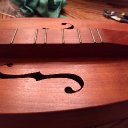
and what PERFECT F holes. I wonder if he used a scroll saw or a coping saw. Beautiful dulcimer. aloha, irene
Yeah, looks like it made the water spots almost disappear- nice results! Thanks for posting that before/after photo. And thanks Dusty for that wood treatment recommendation.
@pondoro You've made some great-looking ukuleles!
That's pretty significant. Glad it worked for you. I may have to get some for some of my older dulcimers.
So I've uploaded a 'before' and 'after' with just one application of the Howard Feed and Wax. It really helped bring out the cherry.
And it turns out the nut is loose like the bridge, and fits very snugly into a slot at the head.
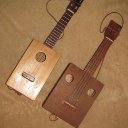
So these are cigar box ukuleles. Both boxes are more than 40 years old. All wood was cut in America (I cannot vouch for the boxes). The larger one has homemade maple tuning pegs, the smaller one has professionally made tuners.
The walnut on the smaller one was harvested by my father. The maple for the tuning pegs on the larger one came from the flooring of a 1900-ish house. Trying to reproduce what a kid in the 1920's might have made, if he had time, tools and skill but no money.
YES YES....FOTMD folks are truly GRAND!! THANKS on the tip about Howard's Feed n Wax, I've got that on my list to get when I go to town next. aloha, irene






 Baby-O Audio recording 2018-11-02.mp3 - 2.6MB