Native American Flutes
Adventures with 'other' instruments...
Thanks Monica! And also to Maria and John. Your insights really helped! Now I'll decide on timing. Gotta wait and see what's on sale in March. 
Thanks Monica! And also to Maria and John. Your insights really helped! Now I'll decide on timing. Gotta wait and see what's on sale in March.
Hi Susie , its about 1 and 3/4..It's very easy and comfortable to hold.I really believe you will be able to play it with ease considering your musical experience and height
Thanks Monica and John. Very nice videos.
John, I'm not considering the contra, just the condor bass Em. Just can't decide between the standard bore and the 1" bore. But, it sounds like the standard bore would be just fine for me. Do you guys have a standard bore condor (not contra) bass?
Monica, sounds like you are handling it without issue. Did you remeasure the outside diameter (1.2" didn't seem right to me)? Thanks.
Mostly I prefer a single melody string - for melody/drone style and for more "modern" styles (cross-picking, melody notes on lower strings etc). I like the clarity of a single treble string, and the even-ness of tone compared to the other strings.
We have visited this topic before - it's one of those that comes up every so often and is always worth debating.
Thanks Jill! We tend to have fun!
The only thing that I would caution about would be a Condor Contra Bass flute. My wife (Karen) has been a professional flute player and teacher since the 1980s. The holes are so large that her fingers go straight into them without stopping to seal the holes. The spread between the holes can also be a challenge for people with smaller hands. I haven't run into many folks who have this problem with the regular Condor Bass series, but I know that some like the smaller bore better for comfort reasons. Here's a video that starts with me using the contra bass. You'll probably be able to tell that I'm working pretty hard to manage the beast, but they have such a wonderful low voice.
I say try the larger size, no squawking and fuller deeper tone..I am 5.3'..and have skinny fingers and have no problem at all..you can always return /exchange if it doesn't work for you.
I am playing the condor bass C in this video..which if anything is slightly larger than the D
Thanks Monica. That outside measurement (1.2") seems like the same as the outside measurement of those with the 1" bore......1.25". I'm talking the outside of the wood. Is it really 1.2" for the standard condor bass?
Thanks for the pics and info. Now I can't decide between the standard bore (will have to confirm measurements) and the 1" bore like Maria's.
My new project is a 5 string dulcimer with double melody string. Its my first at this style. The body is 2 1/4" deep so it should be nice and full sounding.
Played with double melody strings for 4 years. Changed recently to single string which I find considerably easier for finger picking, hammer ons and pull offs. My wife changed to single string for the same reason especially because she is really into finger picking.
I build with 4 tuners, play using 3 strings. It allows double melody, 4 equidistant or single melody string setups.
That particular thread may have no responses but the subject matter is often mentioned/debated on these pages. My own opinion is that it is a personal preference item. I have and play both and notice very little difference. If the dulcimer has mechanical tuners I tend to like the double melocy, wooden tuners, single melody.
Unless I'm doing a reproduction of an older dulcimer, I make them four string. My personal preference for playing is 3 string. It's easier to do hammer ons and pull offs on a single string.
Ken
"The dulcimer sings a sweet song."
This question was asked a couple years ago without any responses. I, being a new builder/player, would like to pose the same question. I have looked and have found very little discussion on this topic and look forward to hearing from those with more experience. Bottom line it may be simply a matter of 'personal preference' but I would like to hear others opinions: Single or double melody strings? 
http://fotmd.com/strumelia/group_discuss/1294/personal-preference-question-on-stringing
I buy their bulk Guitar (for ball end) or Loop End strings -- 12 in a sleeve IIRC, of a specified gauge and end type (ball or loop) -- plenty long
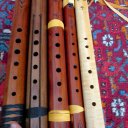
Susie the outside measures over 1.2. I recommend the larger bore it has a fuller deeper sound . I am a small person and I have no problem. The condor bass D is aromatic Cedar and the Bass C is walnut. I also have a condor bass B that is spanish cedar ..it's a lot more challenging to play the holes are larger and further apart..but doable. I also recommend you check out Ancient Territories I have a couple of his flutes..beautiful craftsmanship and sound.in the photos starting from the left High spirits Condor bass B,C,D , Gm and Em 432 from atflutes.com
Like Dusty I buy both locally and from JustStrings. Never had a problem with them in all the years I've ordered from them. Often they send little extras, like string cleaning cloths or flat picks. I usually get a dozen of each of my most common gauges (18, 14, 12).
Banjo, rather than Mandolin, strings are the most common "crossover instrument" strings. I believe Jean Ritchie talked about using banjo 2nd and 3rd on dulcimer.
Ken H, I'm about to buy bulk strings from JustStrings, and found you answered my question 2 yr's ago! I wasn't sure which instrument string length would be a crossover for the dulcimer, but Banjo it is.
Monica, what is the outside diameter of your HS bass flutes? I know it's 1 1/4" for the 1" bore flutes. Was curious how they compare. I'm tall, have pretty good size hands and have 43 years experience playing stringed instruments. So I'm thinking I could handle the bass flute size (even the non-1" bore). Sounds like you have no problem with the size. What woods are yours?
I have the condor bass D and C, not the 1" bore however. I have no problems playing them, infact they play with ease and sound beautiful. The larger bore has no squawking but I do have squawking with the smaller bore flutes( Gm, F#) from high spirits.
Thanks Maria. I'm thinking seriously about the 1" bore Em flute (walnut). I love the low tones and this would fit nicely into my mix.
[quote="Susie"]
Has anyone purchased a bass tone flute or more specifically, a HS 1" bore bass tone flute?
[/quote
Yup Suzie. I have their Dm and Em 1 inch bore flutes. I love both of them but the Dm took me much longer to be able to play without squawking. I was silly and it was only my 2nd flute after the Jonah Thompson Am that I learned on...but now after 10 months of playing the NA flute I can play it just like the others. Both of mine are in Walnut as they are much more durable (and I seem to always whack my instruments onto something lol)
Good luck
Maria
Has anyone purchased a bass tone flute or more specifically, a HS 1" bore bass tone flute?
Thanks, Jan. I knew the different airlines were talking about these changes but haven't flown lately.... Good to know. There are also new regulations (Federal? International?) regarding traveling between countries with rosewood (endangered). I had a luthier tell me to have a receipt with me for any instrument that I travel with, out of the country, that has rosewood or its cousins (fingerboard, bridge, etc). - the receipt proves I purchased it within the United States and I did not buy the instrument 'out of the country' and then am bringing it into the U.S. illegally (without paying the penalties). Sorry I don't have all the details on hand at the moment...but something to look into if you're going out of the country.
Cute, John! I don't think I knew that many songs at that age?? You seem to have control over the group LOL!
thanks, Ken, for your info and encouragement !! I will be sending Robert Force a note about other players .
I'm still reading Thomas Jefferson The Art of Power. I just received the latest issue of The Fretboard Journal, so I'm reading that as well.
Ken
"The dulcimer sings a sweet song."
Younger Next Year truly has changed my life, so now I've moved onto Thinner This Year. I'm also reading 'Tis a Gift to be Simple and am enjoying it, though I wish more were written on the subject by people living in poverty. There's a whole idea to this concerning judgment and acceptance I don't know how to explain... Lastly, I'm reading the third of a multicultural fantasy series (The Dragon Songs Saga) by my acupuncturist, Dances of Deception. I've never liked fantasy, but I have trouble putting these down once I've started!
What an amazing and thoughtful gift~she will treasure it! Did you also get a case? That's the only other thing I can think of....
Here's some that we do right now!
You'll really like that Pritchard! FWIW, there is a hotbed of mountain dulcimer in western WA. Dulcimer godfather Robert Force lives in Port Townsend. Although as the osprey flies it's close, I know it's not easy to get from Camano Island to Port Townsend -- probably faster by boat than car. But if you get in touch with him (through his website www.robertforce.com, he can certainly connect you to other players in the area.
Actually, Ken, I wanted mellow for hymns and slower songs, but ringing strings and noter squeeks are also fine with me. My fingers on the left hand have some problems, so noter playing is great. Having had years of piano and autoharp, singing duets at church, loving many types of music, I drive myself crazy going around singing and whistling constantly. The dulcimer is a sanity saver. I think I've picked up enough in the past couple of months to graduate to a real instrument, so I've asked Kevin Messenger to build me a Pritchard which should be on it's way in a month or so. I hope to "grow into" this instrument as I continue to play. This website is so motivating.
There is very little dulcimer activity in this area (Western Washington State) so internet is the best I've got for now. And I've found quite a bit of info, fascinating stuff!!
I was a single father of two 3-7 year old sons for about 4 years. The songs they loved us to sing while driving in our truck were Mama's Don't Let Your Babies Grow Up To Be Cowboys, John Prine's Spanish Pipe Dream (which they called "that Blow up your TV song") and Gene Autry's Cowpoke Pokin' Along.
Here's a START!
Pre-school through Kindergarten (in Michigan) I remember learning:
[quote="marg"]
I went through Gold Tone in buying mine. I think if they spent a bit more time on fixing their design they would have a great instrument but it seems to be a hit & miss still.
[/quote
For whatever reason (time, money, ego issues, whatever), I think you're correct that consistency just isn't there. I know that my supplier does not have the instruments shipped to him; he personally goes to the factory and hand selects the ones that he will take home and work on and get ready to sell. I guess they need to have someone like him on staff--someone who knows how a dulcimer player, who buys this, is going to want it set up. As far as looks go, they sell themselves. And if you just strum it a few times you may think WOW, this is for me! I know not everyone can sit and play an instrument for several hours (I played this one throughout the entire vendor set up hours at DulcimerU), but take as much time as you can to decide if an instrument is really for you when buying at a show or a store. Of course if the instrument changes considerably after you've brought it home....ACK! No one seems to have the answer for everyone about how--or whether--to display or store dulcimers...I think it depends on the humidity and temperature changes at each location. That being said, I have some I always store in cases and some I never put in a case!
I don't have a 'scalloped fretboard'
My dulciborn was part of the new models they were hoping was going to fix some of their earlier problems.
My only issue was the action & that was corrected. I went through Gold Tone in buying mine. I think if they spent a bit more time on fixing their design they would have a great instrument but it seems to be a hit & miss still. I do like mine & have had it about 2.5 years now. It is much easier to play if it is out on a stand and not in it's case, I wonder if location has something to do with leaving them out or putting the back in their case. It is a very nice case, one of the nicest cases I have for any of my dulcimers.
Hi betm -- welcome! You're right that those of us who write about dulcimer regularly, may not have mentioned the "strumming up the fretboard rather than in the strum hollow" effect very much; it's one of those things that folks mostly discover for themselves as part of learning about their instrument. I'd guess most people strum up around fret 12-14.
As you can see from this discussion, there are other techniques for getting a "mellow" sound, by changing the kind of pick. When you're ready to step up to a wooden dulcimer, one of the factors you want to look at is the volume of the sound box -- more volume equals more mellow. Two dulcimers with the same top shape and dimensions - the one with the deeper side will sound more mellow. Just something to watch for.
I used to like mellow 'baritone-ish sounding dulcimers, but over the years have come to appreciate more the "high-silvery" soundof the narrow/shallow traditional instruments. Each to his/er own!
hi marg - yes, it's one of the scalloped fretboards, and it warped into bumps and valleys. the factory did an excellent job fixing the problem; however, their customer service skills were not as well honed. i now leave the dulciborn in its case when not being played, and throw in a moist sponge inside a two piece soap dish w/the top perforated. seems to work well.
as a postscript to dusty's welcome share about frets, i need to add that mike clemmer was nice enough to work on my bridge to improve the intonation on this dulciborn a great deal, which further illustrates the need for an excellent luthiers help to make this a truly playable instrument.
Hi All, Totally new here...but I was looking for info on mellow strumming. Actually I have found by experimenting that if you strum on the fingerboard and not in the strum hollow, the sound is vastly different. I haven't seen this mentioned anywhere but I haven't listened to or read everything yet! So now I have two sounds on my cardboard beginner's unit - dulcimer and mellow dulcimer. Makes my practicing even more fun !