Forum Activity for @cheryl-johnson

Dusty Turtle
@dusty
08/14/13 02:32:11PM
1,851 posts

Si Bheag Si Mohr dulcimer duet


General mountain dulcimer or music discussions

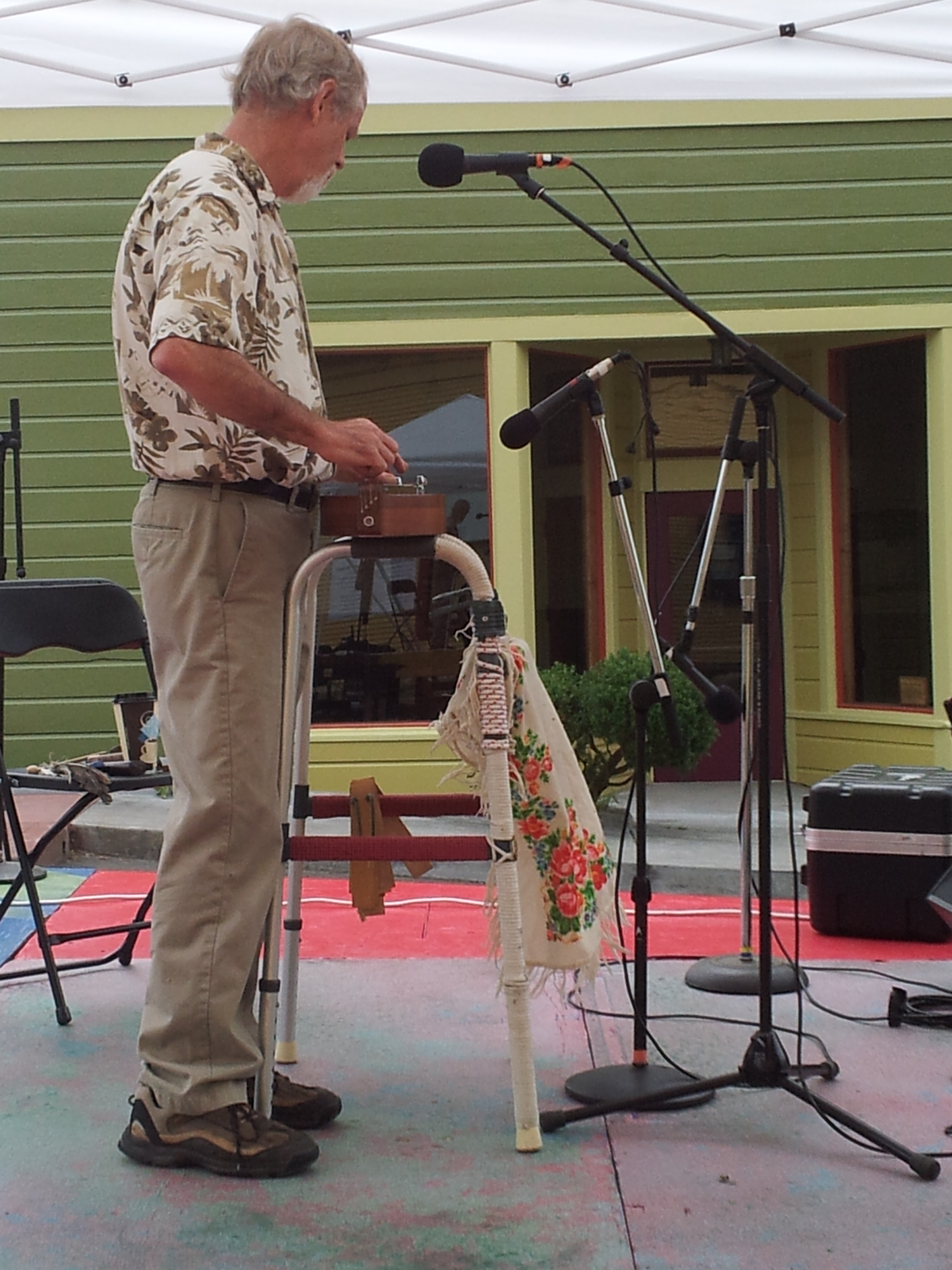
Since I am not playing in this video, I can't upload it to our video library, but I wanted to share with everyone this carefully arranged duet of Turlough O'Carolan's "Si Bheag Si Mohr" which Paul Furnas and Ron Beardslee played at the Redwood Dulcimer Day this past weekend.

Both are founding members ofmy dulcimer group, River City Dulcimers. Paul has been playing and teaching the dulcimer for decades. He has a doctorate in early music and is a font of knowledge about music history and music theory. He has many arrangements of songs, all very carefully thought out. It is a bit hard to hear his fingerpicking here, but hopefully you can all see how pretty the arrangement is. And Paul's smile at the end is precious!

Listening to this soft and carefularrangement of the song makes me feel like that proverbial bull in a china shop when I play my awkward strumming version of the tune.


updated by @dusty: 07/31/23 09:26:23PM
Stephanie Stuckwisch
@stephanie-stuckwisch
08/10/13 10:59:06AM
45 posts


From personal experience, I've found that using the middle, ring and pinky finger for barre chords keeps my wrist in a better anatomic position.

Ken has an article on hand health for MD players on the Everything Dulcimer site. I find it helpful to do a these before and after playing.

http://www.everythingdulcimer.com/articles/28/hand_health.pdf

Dusty Turtle
@dusty
08/08/13 06:47:16PM
1,851 posts


Joseph, personally I do tilt the dulcimer up a little bit, not fully vertical like a guitar, but just enough so the back is off my lap. But I do that more for the comfort of my strumming hand and not my fretting hand.

First, most of the time when dulcimer player refer to barre chords they do not actually mean they finger them as barre chords with a single finger. Most dulcimer players fret across all the strings on the same fret by using either their middle, ring, and pinky fingers or their index, middle, and ring fingers. Mark Gilston does the former; Linda Brockinton does the latter. I do both, depending on the chords or notes immediately before and after the barre chord.

Second, people who do barre a lot with a single finger tilt their hand so that it is more the side of their finger making the barre than the soft bottom. Using the side allows you to use the bone of your finger as a brace. If I am not mistaken, Stephen Seifert uses his ring finger to barre in that fashion.

Third, professionals who barre a lot get dulcimers with what is called a radiused fretboard. That means the fretboard is curved so as to allow an easier barre. Almost all guitar fretboards are radiused, but a different degree of curve is necessary for the dulcimer. Both Aaron O'Rourke and Erin Rogers play on dulcimers made by David Beede with radiused fretboards.

Fourth, Ken is correct that as you stretch for more chords you will be using muscles in your fingers and hands that have rarely been used before. Some discomfort at first is to be expected. But you should definitely not continue doing things that cause you pain. In order to play well you have to be comfortable. If some chords necessitate a stretch that hurts, find another way of playing the chord. Over time those stretches will be easier and easier, but you certainly don't want to hurt yourself.

Fifth, Ken is also correct (notice a pattern here?) about arched fingers. Obviously he is not referring to forming a barre chord with a single finger, but when you finger the fretboard, you should be using the very tips of your fingers, not the fat pads. To do that well might require developing some strength in the fingers, but that will come with time. When my daughter plays the piano, I encourage her to hold her hands so that an egg could fit beneath her fingers and palm on the keyboard and her hand won't crush it. As a general rule that is good advice for the playing the dulcimer as well.

Ken Hulme
@ken-hulme
08/08/13 05:16:30PM
2,157 posts


Are you barring with the edge of your little finger, or with three fingertips? As a new player, you're bound to get twinges of pain now and again, especially if you've not played other stringed instruments, or if you're changing from playing vertical guitar to horizontal dulcimer fretting. The only real rule of thumb (as it were) is that there is no one way to finger a chord. I'm not a chord-melody style players, but from what I've seen, arched fingers are better than flat.


updated by @ken-hulme: 02/16/16 12:30:00AM
Ken Hulme
@ken-hulme
08/08/13 01:33:32PM
2,157 posts


Nah, I don't think many folks strum over the hollow, I strum around fret 12 or 14. Ideally the best place to strum is half way between the end points of the string. Of course than changes every time you fret at a different location.

Rather than filing/cutting down the slots, it's better, IMHO to sand the bottom of the nut/bridge. Loosen the strings,remove the bridge/nut. Place a piece of say 100 grit sandpaper on a hard flat surface (table) and given the bottom of the nut/bridge say 10 sanding strokes. Return the nut/bridge to it's place, tighten up the strings at least somewhat, and check the new height. Rinse and repeat until you get the action down where you want. If both ends are 'way too high, start with the nut end first, get it almost right, then lower the bridge end..

Ken Hulme
@ken-hulme
08/08/13 08:36:06AM
2,157 posts


Joseph - part of your problem may indeed be fretting too hard. Especially coming back to the instrument after a time. Action height is easy to check using a nickel and a dime. Put the dulcimer on a table so you can look alongside the fretbard. Place a dime on the fretboard next to the first fret. Each string should just touch the dime. At the same time, balance a nickel on top of the 7th fret. Again each string should just touch the coin. If your action is much higher than described, you certainly might want to have it adjusted lower.

If, when you hold the dulcimer on your lap, the first-to-third frets are over your left knee, and the tail is into your hip, you shouldn't have much movement going on at all. If you do, simply resting you right hand little finger and perhaps ring finger on the top of the dulcimer, on the far side of the fretboard, will counter most 'rocking' motion and those fingers are also useful for pulling in on the fretboard to re-adjust the dulcimer as it works its way outward.

Most folks don't hold a dulcimer "guitar fashion" for one or more reasons: 1) it's not a guitar; 2) guitar chord players find it impossible to wrap their hands around the body like they do a neck, necessitating learning a new hand position; 3) flat-on-the-lap is traditional and more comfortable for non-guitar players.

Two of the more famous dulcimer players in the world are Jean Ritchie and Robert Force. Jean plays traditionally with the dulcimer flat on her lap. Robert more or less invented and perfected the stand-up, hang-it-from-a-strap-around-your-neck, guitar-style hold. Both are fabulous musicians although totally different in what they sing and play. Ultimately, it's up to you how you hold and play your dulcimer.

Jim Fawcett
@jim-fawcett
08/08/13 01:52:57AM
85 posts


Joseph, just slide the dulcimer more to the right, so that it is more stable on your lap when you fret the 1st and 2nd frets. You don't have to strum over the strum hollow so move the dulcimer to the right a little more and your problem will be solved. It also needs to be on a slight angle so that the tail of the dulcimer is closer to your right hip and the scroll head is just beyond the left knee.


updated by @jim-fawcett: 02/08/16 08:48:05AM
Dusty Turtle
@dusty
08/17/13 12:26:11PM
1,851 posts


Thanks, Babs. I figure if you find just one or two ideas, then it was a success. Let me know if you have any questions.

Babs Greene said:

Nice vids Dusty, also given me some new stuff to get in to.

Strumelia
@strumelia
08/15/13 10:25:25PM
2,404 posts


This all sounds wonderfully helpful. Be sure to post the links here on this thread to the great videos you guys are referring to!

Dusty Turtle
@dusty
08/15/13 08:21:27PM
1,851 posts


Glad you've found the videos helpful, Helen. It's interesting that John comes from the drums and I come from the guitar, but we both end up in the same place. Don't be afraid to peek at the third video. Basically, it shows how the same flatpicking pattern works for picking single notes and not just strumming all the strings. You may or may not be ready for it, but it can't hurt for you to begin thinking about where you could put a single note or short single-note run into songs you already play.

Theenthusiasmanddedicationyou have shown in learning this instrument and in playing in public is inspiring to us all, Helen. Keep it up!

Dusty Turtle
@dusty
08/12/13 12:04:49AM
1,851 posts


David, I think we are talking about two different issues here. You seem to be concerned with how to arrange a tune, meaning how fast it should be, how much embellishment is appropriate, and so forth. I am talking about technique, meaning the ability to play accurately no matter what speed you choose to play. But I don't think I disagree with anything you've said.

Obviously, if people are playing together and one is playing faster or slower than the others, that is not good. As every kindergarten teacher knows, the ability to play well with others is important. That is why someone usually counts off "12ready go" or whatever they choose before they start playing together, to ensure they play at the same tempo. Often in bluegrass bands the fiddler will begin with the "taters," just a couple of notes (usually in a bum-ditty rhythm) to set the tempo. But one big difference between professional and amateur musicians is the ability to play in a constant rhythm. And for many stringed instruments (guitar, mandolin, dulcimer, etc.) the key is right-hand technique. (For the record, I do indeed use a metronome a lot when I practice.)

I think how busy one is when playing should in part at least be a function of how many musicians are involved. The more musicians, the less you should be playing. As you point out, some songs just don't call for much embellishment at all. But these are questions of arrangement, not technique.

In the case of the three versions of "Simple Gifts," I agree with Wayne, Babs, and (I assume) David that the first version is better. But we are making that judgment based on the arrangements of the song, not the playing ability of the performers. That song is a great example of one that should be played slowly with a sparse arrangement and little embellishment. Personally, I play that song on the penny whistle and the autoharp, but not on the guitar or dulcimer. If I were to play it on the dulcimer I would choose a baritone with a deep voice and good sustain so I could letall those half-notes (and even those few whole notes) ring out.

At the end of the third video to which I point Helen as part of my explanation of my flatpicking technique, Idemonstrate the song "East Virginia." (It is an old Carter Family tune but it is alsoa generic country song melody and I know of at least two other songs that use the same melody.) You never hear dulcimer players play this song. It is filled with a lot of notes that last 4, 5, 6, or 8 beats. It works great with a singer accompanied by a guitar strumming chords. But on the dulcimer, leaving all those long notes to ring out creates problems. One is that it is hard to know when to start playing again, and the risk is great that you'll come back too early, thus ruining the rhythm of the song. It is also the case that all those long notes ringing out when there is no playing going on increases the nap factor, meaning it will put the audience to sleep. I demonstrate on that video what the song would sound like if you played the melody as written. But then I demonstrate what it would sound like if you add the kind of chordal accompaniment a guitar would offer. It becomes a song at that point. And then I also demonstrate how those long pauses are places one might choose to add some filler licks. The end result is a version of the song that clearly differentiates between the melody, the chords, and the filler. Basically that version combines the jobs of singer, guitarist, and (perhaps) mandolin player. And it is all made possible by a right-hand technique capable of keeping a steady beat. The point is not that you have to strum chords on every eighth noteor fill every pause with lots of extra notes, but that the same technique that will allow you to play Bile Dem Cabbage steadily at any speed will also allow you to play chordal accompaniment or add filler when you deem it appropriate .

Just yesterday I was taught a song by Karen Mueller at the Redwood Dulcimer Day: "Jeff Davis" by Norman Blake. If you excuse my sloppy play (I was just introduced to thesong yesterday) and weird lighting (I'm using a halogen shop light), please look at the "A" part of the song. The first part of that selection begins with an eighth note pair followed by a quarter note, and that pattern repeats a few times. It is essential that the eighth note pairs have the same duration as the quarter notes that follow them. And then thelast two measures are a longeighth note run.

When we worked on the song at the festival, a lot of people had trouble with the rhythm of the song. That was unfortunate, since the workshop was supposed to be on how to use the 1+ fret, not how to play accurately. So Karen had to explain to folks how to alternate their strumming so that they could get accurate differentiation between eighth notes and quarter notes and could someday be able to play the last measures at a speed faster than the sleep-walking speed used to teach the song. Note that what I play here (other than that last strum at the end) is nothing but what is written as the melody. I add no chords and no embellishment. The right-hand technique I've developed, though, allows me to learn that song without having to count in my head to ensure that quarter notes get twice as much time as eighth notes and allows me to begin playing it up to speed (I've still got a ways to go) even though I amjust learning the song.

But that same right-handed technique allows one to add chords and add fillers when one chooses, with the confidence that the notes will always beon rhythm. That doesn't mean we will always play the correct chords, or our filler will always be tasteful or we won't ruin a wonderful song by playing it like Speedy Gonzales on chrystal meth. But we can rest assured that our playing will always be accurate and steady. The back-and-forth right-hand technique is nothing but a tool that allows us to play steadily so that we can concentrate on the more creative aspects of making beautiful music.

Dusty Turtle
@dusty
08/11/13 03:55:00PM
1,851 posts


Given the last set of comments here, I just want to offer a clarification of my own position. In my mind, there is a set pattern for strumming. It is in-out or out-in on a regular beat. Usually that is an eighth note pattern but on some slower songs it might actually be a sixteenth-note pattern. That is the pattern that is implicit in your right hand. But that pattern does not have to be actualized on the strings. Depending on the song, you might only hit the strings on a fraction of those strums. What the pattern does, however, is ensure that you are exactly on beat when you choose to strum. In other words, you need to be able to strum in-out or out-in in a regular pattern, but that does not mean you always do it.

Secondly, what we refer to as a strum might indeed be a pick. Just as you can choose to hit no strings on a strum (what some instructors call air strums) you can choose to hit only one or two strings as well. In my mind there ought to be no difference in your right hand between strumming and picking. And you should be able to shift between strumming all the strings and playing single-note runs or arpeggios with no alteration in the basic rhythm of your right hand.

So the way think of this, your right hand develops an out-in (or in-out) pattern which is usually based on eighth notes, so it moves out on the down beats and in on the upbeats, but on any strum you can choose to play three strings, two strings, one string, or no strings. What the pattern assures is that you will always be exactly on beat.

There are an infinite number of specific rhythmic combinations you can choose from. (The Bum-ditty is one example, where you are playing this out-in strum based on eighth notes but choose not to strum on the & following the 1st and 3rd beats. In other words, you are playing a quarter note, two eighth notes, quarter note, two eighth notes.) And I thoroughly agree with the emphasis of David and John's posts above that you should not get locked into one rhythmic pattern but should vary it as the song and even the phrase suggests.

John Henry
@john-henry
08/11/13 09:33:31AM
258 posts


John Henry
@john-henry
08/11/13 09:28:50AM
258 posts


Hello Helen, just felt that I would like to make a comment ! As a completely untutored noter/drone player (for a while some time back I thought I was the only one leftin the world !!!)I do not pretend to be an expert on strumming, rather the opposite, but am happy with what I do whilst playing. I often play ballads (even sing to 'em sometimes ,lol) and use a variety of things to strum with, including quills, wooden, bone or leather pics, and without exception, whatever I am using I rely on 'the tune in my head' to tell me what to do. Which means I do not work to a 'set' pattern, it '' jus ' appens "! Which,I think,is what David has already said ? I referyou to a vid which I have just posted, which may be of interest, 'cos I sorta play a ballad in two tempo's, involving differing strumming pattens. I repeat, I do not offer this as 'the way', just 'a way' !

best wishes

John

Dusty Turtle
@dusty
08/08/13 10:49:53AM
1,851 posts


Helen, I just took another listen to your John Stinson, and it is clear that you are getting very close to a steady back-and-forth strum. You do not have to reinvent anything you are doing.

In that song, the first measure is simply four quarter notes. You strum out on all of those. Good! The second measure has two quarter notes and then four eighth notes. You strum out on the quarter notes and out-in on each of the eighth note pairs. Excellent! You are doing just what I would be doing.

All you need to work on is keeping that strum as steady as possible so that you are always on beat. And remember that whenever you strum out, your hand has to come back in before you strum out again. That in strum should happen evenly even if you choose not to strum any strings. Although you might play "Bum bum ditty ditty" or "Bum ditty bum ditty" your hand should be moving "ditty ditty" all the time. (The bums are just quarter notes and the ditty is a pair of eighth notes.)

Strumelia
@strumelia
08/08/13 09:12:38AM
2,404 posts


Helen, also keep in mind that in learning something new, you never have to completely change everything all at once. Continue doing as you usually do, then take a few minutes at each practice to experiment with the new technique. Over time it will seem easier and then you can decide whether you want to incorporate it into more, or all, of your playing.

Strumelia
@strumelia
08/07/13 11:35:08PM
2,404 posts


Yet one more video about where to put in extra strums, or not: http://dulcimer-noter-drone.blogspot.com/2010/01/video-tips-for-beginners-where-to-add.html

Ultimately, as others have said, you should do what makes you feel good , whether it's learning new stuff or continuing what you are doing now.

Dusty Turtle
@dusty
08/07/13 09:58:47PM
1,851 posts


You're too kind,John.The fact is that you dojust as much in ahigher-quality 6-minute video asI do inmy amateur 45 minutes.Plusyou play the drums.

John Keane said:

Dusty, there's a bunch of great info in those videos of yours and well worth checkin' out!

John Keane
@john-keane
08/07/13 09:21:38PM
181 posts


Dusty, there's a bunch of great info in those videos of yours and well worth checkin' out!

Dusty Turtle
@dusty
08/07/13 07:57:36PM
1,851 posts


Helen,

Whether or not in practice you actuallystrum in-out or out-in when playing a tune should depend on the tune and how you want to play it. However, it is very important that you have a steady strum and stay on beat. It might be a good idea to practice with a metronome for that reason. Once you have mastered steady playing, you can vary it according to the needs of the song. But first you have to master the ability to play steadily.

There are innumerable advantages to developing a steady in-out or out-in strum. I outline how to develop that kind of a strum in a series of three instructional videos (amateur ones, of course) which I made available here:

Part 1

Part 2

Part 3

The strum I teach in that series of videos is basically an eighth note pattern in which you strum out on the down beats and in on the up beats. So when you count 1&2&3&4& you strum out on the numbers and in on the &s. You can reverse that and strum in-out instead, but what matters is keeping it consistent. Once you have a machine-like regularity, you can begin to accent or stress certain strums and "swing" the rhythm, too. That is where the first video ends. Once you have that accented out-in strum down and are swinging it, you have a rhythm that you can use for any tune. And what is great about it is that you don't have to count beats; the strum does it for you. If you accent the first beat, for example, you will always know where you are in a song. And you know to strum quarter notes, half-notes, and the first half of eighth note pairs on the out strum and the second half of eighth note pairs on the in strum.

The second video then gets more creative with rhythms, explaining how you can skip strums, mute strums, and accent strums to get really complex rhythms. In the third video I move from strumming across all the strings to adding single notes, for there is no rule that says you have to strum all the strings on any beat. You can play one, two, three, or no strings as you wish. So that technique for strumming also allows you to begin flatpicking.

Anyway, feel free to take a look at those videos and ask me any questions you want. I will never tell anyone that they have to play a certain way. But I can tell you that I find it helpful to develop a very steady back-and-forth right hand.

At the local dulcimer group I started last fall, there are basically two of us who are the leaders since we are the most experienced. Ron Beardslee does not strum in the method I do. He is very precise and only plays exactly the notes in the music or tablature. He is able to get very clean and sparse arrangements that sound great. But he counts in his head all the time, and he has difficulty just playing along with people and following other musicians rather than playing from music. I have other skills and other problems. When I play my right hand is constantly moving out and in. I don't always pluck a string, but more often than not I do. I often stick in chords or bass notes or an arpeggio or occasionally a little lick when it does not appear on the tablature. Ron calls this me being fancy, but to me it is just playing. My hand is moving all the time. And because the rhythm of my hand does the counting for me, my brain is free to watch other musicians or think of something to add or whatever. I don't have to count to get that 3& beat since I know I'll catch it on the in strum after the accented 3 beat of the measure.

Again, there are a lot of ways to play the dulcimer. You do not have to develop a steady out-in or in-out strum. But you should aim at developing a steady strum, and to do that you either have to count constantly in your head or you have to develop that strum you are describing.

One final point: Ken mentions ballads and the desire to keep the rhythm of the melody. That is indeed one very good way of playing. But there are others. Jean Ritchie, for example, does a lot of counter-melody work. Other modern players who also sing, like Sarah Morgan, develop a rhythmic strumming that accompanies but does not copy the singing. But I'd like to make a different point.What do you do if you are playing a slow ballad in which a single note carries on for a whole measure or two whole measures? Do you strum once and then count in your head (1&2&3&4& 1&2&3&4&) before playing another note? OK, you might do that on occasion, but if your song has a lot of long, drawn-out whole notes, you need to come up with something else. A regular, swing-version of an in-out strum all by itself can help you fill in those spaces in a way that does not detract from the melody. That is something I demonstrate at the end of the third of those instructional videos.

I won't be insulted, Helen, if you don't find my videos helpful. Don't feel obliged to watch them. But I do think they are a good introduction to the benefits of developing a steady out-in right hand. So if you are asking why you might want to learn to play like this, the videos try to answer that question. And of course, contact me with questions or comments or points of disagreement or whatever.

John Keane
@john-keane
08/07/13 07:48:38PM
181 posts


Helen, if you are not happy with what you are doing, continuing to do it is just reinforcing your unhappiness. If you want to try for a little more "even" approach to your strum, try this and see if it makes sense to you. It's a ton of thought in a short time, but the rewind button may help lol:

Ken Hulme
@ken-hulme
08/07/13 07:24:52PM
2,157 posts


Helen; how you strum - steady "metro-gnome" style or "go with the flow" style - really is part of what makes your Way, your Style. Also, I think, it depends on the kind of music you're playing.

Personally I think fiddle tunes are the perfect example of playing steady metro-gnome style. Those tunes were/are most often dance tunes, and if there's one thing that dancers don't like is some musician changing the tempo, the rhythm of their dance. They want a steady 1-2-3-4 or 1---2-3-4 or whatever the time signature is.

Ballads and similar songs, however, again IMHO, are best served by playing to the rhythm of the words, as that helps emphasize the parts that you as the performer want to have stand out.

I play mostly ballads and other songs with words, and occasionally torture audiences with singing, hence I primarily play to the rhythm of the words. But if I'm playing Maire's Wedding or Tennessee Waltz I'm playing a steady dance rhythm.

If you like playing "Oz Style" by all means do so. But if you want to shift to steady state playing that's OK too. Like so many things with dulcimer, it depends more on what you like than what anyone else thinks.

John Henry
@john-henry
09/10/13 05:22:10PM
258 posts

Opinions on new dulcimer


General mountain dulcimer or music discussions

LOL, So it starts ! Sigh, the onset of DAD !!!! It looks as if Scott did you proud Gail, thanks for sharing

Treat 'em well, play 'em often

best wishes

JohnH

Gail Webber
@gail-webber
09/10/13 05:11:59PM
70 posts

Opinions on new dulcimer


General mountain dulcimer or music discussions

I bought 2 new dulcimers yesterday from Scott Rhodes, a member here. I bought the 2003 McSpadden walnut teardrop he had for sale and and really love it. While there I also bought a cedar dulcimer made back in 1990 - we think it was made by Dorsey Williams. They both have their own unique sound. I plan to leave the double melody strings on these and use them for noter playing. Thank you Scott. I am very happy with them! I have attached a picture of them below.

Ken Hulme
@ken-hulme
09/07/13 08:57:33AM
2,157 posts

Opinions on new dulcimer


General mountain dulcimer or music discussions

Wormy chestnut makes a very beautiful instrument. Worm tracks and holes will not impact the sound.

Terry Wilson
@terry-wilson
09/07/13 08:30:32AM
297 posts

Opinions on new dulcimer


General mountain dulcimer or music discussions

Anyone got an opinion of a dulcimer built with wormy chestnut?

Gail Webber
@gail-webber
09/06/13 05:36:22PM
70 posts

Opinions on new dulcimer


General mountain dulcimer or music discussions

Thanks for your advice, Paul. I think you are right. There are some dulcimer shops within a couple of hours of where I live - in fact that's how I got my McSpadden. They mainly carry McSpadden, but it would be a good idea now to try some of the others that they carry.

Paul Certo
@paul-certo
09/06/13 02:03:05AM
242 posts

Opinions on new dulcimer


General mountain dulcimer or music discussions

Gail, if you are looking for a specific sound you aren't finding in your current dulcimers, your best bet is to get to a few shops or festivals where you can play a number of different instruments and let your ears tell you which one you like. Play every one in your price range, and if you don't find what you want, save up till you can increase your price limit. It's not only one of life's great pleasures to shop by ear, but probably the only way you will really find the one dulcimer that you just have to own. Sooner or later one dulcimer will refuse to let you leave without it.

folkfan
@folkfan
08/21/13 06:19:12PM
357 posts

Opinions on new dulcimer


General mountain dulcimer or music discussions

Carolyn, No one is saying that the wood isn't important in making an instrument, any instrument. There are woods that I would choose over others. I wouldn't want to make an instrument out of balsa, for example. Two of my constructions have been made of cherry with western red cedar soundboards, though. The sound difference is dramatic, one is high, light, and sweet, the other has more of a mellow modern guitar type of sound. The first instrument is a traditional construction of the bridge resting on the fretboard but directly over the tail piece with a small shallow body. The bridge is about 5/8" away from the end of the instrument. The second is build with the bridge resting on the fretboard but way in (about 3 ") over a very large (wide and deep) sound box. Same woods, but the tone or voice of the instruments is totally different.

Ken Hulme
@ken-hulme
08/21/13 06:17:20PM
2,157 posts

Opinions on new dulcimer


General mountain dulcimer or music discussions

Carolyn - read David's explanation at the bottom of the previous page. No one says that the kind of wood in a dulcimer is not important. It's just not the most important factor in making dulcimer (or violin) sound the way many people have believed. There are many other things that a builder can do that will influence the sound quality more than the choice of wood species. It wasn't the wood that Antonio Stradivari used that made his violins so much better than others. It was many other things, including mineral treatments, varnish formula and more. There are perfectly good or better dulcimers and violins that are made from cardboard, plastic, even metal.

Carolyn Fleming
@carolyn-fleming
08/21/13 05:29:44PM
5 posts

Opinions on new dulcimer


General mountain dulcimer or music discussions

The wood is important in a violin why not a dulcimer?

Gail Webber
@gail-webber
08/08/13 09:28:33PM
70 posts

Opinions on new dulcimer


General mountain dulcimer or music discussions

Thanks Lisa, Ken and Kevin. Kevin, I'll sure take a look at some of yours. I mainly play chord/melody on my current dulcimers, but may want to play more of the noter and drone style on the other one. I really like both styles of playing. I have messed around a little bit with the noter,but am by no means very good at it yet (posted a video a while backI did with the noter here - Sad Old Aunt Rhodie).

Kevin Messenger
@kevin-messenger
08/08/13 06:09:47PM
85 posts

Opinions on new dulcimer


General mountain dulcimer or music discussions

Gail, I am the Kevin Messenger that these kind folks have mentioned above. And thanks guys for the mention. I myself believe that build design, set up , and string selection ha much to do with the tonal outcome of the instrument. I build mainly with poplar ,like a lot of the early builders did. I like the earthy tone of poplar. I use piano wire strings, that I make myself, the seem to have a brighter sound, more sustain, and just ring like a bell. Robin Clark a member here has many audio, and video files ,of him playing one of my Prichard reproductions. Take a listen and see if this is the sound you are looking for. The instrument has quite a range. You can also take a look on my website , www.kevinmessengermountaindulcimers.net and look at some of my instruments. Thanks again for the mention guys.

Kevin.

Ken Hulme
@ken-hulme
08/08/13 05:22:42PM
2,157 posts

Opinions on new dulcimer


General mountain dulcimer or music discussions

Second, and thrid Lisa's recommendation to take up Noter & Drone style when you get that narrow/shallow, high-silvery sounding dulcimer (or even before). The singing of the drones is, IMVHO a great part of that sound.

Strumelia
@strumelia
08/08/13 11:54:38AM
2,404 posts

Opinions on new dulcimer


General mountain dulcimer or music discussions


Gail Webber said:

I guess that high silvery sound is really what I am looking for.

Gail, if you are looking for that sound, then you'd most likely find it in a fairly narrow and shallow soundbox. I can second Ken's recommendations of three people who build this kind of dulcimer here on FOTMD: Bobby Ratliff (Slate Creek Dulcimers), Kevin Messenger , and John Knopf. All three are dependable, high quality builders who specialize in traditional style dulcimers with that kind of sound.

Of course, to really bring out a 'silvery' effect, you'd want to try playing with a noter- that's where the bestest zzziiiiiiiiing! comes from.

Gail Webber
@gail-webber
08/08/13 11:29:37AM
70 posts

Opinions on new dulcimer


General mountain dulcimer or music discussions

I guess that high silvery sound is really what I am looking for. It sounds like a number of factors affect the sound. John, I have never been to Song of the Wood shop in Black Mountain, but want to go. I got my current regular McSpadden from The Dulcimer Shop in Blowing Rock. It was nice because I just kept playing different ones (as much as I could back in December) and found one pleasing to my ear.

John Henry
@john-henry
08/08/13 10:06:52AM
258 posts

Opinions on new dulcimer


General mountain dulcimer or music discussions

As I have indicated in more than one post, I think that the sounds one hears from one's dulcimer may quite well be viewed as 'Subjective' even tho' we may start out looking for an objective result ! After years of noise from woodworking machinery and associated construction site noise, I know only too well how tinitus can interfer with things !!! On the positive side, it may make my playing sound better than it is, to me at least !!!

JohnH

Mike A ! again as said before, I grew up in the construction industry in the days when one's claw hammer became an extension of the arm, and six inch round steel nails formed an important part of a joint in some timber constructions, so yes, I drove steel !

Strumelia
@strumelia
08/08/13 09:22:28AM
2,404 posts

Opinions on new dulcimer


General mountain dulcimer or music discussions

Descriptions of sound are subject to variation based on people's definitions of things. To one person, a 'traditional sound' may mean bright and high...to another it might mean sweet and quiet. So rather than my attempting to define what is a 'traditional sound', I simply say that soft soundboards (spruce etc) and larger/deeper soundboxes usually produce rounder more mellow tones, while shallow/smaller soundboxes and hardwoods tend to produce a crisper brighter sound.

Ken Hulme
@ken-hulme
08/08/13 08:16:23AM
2,157 posts

Opinions on new dulcimer


General mountain dulcimer or music discussions

No one denies that wood is one factor in the kind/quality of sound in a dulcimer.

IMHO and that of many others, who are also builders, it is not the most important factor in the creation of that sound quality. There are other variables which can be scientifically proven to influence sound quality to a greater degree. Most notably cubic volume of the sound body.

This can be proven with a simple experiment involving a narrow necked bottle of glass and another of plastic, and some water. Begin with empty containers and blow across the mouths of said containers. Now fill each container 1/4 full with water and repeat. Do the same with half and three-quarter fillings. Larger volumes produce more bass/baritone/mellow sounds than do smaller volumes, regardless of material of the sound body.

  583