DAA chord chart?
Dulcimer Resources:TABS/Books/websites/DVDs
Thank you Ken! I have bookmarked the chord wizard, and expect I will be consulting it often. 
Thank you Ken! I have bookmarked the chord wizard, and expect I will be consulting it often.
I have a copy of Merv Rowley's definitive article on Chord-Melody playing in DAA tuning -- An Approach to Learning Chord-Melody Style . The chord-charts there do not include any plus frets because it was written for those of us who only have pure diatonic fret layouts -- not even the 6+ fret.
Your best bet in to learn to use the Strothers Diatonic Chord Wizard:
Tom & Missy Strothers | Diatonic Chord]
Do you have a comprehensive DAA chord chart you could post? The chart I have shows only D Major, E Minor, F# Minor, G Major, A Major, B Minor, E Major, C Major, and C# Minor. I am especially interested in what additional chords may be formed using the 1 1/2 fret. Thank you!
There is also the possibility that the builder cut the fret slots too wide and those frets eventually worked their way out. As one hammers in frets the slots in toward the center of the fret board tend to compress a little bit which may be why the ends came out while the middle frets stayed in.
Ken
"The dulcimer sings a sweet song."
Nate, I just did the test and got 29/32. All my mistakes were 1/64 of a note. There were four such questions, and I got the last one correct, which makes me think you could get better if you practiced and trained your ear to hear such minute differences in pitch.
Edit: I did the test again and got 31/32. Still, the one I missed was a 1/64, and I was kinda sorta guessing on the other 1/64 questions.
So I can clearly hear the 1/32 interval, but the 1/64 is still giving me trouble.
Any idea how the quarter tones relate to cents? My understanding is that when we measure pitch in cents, each of the 12 half-notes of the chromatic scale measures 100 cents. So is the 1/64 equivalent to 1.5625 cents (1/64 x 100)? I'm trying to figure out how accurate an electronic tuner has to be for it to be better than my ears.
"There's no right way or wrong way to play the dulcimer". -- Tom & Missy Strothers
A test to determine how well you can discern subtle differences in pitch. I always assumed that I had poor pitch perception, but apparently I can detect a 1-16th of a note difference reliably! If anyone else would like to take this test, I'd love to know what you score!
https://www.themusiclab.org/quizzes/td
Nate
On a serious note though, I am quite curious about what would compel someone to remove frets from the fingerboard...it strikes me that the frets are removed from the outer ends of the instrument. Is the dulcimer 'bowed' downward such that the bridge and nut are lower than the center of the fretboard? Maybe the frets were removed to prevent buzzing? If so, the repair might be a touch more complicated. Is the fretboard level for it's full length?
Haha I found the misunderstanding about 'missing frets' amusing. Surely you guys must be aware that a truly traditional dulcimer only has 3 frets to an octave. This was increased to 7 during an early surge in popularity known as the "vival" hundreds of years before the 1.5 and 6.5 were later also added during a period called the "re-vival."

My cat is very indifferent to the dulcimer, but gets very concerned when I play the harmonica and hates when I play the pennywhistle. More than anything, I think he doesnt like that my dulcimer occupies my lap when he wishes he did.
"Folk music is high-class music. There's a lotta low-class people singin' it. Matter of fact, most so-called folk singers don't even look like folk." -Abner Jay
John and Ken gave you the advice I was going to offer. You don't say where you are located in British Columbia but if you are near a shop that works on fretted instruments (guitar, banjo, mandolin, dulcimer, etc.) you should be able to have the proper frets installed. Good luck.
Ken
"The dulcimer sings a sweet song."
Hi everyone!
There are a lot of new folks on board, so I thought it would be fun to dig up this old discussion to share and see if maybe we could add some new “Just for fun” phrases!
Thank you and have fun!
Lovely dulcimer. As John says, measure the width of the fretwire where the "mushroom cap" touches the wood, in millimeters or 1/100ths of an inch. A caliper will do the job. Thenyou can (hopefully) acquire some appropriate fretwire and either insert the frets yourself, or have someone do it for you. Look for fretwire on sites like Stewart Macdonald (stewmac.com) or other places that sell luthier supplies. To replace those 5 frets you'll need less that 2 ft of wire (but may have to buy 10 ft). Find the wire, and we can probably find you someone to put them in for you for less than two arms and a leg...
Along those lines: "Success is getting what you want, happiness is wanting what you get." I don't remember where I picked that up.
I'm a cobbler gobbler! When I can find one, that is... Best is blueberry or peach, but I'll settle for whatever you've got!
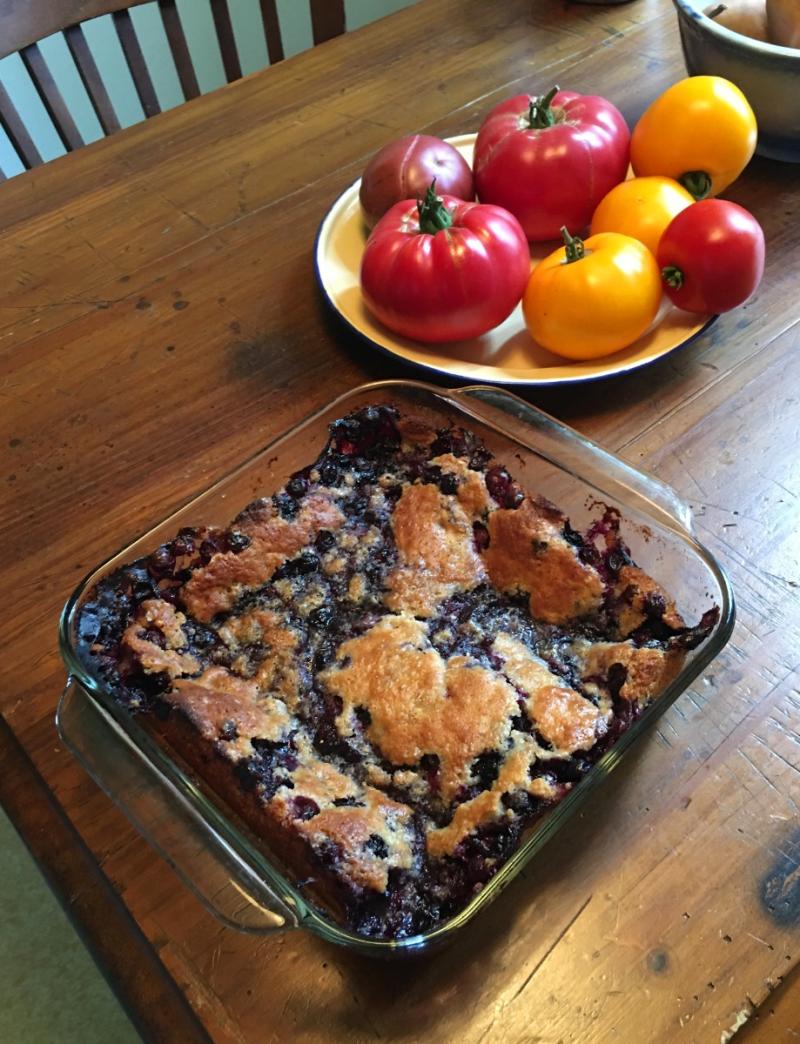
Our backyard blueberries are winding down, while the tomatoes are now gearing up. Yet another cobbler!
This concept puts me in mind a bit of past blog posts i made long ago, like these two:
https://dulcimer-noter-drone.blogspot.com/2010/08/why-is-it-taking-so-long-for-me-to.html
https://dulcimer-noter-drone.blogspot.com/2011/01/down-with-tyrant-carrot-or-dont-punch.html
This! 💯 I have never excelled in anything, but have learned to love time spent playing music, gardening, catching some pretty cool pictures, etc etc! I have found much true happiness in these things even though I am not at the top. Well, I AM at the top of what matters to me 🎶 😊 
I just love that. I was raised playing sports; competing; excelling; career, etc. I reached a point where I got tired of it and just wanted to enjoy doing what I loved to do, one of which was music (since 1973). Now retired, it's a nice place to be in life, with my husband, family, and doggos.
Yes, you're correct, you'll need those slots filled with frets. Frank didn't put any "extra" frets in on this dulcimer. If you can measure the size of the fret-wire on this, you may be able to have the missing frets added back in. You could also just replace ALL of the frets at the same time, practically guaranteeing an accurate fretting job. That's an attractive dulcimer you have!
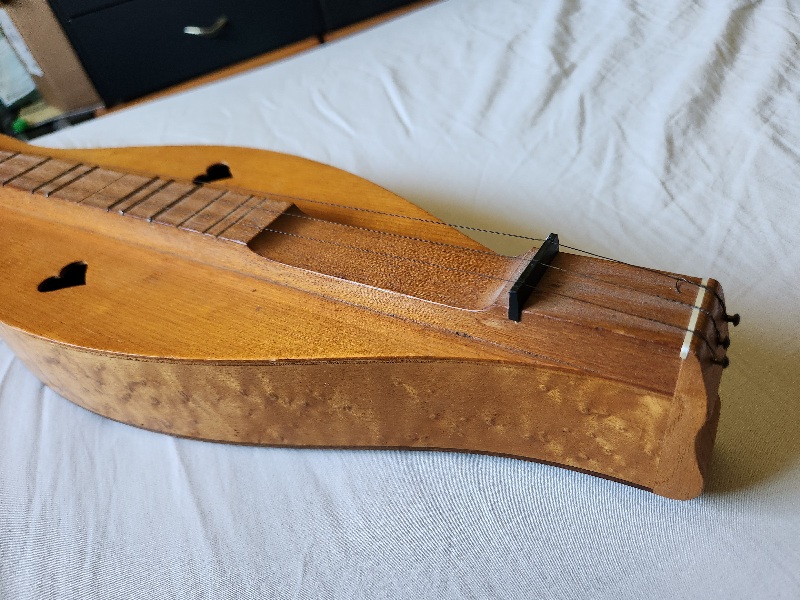
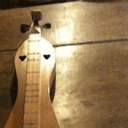
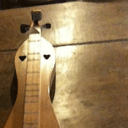
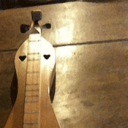
Closeup of one of the missing frets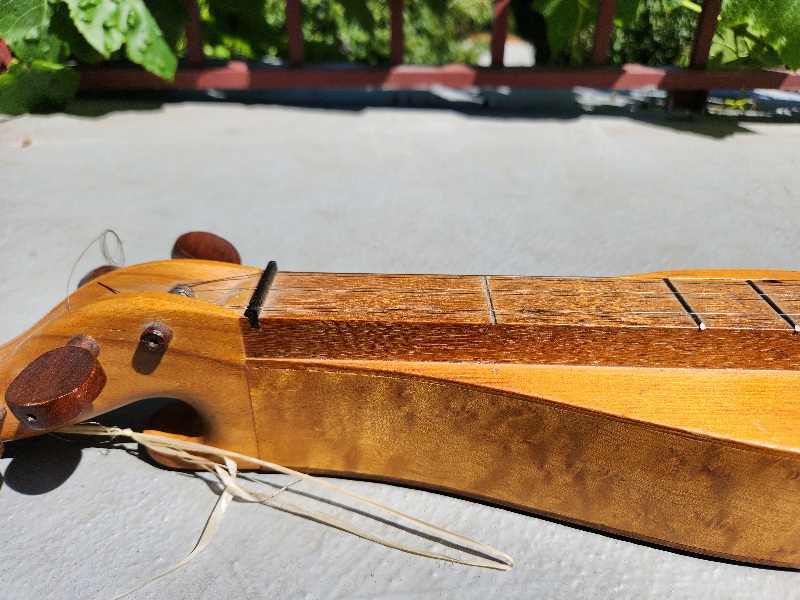
Thanks for the welcome and advice! This is the instrument in question. It measures about 28" from nut to bridge, and has 17 frets but 5 are missing the wire. If it was modified to have a non-traditional tuning, I'd like to restore it to traditional number of frets. 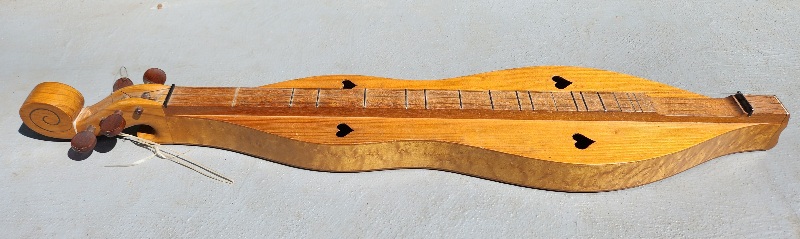
Thank you guys for all your feedback.
Regardless of the veracity of the story, there is wisdom therein.
I read that Kurt Vonnegut said this. Not sure how accurate that is, but i love the message!:
“When I was 15, I spent a month working on an archeological dig. I was talking to one of the archeologists one day during our lunch break and he asked those kinds of ‘getting to know you’ questions you ask young people: Do you play sports? What’s your favorite subject? And I told him, no I don’t play any sports. I do theater, I’m in choir, I play the violin and piano, I used to take art classes.
“And he went wow. That’s amazing! And I said, ‘Oh no, but I’m not any good at any of them.’
“And he said something then that I will never forget and which absolutely blew my mind because no one had ever said anything like it to me before: ‘I don’t think being good at things is the point of doing them. I think you’ve got all these wonderful experiences with different skills, and that all teaches you things and makes you an interesting person, no matter how well you do them.’
“And that honestly changed my life. Because I went from a failure, someone who hadn’t been talented enough at anything to excel, to someone who did things because I enjoyed them. I had been raised in such an achievement-oriented environment, so inundated with the myth of Talent, that I thought it was only worth doing things if you could ‘win’ at them.”
That's about what I know as well (see Chicago Chorale info here ). Niles claims to have heard a North Carolina girl sing a couple of lines, which he then enhanced and expanded into the song we know. Regardless of how honest he was, if he only heard an individual voice, there was no "original" harmonic structure, so any chords he added represent his own "embellishment," as @strumelia says. There is no way to know whether the original was major or minor. And if it was modal, it was neither!
There is some info here: https://en.wikipedia.org/wiki/I_Wonder_as_I_Wander
I read what JJ Niles wrote about it in one of his books... that he 'fleshed out' the tune after hearing a girl singing it. He claimed he heard only a brief 'crude snippet' and that he composed the rest, but i suspect the girl sang more than just a snippet. From my readings years ago, I concluded that Niles had a tendency to take credit for composing stuff that already existed. I do feel he likely added chords to embellish the unaccompanied ballad.
I think it is important to kept the historical information about the tunes we play flowing otherwise it will be lost forever. Even if someone plays a tune as a major but was originally a minor tune the history is still important. With that said I was wondering if anyone knows the history behind the (I Wonder as I Wander) tune. Thanks for the feedback.
Hi Lyssa;
Welcome to the world of dulcimers! We can probably help you, but we're going to need to see what's what.
You may not, in fact, be "missing" any frets. Older dulcimers -- what we call "pre-Revival" and dulcimers from the early Revival period of the 1960s, '70s and even some today, have what is known as a 'true' diatonic fret layout. More modern dulcimers have two and sometimes more frets not found on a diatonic fretboard -- but that does not mean the instrument is "wrong" or "broken".
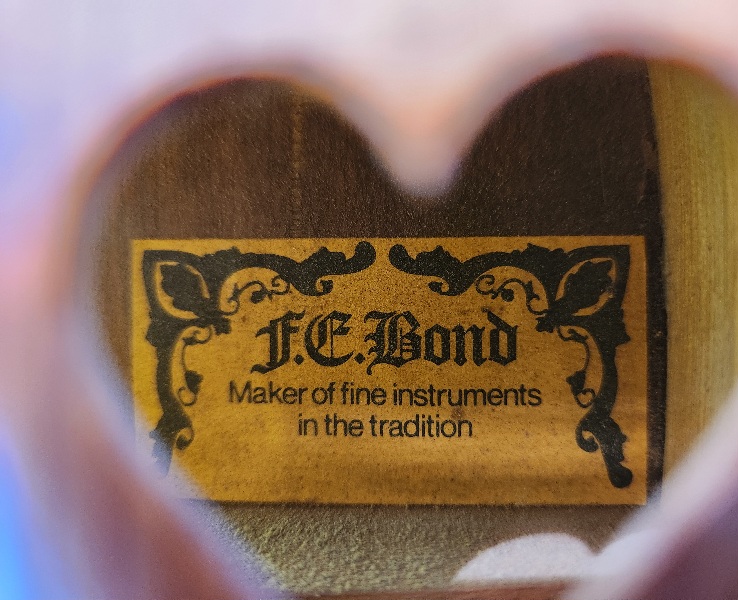
Frank Bond was a "fashionable" and popular dulcimer builder in London in the late 60s and 70s. He built a number of different styles/shapes/sizes of instruments with fairly long VSLs (distance between nut and bridge). He also built diatonic and "diatonic-plus" fret layouts. His instruments are highly regarded by dulcimer collectors, especially on this side of The Pond, as they are few and far between. IIRC, there are a couple folk who are members here who own one or more Bond dulcimers.
We're going to need to see clear and relatively close up pictures of the instrument, particularly the tuning head area, tail area, and the fretboard itself, so we can determine whether there are indeed any frets missing.
New strings are simple, cheap, and easy to come by at a local acoustic music shop or online, and given the distance between the nut and bridge we can tell you what strings to buy and how to go about changing them.
Looking forward to seeing your Bond, Frank Bond (not James)!
Replacing missing frets is a straight forward easy task. You can order fret wire from various luthier supply companies. Note: fret wire comes in various sizes and materials, so examine and measure the existing frets before buying new fret wire. Otherwise you will need to replace all the frets to make it look better and play better. Luckly that task is usually not difficult. Good luck.
Hi folks,
I know very little about dulcimers, but I've always liked the sound and couldn't resist buying this one to learn to play.
I'm told it is by Frank Bond. The fella I bought it from inherited it from his dad, who did some travelling around England and Europe and apparently had quite a collection of instruments, but this one doesn't look like it has been touched in decades. Researching the makers mark brought me here to you all.
It looks like it is missing a few frets and needs new strings, but looks otherwise intact. Is replacing frets an easy enough job for a crafty handy person? I live in a small town in British Columbia, so getting it to a knowledgeable luthier is not so easy.
Thanks,
Lyssa
Native American flutes are so intriguing! The ebonized walnut flute from High Spirits sounds rad, especially with those turquoise cabochons! The Crow flute in the key of A must have a sweet, warm tone!
I totally get it. Once you find a generous coupon code, you just gotta go for it! I've been eyeing the average flute price . So, I'm thinking of adding another one to my collection 'cause you can never have too many flutes, right?So now you're at 5 flutes, and that sounds like a fantastic collection! Keep jamming and exploring those beautiful tones! Music is such a soulful journey, and these flutes add a magical touch to it all!
@dusty I saw where Ken Bloom's sister's ukulele group already made their video and will post it on PMOTPD. So, that's an option. Mark & I may make our recording ahead of time due to family health woes and post it on PMOTPD to mark the day.
Native American flutes are so intriguing! The ebonized walnut flute from High Spirits sounds rad, especially with those turquoise cabochons! The Crow flute in the key of A must have a sweet, warm tone!
Unfortunately, I'll be traveling on Play Music on the Porch Day this year, so I'll have to just be a spectator and hope lots of dulcimer players post beautiful music for me to enjoy.