That is great to hear, Jon! Well done.
--
Site Owner
Those irritated by grain of sand best avoid beach.
-Strumelia proverb c.1990
That is great to hear, Jon! Well done.
Jon, it's nice to hear how the uke folks welcomed you. If they are already teasing you about your instrument, you're in!
Don't worry about the G7 chord. Just play a G. For any chord that has a number after it, you can ignore the number. Those chords have four notes and we only have three strings, so we always have to play a partial chord anyway.
For the record, a G7 chord is made up of G, B, D, and F. You don't even have an F on the dulcimer, but just playing a G chord will get the other three notes, so you'll fit in fine.
Something tells me you'll be singing a bunch of Hawaiian tunes soon. 
Just a little follow-up on my experiment with the ukulele / my dulcimer experiment.
The ukulele group said they didn't mind me sitting in, in fact they were giving me a hard time since our instruments standard three string setup. They said, what's the matter? can't afford the extra string. That made me chuckle. I'm not really sure at this point how to approach some of the chords they use like the G7, chords Time to go on line That all
Great advice from Dusty. 
LilleyPad, you sound like you have a good plan of action now, and a good grasp of the concepts. Go forth and have fun!
First thanks everybody for all the good information This is starting to sound a lot more easier and simpler. Number one: find somebody who knows what key they're in or what key they like to play in. That person who said they just have open tuning when I asked them what key they play in, really just threw me off for a big loop. Don't worry about how they have their strings tuned to. just play along using our cords. And of course the most important part and going without saying is to find out if they mind someone with a different instrument to just play along. okay once again thanks everybody I'll let you know how it goes. It'll be interesting to see If they let me play along and how the steel strings blend with the plastic nylon strings they use. I would think that strumming with a pick would be out of the question. I think it would be too overpowering at my end . well won't know until it happens thanks again everybody
Yes, I definitely look younger in that video. 
The standard tuning for a uke is indeed GCEA. But that is not a key. A key refers to the central tone of a song, not a tuning. (The dulcimer is generally tuned to an open D, and we usually play in the key of D, but we also play frequently in the keys of Bm, G, Em, and even A without retuning.) GCEA is actually a C6 chord, so it is not an open chord. And because the ukulele is chromatic, it can play in any key. Playing in a ukulele jam is no different than playing in any other multi-instrument jam for that reason.
I think I already stated that ukulele jams are like sing-a-longs. They share lyrics with the chords indicated, everyone strums chords, and most people sing. Sometimes they even specify what strumming pattern to use for each song.
If you want to play with them on your dulcimer, learning ukulele chords won't help you. Learn dulcimer chords. With a dulcimer tuned DAd or DAA you can play all the chords you need to play in the keys of C, D, G, and A, which would cover 90 percent of the tunes. Here's a good chord chart for DAd . (I think Stephen Seifert created it, but I found it through a random Google search.)
Just learn your chords and strum away! Well, strum quietly. You want to fit in, not stand out.
Just wanted to say good video Dusty “Have Capo Will Travel” That you posted years ago I thought your fingers looked a little younger smile I'm a visual person and that really helps thanks much Going by the internet they tune their instrument The ukulele to G-C-E-A So what key would that be ? Okay I guess that's it until I have the opportunity to sit in on one more of their meetings and pick their brains and definitely find out if they are opposed to other instruments sitting in or what
Well just like with a mandolin- on a dulcimer you can choose to play just melody notes, or you can play just chords, or you can play a combo of both together. Uke players often play chords and sing the song along with it. Folk guitar players often do that too. You could do that too, or just play the melody line or just play chords.
If all the uke players in the jam are playing chords... then who or what is either playing the song melody or singing the song lyrics? Are you saying that all the players there are simply playing chords while a recording of the song is playing on a machine?
If you asked somebody what key they usually play in, and they answer "open tuning "... that's not answering your question at all. You are not asking about their uke tunings. That person may not even understand the difference, or even why you'd want or need to know. Ask somebody else!  It's quite possible that many of the uke jammers there know how to follow the chord or tuning charts but might not even be aware of what 'key' they are playing in. Somebody there will know the key! You shouldn't have to tune to a ukulele tuning to play along with them, but it will help to know the key they are playing in, so you can play the chords on your dulcimer.
I just read your post Wally that makes sense sounds easier I've only just sat in once to their meeting looks like they don't use any sheet music at all they just project a tune song up on the screen and it looks to me like it's just a cord followed by a bunch of dots presumably that means how many strums they play on that particular cord and at the same time they have music of that song going on in the background. totally different experience from when I go to my dulcimer Jam where people pass out sheet music and mainly play the melody, whole different ball of Wax not really sure what that idiom means but it sounds cool
Howdy Strumelia. Oh yes very good point I definitely will ask them if I can join them with a different instrument. I did notice someone playing an electric bass guitar but that is a good point, also I did ask someone about what key they play in and that person said that it's an open tuning I don't know what that means over my head no idea I can only go by with that person said. I'll try asking someone else about what key they mainly play in and see what answer I get. This is all new to me trying to blend in playing with another group especially when they're playing totally different instruments. Will be a interesting experience to say the least also good practice in general
Hey Dusty. I know I said that I had a baritone dulcimer I should have said I think I have a baritone dulcimer it's been sitting in the closet ever since I bought it last year I made my guess based on the shape of the instrument it is larger than my standard ”traditional” instrument. And it's set up for four strings equally spaced which I haven't even begun to explore. also the strings are really loose so I have no idea what it was originally tuned to. Also the bass string on this instrument looks like it's a bit fatter than the one on my standard instrument and the one next to it is also brass. Which brings up the question: how can you tell what gauge a string is? Does a music shop have some sort of tool to tell what gauge they are or is it one of those things that you just put whatever you want on? It would be interesting to know what this was originally strong as.
I did find a chord chart for the ukulele Am-Em-G-C-D-A-F-E at this point looks like there are Eight basic chords they use and I think I can get those on my standard dulcimer tune to D-A-D well I'll let you guys know how it goes
Is the Uke jam playing mostly/always in the key of C? That would be real useful to know.
What key(s) are they typically playing in... can you ask someone?
Also... have you thought to inquire whether they actually welcome instruments other than ukes? I mean, perhaps they don't call it a ukulele jam for nothing. 
>>> I think where I'm getting all messed up with this trying to blend in with the ukuleles is that they're chromatic and we're diatonic.....
You are speaking of the fret boards, not the music.
With a basic club in a library, it is highly likely the 75% or more of the melodies (maybe even 90%+) which they actually play are diatonic. Look at the sheet music for "sing-along" tunes. You will rarely see any accidentals (sharps or flats) in them. A 6+ fret gives you one small step toward chromatic.
Since they are using C tuning, not D, tune CGcc or CGGG and play softly. I would choose CGGG and not use any chord fingering..
A beginners ukulele group isn't going to be running a "multi-instrument jam" with fiddlers or banjo players choosing the key.
Yes, mostly they will be using the I, IV, V chords, which are C, F, G, and your C and G drones will fit OK. They will also probably be challenged by anything in a minor key.
"Don't worry, be happy."
John, I think you really need to just start playing with people rather than trying to think too hard about this and just confusing yourself even more. As we've seen, the most common keys played in multi-instrument jams are C, D, G, and A.
The most important chords in any key are the I, IV, and V chords. In D that means D, G, and A. In G they are G, C, and D. In A they are A, D, and E.
Tuned to DAd, all those chords exist on the fretboard. So start by learning those chords and practicing them so your fingers can get to them quickly and without having to think too much.
That leaves the key of C. The I, IV, V chords in C are C, F, and G. If you have a 1+ fret, you can play an F as as bar chord at 1+. If you don't, play a partial F sticking to the C and A notes. Perhaps 6-7-6.
So without retuning and without using a capo, you can get the main chords in the 4 main keys. Start there.
At some point you will realize that you also need to play some minor chords. The minor chords that come into play are the relative minors of each of the major chords. One reason I don't agree with Skip's suggestion of tuning to a 1-3-5 tuning (D F# A) is that you would still have to learn minor chords. If you tune DAd or DAA, your barre chords can serve as either major or minor. So 0-0-0 is D or Dm; 1-1-1 is E or Em; 2-2-2 is F# or F#m, 3-3-3 is G or Gm, and so forth.
Don't keep wondering about this stuff. Just learn your chords. The ukulele group will share lyrics sheets with chord names and perhaps a strumming pattern for each song. Join their jam. Play the chords you know. Skip the ones you don't. They'll do a lot of the same tunes each time, so you can prepare ahead of time and learn the chords you don't already know.
In my mind, that is the simplest thing to do without diving into music theory. No retuning. No capos. Just learn your chords.
- - - - - - - - - - - - - - - - - - - - - - - - - - - - - - - - - - - - - - - - - - - - - - - -
However, I mentioned in an earlier post in this thread that when I only have my standard dulcimer at a multi-instrument jam, I use a capo for the keys of G and A and retune to CGc for tunes in C. Then my fingers pretend I am playing in D. Here is a video I made years ago explaining how to use the capo for that purpose:
Personally, I don't think of chords by their names. I think of them by numbers. This chart will help you know what chord shape in D you would want to use for chords in other keys.
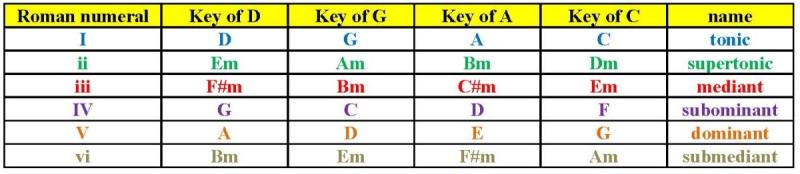
Basically, to transpose, stay on the same row. Here are some examples, all assuming you are tuned DAd or DAA:
If you are playing in the key of G with the capo at the third fret, and the music calls for a G chord, use the fingering for a D chord. If the music calls for an Em, use the fingering for a Bm.
If you are playing in A with the capo at the fourth fret, and the music calls for a D chord, use the fingering for a G chord. If the music calls for a Bm, use the fingering for Em.
If are you playing in C and are tuned CGc or CGG, and the music calls for an Am chord, use the fingering for a Bm chord. If the music calls for an F chord, use the fingering for a G chord.
What this approach allows you to do is to "pretend" that you are playing in D all the time. You don't have to retune or learn new chords. Everything you have learned in your open DAd or DAA tuning is available to you.
Over time, your ear will also let you know when the music moves from a I chord to a IV chord or V chord. Each chord has a different feel. And then you'll start to hear the relative minors and a handful of other chords. Pretty quickly, you won't need this chart at all.
Here's something that may work for you if you have a 1+. [toothpick or paperclip can be used as temp fret.]
Tune to D-F#-A, [loosen the middle string]. This will make every fret a chord across all 3 strings.
open = D
Fret 1= E
Fret 1+= F
Fret 2 = F#
Fret 3 = G
Fret 4 = A
Fret 5 = B
Fret 6 = C
Fret 6+ = C#
Then the only thing you will need extra is access to the sheet music to see what chords you need to play. Those chords are the letters just above the standard notation. or above the lyrics in text like ChordPro.
Hey Dusty thanks for the info. I think where I'm getting all messed up with this trying to blend in with the ukuleles is that they're chromatic and we're diatonic. Someone said they have open tuning whatever the hell that's supposed to mean. And they don't play in a key per say. I was kind of hoping that the ukuleles had maybe three or four basic chords that they use all the time like for example we use D-G-A. When I went to my local library they have a ukulele that you can check out. I tried that but they're so small my fingers just don't work with the small frets and the strings are too close. Just is not going to work with my big fingers. I think I need to take your advice and Google and see if there are any Ukulele chords that I could improvise with once I find that out. Maybe I can just use a baritone dulcimer and use those cords or standard dulcimer. Hopefully that would match them. I don't know I'm way over my head and I'm still trying to figure this out. just experimenting. Thanks Oh yes thanks for warning me on just replacing the strings on my standard instrument. I wouldn't want to miss that up. I'd be kicking myself in the well you know. luckily I do have a baritone dulcimer if I go in that direction. I believe I did notice someone playing an electric Bass guitar when I was at the ukulele get together. well they meet once a week I'll just have to go around and pick everybody's brain but trying to blend in with a ukulele I was more curious what it would sound like using the dulcimer with a different group and trying to play along. it's a learning experience thanks again Dusty
John, that's a baritone tuning. I string my baritone with a wound .036" on the bass, a wound .024 on the middle, and .014 on the melody. You could probably go a bit lighter on all three.
But I would hesitate to string a regular dulcimer like that. One of two things might happen. The bigger strings might make bigger grooves in your nut and bridge, thus creating buzz when you put your regular strings on, or they may just sit on top, creating a slight intonation problem.
I would also check with the maker of your dulcimer to ensure the instrument is sufficiently strong to handle the bigger strings.
I also have a "baritone dulcimette" that is tuned an octave above a regular baritone, meaning I tune it to GDg or AEa, but that's a significantly smaller dulcimer.
A better approach for you, I think, is to use a capo. Tune DAd, capo at 3, and you are tuned GDg, which would be great for playing in G. If you capo at 4, you'll be in AEa, great for playing in A. Then you can tune down to CGc to play in C. That's usually how I approach multi-instrument jams when I only have one standard dulcimer with me.
Well still playing around with this idea one more question: if I return the instrument to G-D-G what would some good strings size and I guess type to go with? if that makes any sense?
Base G mid D and G from Melody string
I just had a senior moment ,Oh thanks Wally also.
Hey Dusty thanks for all the good information I knew I was diving into deep water here
The ukulele kids get together every Wednesday at the senior center and I thought maybe it could be interesting to see if I could blend in with the dulcimer. Even though my library loans out ukuleles I am not quite sure I'm ready to take up a new instrument.But who knows maybe I'll check out a ukulele and not try to blend in with the Mountain Dulcimer and see how that goes But any practice with the dulcimer is good practice and there's nothing like a new challenge I guess smile
You're the best Dusty hope everything is going well with you
I just want to clarify something. A standard ukulele tuning is a C6 chord. It is not an open tuning like the dulcimer. It is not necessarily easier to play the ukulele in C than it is in other "normal" keys such as G or D. If you just Google "ukulele songbooks," you'll be able to find the lyrics and chords that ukulele clubs use. This page lists several of those songbooks. I just took a look at the first one, and of the first ten songs, 5 are in the key of G, 3 are the key of C, 1 is in the key of A, and 1 is in the key of D.
I don't know if those proportions characterize the rest of the book or the other books, but they confirm that in most old timey, folk, and bluegrass jams, the most common keys are C, D, G, and A. It would be good for anyone interested in playing in multi-instrument jams to get comfortable in those four keys. And if you peruse the songbooks, you'll see the other chords that come in to play when playing in those four keys. Learning those chords will enable you to join in 90 percent of the tunes played at any ukulele jam.
>>> just playing the tunes root chord will work when you can't figure out the other chords
That is essentially what you are doing if you only finger the melody string - It is what happens when we play Noter-Drone style. This only works for tunes in the major key, although we can do minor key with a Capo on Fret 1.
It will usually work with a uke group since most of what they do is likely to be in C major.
All these guidelines may fail if the player(s) on either instrument are really good.
To expand a bit, GCEA ukulele tuning is considered a C tuning in the UKE [I'm learning the instrument] community so @wally-venable tuning suggestion is really good.
My first MD instructor proved to us that just playing the tunes root chord will work when you can't figure out the other chords.
John, Wally is giving you good advice. Your question is basically how to join in multi-instrument jams with your dulcimer. Whether you are joining ukuleles, banjos, fiddles, or French horns is not really important.
The ukulele gatherings that I know of are basically sing-a-longs where people strum their instruments and someone (sometimes everyone) sings the lyrics. So the trick to joining would just be to learning all your chords. Of particular use will be the barre chords, since those can serve as both major and minor. 000 is a D or Dm, 111 is an E or Em, 222 is an F# or F#m, 333 is a G or Gm, and so forth.
You might also learn how to fake chords. It is true, as Wally says, that you don't have an F natural on the dulcimer, but the F chord is made up of F, A, and C, so you could just play As and Cs, such as 6-7-6 if you're tuned DAD or 6-7-7 in DAA.
And learning how to use a capo could be very helpful. If there is a tune in F, for example, you could tune to CGC and put the capo at 4. Your D chord positions will give you an F chord. Your G chord positions will give you a Bb. Your A chord positions will give you a C.
With a little knowledge, even a diatonic dulcimer can play in any key.
Most of those uke gatherings work with a stable set of songs, often centering on a songbook. That would enable you to go through and figure out how to play each chord ahead of time.
My final comment is just good advice for joining any jam. Your job is to fit in, not stand out. Play softly. You don't have to carry the whole piece. You might choose just to play a single note instead of a whole chord. As long as it is one of the chord tones, you'll be OK. And it is also OK to sit a tune out. I'm not sure I would join in if someone is doing Rhapsody in Blue in Bb, for example!
Yes, an A chord is just an A chord, no mater what the instrument, but ......
Unless you have a chromatic dulcimer, there will be lots of times when you can't play the required chord. You can't do a C or F chord in DAD, can you? They will mostly play C-F-G (1-4-5) chords.
Years ago, ukuleles were typically tuned to the key of D. There are still a number of books available on that and most of the old sheet music with uke chords used that. If you were playing a uke with a dulcimer group, the answer would be just use D tuning on you uke.
I did that for a while before I switched from uke to DAA noter-drone dulcimer.
You are trying to do the reverse.
Consider tuning a DAD dulcimer to CGc, or a DAA dulcimer to CGG (a traditional tuning). That should match up well.
If you are playing from their TABs, you'll still have to transpose chord labels if you are working from those, but D becomes C, F becomes E, G becomes A, etc.
Hi kids I think I may be diving into Deep-water here but anyhow here goes. I'll try my best not to just ramble on. I just noticed there is a big ukulele group that meets every week in my area. My question is,
Is it possible to play along with ukuleles with a dulcimer? I have noticed that it appears that the ukulele group mainly play with just their chords, so is it possible to play along with the Mountain Dulcimer just using our cords? They're tuning is G-C-E-A So if my instrument is tuned to D-A-D And the Ukulele group is playing a song with their A chord and then if I play using our A chord On the dulcimer Would that work? Would it sound okay? Is an A chord just an A chord. I just picked A chord for an example hopefully this makes sense
Thanks from Jon Lilley