Tuning peg replacement question
Instruments- discuss specific features, luthiers, instrument problems & questions
Put some tape on the end block to protect it an use a file.
Maybe I could just carefully sand down the diameter of the end piece so the loops will more easily fit over it?
Un-winding the loops work-hardens the wire, Try feeding the loose end though the loop [kids lasso] to fit over the peg. If they still break, wrap the wire twice around the peg then through the loop, kind of a reverse tuning pin technique.
Ken, the original string set I had on (and have put back on) was a D'Addario dulcimer set, 12, 12, 14, 22. I'm not sure what you mean by a running loop. Will pulling the other end through the loop make it bigger?
Try using the loop-end to make a running loop, by putting the stabby-end through the loop and pulling it up. You might want to order, or find locally, dulcimer string sets or individual strings of specific gauges.
Ok, I received the lighter strings today (Vega light banjo strings - 9, 10, 13, 20, 9). Promptly broke both 9's and the 20 trying to string them up. Interestingly, it wasn't while tuning - this dulcimer has one 3/16" diameter knob (sticking out about 1/4") on the bridge end on which to fit the string loops (as opposed to screws or multiple knobs). In order to do that, the loops have to be slightly stretched due to the size of the knob. That seems to sometimes weaken the loops, causing them to break. I think I saw banjo string sets that claim to have larger loops, so I might try them.
In addition, I slightly sanded the pegs, as Randy had recommended, only allowed for a few wraps before cutting off the excess at the pegs as Ken said, and installed the strings left to right - for some reason I had been connecting the bass string to what was the middle peg (see my prior photos). I'm back to 12, 12 and 22, in C G G tuning. The pegs seem to hold, but it's maddening to get them tuned just right, even to each other - I'm reading that that is an acquired skill.
So thanks to all of you, I'm getting there!
Thanks again to all for your suggestions. So I'm going to install lighter strings, lightly sand the peg shafts, and, if needed, acquire some peg drops. I have a feeling the Hiderpaste I applied may have had the opposite effect.
For wooden pegs that are slipping under tension, I agree with Lisa that the Original Ardsley Peg Drops are the way to go.
However, if your pegs are stuck and difficult to turn, a second product comes in handy. W.E. Hill Peg Composition helps to lubricate the shaft of the peg so it will tune smoothly. The peg compound comes in a small tube and it looks like a tube of chapstick. I find the Hill Peg Composition very good for restoring old pegs to usability. If you have an old peg that has "frozen" in position, you will first need to tap it back out of the peghead with a small hammer. The Hill Peg Compound can then be rubbed onto the peg shaft before re-inserting the peg into the peghole.
So for slipping pegs you want the peg drops. But for sticking pegs you want a tube of the Hill peg compound.
FWIW Roy, I always use PegDrops brand on my wooden pegs, and ONLY that. Everything I've tried has been too slippy. I make sure all other products are gone from the pegs completely, and then I follow the bottle instructions exactly, only like two drop per peg right in the spot where they touch the box as they spin, and spinning them there a bit. Then i let them 'cure' overnight before putting them to the test. They have liquid rosin in them and are just right for my wood peg banjos at high tension.
Thanks Strumelia. I was beginning to suspect what you said about C tuning for this longer, older instrument. I'll try going lighter and see if there's a balance between floppy strings and slipping pegs in C tuning
!
Roy, maybe you already know this but- a heavier string and a lighter string, if tuned to the same note over the same scale length, ...the heavier string will be tighter/tauter and the lighter string will be a little more relaxed. That's why it helps to go to a lighter string if the heavier string pulls so much that the pegs can't hold it.
28" is a 'slightly' long scale these days- many dulcimers are now built 25.5 to 27" vsl... which makes sense since dulcimers used to often be tuned to the key of C rather than today's standard key of D. It's not uncommon to see older dulcimer instruction books from the 1960s or 70s written for key of C tuning.
Tuning peg shafts are seldom very thick.
Full size (4/4) violin pegs are .25" at the tip
1/4 violin pegs are .23"
1/8 violin pegs (the smallest) are .196 at the tip
You can buy an inexpensive standard taper reamer for under $20 on Amazon (I think I paid $12) and standard violin pegs can be had from internationalviolin.com from $.95 each on up depending on size and wood. The standard taper matches the taper of standard violin pegs without any tweaking. All you do is insert the reamer in the large end of the hole, push gently and twist a couple times, test fit the new peg, and repeat as necessary.
For strings on 28"
D = .019 or .020 plain steel. You can use a .020 wound if you like
A = .012 or .014 plain steel
To both Ken's, on bass string recommendations - .018 or .020 plain, or .020 wound, for my 28" VSL? And yes, the tuning peg shafts are thin - looking at the possibility of replacing them, even violin pegs seem somewhat wider in diameter, which would require reaming the holes or sanding down the new pegs, neither of which I'd be comfortable doing. Even replacing them with Grover dulcimer tuners would require alterations. I agree with Ken Hulme that I should perhaps try to salvage the original pegs. Thanks
It really is a very nice dulcimer although, as I recall, the shafts of the tuning pegs are rather thin. I think dropping down to a 0.020 wound string for the D would be good. The 0.012 are about right for A, but you could try a 0.014 which is 0.001 heavier than the suggested string on the Strothers' String Size calculator. 0.012 is 0.001 lighter. You might be able to get away with a 0.011 or 0.010 if they don't get too floppy when tuned up to pitch.
Ken
"The dulcimer sings a sweet song."
Carl E. LaTray from Frankfort, NY 1969 #1. Never heard of him. Dulcimer Godmother Jean Ritchie (originally from Viper, KY) lived in Port Washington, NY and she & husband George Pickow made similar instruments at that same period of time. Co-incidence? I dunno.
Carl passed away in 2013. Here's a link to his Obituary, which says in part " Carl was also a skilled craftsman known for his beautifully created woodwork of dulcimers, guitars and various woodworking designs.
Carl LaTray Obituary (2013) - Utica, NY - The Observer-Dispatch (legacy.com)
That is a very fine "first build" dulcimer you have there. It would be interesting to see the last dulcimer he built!
The footed back is very traditional, it allows you to set the instrument on a "possum board" and then set it in your lap, which allows the back to vibrate and gives you more volume.
The arched fretboard was known in a few traditional dulcemores, but was pretty rare back in 1969. It isn't particularly common today but can be a functional "accent". The arches allow the fretboard to remain rigid but gives a significant reduction in mass, making the whole instrument lighter and more responsive.
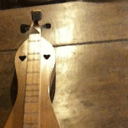
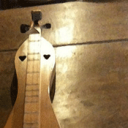
Ken, I thought you might like to see more photos of my dulcimer. Attached are photos showing the label, back with feet, and a side view showing what I'm told is unusual, 'open' fretboard sides. Reminds me of a Roman aqueduct. There are openings cut in the dulcimer top, somewhat corresponding to these fretboard openings.
Thanks for the info, Ken. I happened upon this dulcimer four years ago at a guitar show, took it home cleaned it up and restrung it. Reading Jean Ritchie's books and other research explained what I had, in the way of staple frets, hand made pegs, etc. The label shows it was made by Carl E. LaTray, of Frankfort, NY, dated March 20, 1969, and he designated it "No. 1". Couldn't find much on him, except that he did make instruments as a hobby, and passed away in 2013, at the age of 85. The strings I currently have on it are D'Addario's, 12, 12, and a wound 22. I suspect they are too heavy for the instrument, which may contribute to the peg slipping problem (?). The VSL is 28" exactly. I didn't think I needed as many wraps around the pegs, but when I wrap less of the 22 gauge string it consistently snaps as I'm turning it up to tone, for some reason. I have actually tuned it as you suggest - a bit sharp and let it settle back to tone. Ken Longfield and I had been communicating on this forum some time ago about this instrument, and he took a look at it during a visit to my area. I'll try for lighter strings and less wraps if that's what you recommend. Thanks again.
Having looked at the photos you posted in your other thread, Roy, It is obvious that you have a very nice older dulcemore intended only for Noter & Drone or Fingerdancing style play. The instrument is in the style of a Kentucky or JE Thomas dulcemore with staple frets under only the melody string. There is no 6+ fret either, again pointing to the traditional nature of the instrument
That is a very nice older "Kentucky style" similar to a J.E. "Uncle Ed" Thomas dulcemore with staple frets under only the melody string -- thus intended strictly for Noter & Drone or Fingerdancing style play. There is no 6+ fret.
If you look through the rear sound holes with a flashlight, is there any sort of maker's label, or written name/date in the wood of the inside bottom?
Personally I would do everything possible to keep the original pegs functioning. Although they are "in the style of" I don't believe those are commercial pegs.
What is the VSL? That's what we need to determine which strings you'll need. Is the bass string wound? It's hard to tell. Many/most traditional dulcemores did not use wound bass strings, which contributes to the 'high silvery' sound of traditional dulcemores rather than the deeper more mellow tone of modern dulcimers.
You do not need all those wraps of string around the pegs. Through the hole and around twice is all that's necessary; then cut of the excess to avoid birds nests in the pegbox.
If you have a micrometer, you could mike the strings and see what is currently installed. But with the VSL and knowing you want to tune DAA, we can use a calculator to determine more exact gauges. However, for VSLs between 24-26", a pair of plain steel .012s for the melody and mid drone, and a plain .018 or .020 for the bass are a good place to start.
Tuning a bit sharp, with a push at the end to lock the peg is the technique I use. Then as you play a bit the strings stretch just a hair reducing the sharpness. Since we mostly play solo, the exact notes of the tuning are not super critical, although too sharp or too flat don't sound very sweet together.
Ken, I think I've now attached two photos. Thanks for your help.
@jost -- A transitioning guitar player has to understand that the usual flat finger type of fretting which works on guitar doesn't work well on a dulcimer flat in your lap; a more finger-tip approach is required. I think Roy is wise to change playing style to noter as the way to transition from painful guitar to dulcimer. Trying to treat a dulcimer as a miniature guitar can be fraught with "issues". Learning the dulcimer as the dulcimer is traditionally played -- and then adapting some guitar technique seems best among those I know who have transitioned.
Jost, I haven't mastered chording (as opposed to the noter) or finger picking, as opposed to a pick. Still learning to tune (see my other posts about my wooden tuner battle) and pick out tunes with a noter. I think the distance between strings is the same on the dulcimer as it is on the guitar, but I can see needing a wider fretboard if you're used to a guitar fretboard. I'm personally more comfortable with a 2" classical guitar type fretboard, and have found even 1/8" difference can make fretting harder.
Thanks Skip. That's what I've been doing lately. Very frustrating to have such a learning curve ahead of me for what should be a simple tuning process. Used to guitars and ukuleles. Never played violin.
Ok. I had the same slipping problem the first time I messed with wood pegs. What I found to work best for me is to push the peg further into the hole as I finished, maybe going a little bit past where I wanted to be.
Skip, to answer your question - this is my first experience with wooden pegs. Only used to guitar type geared tuners.
Yes Ken, I'm going for at least a DAA option
VSL is exactly 28"
I'll try to post photos later.
What is your VSL (distance between nut and bridge)? String gauges are dependent on the VSL and the open tuning of the strings. I take it you're trying to tune DAA.
The age of your dulcimer isn't really a factor; but without a photo or two we can't tell whether the builder used hand-made pegs or regular commercial violin pegs.
I personally build several 24"-26" VSL dulcemore patterns, and use what are called 1/4 size Violin pegs and a standard violin taper reamer to taper the holes in the peghead. Those pegs are about the dimensions you mention, and they tune just fine to D and even E and high -- with appropriate gauge strings -- without any issues.
Have you used wood pegs before? Just curious.
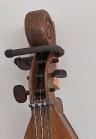
So I changed the (old) strings, sanded the pegs as suggested and applied a little paste. The pegs are a bit more usable, but still won't stay put at anything above C-G-G, and even that combination is actually flat (really B#-F#-F# - yes I know there's no B#). Should I perhaps try lighter gauge strings? I'm currently using D'Addario 12, 12 and 22w. Also, my dulcimer is a hand made instrument from 1969, with what seem to be pegs on the smaller side - 2" long shaft, but a diameter of 1/4" tapered down to 3/16". Thanks
The style also depends on your instrument and your fingers ( at least in my humble opinion). My dulcimers fretboard is quite narrow thus I plain only noter/drone style ( Sound is great!) since my fingers always touch their neighbour strings. Of course one might argue that the fretboard isn't too narrow but my fingers to thick 😀
I'm saving money for getting another one with a wider fretboard now.
So: If you are interested in a certain style it might be an idea to get an instrument designed for it.
Like Dusty I would suggest to try several style and See what fit's you best.
Just my two Cents
Btw: I'm playing guitar ( first chord strumming, now mainly finger-picking) too. I switch Instruments when one tires my fingers out too much.
Thanks Dusty. Definitely food for thought.
@RoyB, I would encourage you to think of noter/drone play not as a beginner "stage" in your dulcimer playing but as a unique style that may be relatively easy to learn at first but still requires years of practice to master. You might consider embracing that style and planning on developing your noter technique over time.
On the other hand, if you want to play more modern styles of music on your dulcimer, you might be able to despite your arthritis. With five fingers and only three strings, there are multiple ways of fingering chords and playing melodies across those strings. I have a private student who has pretty bad arthritis in 1-2 fingers of her fretting hand, and we find ways to work around that limitation, either by finding alternative fingerings or sometimes revising arrangements.
And I should add that there are some great dulcimer players who don't use their pinky at all.
My advice is to concentrate on learning the instrument and playing the music you like. Unless your arthritis gets much, much worse, there will be work-arounds for any obstacles you encounter.
Thanks, Lois. While I fingerpick folk music on guitar, I'm still at the noter stage on dulcimer. Saw a doctor and am treating what seems to be an arthritic finger (ain't gettin' old great?), but I may be joining your camp - I don't know how much I want to push my luck with it.
Thank you, Ken & Leo, for making me doubt I under-watered, although the summer/winter differences are worth remembering. This is the first I've heard of it. I really suspect my problem is lack of attention. I'm fairly sure the planting medium was dry whenever I watered. Saying "summer watering on the order of twice a week" is definitely not what I've done. These aren't cacti and they may be getting too little light, too. (It's a big east facing window that isn't used constantly.) For now I'll keep the few that have survived, but have two small pots that I'd love to fill. Suspect some time I'll give in to the temptation when I see them at the grocery store or nearby greenhouse/plant store. Hate to be a serial plant killer.
While I still will use a guitar when needed for my storytelling programs, it's not easy with my fretting hand shortened on the pinky finger due to Dupuytren's Contracture. I had the finger worked on once, but the brace I was supposed to use during recovery was too big & the finger became worse. Not interested in possibly tempting my luck further with other treatment. Fortunately the dulcimer is easier even when I do something forming a chord. I'm told I mainly "finger dance" as I find the noter doesn't quite satisfy my desire to be "hands on."
Dusty, That's a good idea. Thanks. In the flesh, so to speak, is always preferable.
Curtis, I see you are in the San Diego area. If you haven't already done so, you might consider contacting the Southern California Dulcimer Heritage Society . They hold a big annual event in the fall, and you might be able to showcase some of your instruments there. @Leo-Kretzner is a member here and is intimately involved in that group. He might have some advice for you as well.
If you are going to sell some of them, it's the shipping which will become the biggest chore, and the protective packaging so they don't get crushed in transit, and just getting suitable shipping boxes.
Are you saying you have over 80 dulcimers? You may want to get a well advertised estate sale going and a professional person to help with this. It's a whole lot of dulcimers.
Jim, I have an old John Maxwell dulcimer that was missing a peg when I bought it. I fashioned a new one of maple that looked similar to the original. His pegs were distinctive.