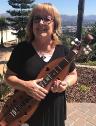
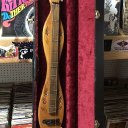
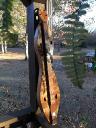
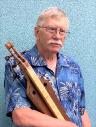
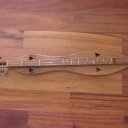
Heard of "The Left Hand Dulcimer Band"?
General mountain dulcimer or music discussions
See pages 31-33 of the book in this link. It may help you find one of the band members. https://issuu.com/dulcimerplayersnewsinc/docs/14-1
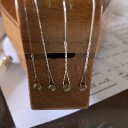
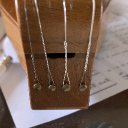
When I replace my strings do they include the chenille wrap on the loop ends that looks like fly fishing wrap?
No, if you buy dulcimer string sets. I am not aware of any manufacturers who offer this.
Why did they wrap the loop end with chenille?
This is a feature of some banjo strings. The chenille was added to prevent overtones and the string rattling on the banjo tailpiece which is made of metal. Dulcimer players would buy banjo strings in the proper gauges to put on their dulcimers because they were loop end strings. This was before dulcimer string sets became readily available. Under tension dulcimer strings can eat in to the end of the fret board depending upon how they are attached and chenille my help prevent this.
If by chance you say new strings do not include chenille loop ends since that was done in the 70’s, then why not wrap them any more?
Banjos still have metal tailpieces. Again, I am not aware of dulcimer string sets that come with chenille wrap.
Do new steel strings stretch like ukulele strings after they’re installed?
No, steel string stretch, but not as much as nylon ukulele strings. After steel strings are brought up to the proper pitch, they will stretch a little and need to be tightened. Like other materials, steel is subject to expanding when hot and shrinking when cold, so changes in temperature will require tuning. So will changes in humidity as that effects the wood of the dulcimer.
You can purchase strings for you dulcimer from The Dulcimer Shoppe in Mountain View, Arkansas. They offer sets for DAA or DAd tunings.
I hope this helps you.
Ken
"The dulcimer sings a sweet song."
When I replace my strings do they include the chenille wrap on the loop ends that looks like fly fishing wrap?
No, if you buy dulcimer string sets. I am not aware of any manufacturers who offer this.
Why did they wrap the loop end with chenille?
This is a feature of some banjo strings. The chenille was added to prevent overtones and the string rattling on the banjo tailpiece which is made of metal. Dulcimer players would buy banjo strings in the proper gauges to put on their dulcimers because they were loop end strings. This was before dulcimer string sets became readily available. Under tension dulcimer strings can eat in to the end of the fret board depending upon how they are attached and chenille my help prevent this.
If by chance you say new strings do not include chenille loop ends since that was done in the 70’s, then why not wrap them any more?
Banjos still have metal tailpieces. Again, I am not aware of dulcimer string sets that come with chenille wrap.
Do new steel strings stretch like ukulele strings after they’re installed?
No, steel string stretch, but not as much as nylon ukulele strings. After steel strings are brought up to the proper pitch, they will stretch a little and need to be tightened. Like other materials, steel is subject to expanding when hot and shrinking when cold, so changes in temperature will require tuning. So will changes in humidity as that effects the wood of the dulcimer.
You can purchase strings for you dulcimer from The Dulcimer Shoppe in Mountain View, Arkansas. They offer sets for DAA or DAd tunings.
I hope this helps you.
Ken
"The dulcimer sings a sweet song."
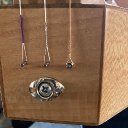
It looks like string tension has pulled the pins toward the saddle. One reason this could happen is the pins are too short to take the pressure of a tightened string. Ken's suggestion to use at least 1" brads is one solution. Another reason this could have occurred is that the wood is not very hard. And yet another is too much pressure on the pins from over tuning. Two other solutions for this problem are to use screws instead of brads or to move the brads from their current position to the end of the dulcimer. The latter might cause the strings to imbed themselves in the end of the fret board as they pass over the top of the dulcimer.
The saddle in the second photo shows quite a bit of damage and needs to be replaced. In replacing it you need to measure its size; length, width, height. If you can't find the exact size for replacement you will need to purchase something a little larger and sand it down. Two places to look for parts for dulcimers are www.folkcraft.com and https://mcspaddendulcimers.com . You may have to search the sites to find what you want.
Ken
"The dulcimer sings a sweet song."
Tailpins made of nails aren't a problem with loop-end strings. When I started with dulcimers in the mid-70s, all of the strings were loop-end, sometimes with green chenille wrapped into the windings!
Ball-end strings can be converted to loop-end strings by removing the "ball". If you dare, take heavy electrician's pliers and squeeze the thing until it cracks, then remove the pieces. VOILA! A loop-end string!
I suspect someone who didn't know better forced the brads down to hold the strings in place while tuning. A bad move, and probably not done by the maker.
I removed the strings a couple days ago. In two cases the brads just fell out. New parts will be here on Tuesday and I'll be back to update you all on my progress.
Also, the in other cases the strings couldn't be removed without puling the brads out. It seems to me an odd way to do something when you know you're going to have to replace the strings at some point.
You know, unless the pins/brads/nails are loose, you don't have a problem. Typically they aren't driven all the way in, but leave a small amount of the shaft exposed, on which the loop sits. The head helps keep the string from sliding off. Consider simply replacing the strings (who know how old they are!) and find someone to help you and your wife get started playing!
Beautiful, Susie! I'm a fan of the Gingers and think they sound great tuned up to F, G, or A.
Thank you Dusty. I've wanted to add a Ginger to my stable, and I'm sure glad I did. I'm loving it in the G tuning right now, but I may experiment with other tunings down the road. They are fun!
What a pretty cherry Ginger Susie! And the pair together are so complimentary.
Sounds like you did some good research beforehand as to what your preferences and needs are. Good for you!
Enjoy your sweet new bright singing bird.
Thank you Strumelia. Yes, I wanted the two to give me a variety in my music....they are part of some other wonderful dulcimers in my life. I did do research, and I appreciate the feedback I got from the members here. I'm enjoying the new Ginger so much already.
When you're ready to set the new nuts/bridges, start a new thread here so that we can talk you through the simple process of setting the "action height" -- distance of strings above frets -- to something that won't slice your fingers!
Darn! My loss for sure. There's tons you could teach me I'm sure.
Parts are ordered, so I imagine early next week I can get to work!
OK, so not around the corner from my shop!
Thank you all. I sort of knew what needed to be done and you've helped me decide how to go about this. I'm going to attempt repair instead of writing it off as a poor decision to purchase them. If it doesn't go well, I'm not out much in the way of money and I'll have learned something in the process.
Oh, to answer John's question I'm in Wayne Nebraska.
Thanx Ken, I completely missed the bridge in that second photo. You're right, that looks like a common Delrin(tm) bridge from McSpad or Folkcraft, and it really needs replacing.
Beautiful, Susie! I'm a fan of the Gingers and think they sound great tuned up to F, G, or A.
What a pretty cherry Ginger Susie! And the pair together are so complimentary.
Sounds like you did some good research beforehand as to what your preferences and needs are. Good for you!
Enjoy your sweet new bright singing bird.
It looks like string tension has pulled the pins toward the saddle. One reason this could happen is the pins are too short to take the pressure of a tightened string. Ken's suggestion to use at least 1" brads is one solution. Another reason this could have occurred is that the wood is not very hard. And yet another is too much pressure on the pins from over tuning. Two other solutions for this problem are to use screws instead of brads or to move the brads from their current position to the end of the dulcimer. The latter might cause the strings to imbed themselves in the end of the fret board as they pass over the top of the dulcimer.
The saddle in the second photo shows quite a bit of damage and needs to be replaced. In replacing it you need to measure its size; length, width, height. If you can't find the exact size for replacement you will need to purchase something a little larger and sand it down. Two places to look for parts for dulcimers are www.folkcraft.com and https://mcspaddendulcimers.com . You may have to search the sites to find what you want.
Ken
"The dulcimer sings a sweet song."
I received my new McSpadden Ginger (all cherry). I absolutely love its sound, workmanship, and beauty. It is clear, articulate, and balanced. The sustain and volume are really good, even though it is a smaller dulcimer. I went with the G tuning, to give all my songs a new voice. It's going to be fun, whether playing at home or at festivals. It completes a great duo, with its big sister, an all walnut standard McSpadden (26"), and complements my other (brand) dulcimers. I did a lot of thinking before ordering this and even contacted some members here for their insights (thanks again). I'm very happy with my choice to go with the cherry, an under-rated tonewood, in the world of walnut dulcimers. I don't think the woods make a significant difference, and cherry can be so visually appealing in its own way.
Those brass brads are very common as string pins even among the best of dulcimer builders; they do not get tapped in to hold the string in place. Pressure of the strings being tightened is what holds the strings on the pins.
Are the existing pins actually loose, or are you just interested in making them look more aesthetically pleasing?
The 'odd' bit is that someone used a ball-end string to make a loop-end rather than using all loop end strings. I suggest using only loop-end strings on instruments with this string-pin arrangement. Or, if you want to be able to use ball-end strings as well as loop-ends, use headless string pins of small enough diameter that the ball of ball-end strings can be slid onto the shaft of the pin.
The simplest repair is to just put new 1" brads in place a half-inch up from the old positions. Sink them in about as far as the existing brads -- say 3/4" deep, Then sand and fill the old holes with glue-dust or wood putty.
You didn't post any photos of the nuts/bridges, so we can't tell what kind they are, how they are set into or onto the fretboard, or whether they actually need replacing.
John, Ken: Thanks for your quick responses. One other thing is that both instruments will need new bridges and probably tuning pegs. Do you know of a reputable website for purchasing these items?
Thanks again,
Mike
Ken's right-- it would be best to see a photo or two. The fix shouldn't be that difficult, based on what you've said.
Are you by any chance in Wayne County, MI?
I read the Calistoga fire evacuation ended. I’m not sure how long it lasted. Thankfully nobody was injured and the town was spared. Hopefully it won’t delay my dulcimer too much. I’m sure he’s got other things on his mind right now.
Mike, without a photo to see exactly what is going on with the dulcimers, I'm giving advice blindly.You could pull out all the string anchors and fill the holes with some type of wood. If it is a small hole, you might be able to use a round tooth pick. for slightly larger holes you might find a dowel that fits. Once glued in you can put in either small brads or nails. Not knowing how thick the end block is, it could be that the anchors don't go far enough in to the block not to bend. Another option is to use small #2 brass screws of 1/2" to 3/4".
I hope this helps with your problem. If not, feel free to ask again.
Ken
"The dulcimer sings a sweet song."
I just bought two Dulcimers at a surplus auction at the local college. Perhaps it wasn't a good idea as the photos weren't very good and pre-inspection isn't a thing at the auctions. I did get them pretty cheap so perhaps it won't be a bad deal.
The problem the both have is that the anchor(?) pins at the base of the instrument and not in good shape at all. They look like someone tightened the strings to tight and they are pulling out. Odd thing is that they look like small brass brads like you would use in finish carpentry. A couple of them look as though you would have had to set the loop end on the string and then tap the 'brad' into place to hold it.
It makes me wonder if these were just poorly constructed and then abused by the students over who knows how many years.
My question is this: My wife and I want to learn to play (retirement hobby) but now I wonder if I should try to repair them. Could new holes be drilled for a more proper hitch pin/anchor?
Thanks for any help you can offer.
Mike
What a great title for a thread! (poem, article, etcetera) I feel that way about many things, certainly wrt consistency of practicing - frequency and time spent. I was more disciplined when younger, for sure. Maybe some folks get better at that but I can't say I have!
I do try to be consistent with 'default' fingerings for chords and the overall fingerings I arrive at for any given piece - though they may need to deviate in other places/tunes. Eg, my 1st position G in DAD tuning, 3-1-0, or the flip of that, 0-1-3, I always do with index on 3 and ring on 1 of the middle string, which is probably a common fingering for that one. Main point w consistency of fingering is having set patterns that become automatic and therefore smoother. I want to try to avoid micro-second slow-downs while my brain is deciding 'which finger??'
As to warm-ups - good question/topic! Running through the scales is always good, and I second Dusty's suggestion of arpeggio's: the notes of a scale that make specific chords, like the d-arpeggio, 0 - 2 - 4 - 7- 4 - 2 - 0, on either bass or melody d-strings; d-arpeg on the middle is 0 - 3 - 5 - 7 - 10 and back again (important!). [Chord tonics/names highlighted.] One G-arpeggio in DAD could be 0 - 3 - 5 - 7 - 10 and back down again on melody or bass d string. Here too, develop a consistent fingering choice/pattern. Can you find an arpeggio going across the strings - first on bass, then middle, then melody, and back?? They are there!
I have a chord-melody warm up I do, especially when rusty. I have tab for it somewhere, but it's this, w scale highlighted:
0-0-0 (D), 1-0-1 (A), 0-0-2 (D), 0-1-3 (G), 0-0-4 or 2-3-4 (D), 3-3-5 (G), 4-4-6+ (A), 0-5-7 (D) and back again. Invert to bass.
Lastly, doing a couple familiar pieces, always. Perhaps choose one or two 'touchstone' pieces you play every time you sit down. (Prediction: You'll get really good at these and they will become 'fallback' or 'in the bag to pull out' pieces.)
I suggest slower-than-performing speed - you are warming up. It's "just" warm up but I say do it well, not sloppy!
More important than people may realize: Since they're familiar - as the patterns above will become - play without tab as much as possible - so you can watch your fingers! This is how to improve technique.
Make sure your fingers are doing what you want them to! (think of them like kids!) You need to make an eye-finger connection for your brain, that it will use when you inevitably need to look elsewhere (sing, etc) while you're playing. Get away from the tab as soon as you can, even if you make more mistakes initially. It's one step back, two steps forward, I guarantee!
O course that doesn't apply strictly to beginners who need more visual reminders, but as you play more, don't remain stuck on 'the paper.' Even for beginners, very simple patterns 0-1-2-3-2-1-0 shouldn't need to be read after the first time or two.
I see there's overlap here between warm-up and practice, but I guess that's the point: Stuff you can consistently do to get you going!
Sorry, I tend to be wordy, but all of the above ends up actually being just 3 or 4 to 10 minutes, max! You can do it!
Nate, as Ken and Skip have explained, the notion of key on a modal instrument gets a little tricky.
I would just define a key as the tonal center of a piece of music, the tone that seems to represent rest or resolution with the other notes creating different degrees of tension.
Your effort to determine key by examining the sharps and flats of a piece makes sense in western classical music, and you are correct that the key of D major has a C# and they key of G has a C natural. That "key signature" defines the major scale, or the Ionian mode. However, with traditional, modal music, any mode can be played in any key, so the key, or tonal center, does not necessarily determine the scale pattern. To use the most common examples, D Ionian uses the C sharp, but D Mixolydian uses the C natural.
In fact, those examples explain why the 6+ fret was added. On a true diatonic dulcimer tuned to D, tuning DAd would not give you a major scale (Ionian mode) precisely because the 6 fret is a C natural. To play the major scale, one would tune DAA and start the scale at the 3rd fret. Then you get the C# on the 9th fret. To avoid having to retune, dulcimer players about a half century ago began adding the 6+ fret so that they could play in the two most common major-sounding modes, the Ionian and Mixolydian, without re-tuning.
Let's also remember that a lot of folk and pop music doesn't use all the notes of the scale or mode. A lot of music is pentatonic, meaning only 5 notes are used. And heck, the old song by the Chrystals, "Da Doo Ron Ron," only has three notes in it!
"So what?" you might ask. Good question. My point is that every song has a key, meaning the tonal center or "home base" even if it does not make use of the scale indicated by the key signature.
Having said all this, I would guess that 90 percent of the time when you are tuned DAA or DAd you are playing in the key of D (or Bm, the "relative minor"). If you fret across all the strings, then you can also play in G and perhaps (though it gets tricky) A. I've recently been arranging several tunes that work in both D and G on the DAd dulcimer. That way you can modulate after a couple of verses and impress your friends and family.
Ok maybe 35 years ago. ;-) my first computer was an Atari 520 st. The internet was just beginning. There were some forums, or I guess they were called bulletin boards or news groups back then. Same idea, slightly different email based format as I recall. It seems like 40 years. Just ask Ken. ;-)
I learned several years ago that it is much easier to understand music theory, as applied to MD, when the word 'key' [in music] has several definitions. One defines or indicates the specific notes in a scale [the one you found], another, more generic, refers to the lowest note in a scale, regardless of the notes involved. The second one can also be a 'keynote' or 'scale center'.
So, in your tune, the written 'key' scale [def 1] is G; the 'key' on the instrument [def 2] is D.
The 6+ can be considered an additional fretboard overlay that modifies the mode layout of the frets. Two fret board layouts, 1 without the 6+, one without the 6.
Yes a little disoriented. I’m getting more familiar as I use it. I guess I imagined that groups were the same as discussions where different topics like “Instruments”, “playing and jamming” or “beginner players” and “fingerpicking” are organized. I guess technically the answer to my question was “no”. Assuming posts to groups are also called topics. I have been kind of looking at the screen with a confused look trying to understand why it seemed like things were in two different places. Now I understand. What can I say? Us old guys take a while. lol
Traildad, Fotmd is a social network, which has more various areas of content than a typical php forum, while it's also more searchable with less marketing than most Facebook pages.
Our Forums section is for most general interest discussions, and you can search within the categories there. But say you are particularly into noter playing, or chromatic dulcimer playing, or building, or dulcimer history- there may be a special interest focus Group for that interest area, where people with a particular passion can hold discussions specifically related to that interest. Having Groups is a way of keeping in one place discussions and info related to that certain focus area. Think of a Group as a club rather than a forum. In this respect Groups are useful. Imagine a new member looking for help in TablEdit or microphones... they can find that help very quickly in our Technology Group rather than searching all over the site.
But the general Forums area is useful because the subjects are more likely to be of interest to the whole membership ... such as changing strings or identifying a mystery dulcimer or finding tab books. Or, just gabbing about something nice that happened to you yesterday, or what new tune you are working on.
I hope that helps clarify a little more the difference between Groups (and their discussions) and the site's "Forums" area. FOTMD includes more than discussions and forums. Members have their own profile page with photo galleries, their videos and audio recordings, and events. Additionally, members can browse and search ALL the site's videos in one place, also all the site's photos and audios. Thus, you can go to a member's page to see that member's content and activity, but you can also go see ALL the photos, audios, or videos on the site in one central place by clicking on the top bar links.
When new members join, they are frequently disoriented by the many site areas and functions... and I understand that they might feel frustrated. I wouldn't want to write tutorials on every area and function here- it would simply take me way too long and few would want to slog through it. People tend to be impatient. But if they stick around and click around, they'll get a sense for how things are organized. Time makes things clearer.
I'll be the first to say FOTMD is not perfect by any means. More than anything else, it's meant to simply be an encouraging and safe place for beginner players to get help and make dulcimer friends.
My curiosity compels me to ask- what forums were you participating in forty years ago? I'm dying to know!
Normally, "the key I'm in" is the open note of the Bass string. That is, the entire instrument is tuned to a particular keynote -- C, D, G, whatever.
The + frets are not there to supply notes -- not just sharps or flats -- above and beyond the diatonic scale. The 6+ fret in particular was added to the fretboard because people wanted to be able to play a C natural as well as the C# which is 'natural' to that diatonic scale.
When I first learned all this we talked about Modes, and the idea that players wanted to be able to play in more than one Mode with re-tuning. DAA (a.k.a. Ionian Mode) is what guitar folks think of as the Natural Major Scale. DAd (a.k.a. Mixolydian Mode) is almost the same -- except that the 7th note of the scale is "flatted" (a half step below what it would be in the Natural Major scale). The 6+ fret was added so that players could play both the natural and the flatted 7th note of a scale starting on the Open fret.
Years ago I wrote the attached article about modes (scales) and the diatonic nature of the dulcimer. It might help you understand things...
I’m not sure if that helps or if I more confused than ever. lol. Maybe there is a forum tutorial I should have read. What is the difference between forums and groups? I thought everything was posted in a group and you had to join the group first. Oh well. I’ve been on forums for forty years and I just haven’t seen this format before. I’ll get the hang of it eventually. :-)
Note that the My Posts tab is on the Forums page. Thus, as you correctly guessed, it shows you which Forum discussions you have posted in.
The "Help me learn this song" group is a Group. Groups have their own discussions which are completely separate from our site discussion Forums. There is no tab that specifically shows you what Group discussions you've been active on, however if you go to a Group that you are a member of, you can see the Group's list of discussions. When you see the 'subscribe' button next to a discussion that is Yellow, you have either posted in that discussion OR you clicked to subscribe to that group discussion. Note that if you post in a Group discussion, you will be automatically subscribed/following it (the button will be yellow to indicate this). You can always click the yellow button to turn OFF your following of that discussion if you no longer want to receive notifications of a new post in that discussion.
Additionally, on your Profile page, there are sections for "All Activity" (all your recent activity, including things you 'liked'), "Latest Group Discussions" (that you have participated in), and "Latest Forum Discussions" (that you have participated in).
The activity sections on your profile page show your activity as opposed to the general site activity of all members seen on the site's Main page.
Hope this helps.
Since I took the screen shot the list has updated with my activity. The list isn’t complete though. I’m not sure how many are missing but the one I posted in “Help me learn this song” is not listed. I’m sure there are others.
On the Forums Page there is a tab “My Posts”. When I click on it I get a page with a list of some topics. Is it supposed to be a list of all topics I’ve posted in or created?
Yes.
On the Forums Page there is a tab “My Posts”. When I click on it I get a page with a list of some topics. Is it supposed to be a list of all topics I’ve posted in or created? Thanks.
Most forums I’ve used take you to the beginning of the conversation at the top if you click the topic link, but have a second “recent” button that takes you to the last post at the bottom. That way you can start reading at either end. This did take some getting used to but at least now I can find the beginning. lol