Deputy Mo ejects Evil Spammer while Strumelia snoozes on the job!
OFF TOPIC discussions
updated by @strumelia: 01/13/19 05:09:18PM
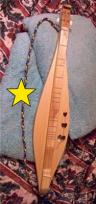
Carol, The possum board with a leg is mine and was made for me by Dave Lynch. He's known as Harpmaker on the discussion because he also makes those as well as dulcimers. You can reach him through his web site Sweet Woods Instruments or go directly to harpmaker (at) sweetwoodsinstruments (dot) com or at 660/ 747 8618
carol anderson said:
I just came across this thread; and wondered if the possum board w/leg is available to buy somewhere, or if it was made by the owner of it?
I'd really like to get one!
Check with David Lynch in Missouri. He makes them. Google him for his website. I think he is also a FOTMD member.
It's funny, but I don't think of DAd and DAA as different tunings so much as different fret numberings. The scale notes are the same except for the 7th note using the 6. They're exactly the same using 6+. So DAd and DAA can play together in the major scale just fine. Never could figure out why people go nuts when someone else is playing the same note but on a different fret.
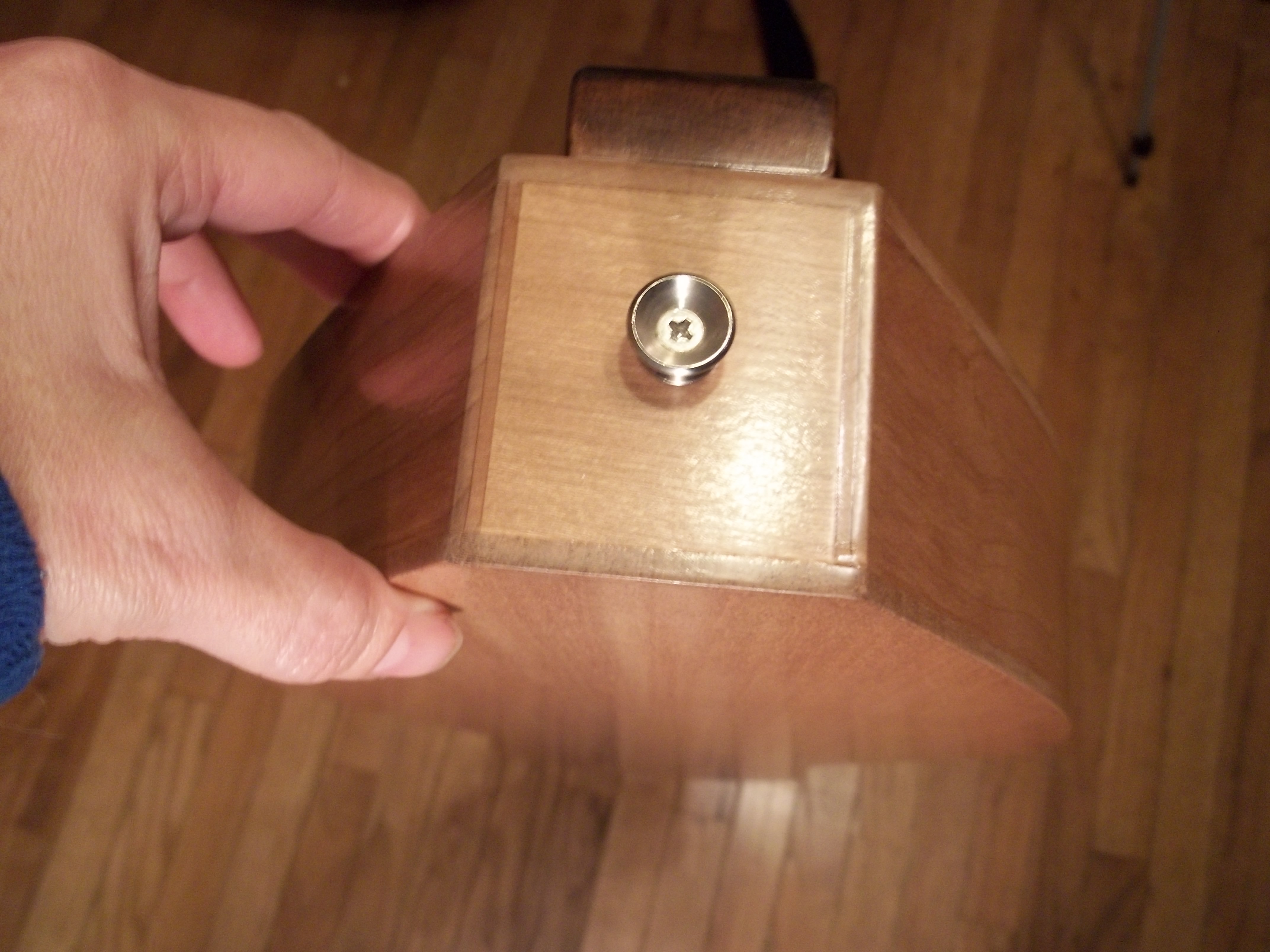
I agree with Strumelian and like to play with a strap holding the dulcimer on my lap. Here's a pic of the strap button I installed on my dulci. It does require drilling a small pilot hole so it is not for the faint of heart worried about their dulci
Google 'harpkit' for an online tuner. It will get you through till you can get one. I just got a new SN8 (from that 'e' place). $12.00 free shipping. It has a larger, easier to see illuminated scale. I like it.
Dana R. McCall said:
Great Gobbs of Goose Grease I've lost my SNARK!!! and my dulcimer is out of tune. It is my favorite and most valuable accessorie. I can't live without it. I need to learn to tune by ear. What am I going to do till I get another one?
That Snark are actually a BooJum Model 666...
Hunting the Snark !  Hmm, make a great title for a book
  , or poem, or something ??? (
  you could always use one of those other dulcimers you have Dana ) A couple of years back I left my 'goodies' bag (couple of tuners, spare strings, hammers, tuning wrench etc) , at a festival, got it back intact !
hope it turns out OK for you !
John
Judy, It lays across my lap flat down. Since the back has a large area covered with the no slip rubber shelf liner, I can angle it just like I angle my dulcimer and it doesn't move. Neither does the dulcimer as I've never lost a dulcimer off of a possum board.
Opportunity's knocking, Dana!
Folkfan's advice is great.
Dana R. McCall said:
Great Gobbs of Goose Grease I've lost my SNARK!!! and my dulcimer is out of tune. It is my favorite and most valuable accessorie. I can't live without it. I need to learn to tune by ear. What am I going to do till I get another one?
Be a traditional player for awhile and tune the instrument to itself. Either start on the bass string or melody and choose a good pitch. The dulcimer will play fine without being at a 440 A exactly. And I hope your SNARK is found or that another arrives quickly. I love my tuners too.
Great Gobbs of Goose Grease I've lost my SNARK!!! and my dulcimer is out of tune. It is my favorite and most valuable accessorie. I can't live without it. I need to learn to tune by ear. What am I going to do till I get another one?
My favorite accessory item is my adjustable playing stand made by Gene Lamprecht of Corpus Christi, TX.Leave my dulcimer on it all day for immediate playing.
A couple of dulcimer stands I have will hold a notebook when I'm playing but not the book and the dulcimer at the same time. It's a pain to have to take the notebook off to put my dulcimer down, so I designed a stand that will hold my music and hold my dulcimer at the same time. And it all folds down into a bag. Then I found this really light weight metal music stand so I designed an attachment that goes on it that holds my dulcimer. I really like dual purpose things.
The idea of a bag to hold an dulcimer on the back of my chair wouldn't be difficult to do though. I posted a picture of the canvas chair I take places with me. I could easily sew a velcro attachment system to the back. That way I could carry more than one dulcimer and know it would be safe. Thanks for the idea. Now back to the drawing board.
If I got one order, it would be for more than I could handle. The trick to the bag is the flat plastic skirt hanger I use for the top which goes over the closet door. It doesn't have any effect on the opening and closing of the doors. It is, however, the type of skirt hanger that has a metal over the rod hook which rotates and I only have 4 of them. hehehehe. So I can make the 4 bags I'd need but wouldn't be able to do anymore until I could find a steady source for something that would function as well as these skirt hangers do and still be at a reasonable price. I got them for free with some slacks I bought.
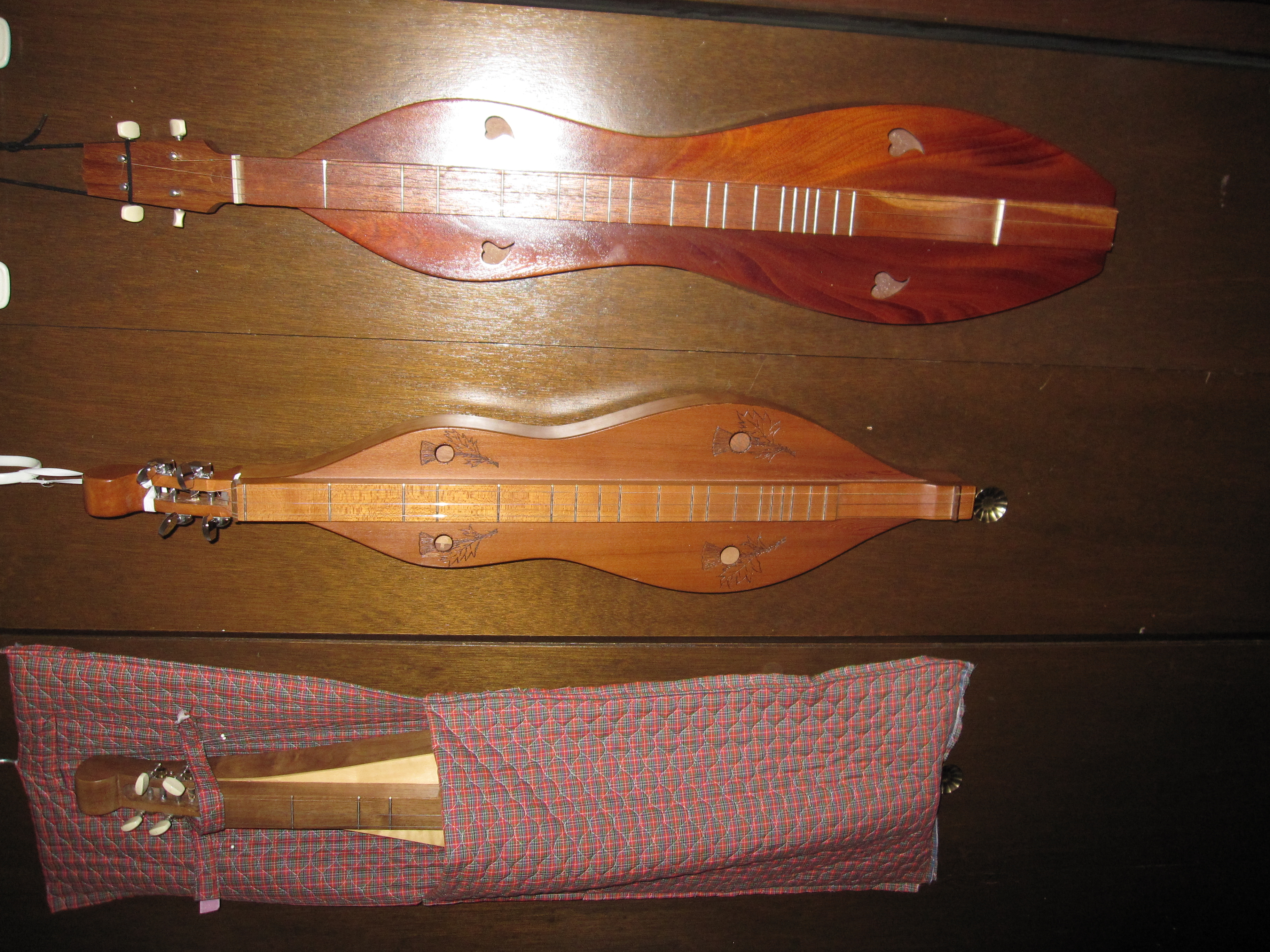
Recently I've been trying to figure out how to keep some of my instrument in my computer room without hanging them on the wall. I've tried hanging 4 of them from a closet door, but I don't really like hanging instrument by their peg heads, especially if they are being hung with pressure on the tuning machine heads. Also though I don't use the closet that much, when I do open the door the backs of the instruments sort of clatter on the wood. Not a good idea. So here's a picture of a prototype of a hanger bag for hanging on the door. It's just roughly done as my good sewing machine that I'd use to finish off the edges is broken at the moment.One instrument is hanging from a skirt hanger, but by it's peg head. The next one is hanging on an over the door hook with the cord through the scroll and not pulling on the tuners. The third is cradled in a quilted fabric bag and doesn't bang or clatter when the door is open. I'm going to make up 4 nicely finished bags on this pattern and get my dulcimers off the floor. And if things go as they have been this picture will be sideways. I'm not sure how to turn them.
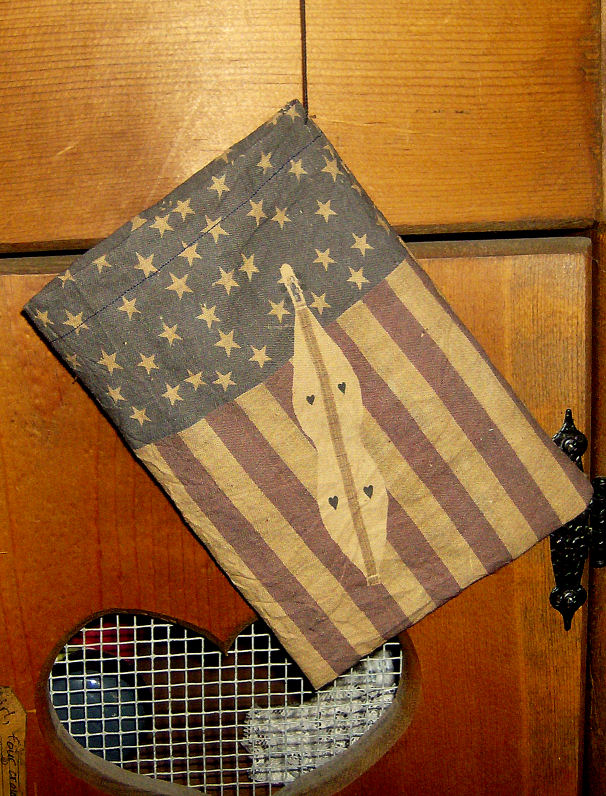
Thanks. Here's an accessory I made for my brother, Dave. He is a luthier and does music festivasl and uses my quilts for table cloths. This one is long and narrow and made completely of hand dyed and batik fabrics.
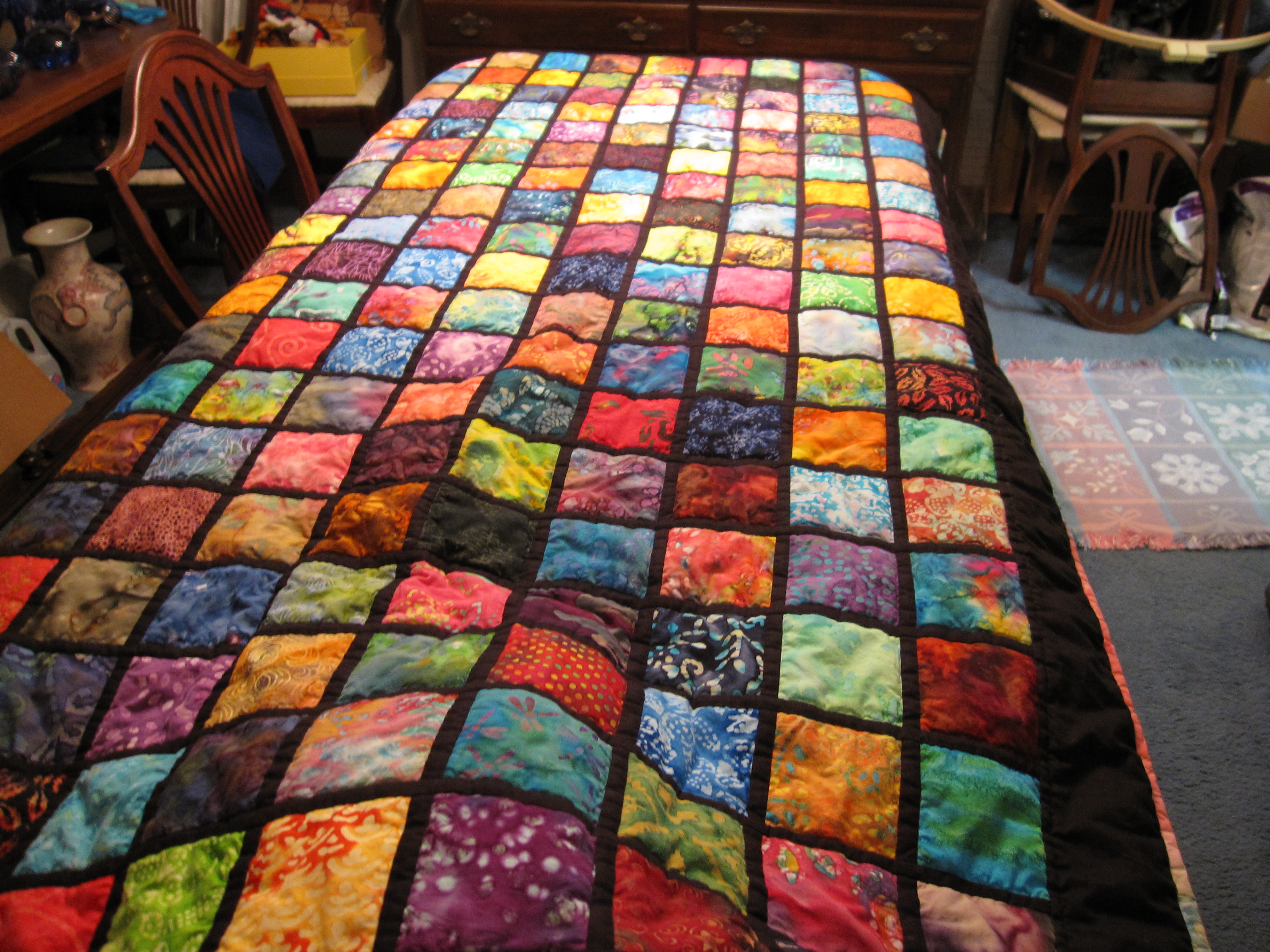
Vicki Miles said:
Excellent idea and beautiful quilts!
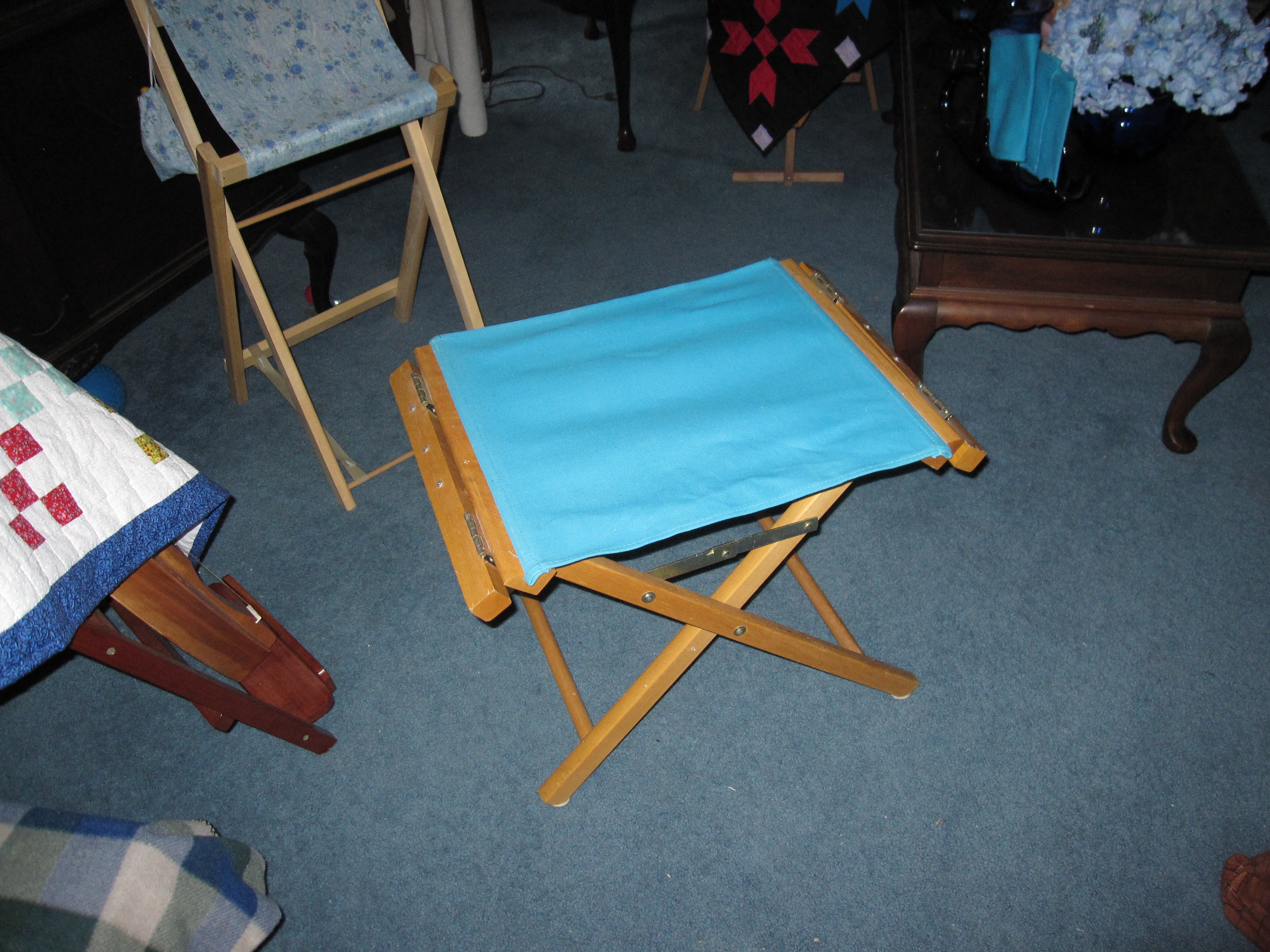
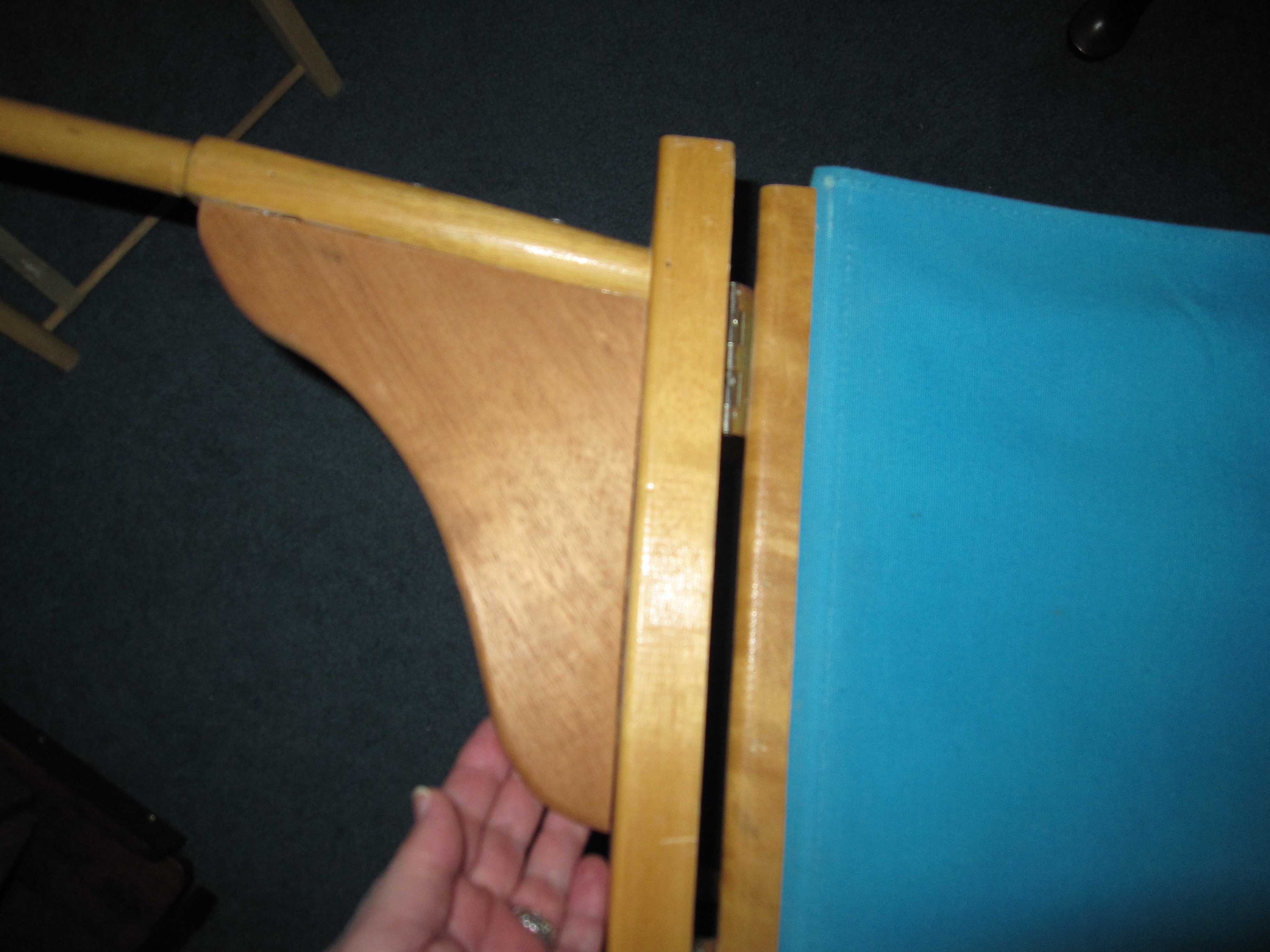
Well I've shown you my favorite pickin' chair for at home, but I will admit to finding it difficult to put in the car. So here is my favorite chair for festivals or for just going outside and sitting on the deck. It's a wooden director's chair that I cut the arms off of so my dulcimer wouldn't be always bumping into them. (Picture 1) However, the lack of arms made the back unsturdy and I used it as a stool for awhile with just the arms down. (Picture 2)But since I wanted to keep the use of the back, I added some wooden braces. (Picture 3). For extra back support I throw a small quilt over it and add a pillow for a more upright sitting angle.(Picture 4)
My dulcimer teacher just introduced me to the folding foot stool made by Lee Felt (aka the Dulcimer Bag Lady). It fits just right for my stumpy little legs. I'm ordering one tomorrow. It'll be easier than sawing the legs of a chair (how does one get them all even?).
Wow after looking online those quilt stands are very pricey so it is not likely there will be one in the goodwill shop. Looking at it though I think some pine shelving and boards will do fine to make one with my jigsaw and drill. I think I will put a slant on it too so they won't fall off. Oh the wheels are turning!!!!
Thanks again Folkfan.
Wow after looking online those quilt stands are very pricey so it is not likely there will be one in the goodwill shop. Looking at it though I think some pine shelving and boards will do fine to make one with my jigsaw and drill. I think I will put a slant on it too so they won't fall off. Oh the wheels are turning!!!!
Thanks again Folkfan.
Ken, I was thinking of makming a fun little YouTube video showing how I make my 'button straps' for my dulcimers. I think I'll do that next! ...and next thing you know there will be button straps on dulcimers everywhere ! ;DLisa, I'd love to see how one of your straps works. Can't quite envision it from the description, and it's neat to hear of a way to do this without putting a strap peg on the instrument.
I would have to say my fiddle is my favorite accessory. Does that count? :)
But the term "possum board" historically refers to a pelt stretcher. Also works for cats, btw, or any similar sized critter, the hide of which one wants to use. For several of the appropriate uses, verses of the song "Ground Hog" are informative. Here is an actual possum board; some dulcimer player realized long ago that it was also an acoustically useful accessory.
http://www.museumofappalachia.org/veWebsite/exhibit1/e10342a.htm
Rosemary,
A dulcimer rests on a possum board for play, allowing the back of the dulcimer to vibrate with greater freedom, thus producing greater volume.
One of my favorite dulcimer accessories is a section of rubber bath mat that's placed on the lap under the dulcimer. Since I don't usually use a strap on my instrument, I like the mat for keeping the instrument from sliding onto the floor. :)