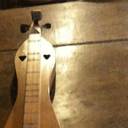
Sears and Roebuck dulcimers
Instruments- discuss specific features, luthiers, instrument problems & questions
@rain-dog It's cool you have the box and everything!
@geezer , I agree with what Brian G advised. With your experience, there really is little need for you to be looking for tab books. Though dulcimers are not tuned to the same intervals as guitars, thus you'd have to learn different fingerings and chords than you use on your guitar. But you should be able to figure out lots of contemporary tunes you already are familiar with, on your own.
If you read sheet music, you can skip looking for dulcimer tabs books and instead do google image searches for tunes you want to play. Keep in mind that if a tune is contemporary, it will more likely be under copyright and this limits your ability to get copies of it for free and/or online... whether it's dulcimer tab, standard sheet music, guitar tab, etc.
@Gennaro - there are skilled dulcimer players around who play complex modern music, blues, baroque music, etc on their dulcimers, and they do it beautifully. But do keep in mind that mountain dulcimers were created in the 1800s in imitation of yet older European folk instruments that were used by 'common folk' to play relatively simple folk tunes and hymns... hence the diatonic fretboard and traditional basic tunings using the tonic note and a fifth for the most part (DAd, DAA). It's a little more challenging to play modern or complex music on a diatonic dulcimer than it is to play such music on a chromatic six string guitar. Some people who play various types of instruments will have different repertoires that they choose for a particular instrument, based on what that instrument is best at doing. There are no actual limits, but know that some things can be easier or more challenging!
If you play other instruments as well, you have a general musical jump start and advantage. But, you won't be able to play the same fingerings/chords you are used to between dulcimer and guitar or banjo.
The wedged in nut and bridge which lean into the center are NOT "standard stuff". They don't have to be 'hammered-in tight' or glued in place, but should not need wedges to hold them either. Neither should the lean in to center, although the tops can be angle cut so that they are thinner on the outside, and may appear to be leaning... Looking at the photos -- that poor of workmanship in the fit of the nut and bridge is not something that Bill would allow out of his shop! My guess is that someone (naming no names) lost the original nut and bridge (perhaps by replacing all the string at once instead of one-by-one) and what you see are improper replacements...
You might call or email Bill, give him the model number of the instrument and explain the situation. Give him the slot measurements and ask him to send you a new nut and bridge. His contact info is on his website:
https://mountainmademusic.com/
The wooden dowel is what we call a Noter and is used to fret the melody strings in the traditional style of dulcimer play called Noter & Drone.
On a 5 string setup, it is not uncommon for the bass couplet to consist of a Dd pair rather than a DD pair. The octave bass couplet gives a richer overall sound. Although I would have used another .010 string rather than a .008 and I believe that is what Bill uses. Perhaps your friend broke the thin bass string and replaced it with what he could find. Overall the other gauges seem fine for that tuning.
No reason you can't change over to a 4-string setup. Just don't put a string on the outer-most of the melody couplet tuners.
Action -- a generally good place to start with the action is what we call the Nickel & Dime. Lay a dime next to the first fret and lower the strings (by sanding the bottom of the nut) until the strings just touch the dime. Then balance a nickel on top of the 7th fret and this time lower the strings by sanding the bridge until the string just touch the coin.
Fretboard 'bow'? I don't see enough there to be an issue as long as it doesn't cause any fretting issues. Most folks don't play as far up as fret 14 anyway!
Thank you Cynthia, Gordon, Robin - I am happy that you like it...and Robin thank you in advance for your participation with your "guitar man"
Oh Dusty - that would be great!
Hi folks, I inherited an older friend’s 5-string Berg dulcimer via his widow asking me if I would ever want to play it. And 5 or 6 years later I have finally pulled out to get acquainted, along with my decades’ ignored guitar. And guess which one fascinates me at this time😀 Ken’s “I just got a dulcimer.....” article was most helpful and has got me off to a good start.
There is no doubt in my mind that the action is too high. There was a wooden dowel with the dulcimer, so I guess my friend was using that to play because it would have otherwise been too tough on his fingers. The nut and bridge are narrower than than the slots provided and they are held in place with outboard wedges that appear to be the same wood as the fret board. I am guessing that this is standard stuff? But are the wedges generally reusable? The nut and bridge lean over towards the middle a bit.
After I am satisfied the with lowering of both the nut and bridge, I will replace the strings. I confess that if this was a 4-string I would have purchased a D’Addario string set on Amazon and been done with it. My friend had apparently only recently purchased this before he passed and I might assume that the string setup would be original, but who knows, eh? The 27.5” (vibrating) string setup diameters and rounded Hz as measured by me are:
D: .022” 147 Hz
d: .008“ 294 Hz
A: .012” 220 Hz
d: .010” 294 Hz
d: .010” 294 Hz
I was surprised that the one “d” was smaller than the other two. The 4 strings off Amazon.ca are .012, 012, .014, .022 and I am happy to mail order elsewhere.
Also, I notice a slight bow in the fretboard mainly around the 14th fret (model aircraft builder, can’t help it, hehe). Hopefully not significant.
Any advice would be appreciated and yeah, I get somewhat wordy, LOL. Existing string sizes, setup OK? Leaning nut/bridge normal?
Cheers!
Glen
I'm also looking for something more contemporary. Bought a 70 song tab book and am only interested in one song. Cat Stevens' Morning has broken. Won't do that again. Found one fellow teaching Norwegian Wood on stick dulcimer but just a lot of strumming. I must be old to consider a 50 yr old song contemporary, but compared to most I see, it is.
Hi Gennaro,
The melody of Morning Has Broken is actually a traditional Scottish Gaelic tune called Bunessan. (And the lyrics for Morning Has Broken were actually written by Eleanor Farjeon and set to this melody). You can find the tune here:
As for Norwegian Wood, I play an arrangement that is not just strumming. In case it helps you in any way, you can see it here:
I'm also looking for something more contemporary. Bought a 70 song tab book and am only interested in one song. Cat Stevens' Morning has broken. Won't do that again. Found one fellow teaching Norwegian Wood on stick dulcimer but just a lot of strumming. I must be old to consider a 50 yr old song contemporary, but compared to most I see, it is.
Hi Geezer,
I would normally suggest getting yourself a software program that can read ABC files (at a minimum) and then using that software to turn those files into tablature. Such software can be found for free, and there are many ABC tune files available for free online.
But if you've been playing classical guitar for 40 years, you can read music, and you can skip the conversion to tab and just look online. There are countless tunes available online for free. To give one example, you can go to http://abcnotation.com/. From there you can get to over 600,000 tunes as abc files, sheet music pdfs, MIDI files, etc. It's truly amazing how much is available.
Enjoy your dulcimer. It's a fantastic instrument. (This is coming from a guy who also studied classical guitar, though I don't play too much anymore, and I haven't played for 40 years.) :)
Yes. I've been playing guitar for 60 years -- mostly classical for the last 40. That might sound impressive to a lot of people, but I'm really not all that good at it. I'm hoping some of what I can do will transfer to some extent.
That festival is only 2 hours away!
Thanks for the info!
Hi Geezer, do you play other instruments or will dulcimer be your first?
Celtic music works beautifully on dulcimer. Many tab books are available (look for Irish, Celtic, O'Carolan in the titles) and you can download free tabs here to get started: https://www.dulcimer.net/dulcimer-celtic-tabs/
Blues is also surprisingly well suited to dulcimer. Bing Futch has the book you need. The festival you need is coming in April: https://fotmd.com/carla-maxwell/event/221/delta-blues-dulcimer-revival-clarksdale-ms#cm165388
A 1-1/2 fret is very useful for blues players. Not mandatory, but it makes life easier.
Jazz standards are tricky. They require notes you can't easily find on a traditional dulcimer fretboard. If that's your music, I suggest you start with a chromatically-fretted dulcimer and check out Stephen Seifert's books and online classes. There is another option: use a regular diatonic fretboard and try Janita Baker's four-string chromatic tunings from her Blues and Ragtime book: https://www.bluelioninstruments.com/books_cds.html
Neither of those options is particularly easy. Quite frankly, if you are a beginning musician and your heart's set on playing Gershwin as soon as possible, then I am honor-bound to tell you it'd be easier on ukulele. There are tons of books and lessons for learning the Great American Songbook on uke. It's hard to find similar materials for dulcimer.
Of course, hard-to-find is not the same as impossible. Here's Misty on dulcimer: https://www.tullglazener.com/instruction-packets/misty
There are probably thousands of books out there now which have tab for a wide variety of musical styles; in particular Celtic. Mel Bay publishes a ton of tab books. Individual artists also make and sell tab books on their own websites. Old jazz standards and blues tab for dulcimer is going to be much harder to find. You can always contact Stephen Seifert directly, and Bing Futch for jazz.
Most of what you mention are not particularly suited for beginners, however. We find that often the best beginning tunes are those which you have imbedded in you since childhood.... tunes you can sing/hum/or whistle on demand. Learning to pick out those sorts of tunes is an excellent way to learn what your dulcimer is capable of.
I'm thinking about trying the dulcimer. I'm going this week to a dealer to look at some instruments. Where can I find music other than Appalachian and hymns? I like old jazz standards such as Misty, The Nearness of You, Someone to Watch Over Me, etc.
I'd also like some Irish/Celtic tunes --- calm, mellow, slower tunes -- maybe even some blues. I've watched a few Stephen Seifert YouTube videos. He play some stuff I really like.
What a fine idea!
Let's see if the muse offers up a new tune . . .
Thank you all for your replies. For some songs, I agree that the percussive click adds a cool rhythm element, just like it does on guitar. It made a really big difference when I switched from the thin, large triangular pick that came with the dulcimer to one of my thicker guitar picks, where I don't have as much of the point exposed. As a new dulcimist, I wouldn't have reached those conclusions on my own this quickly without your help!
Last night, I realized I'd learned all but one chord to James Taylor's cowboy lullabye, "Sweet Baby James," so I looked up Bm and started playing. Suddenly, it felt like I was back on the steps at my grandparents' home in south Arkansas in 1972, struggling to change through the same chords on my first guitar. So my new-to-me dulcimer has already brought back some wonderful memories and enabled me to appreciate the joy of learning an old, old favorite--all over again in a new way.
Welcome to the group, Rain Dog! This is a great resource for dulcimer new-bies. Ask a lot of questions if you like. One of us (at least) should be able to help you out. Have a good day!
Looking forward to this! I marvel at your talents, Ariane.
This sounds like a real good idea, thanks Ariane!!
Aw, this will bloom into so much joy for everyone and you! You're awesome.
NEW ONLINE PROJECT "MUSICAL SPRING 2020"
Since the "Musical Advent/Christmas" online calendar was so much joy and fun there is the idea of making a new online calendar project: "Musical Spring 2020"
Filled with preferably original compositions preferably on mountain or hammered dulcimer.
It is of course possible to participate with a recording of a public domain tune ideally having a kind of "spring theme" (flowers, warmth, blossoming, awakening, cycle, love, feelings etc.).
The recordings should be newly made - so to say recorded especially for this "Spring Calendar".
You will need to upload your recording as "not listed" on youtube or soundcloud and send me the link per private message.
(In case you do not have a youtube channel you can send me your audio file (best as mp3 file) per private message and I can upload it on to my youtube channel for you.)
The beginning and ending of this "Spring Calendar" is depending on how many musicians will participate.
Most probably the "Spring Calendar" will start on Easter Sunday (April 12, 2020) and will be posted in the dulcimer Facebook groups and dulcimer forums.
I make this post already now so that you will have enough time for creating your original composition.
And now...I am looking forward to all participants! 😊
Thanks for the link, Dusty! I hope no one feels the need to correct the fretboards being referred to as "necks". Our humble instrument is a wonderful thing.
A few comments, some of which have already been stated.
A thicker pick will lead to less pick clack.
Holding the pick so that less sticks out of your fingers will decrease the contact between the pick and the fretboard. Remember that you only have to graze the top of the strings. You don't have to actually dig down beneath them.
Some pick materials make more clack than others. I am not fan of the felt picks Lois recommends because it is too hard to pick individual strings or play fast. But you might experiment with different brands of picks and different models from different brands and see if some have less clack than others. (I've actually started using pretty expensive picks because they have a warmer, less plasticky tone and very little pick clack. But the really expensive one I have was given as a gift. I would never spend $35 on a single pick, and you shouldn't either!)
You probably hear the pick clack more than your audience.
Some people, as Strumelia explains, don't mind the pick clack at all. Personally, I enjoy hearing fingers sliding on strings and picks hitting the instrument. It's a reminder that playing an instrument is a tactile experience as well as a musical one and is not merely a computer producing clean digital tones. (I like to hear the valve noise of jazz saxophone players, too.)
If you really hate it, play with your fingers. I love the soft sound of bare fingertips caressing the strings. Linda Brockinton and Nina Zanetti play such moving music. You can, too.
Folks, here's another newspaper article on a dulcimer club in Jasper, IN.
Dulcimer Group Relaxes the Strings of Life
This won't help with any "bad habit", but if you're playing a piece where you don't want that percussive sound I strongly recommend felt picks. I also find they don't produce as loud a sound. I tend to think of myself as having a fairly strong voice, but picks produce so much louder sounds that it can be hard to be heard over it in an acoustic setting without a microphone.
Pick click comes from a couple of things. Thinness of the pick; how deep the pick goes below the plane of the strings; and your wrist action together with how you hold the pick.
Thicker pick with less of it sticking out of your fist (and not going deep below the string plane) usually go a long way towards solving the CLICK.
Still, your hand/wrist action is an important part of controlling the sound of the pick. If you are holding the pick rigidly upright like this: | as you strum across the strings, the drag as the pick passes each string and releases it -- causes the dreaded CLICK. If instead, you rotate your wrist and the "attack" of the pick, you'll get a lot softer sound. As you strum outward and inward, rotate your wrist a bit in each direction so that the pick slips or brushes across strings rather than digging into them. Like this: /outward and this: \inward only even flatter angles...
You can try a thicker pick to soften that pick clicking noise. Or you can try angling the pick differently.
Some people (myself included) actually like that pick clicking/percussion effect and use it as part of our personal playing sound. One person's "bad habit" may be another person's 'bonus effect'!
I'm learning to play quickly after almost 50 years with other stringed instruments, but it feels like I may be developing a bad habit. When I strum with a thin triangular pick over the lower bout sound holes to get a sweeter tone, I'm also getting a consistent click from the pick striking the fretboard.
I watched a very experienced player recently and noticed some clicking from him, too. Is that sound just inevitable, or is there a technique I should be using to minimize pick click when I'm not strumming over the scooped portion of the instrument?
Thanks for any advice!
I'm sure I'll be trying a variety of styles. I am going to grow my nails. I am currently trying just a thumb pick to get a better strum. My thumb nail works for picking, but I'm not satisfied with the muted strum my thumb provides.I have moved to the hollow when finger picking, as suggested. Not so much, flat picking. I'll be having a work shop soon for Twinkle Twinkle. lol
~L~ Yeah, I saw that! No worries, I think a lot of us feel the same. When there is a real passion for playing, both the music and the instrument, there is always something new to learn...and a lot of practice.
Make sure to join and the Fingerpicking group/forum. Lot's of good people there. Just 'cause y'all don't JUST fingerpick! ~L~. Grow your nails or don't. How far up or down the fret board do you play?
Lot's of good people at FOTMD. This is one great site.
Thanks! Only a little over a year ago, I decided to make a cardboard dulcimer more as an art/craft project, and if it was fun/easy to play, bonus. Who knew it would lead to all this? I'm having SO MUCH FUN!
I have to admit to a bit of a bias. I was initially taught to play by fingerpicking. It is all I do. But then, I lack some of the needed coordination to use a pick. That and toe tapping for time keeping.
~L~ None of it matters when the instrument is sweet and the desire is 'there', eh?
I spent 7 years practicing guitar ( notice I didn't say playing). I flat picked the whole time so it feels natural. I just always wanted to try finger picking and figured since I'm just starting, why not.
John Calkin has a facebook page noted as JohnCalkin.92. The guitars that Huss & Dalton build cost about 4 grand, so I would venture to say that John is a top notch builder of acoustic instruments. Drop him a note on facebook if you wish.....
Thanks. I'm definitely going to look him up.
A beautiful and unusual looking dulcimer, Gennaro! Congratulations!
I've gotten pegs from both these, and been very happy.
Here's a source for inexpensive pegs of various sizes.
http://www.newarkmusical.com/index.php?cPath=322_25_332
A little more expensive, but good selection of woods:
https://fiddlershop.com/collections/violin-pegs/product-type_pegs
John Calkin has a facebook page noted as JohnCalkin.92. The guitars that Huss & Dalton build cost about 4 grand, so I would venture to say that John is a top notch builder of acoustic instruments. Drop him a note on facebook if you wish.....