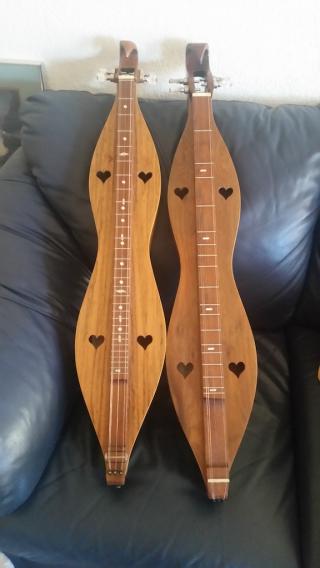
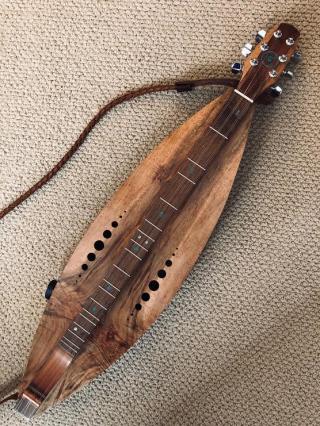
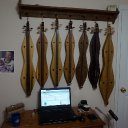
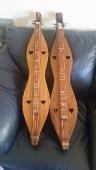
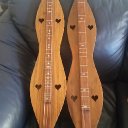
@Kusani, the burl maple top on that dulcimer is astounding!
updated by @dusty: 11/17/18 12:04:44PM
Probably not what you're looking for but I just say "collection"... though agglomeration and arsenal come to mind as well.
Well, Dan, I've never really thought about this. I usually just say I have "a lot" of dulcimers or sometimes a "bunch." All I know is that I keep enlarging the "herd" despite trying to thin it from time-to-time.
Ken
"The dulcimer sings a sweet song."
Wow, @Kusani ! That wood is stunningly beautiful!
I feel lucky to have several wonderful dulcimers! If I could keep just one-- I've referred to it before as my nursing home dulcimer because I'd have to choose one when I go into nusing home someday-- it'd be my Blue Lion Jean Ritchie model.
My purple 28 inch ultra-lite. It is what I'd describe as the most traditional....
DAN
www.dulcimore.com
@lisa-summey , are you still having problems with this? Do you think you got the dulcimer tuned correctly with your electronic tuner? Is it holding now?
I don't recall a discussion on the name of our group of dulcimores. I refer to them as a "clutch" , but would like to hear what you guys call them.... maybe put together a survey?
DAN
Jane, I'm so glad you are enjoying your dulcimer and enjoying the site here! 
...
Dan does a very good job of making things from wood.
Ken
"The dulcimer sings a sweet song."
Dan makes some wonderful modern style dulcimers. Great quality for a decent price. Earlier this year they moved from Yreka, CA to Wabash, IL, and are happy for the change.
Groundhog is one of many names for a very large underground dwelling rodent. Think underground beaver. Beaver live in water, Groundhogs live underground. They're 16"-20" and weigh up to 20 lbs. Vegetarian, they love to raid gardens and large crop fields and so are considered pests. Relatively easily caught, they were sort of 'survival food' for early pioneers. Reasonably tasty.
We sing about railroad men so much because they were our Industrial Age heroes. They connected one side of this huge country to the other. They worked hard and played hard. England had/has its canals that connected the industrial Midlands to the coastal ports -- Josiah Wedgewood helped build canals so his pottery could get to the coast without half of every wagonload being broken. You also had your Navvies who dug and built, and the sailors who linked the pieces of the EMpire together.
I play the old ballads myself. The Child Ballads and others -- 16th and 17th century versions of the tunes and words that changed dozens of times between there and then, and here and now. From the Elfin Knight to Scarborough Fair. All the dozens of versions of The Riddle Song from Lay the Bend to the Bonnie Broom on down through history.
The site looks good. It is easy to navigate. Thanks for keeping it simple and elegant.
Ken
"The dulcimer sings a sweet song."
I plan to check back from time to time to see what's listed for MI, OH, IN.
Most folks remove the outer melody string if they are playing chords as they get a bit more fretboard to press on. Most Noter & Drone stylists remove the inner melody string so there is more space between the melody and middle drone string and less chance of the noter getting caught in the middle drone.
I believe it's your option. If if it were me, I would remove the inside melody string. Inside, meaning the one next to the middle string.
Which string should be removed for a three string dulcimer
Do you have a pic of the one you’re interested in?
I was looking for a new MD and while searching discovered one I never heard of but worth sharing. Not trying to promote or play any games...just a regular corn lovin Iowa boy playing MD in the Midwest here. I was impressed with the sound before looks mindset and they are priced right too!! Lol. Search for em on the tube for sound samples and specs. Website is newtraditionsdulcimers.com
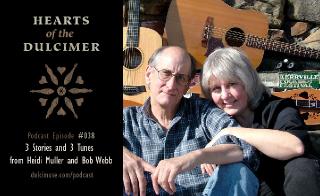
Hearts of the Dulcimer Podcast - Episode 38
3 Stories and 3 Tunes from Heidi Muller and Bob Webb
Winter’s Turning, My Barista, and Sacred Ground. What do they have in common? They were all written by singer songwriter and dulcimer player Heidi Muller. Heidi and her husband Bob Webb tell us the stories behind each of these three tunes.
Hearts of the Dulcimer Podcast can be found on most podcast apps.
Here's the link to Hearts of the Dulcimer on iTunes: http://bit.ly/hotdpodcast
Don't use a podcast app or iTunes? You can listen to all the podcast episodes directly on our website: http://dulcimuse.com/podcast
We also have a resource page for every episode, where you can find photos, videos, and song lists. Here's the resource page for this episode: http://dulcimuse.com/podcast/resource/038.html
Thanks for listening! :-)
Thanks Steve!
A truly great podcast. Thanks for all your hard work. I love it!
The site seems to be working well, Stephen. I'm hoping someone posts something from Hawaii so my listings will no longer be the most westerly on the map.
That's cool, Stephen. 
A truly great podcast. Thanks for all your hard work. I love it!
Ken, your lyre's are very very beautiful....and made to replicate really the REAL OLD ONES. wow. And....Lorraine, From the bottom note of the Old world Lyre....what note do you start with. "G"? and so when I go on up to the highest string...I have to skip the leading note, "B" and C is my highest string. Interesting that the olden days they were NOT sung with, but just played. hoooo boy. sooooooooo much to learn and so little time to learn it. Thanks so very much. aloha, irene
Steve,
Mark did reply, Randy Downing forwarded my info to him
thanks again,
UPDATE: The site is going well. Organizers, clubs, and individuals are signing up. I recently sent the following out to many event organizers. Please spread the word!
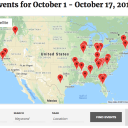
I made a website for listing and searching mountain and hammered dulcimer events: http://dulcimerevents.com . It's easy to submit and edit your events. You can search present and past events, see everything on a map, and even search for events near you. Dulcimer clubs and jams, it even allows recurring events so you can add your upcoming meetings. Visit http://dulcimerevents.com and register to create a free account. Your events will appear after an administrator approves them. If you have any questions or need any help, please let me know.
Thanks,
Stephen Seifert
stephen@stephenseifert.com
I'm attaching an image of the map. It looks pretty cool!
Sorry. I've never heard of him, but his dulcimers look very nice. Enjoy playing them.
Ken
"The dulcimer sings a sweet song."
Lorraine and Ken, you have made some very nice instruments. I'm sure yours are nice as well Irene. I just can't see them at the moment. It is good that you play them for people so that they can get an idea of how music was made a long time ago.
Ken
"The dulcimer sings a sweet song."
Thanks Steve,
I had checked out Tindle's web site and tried contacting him. I wonder why there is no mention of any of his dulcimers he made? Do you have any idea about how many he made or what would be a fair price to ask for one?
I do play them -- in the old style -- not singing along with the music. Lyres, at least the Anglo-Saxon lyres that I build, come from a tradition that pre-dates singing along with music.
The Cologne Lyre is GABcde, and the Oberflacht is tuned DEFABc
Irene,, yes they were a bit challenging ..esp putting the strings on the one..i just finished both of them this month...i tne the small one to c and the lg to d. One thing to do on the olde is to play melody and shen u run out of notes go to the lower note and play it there...so if you are playing the high e but the need to play the higher f and g go to the lower f and g and play them..it sounds pretty fine..i too play older songs on it
Ken, those are great..do u plsy them and how do you tune them..what noes
I bought two dulcimers from George Hendrickson in about 1976 when we were both in the Hampton Roads, Virginia, area. I haven't touched them for decades until now but starting to and am wondering if others are out there and what became of him. He worked some area festivals and contributed an article to the Dulcimer Players News, but haven't been able to find anything else.