Unknown maker
Instruments- discuss specific features, luthiers, instrument problems & questions
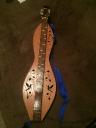
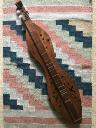
Dan is right-- there are many dulcimers that were made by novices that were never signed, for whatever reason. This looks to be one of them.
I saw that piece and thought it was quite interesting. (Still do!) There are a lot of pieces out there that were made one off. If the maker didn't sign it, we may never know?
I've looked all over and cannot determine who made this dulcimer. I got it through an online auction. The dulcimer was in Roanoke va.
Great News! My dulcimer is really fixed. I found someone in North Georgia who actually cleaned up several frets, had to level one fret and built up the bridge under the bass string. Used a wood that matched perfectly. I did write to McSpadden since I had shipped the dulcimer once to them. They were willing to pay for the repair since I made the effort to ship it to them first under warranty. This restores my faith in McSpadden. Just wanted to let everyone know the update.
I like the challenge of playing slowly-- it can be hard to keep a tune slow and melodic. Great exercise for me! @ariane's Shenandoah project is just the right kind of challenge for this old girl.
Nate,
Many things impact loudness, size of the sound box, thickness of the soundboard, weight of the strings, size of the soundhole and how hard the player hits the strings.
Matt
I'm going to suggest a large Galax with heavy strings drawn up tighter than a banjo.......like a Mahhee in steroids?
The general rule of thumb for loudness and 'baritone-ness' is that the larger the volume of the soundbox (not just width or length, but volume), the louder the overall sound... especially when accompanied by more than 4 or 5 square inches of sound hole.
Size (square inches) of sound hole is important to creating volume. There's a complex mathematical solution called the Helmholts Equation (Wikipedia has a good write up on the subject). As a dulcimer gets bigger it needs more soundhole to let out the sound, and it's not a linear progression. John's Uncle Eddie has soundholes that are scaled up from the originals, but it needs maybe almost twice as much area of soundhole to "let it all out". If you are truly interested in maximizing performance, I think you'll want to find someone who can help you solve the Helmholtz equation specifically for the volume of the proposed body.
Mass of the body isn't as important as you might think.
Look at the traditional Tennessee Music Box -- roughly 4" deep, 14" wide and 26'-28" long, with planks (sides/top/bottom/back) averaging about 3/8" thick! Usually on feet to allow the back to vibrate as well, and a solid (seldom hollowed) 2x2 freboard.
Without a lot of "messing about", the simplest solution to a LOUD dulcimer is, IMHO, to build something about the same dimensions as the Tennessee Music Box I described above. Look at pictures of original TMBs to get an idea of how many soundholes/how much area of hole you'll need for something that size. Then here's my suggestion. Make twice as many soundholes as an original TMB of the same dimensions. Then start blocking off holes two at a time, and see the effect on the sound.
Nate, look at a mariachi guitarra quintet. They have all sizes of guitar soundboards. The largest is pretty BIG.
But then, a dulcimer is not a guitar. "Uncle Eddie", the world's largest (and longest) dulcimer is not particularly loud for its size and soundbox volume. Usually taller sides equal more bass response, and maybe more loudness too. I think overall loudness is derived from several factors working together, such as wood thickness, bracing, design, string gauges and tension, etc.
Hello all, I was wondering how much loudness is affected by the size of the soundbox. I am trying to make an extremely loud dulcimer that doesn't rely on any metal cones, pickups, or microphones, and have been testing lots of concepts to try to get the most efficiency I can, but my understanding of the physics of acoustics is very limited. I assumed bigger means louder, but i would also imagine that the more wood which has to vibrate, the more energy is needed to get the whole box vibrating before it can project any sound. So it would make sense to me if a small box lets the energy be more concentrated and therefore agitate the air more, but it would also make sense to me that a bigger box is more wood moving more air and therefore more loudness. I really am out of my depth so I'd love some input.
1: Is taller louder?
2: Is a larger soundboard louder?
3: Is there a size that is accepted to be loudest?
Also, I have reduced as much extra mass as I can off my last build with the most minimal bracing necessary to not warp or flex, a false bottom, an almost entirely hollow fingerboard, and a saddle that sits directly on the soundboard. Pretty dang loud but I want to leave no stone unturned so I am very open to more ideas for loudness.
Thanks!
<crawling back under my rock now... see you when Covid is a memory...>
When I don't have an answer I ask myself, "What would Groucho say?"
Not only for recordings like this, but for any kind of group play we don't have the luxury of varying tempo for expressiveness. Unless you have a conductor or other clear leader, you just have to find a tempo and stick with it. I am always humbled when I practice with a metronome. It is one thing to vary tempo on purpose, but too often I vary uknowingly, speeding up over easy sections and slower down over the harder ones. That's something I'd like to eliminate. I wasn't joking when I mentioned the frustration that comes with a metronome. I can only take it in small doses.
"like a kidney stone...." ...that's a gem! I'll definitely be using that one.
Ken, I guess it'll be a good growth exercise in controlling your playing then. I know it's true for me that sometimes simpler things can be hard when I'm used to doing stuff my own way (the way I'd prefer).
It's like someone who has lived alone for decades has difficulties adjusting to living with someone else. I had an older girlfriend who was engaged for two years to the nicest guy, they felt so lucky to have found each other, ...but they finally broke up because they both couldn't deal with moving in together and just visiting wasn't what they really wanted... they were each 'married to their own houses' full of their treasured stuff and could not deal with making the changes.
I too can vouch that you've been saying 40 years for about ten years now. No offense intended Ken, but since you mention it on average once every day in one post or another, that means we've all been reminded of your 40 years of playing approximately 3,650 times now. We've definitely gotten the memo!
Yes, "normally" I also prefer when playing alone to paraphrase a tune and to have a more "flexible" tempo - but in such a kind of project I think it is "necessary" to play to an agreed tempo so that I can put the measures of different musicians in a row and the tune still will have its flow.
If one has "difficulties" in taking over the tempo I still have the possibility to place his/her measures more to the end of the tune - that will be no problem
Dusty -- back then -- 10 years ago -- I was saying I'd been playing 30 years. Now, 10 years later, I'm saying 40 years...
2020 -1975 = 45 years
"Time flies when you're having fun; fruit flies like bananas." -- Groucho Marx
I play a number of songs very slow -- Londonderry Air, Danny Boy, Amazing Grace, and others. It's the regular tempo that I'm struggling with -- rather than playing "expressively" to the rhythm of the words, I guess.
"Like a kidney stone, this too shall pass." -- Unk Nown
Ken--Pretend you're playing it to a baby you want to fall asleep. Playing a song slowly is sometimes harder than playing it fast....kind of like riding a bike.
I'm working--and enjoying--Skye Boat Song
@Ken-Hulme, whenever there is too little frustration in my life, I practice with a metronome. Problem solved.
By the way, I first discovered the dulcimer about ten years ago and joined ED and FOTM around then, too. You were saying back then that you'd been playing the dulcimer for 40 years. Maybe the math needs to be updated.
I'm not saying . . . I'm just saying.
Speed issues with Ariane's Shenandoah Summer Project. I've spent 40 years playing to the rhythm of the words, and I decided to get involved with her group play project for the challenge. But 60 beats per minute seems glacial! Have I mentioned how much I hate those little blue city guys -- metro-gnomes?
Tryin' to smooth out ashokan farewell, Barlow Knife, and currently arranging/learning Cold Frosty Morning
Hi Dusty! I agree ... this is a silver lining with this horrible, horrible situation. I'm glad you're enjoying the podcast. We've been busy working on several more episodes ... stay tuned! Hope all is well with you and yours.
I'm just catching up with the last two "Stay at Home and Play Dulcimer" episodes. Thanks once more for making this great podcast!
Both Heidi and Stephen mention something that I've experienced as well. As sad and frustrating as it is to not be able to gather in person with our regular dulcimer friends, moving online has enabled us to connect with others we would not be able to share music with in person. I've picked up a couple of online students who live nowhere near me, and as my local dulcimer club moved online, we ceased to be local and picked up people from across the country. I dare say--and I think Stephen hinted at this--that going online has strengthened rather than weakened the dulcimer community. Even when my local dulcimer club can meet again in person, I hope to continue hosting a regular online jam. How else can people from Maine and Kentucky and Tennessee and Arizona and Oregon and California all share music together?
I'm just catching up with the last two "Stay at Home and Play Dulcimer" episodes. Thanks once more for making this great podcast!
Both Heidi and Stephen mention something that I've experienced as well. As sad and frustrating as it is to not be able to gather in person with our regular dulcimer friends, moving online has enabled us to connect with others we would not be able to share music with in person. I've picked up a couple of online students who live nowhere near me, and as my local dulcimer club moved online, we ceased to be local and picked up people from across the country. I dare say--and I think Stephen hinted at this--that going online has strengthened rather than weakened the dulcimer community. Even when my local dulcimer club can meet again in person, I hope to continue hosting a regular online jam. How else can people from Maine and Kentucky and Tennessee and Arizona and Oregon and California all share music together?
I'm gonna name my next dog, Fretful!
Just saw this on Facebook from @ClassicFM:
My goldfish are named Major, Minor, Dorian, Lydian, and Diminished. The only way I can tell them apart is by their scales.
To which I added that on the Mountain Dulcimer we also have Ionian and Mixolydian.
Woops I forgot poor old sorrowful Aeolian.
Thanks for the update Gail...I wondered how that was working out for y'all.
I have been in a dulcimer orchestra since last fall. Judy House, the music director of the Winston-Salem, NC club, has written a book of multiple part pieces, and we are also working on some pieces from Tull Glazener's 3 String choir. We've played quite a variety of music and it's been a lot of fun. Of course, with COVID-19 we can no longer meet in person, but we have Zoom practices instead. Hopefully we will be able to actually do some performances in the future!
Hello, Gary, I'm glad you are getting back in to playing your dulcimer. I can't really add to what KenH and John have said. Just sit down and play as often as you can. Enjoy.
Ken
"The dulcimer sings a sweet song."
I had Wittner pegs put on my langspil. They're amazing and a real delight to work with! (I'm sure Pegheads are terrific too)
I've switched from Pegheds to Wittner geared tuners. I think the tuning is a little more precise. You would be in big trouble if you cut the button off as the gears are in the button rather than the shaft.
Ken
"The dulcimer sings a sweet song."
Welcome back to music-making, Gary! I came back to dulcimer a little before retiring and have enjoyed it very much. I have also enjoyed the company of the very sweet people on this website.
As for getting back into playing, I suggest you go back and retrace the path you took before. Start with the simple stuff, the things you can play pretty easily now. This will get those skills strong again. And it won't take very long at all. Then add to it as the spirit moves you. You may discover what you played before isn't interesting any more. So don't bother. Work on music you like.
Sometimes our memories play tricks on us. I may not have played as well "back in the day" as I like to remember. But I'm pretty pleased with the sounds I make today.
I appreciate the info! Thanks.
Those inlay are pre-cut. I don't know where they came from originally (maybe Germany or Italy), but were sold in the US by Vitali Imports in Southern California. I imagine the owner either did the inly him- or herself, or had it done.
@robin-thompson One of the things that make Pegheds attractive is they do look very much like wooden friction pegs. Had I been more patient, Chuck, the man who makes them, would have cut the grips (buttons) off the original pegs and attached them to the new geared pegs. But I'm completely happy with what I have. Much more elegant and light-weight than those chrome banjo pegs.
But now I'm causeing the thread to drift. I think I'll go play some dulcimer.
@floralin, take some time to explore this site a bit. In addition to the Forums, there are also Groups devoted to specific topics, including traditional noter/drone style, chord melody, fingerpicking, and so forth. Join a group and start perusing the past discussions.
Thank you all so much. I'm so glad I found this group! After reading your replies, I think what I have been doing is strumming across all the strings all the time. I'll work on that. I'm also trying to accomodate my finger-picking style on the guitar to the dulcimer. Will be reading up on that in the Forums.
Great to know. Thanks! Stay safe, my friend.
Wow thank you April the 3rd 1974 first one that day
@john-gribble While I love the look of old friction tuners, my hands can no longer manage them-- soft tissue woes, not arthritis. Enjoy those Pegheads!