Introduce Yourself!
General mountain dulcimer or music discussions
@shelley1 Great to have you here! There's lots to see on the site-- enjoy poking around!
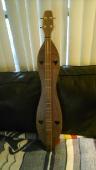
Hi! My name is Shelley and I'm new to the dulcimer world and this site. I started playing about two weeks ago and love it! I'm played guitar since I was 13, and am learning to play a couple of other instruments, but nothing has grabbed my interest the way the dulcimer has. (With the exception of the guitar—LOVE my guitars.) I'm looking forward to learning what I can and hanging out with you!
Funny, I showed my instruments to Butch a couple years ago at Evart. I guess he remembered.
That is interesting. Butch Ross mentioned the concept in our last meeting and I have it on my list of things to learn more about. My latest steel string design seemed to sound best with no soundhole and I have been wondering if the rounded back would still work. I guess I will have to try it with and without a soundhjoe and see how it turns out.
Yes, the rounded bottom seems to focus the sound back to the soundboard.
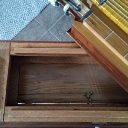
Your bracing is very similar to the Taylor V bracing. I have attached a photo of the bracing used on the dulcimer that Butch Ross is getting. I refer to it as parallel bracing. It is used with strings terminating at the bridge like a guitar. On my dulcimer it yields a rich tone with a strong bass response.
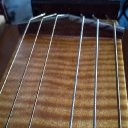
The next photo is of the dulcimer for Aaron O'Rourke. It is a modified X-braced pattern that has more attack and is less bass focused. I would say it is closer to a traditional dulcimer sound.
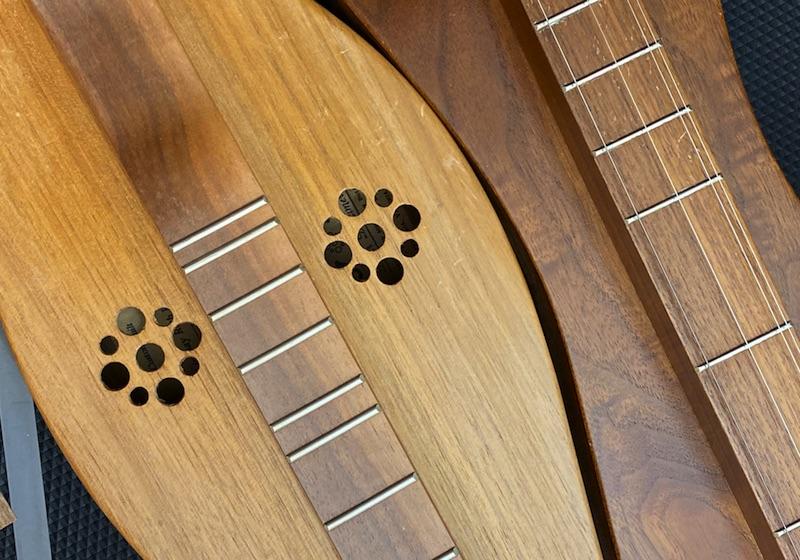
The remaining photos are of my newest design with strings that terminate at the end block. Very close to the prior X- braced design with one small addition. This is the loudest dulcimer I have produced (the one with the 0.100 soundboard).
Are you using a rounded bottom for more projection?
I use fan bracing that comes together at the head and spread all the way to the tailpiece. With a double neck design, you need to have a more or less wide and flat tail piece . With a single neck, generally just two braces. With double necks I find four braces emphasize the treble, three helps the bass. Similarly, straight bracing emphasizes higher pitches, scalloped bracing lower. Haven't tried mixing them in one instrument. Pick your poison.
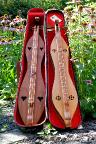
The picture shows a build in progress from a couple years ago. You can see the fan bracing on the soundboard. The X-bracing on the bottom is used so the bottom can be rounded.
I am very intrigued by your solution to the problems of dulcimer design. The fact that you found a way to improve volume and still retain the tone you were after is particularly impressive. Are you using any bracing on the underside of the soundboard? As far as bowing of the fretboard goes, you have effectively isolated it from the forces and torque that would normally cause it to bend by limiting its contact with the body to a very small area. This is a significant improvement over most approaches.
My latest designs use a violin style bridge, but in some cases I found I needed to alter the bracing pattern in order to obtain an acceptable tone. In a few days I will be delivering new steel string designs to Aaron O'Rourke and Butch Ross, and another design to Aaron that may be usable for both steel and nylon strings. Interestingly, Aaron and Butch chose instruments with quite different tones when presented with prototypes, which supports the theory that there is no one perfect design. I am anxious to hear what each of them do with the dulcimers. Aaron and Butch are about as far apart on the technique spectrum as you can get so it will be an interesting comparison.
The neck rests on a single post under the 0 fret. The maple fretboard rests about 3/4 from nut to saddle on a bridge on the soundboard. The strings are set to pull down at a 15 degree angle causing both a bowing down and bowing up tension in the fretboard. I have been using this technique for about 5 years and have not seen any deforming of the fretboard.
I tried using violin style bridges, bridges that stand alone on the soundboard, but felt too much of the unique dulcimer sound was lost. Using a fretboard that runs from nut to saddle restored the unique dulcimer sound.
And, yes, the voices of my instruments are much stronger than other dulcimers. The bass in particular is able to cut through the buzz of a jam, especially when flat picking.
Hello everyone! I wanted to share a song I worked on recently:
It is the Prelude from Bach's cello suite 1. It is a really nice tune I enjoyed learning and enjoy playing. It is played on a chromatic dulcimer, as there are too many extra notes. Just standard DAD, but it is actually in the key of A, to give some extra range down low.
I found lots of videos of hammered dulcimer arrangements, but none of mountain dulcimer. It sounds really nice overall, and it helps that the dulcimer is a soft instrument. It loses some of the low sounding notes which make the cello distinctive, but I think it's still good.
This cello suite actually has 5 parts! This is the first. I'm thinking I may learn more of the parts at some point. This probably would remain the most interesting part but who knows. It's an interesting song because it doesn't have such a clear melody as we're used to, but it's far from being random notes.
Anyway I hope you enjoy watching!
Grant
As magical as the dulcimer is, it is still bound by the laws of physics and basic engineering principals. The engineer in me is compelled to try to explain why all parts of a dulcimer between the string attachment points are under a bending moment, regardless of where the strings are attached. Let me first define a few terms so that we can communicate.
Neutral axis- all bodies (dulcimers included) have a neutral axis that runs the length to the body. When deflected, parts of the body on one side of the neutral axis go into tension while parts on the other side go into compression. If you have a board supported at each end and you load the middle with a weight, the top of the board will be in compression and the bottom in tension.
Force- a force has both magnitude and direction. For the string of a dulcimer, the force is defined by the tension in the string and the location of the string in space.
Moment- the moment (or torque) on a body is the force on the body times the distance from the neutral axis to the line of action of the force.
If we reduce the dulcimer to a simple block of wood, say 2” x 5” x 30” to examine the loading from the strings, we will be able to see why the block is under both a force and a moment from the string tension. Before we get to the actual loading case for the dulcimer, let’s examine the hypothetical case of the strings running right down the middle of the block of wood (1” from either edge and right on the neutral axis). The body of the dulcimer will be under pure compression loading. So if the string tension is 80 pounds and the cross sectional area of the block is 10 square inches, the stress on the block is 80/10 or 8 pounds per square inch. But the string doesn’t run through the middle of the dulcimer, it runs above the body. For this example, let’s say it is 0.25” above the block. The block is still seeing the same compressive loading as before, but now there is an additional moment added to block because the string is not running through the neutral axis. The moment is the tension (80 pounds) times the distance from the neutral axis (1.25”) or 100 inch pounds. This bending moment acts on all elements of the dulcimer body and is the enemy when trying to keep the dulcimer from taking a permanent deflection over time. Exactly how and where the strings attach has no impact on the fact that entire body of the dulcimer between the attach points is under this bending moment.
In an actual dulcimer, the analysis can be quite complex because of the large number of components, many of which have shapes that change as you move from the head to the foot, but the loading is there nonetheless. So as a designer, the challenge is to make sure the structure of the body is adequate to resist the inevitable bowing that will occur. The phenomenon of creep in wood is well documented and is generally thought to have no lower limit of loading for it to occur. If the loading is low enough, the creep may not be apparent over a few decades or even a few lifetimes, which is probably good enough for an instrument. Without dropping over the cliff of engineering analysis, we can try to reduce potential “weak spots” in our dulcimer body. A prime culprit in many designs is the strum hollow. You can greatly reduce the likelihood of a bowed dulcimer by reducing or eliminating it. Most players do not restrict themselves to just strumming over the hollow anyway.
It is this insidious creep that has prompted me to use carbon fiber in my instruments. It has many admirable properties including resistance to creep, extremely high strength to weight ratio and amazing stiffness. These properties come with serious health hazards that demand precautions that are expensive and time consuming to implement. Over time I would love to get to the point where I can eliminate it from my designs and be confident that they can survive for a century or two. The great part about lutherie is that there is always more to learn.
Matt, Thank you for posting your recent build. Not only does is show your excellent workmanship, it has some interesting design features. I am happy to see others getting the neck up off the soundboard. We might be starting a revolution. Could you further explain “single peg”? I also see that you are interested in bass dulcimers, which is great. There is a lot of opportunity for improvement in both baritone and bass dulcimers. The elevated neck will be a big benefit for the lower frequencies as I am sure you realize. I put bass strings on one of my new steel string designs recently and was pleasantly surprised at the result. It too had an elevated neck and modified X bracing. It sounded great when Aaron O’Rourke played it, but he could make a peach crate with a wire stretched over it sound great. I am building one for a client that will be ready soon.
I do not sand my soundboards to a set thickness. I attempt to sand them to a known stiffness, letting the thickness be the variable. Each soundboard is tested for deflection with 12” hanging over the bench and a known weight put on the end. I then sand until I reach an established deflection. It is surprising how much the thickness varies even within a species. I have seen thicknesses form 0.140 to just under 0.100 with one very stiff piece of Port Orford Cedar. This is a very large range when you consider that the stiffness varies with the cube of the thickness. Put another way, if you sand to a set thickness you will have widely ranging stiffnesses (and therefore volume and tone). If you are interested in this sort of thing, I highly recommend “Left Brain Lutherie” by David Hurd. It is a bit technical for some, but you don’t have to be an engineer to get some useful information. The book is written for guitar family instruments, but most of it is transferable to dulcimers.
Bob, you mention that your recent soundboard was thinner than typical at 0.100 inches. My general target for the soundboard is 3/32, roughly 0.100. Depending on the ping of the wood, I may stop earlier. What is your general target for soundboard thickness?
(The attached picture is my current build. You can see the thickness of the soundboard which is made from recovered white cedar. All of my builds have the neck suspended over the sound board on a single peg and a true bridge. This is a double neck, treble and bass.)
@bob-stephens -- you are correct -- IF the builder makes (as many modern builders especially of inexpensive dulcimers do) the tuning head and tail string anchor are all one piece with the fretboard. Especially if the fretboard/head/anchor board is fast-growing flat-sawn, not quarter-sawn, not very hard timber.
If, as Ken Longfield says, the strings are anchored in the tail block and a tuning head attached to the head block, then there is virtually no string pressure trying to pull up the ends of the fretboard and warp it. Rather there is a minimal amount of pressure pressing the ends of the fretboard containing the nut and bridge downward and helping keep it flat.
If you are going to put a truss rod in I would definitely use an adjustable one- preferably double acting so you can correct in either direction.
I have to respectfully disagree with Ken on the point of the strings not putting a bending load on the neck and even the whole body of the dulcimer. The approximately 80 pounds of tension does put a bending load on the neck with most designs. It may transfer through other components, but ultimately the neck is loaded. I have repaired many dulcimers where the neck is permanently bowed over and eighth of an inch along its length (resulting in raised action that makes them unplayable). Some of these were built by respected builders whose names I will not mention. Wood under tension will creep over time. Carbon fiber and steel (a truss rod) will deflect under load, but do not creep.
@dan
VERY cool thanks for sharing!
I have also seen many dulcimers that have survived many decades with no issues. Design and material selection are probably the keys to success.
Getting back to your original question, if the neck runs the full length of the instrument, a truss rod isn't a bad idea. They are relatively inexpensive (about $15) and work well to correct any bowing that might start to develop. The only down side I can see is that they do add some weight to the instrument.
On most dulcimers the strings are not anchored to the neck but to the peg head and the tail piece With a fret board spanning the length of the sound box, it acts as a truss rod preventing the dulcimer from warping by pulling up at either end.
Guitars and banjos need truss rods to stabilize the neck because of the pressure from the strings. On most dulcimers the strings are not anchored to the neck but to the peg head and the tail piece With a fret board spanning the length of the sound box, it acts as a truss rod preventing the dulcimer from warping by pulling up at either end. I have a dulcimer I built 46 years ago which has a cantilevered fret board. To keep the fret board from warping, I made it out of three pieces of wood glued together. It is still flat. Unless there is pressure from the strings or the wood used for construction was not well seasoned you should not have any warping on a mountain dulcimer.
Ken
"The dulcimer sings a sweet song."
Nate, I use carbon fiber stiffening in my necks for several reasons. I strive for very low action, which requires a neck that stays straight within a few thousandths of an inch. I also think that a stiff neck is good for making a responsive instrument. Any energy going into flexing the neck is not generating sound. Lastly, I have seen, and personally repaired, too many dulcimers with bowed necks that have made them unplayable. I would love to get away from using carbon fiber. It is expensive and there are real health hazards associated with machining it. Parts done on the cnc router have to be done under water to minimize the risk.
I have also seen many dulcimers that have survived many decades with no issues. Design and material selection are probably the keys to success.
Getting back to your original question, if the neck runs the full length of the instrument, a truss rod isn't a bad idea. They are relatively inexpensive (about $15) and work well to correct any bowing that might start to develop. The only down side I can see is that they do add some weight to the instrument.
"That makes sense. I am fascinated that there are well preserved dulcimers that old! Do you know where I could find visuals, recordings, or anything like that of dulcimers of that era?"
Warping can always be an issue with instruments, even $100,000 instruments that travel. BUT! "Well kept" is the important thing. Giving the instrument a chance to acclimate to new surroundings is important. I once made a dulcimer that fretted perfectly in mile-high Prescott, AZ, but which raised a fret every time I drove 90 miles south and 4000 ft lower in elevation to the Phoenix area. Drive home again and it was fine. Such issues are extremely rare with dulcimers.
As Dan said, lutes/guitars are completely different critters than fretted zithers/dulcimers, and guitar problems are rarely found in dulcimers. The dulcimer fretboard is rigidly attached for its entire length; a lute/guitar neck is just hanging out there, just asking to be affected by everything! A truss rod on a dulcimer would not be worth the time and effort to make and install.
There are a lot of static photos of 100+ year old dulcimers. And quite a few such instruments in museum collections like the Hindman, KY museum, the UK museum in Louisville, KY, and the 'opening next year' dulcimer museum that John Hallberg is setting up.
Our friend Kendra Ward regularly plays an over-100 year old dulcimer that belonged to her grandmother.
IMHO, with dulcimers, things like truss rods, carbon fiber doohickeys and similar space techno things are just not relevant to making an instrument sound good. If you can do it with well-cured wood, all the hi-tech stuff in the universe won't make your dulcimers any better. More expensive, but not any better. Compare -- sight-unseen -- the sound quality of a dulcimer that Dan, or Bobby Ratliff or some of the others build with simple tools; to the modern marvels made with all the hi-tech widgetry available. The difference is negligible; but all that hi-tech is gonna cost you a LOT more.
I've played several traditional pieces well over one hundred years old and no warping issues! The zither is a very different animal than the lute, requiring very different approaches to design.The truss use came about with the introduction of steel strings cir. 1830's ish for the guitars? I don't know of any one using truss rods for dulcimer traditional or contemporary. I'm sure some one has tried about every thing......
I'm looking smaller in terms of the body (depth and length). Both my Folkcraft Customs, including the baritone, have the deeper body, with galax backs. So, they are quite a bit bigger than the McSpadden. Then, throw in their awesome case, and it's just too big for festivals. Plus, they are more of an investment, in case something were to happen. I love, love them for home and playing with others around home, but another McSpadden would be nicer for festivals. Like you said, I know the quality and tone of a McSpadden too. I've just never tried one of their baritones.
I've played several traditional pieces well over one hundred years old and no warping issues! The zither is a very different animal than the lute, requiring very different approaches to design.The truss use came about with the introduction of steel strings cir. 1830's ish for the guitars? I don't know of any one using truss rods for dulcimer traditional or contemporary. I'm sure some one has tried about every thing......
How common are truss rods in dulcimers? From what I understand they were historically built out of what was available, so it probably wouldnt be very traditional, but would it be practical? Is warping an issue for dulcimer fingerboards over time as much as it is for guitars, or does the rigid structure of the entire neck being glued to the soundboard prevent this issue mostly?
Hi @Susie, you have a good memory. I did indeed have a McSpadden baritone for a spell, but was obliged to sell it to raise money (I think I needed a new catalytic converter). I no longer have the video I posted when I was selling that instrument. If I remember correctly mine had a redwood top and ebony overlay on the fretboard. I think the body was walnut. Mine also had a 1-1/2 fret.
If you already have a McSpadden, you know how consistently playable they are. They also tend to keep their value pretty well in case you have to sell it down the proverbial road sometime. I'm not sure what advice I can give you.
I have to be honest that I don't think my ear is capable of discerning the differences in tone from different wood types. I can hear the differences between luthiers, but I can't hear the difference between a cherry McSpadden and a walnut McSpadden, for example. Having come from the guitar, I prefer softwoods (spruce, cedar, redwood) for the tops, but I choose wood for the body based on how it looks.
When you say you want a McSpadden because it is smaller than the Folkcraft, are you referring to the size of the body? Both Blue Lion and Ron Gibson make baritones with smaller scale lengths. Currently I have my Rick Probst dulcimer strung as a baritone, and that is big, in terms of body, VSL, and sound. I can't imagine lugging that thing to festivals.
Well thank you. It has a great tone, and I have a request to build another; not for charity.
I currently have a Folkcraft Custom Baritone Dulcimer. I love everything about it. I'm toying with the idea of getting a McSpadden baritione (because it is smaller), to accompany me to music festivals, where I also take my standard McSpadden.
For those with McSpadden baritones, can you give me your feedback? Dusty, I think you even did a video once of the one you had. Can you share that? For baritones, I lean towards the cherry/cherry or spruce/walnut woods, which I feel works well with the deeper tones.
Something I've been wondering a lot about! For those who lost their jobs or got hours cut, on one hand lots of people are cooped up and student dulcimers are pretty affordable so I could see how it could help sales for student models, but on the other hand many folks are justifiably being more careful with their money. Some people's careers have not been affected at all by this, but have been seriously limited socially, so that probably amounts to some people with stable income sitting around bored all day looking for new hobbies. I would assume for this reason that the very high end ones may be taking the smallest hit. Also, quarantine has led a lot of people to explore 'DIY projects' so I wonder if companies like Folkcraft or similar kit brands have seen a positive change. Me, I tend to build very low quality dulcimers and just sell them to locals for ~50 bucks to clear up space in my living room! Needless to say I don't have any grasp of the real dulcimer market. Would love to hear more perspectives of people actually selling them. Covid lowering sales would indicate that people are being more cautious with money or simply don't have it, so if that is the consensus, now might be a good time to finish up the video I have been working on geared toward people with minimal woodworking experience for building dirt cheap dulcimers! The video, which is currently dozens of clips I have to learn to edit together, details how to build a craftboard dulcimer for under 15 $ in materials and some simple hand tools nearly everyone should have access to. If people can't afford them now is a great time to learn to make them!
I'm still making a few to donate to charity auctions in our area. The cedar, with ebony overlay on the fretboard, went in an auction that closed last Friday.
Nate,
You always have such great questions. I wish we had more answers that we know to be absolutely true. I have a few thoughts based on a recent dulcimer that I just completed. This is the loudest dulcimer I have ever built by a considerable margin. It contradicts almost everything I thought I knew about how to make a loud dulcimer. Since my instruments are non-conventional in design, these comments may not be of much value. The entire top of the dulcimer is free to vibrate independent of the fretboard since the fretboard is held above it on posts from below. The top is western red cedar and is thinner than is typical for my dulcimers, about 0.100 inch. It is braced from below with a modified X-braced pattern. The strings terminate at the end block. The bridge just sits on the top. So acoustically, it is very similar to an X-braced flat top mandolin. As an aside, mandolins prove that size is not the key factor in making a loud instrument. This dulcimer also has a double back, which I am pretty sure helps the volume- especially if you play with the dulcimer in your lap.
The big surprises were that this string configuration was louder than terminating the strings at the bridge- guitar style. One would have thought that the torque put on the top from the guitar type bridge would generate more volume than the slight downforce from the mandolin arrangement. Apparently not.
The second unexpected result was that blocking off the soundholes completely made no perceptible reduction in the volume. So there goes the large soundhole theory. Blocking did affect the tone, however.
I think you are on the right track to keep the vibrating mass as low as possible. I don't think the total weight of the dulcimer is all that important. The more soundboard you can get into play will likely help too. Fretboards that are in contact with the top for its entire length put severe limitations on volume and tone. I know that this is the way it has traditionally been done, but if you want to break away from result that is typically achieved, you will probably have to strike off in a new direction. I applaud your attempts to push the envelope. Please continue to push the rest of us and share your results.
Oh Marsha! Thank you so much! That was great! When I look at the sheet music, there is indeed a lot of repeats. Keep going girlfriend! Can't wait to hear it all!!
So, you'll be all ready to celebrate the day, @don-grundy ! Happy strumming!
Friends, worldwide Play Music on the Porch Day is always the last Saturday in August. So, 29 August is the day! Mark & I have been practicing the song we will do on the holiday and hope our friends will make homemade music on the day, too:)