Awesome Dulcimer Camaraderie
General mountain dulcimer or music discussions
Play some West Virginia tunes. After all, June 20th is West Virginia Day, a holiday here!
Play some West Virginia tunes. After all, June 20th is West Virginia Day, a holiday here!
The Berea group will begin playing at the Visitor Center (depot) on June 20th from 2-4 and will play each Tuesday during the summer. There is no set play list. We usually take turns choosing a song and hopefully we all have the music.
Giddykitty, most of us check out the Audio and Video sections on a regular basis to hear what music members are playing. Also, when you post there, we can always find it even years later by going to your homepage and clicking "audio" or "video." If you post your music in discussions it will get buried as new discussions are created. Here is a screen shot showing you how to get started. IF you still need help, let me know.
Cool tune, giddykitty. Are you playing or singing on that track?
If you want your music to be easily found by others, use the Audio feature to link from SoundCloud or the Video feature to link to YouTube or Vimeo. Most of us regularly check those spaces rather than Forum discussions to see the new music that members are playing. You start from your home page and then click "audio" or "video" from there to see the "+" button to add a file.
Also, remember that there is a whole group dedicated to " Composing and Songwriting " and another one on " Arranging for Dulcimers ." You may want to join those groups and and share the ups and downs of the process.
I like your stories, folks. <3
Skip has it right. Check out Get Tuned for a visual depiction of the tuning of the dulcimer relative to the piano.
A couple of things to remember:
1) The suggestions you've received so far for string gauge are reasonable, but without knowing the VSL (vibrating string length, or the distance between nut and bridge), no one can really know for sure what gauge strings would be appropriate.
2) Your mileage may vary. Play around a little to find your personal preferences. I have discovered that I like slightly heavier strings than most, at least for flatpicking. But I often tune down to C for fingerpicking because I like a little give in the strings, something I definitely don't want when flatpicking.
3) Steel is steel and strings are strings. Don't worry about brands. Just figure out what gauge you want for each string and buy single strings, avoiding sets which might not have exactly the right gauge for each string and also cost more per string. Once you know what gauges you want you can buy in bulk and save even more.
3a) The exception to the statement above is that wound strings come in a few different varieties. The most common are nickel wound and bronze wound. Take the time to discover your preferences. Personally, I like the bronze-wound strings because the tone is more mellow. The nickel-wound strings have a brighter sound, and that might be more appropriate for some dulcimers than others and for some pairs of ears than others. Also, if you find you get a lot of squeaking on the wound strings, you can get "squeakless" strings (which aren't actually squeakless, but the squeaking is reduced). I won't go into the options there, but just know they exist in several different varieties but some people think they produce a more muted tone.
The bass string is tuned to the D below middle C, D3. The middle string is to the A below middle C, A3. The melody string is tuned to either the same A as the middle string, DAA, or to the D [D4] just above middle C, for DAd. Middle C is C4.
Do you tune the bass string to an A above, or below the D?
The wound string (.022) is the bass string. Low D will be fine with that string....
DAN
www.dulcimore.com
One more question about strings.
Will the .12 .12 .14 .22 accommodate DAA and DAD tuning, or will the .22 break when tuned to D? Does this question even make sense?
Doesn't the Berea group play at the Visitor Center (depot) certain days all summer long? If someone had that info and shared it, maybe a bunch of us would show up and share some tunes!
Love to hear my dulcimer buddies chatting it up! Yes, I do think you two were paired up for the "Finding Do" (as in "Do Re Mi") activity we did awhile back. I encourage everyone to play with lots of different folks-- mix it up, get outside your comfort zone, meet new people, and widen your vision! You will be exposed of different ways to play the same songs, new songs--and possibly some new genres, and maybe learn a few tips you'll find helpful. I'm looking forward to gathering now and then throughout the summer, jamming and learning with folks at Kentucky Music Week in June and also at the Homer Ledford Dulcimer Festival Labor Day weekend. But if you can't attend one of these special events or workshops, hopefully you'll find someone to join you on your porch with a cold drink this summer and you can swap songs, sing a little, and serenade the lightning bugs!
Thanks for all the great info. Looks like I am settling on .12, .12, .14, .22 (or .24)
Appreciated
Also, some players/listeners really don't appreciate the 'squeal, buzz, twang' or whatever some call it on the heaver strings and those (.022" - .024") strings are available in plain steel or a 'silent' wound string.
What gauge is more important than maker, this will all depend on you! Some like them light, some heavier. Start in the middle and give them a while before you decide what is right for you. Next, the specific gauge is determined by the instrument, vibrating string length, maker and such will better let us help you to start.....
Hi, Tom! Welcome to the site.
It would help if we knew what kind (or make) of dulcimer you have and what tuning you'd prefer, but a good starting point would be a set by C. F. Martin, D'Addario or GHS. The strings tend to be plain steel (.012" - .014") and wound steel (.022" - .024").
Hi All,
Totally new to the dulcimer and have a couple of questions about strings.
What brand of strings, and what gauge, do you recommend?
Thanks...Tom
Just read about your loss JH , sorry to hear about it and for your loss. they say Time is a great healer, but every now and then the loss comes back to bite. Lost my Dad nearly 10 yrs ago and still in catches me now and again.
Keep a Haad ,young man.
Hey Dulcimerjones, I go to the Nicholasville group when I can. I think we were partners in the finding "Do" exercise. Yes, come to Berea sometime.
There are European and Latin American styles of HD play that use fingerpicks. The Mexican instrument is called the Salterio.
So glad to know someone else is visiting other groups. I think it's an excellent way to meet players who might line up with your particular style & others that don't. I'm in eastern Ky & have been visiting the group in Nicholasville over the past 6 months--next stop, Berea!
Using a pick for tuning. I ... overlooked that. I was thinking of plucking it with my fingers, but a pick would certainly work.
Now if I can figure out how this thing should be set up. I can tell that a few strings are out of tune.
I keep a pick holder on mine to do the tuning. I pluck each string with a pick. It could have been used for her mountain dulcimer as well since many people play both. Linda
Over the weekend, I retrieved one of my late mother's hammered dulcimers (Jake's Cabin Traveler). I'm new to the instrument but can play the melody of some tunes already.
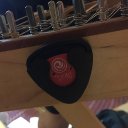
But here's a mystery. There's something on the side of the dulcimer that looks like a pick holder. So I put a pick in there and took a photo of it.
Does anyone use a pick on a hammered dulcimer? Or is it likely there in case my mother had her MD with her as well and needed a pick?
Thanks for the tip about Susato low D whistles, Robert! I have a Susato Kildare in C (which of course is waaay smaller than a low D), and boy that thing is loud and clear- great for playing outside or in a large group or festival/event setting.
I have slightly smaller than average woman's hands, and I find the low G is currently a challenge for me. The idea of a 'keyed' low D is very appealing for me! Will look into this. Might be cool to play a low D if Brian is playing in a higher D octave on his fiddle.
Way cool, dulcinina! I love both Hindman & Berea!
My first was a walnut McSpadden with wooden tuning pegs purchased in summer of 86 on a road trip from FL to CA..whilst driving on the Blue Ridge Parkway. Met the daughter of the owner of that shop at a workshop in northern GA a year or so ago. She said it was going to close soon. They got me started...recommended learning materials (Larkin's book) and basic supplies and sent me on my way. Played at our campground each night for the month-long trip.
Still have it (had the tuners changed out though).
That's great that all were able to get together. There are groups here about 20 miles apart. Only a couple of them (or maybe 1) come to the meetings of each. I agree playing with other musicians who are "new" to you is a good, even great thing. Never been to Berea (yet.... hey I may be available) but I love Hindman and the folks there.
Today my dulcimer group from Berea KY got together with the Hindman KY group who came to Berea for a day trip. After they ran around town they came to our Multignerational facility to play with us. There were about 20 folks from Hindman and about 17 of us. Warren May came to listen as did Jean Ritchie's niece.
We had a great time together and a potluck afterward. We had so much fun that we are planning a trip to Hindman soon to play with them. Hindman is about 100 miles from Berea. I drive 90 miles round trip to play with the Berea/Richmond KY group each week. I am so fortunate to live close enough to take advantage of such opportunities.
I'm a fledgling intermediate player and my advice is to seize any opportunity to play with different groups. It's so rewarding. Dulcinina
It's only too late if you don't start now.
So this koa folkroots. I have given it a name. Jimmy Earl, ala James Earl Jones, "Luke I am your Father". The deep, rich voice this dulcimer has blows me away BUT...that longer vsl, I just can't do it. It will go the way of my last two mcspaddens and I will be sticking to the shorter 25-26" vsl. But seriously folks...how did Howard get such a boomy voice outta these things. Nothing comes close.
That's a funny name! I prefer the 25" - 26" scale for whatever style I play.
My guess is that they are completely gone now. For a while I was making hard copies of some of the articles. When I get home I'll look and see if I still have a file of them. Other than that, I can't help. If they are no longer available on the web, this is a great loss to the dulcimer community.
Ken
"The dulcimer sings a sweet song."
Dana, the longer VSL should not be a problem if you play in a drone style. Consider using this dulcimer (and others with VSLs too long for comfortable chording) specifically for tunes played on the melody string with the drones . . . uh . . . droning.
So this koa folkroots. I have given it a name. Jimmy Earl, ala James Earl Jones, "Luke I am your Father". The deep, rich voice this dulcimer has blows me away BUT...that longer vsl, I just can't do it. It will go the way of my last two mcspaddens and I will be sticking to the shorter 25-26" vsl. But seriously folks...how did Howard get such a boomy voice outta these things. Nothing comes close.
Some of you may be familiar with my blog on traditional style dulcimer playing with videos and Noter style tabs.
https://dulcimer-noter-drone.blogspot.com/
Though I don't create new posts on my Noter blog very often nowadays, I do occasionally make updates or changes to the blog, which I started in 2009.
Today for the second time in eight years, I reviewed the links I had listed there.. Links to various helpful info on traditional dulcimer playing and traditional music resources. Some sites had merely moved and needed their links updated, but I was surprised at the number of links to sites and pages that no longer even exist. It struck me that much has changed online relative to traditional dulcimer playing since I began my blog in 2009!
Ive updated and reorganized the existing links, added a couple, and removed dead or irrelevant links. Ive also now added links to several builders who currently build traditional/early style instruments, such as Kevin Messenger, Dan Cox, John Knopf, and BirdRock (in UK). Hopefully this will be helpful to folks newly interested in traditional dulcimers.
I'm posting this because I'm open to receiving suggestions for including new links that are helpful and relevant to traditional dulcimer playing. I may or may not decide to include such links, but all suggestions will be considered!
Im closing this thread to replies because I'd like to receive these suggested links in private. So please send me your suggestions by clicking the "Contact site owner" link at the very bottom of any page here on FOTMD.
thank you so much! Strumelia
This was a huge resource with articles on mtn dulcimers and playingstyles, both traditional and modern. (For example the article interviewing Phyllis Gaskins on Galax style playing, and the article interviewing Ralph Lee Smith...just to name two)
Is this completely gone now, or does anyone know where it may have been moved to? Was Lois Hornbostel possibly editing/managing it? (I have no clue)
I was saddened to learn of Mr Dorogi's death. I always found it curious that he, L. Allen Smith, and the founder of Stewart-McDonald had Athens OH connections.
I saw that yesterday. Another one of the good ones has passed...