
Native American Flutes
Adventures with 'other' instruments...
Caleb, I have heard that's a good key for playing with md. I have also heard Am will sound good with md too.
Caleb, I have heard that's a good key for playing with md. I have also heard Am will sound good with md too.
Bm flute plays well with dulcimer tuned DAdd. I had a chance to play my dulcimer with a friend at flute circle while he acompanied me with a Bm flute
Thanks so much Sheryl- that makes perfect sense!
Lisa, Great question! I saw a bowl of plastic tubing that was cut into about 1" pieces, next to the flutes. "What's this?" I said. A man next to me explained that we should stick them into the end of the flute we want to try, to solve the sharing issue.
There was a baby grand piano, a md, and a bunch of NAF's, but it seemed to me that a solo on any type of flute, or other instrument, would have been welcomed.
Sheryl, that must have been soooo much fun for you! Was this flute group just about Native American style flutes?- or were there regular classical type flutes, penny whistles, and recorders as well?
Forgive me for asking this question, but I'm curious- how do the folks there deal with the issue of various people trying out flutes on on display, with their mouths on them and all? Or is everyone just not bothered much by it?
Thanks Lexie, I did not play any of the flutes with other instruments, as there were only flutes there. But a lady played a flute in the key of E while her sister accompanied her on the piano, and then we listened to a recording of the same song that was a flute and guitar. That said, I did try a flute made of Lagustrum in Bb and I really liked the sound.
Sheryl that is awesome you have such a great musical community and got to go to a NAF group.
When you tried out the many flutes did you find a key you would like to play with another instrument? I am contemplating a Bb by High Spirits for my next NAF.
I am happy to hear you got to play a solo and have support from your new group.  Happy fluting.
As mentioned, hitch-or-string pins are readily available. If you're breaking a bass string there may be a couple problems. First, you need the correct gauge -- as KenL mentioned a .024 wound string would work for your dulcimer.
You called the bass string the "d (bass) string. In normal dulcimer parlance, a d is D4 an octave higher than the usual bass string D (which is D3). Check out the MusicMakers on-line tuner: http://www.harpkit.com/category/onlinetuner.html
You may be trying to tune the string too high. Which note are you trying to tune to? A .024 wound bass will easily tune to D3 (the usual D) and up to E and maybe F, but it will not tune up to G without breaking. It will never make it to d (D4) without breaking. If you're trying to tune to GDD or GDg you will surely break the bass string unless you use a .016 or .018 bass string.
For the right names for dulcimer parts, you might want to read I Just Got A Dulcimer, Now What? that I wrote several years ago. It's an illustrated glossary of dulcimer terms, plus answers to many beginner questions about tuning, playin, care and feeding of your new friend. Here's the version I recently revised:
A friend of mine gave me a Jonah Thompson flute in Am recently. My first NAF. The Raleigh NC area being the wonderful music community that it is, is home to the Neuse River Flute Circle.
I went to my first meeting yesterday, not knowing what to expect. It was hosted by a couple at their Raleigh home, she gives lessons, he builds flutes. There was a presentation on Taos musician John Rainer Jr., and we listened to some of his recordings. After that we went around the room and whoever wanted to play, played solo. I played the only song I know so far, Cherokee Morning Song. We had snacks, and tried out the many beautiful flutes on display. It was a fun afternoon, and I will be going to the next circle meeting.
I was expecting something more like our dulcimer jams, but there was no group playing. I had previously been focused on buying a flute in a key that sounds good with a md, but now I think I will get one I like the sound of, because I don't really see myself playing folk music on it at a md jam. I see it more played as a duet with an md, guitar, piano, etc. Anyway, I am hooked.
Susie.
That is the same Bm NAF that I own. Since I play solo 100% of the time, I don't know how it sounds with dulcimer.
However, the reason I bought it, my first flute, was because one of our most respected members recommended it. His first name is John, if that's a clue.
I figured one day before I die, I might get a chance to play it in a dulcimer jam.
I love mine. I was just practicing Holy Holy Holy, before leaving for church this morning.
.
Ok, for those of you who have purchased the Bm flute, does it work well with dulcimer? I'm thinking about the White Tail Hawk from High Spirits. It sounds like the best choice for playing with a dulcimer playing in the key of D.
http://highspirits.com/collections/flutes-in-the-key-of-b/products/white-tail-hawk-high-b-walnut
To add to to the above: Strings come either ball-end (with the little brass piece the end of the string is wrapped around) or looped end, no brass piece. Your dulcimer will take either style. If you have a looped end string, just slide the loop over the little pin and tighten it up.
I suspect you're tightening the string too tight, if you have broken two strings already. That bass string is pretty loose when tuned properly.
Are you saying you broke the hitch pin that goes into the wood or that you lost the small brass piece in side the loop? If its the pin that has broken off a good music shop with a guitar repair guy can fix that, if its the brass piece in the string, ball end strings come with them.......no problem there.
Thanks Lexie, and all who have contributed to this discussion. I have enjoyed listening and learning from your experiences.
I got my tabor drum today (so fast!) and yes it is perfect! Thank you Terry for advising me to get the smaller 9" one...it's just right for me and has a wonderful old tone, though naturally not as deep a tone as Terry's 12" drum.
I padded the end of the stick a little to mellow it when playing in the house. (!)
It's a quality drum, two sided, and I'd recommend it to anyone wanting a drum for multi purposes.
I'm really excited.... but now my practice sessions become more challenging still... pipe AND tabor simultaneously... yikes! 
Terry says:
I'm here to tell someone out there, if you are a little bored, and seeking a new challenge, another adventure, then Pipe and Tabor might just fill this need.
Agreed...and it's FUN! -but be forewarned, it's a pretty major learning curve, especially if you've never played a flute or whistle before. 
Sense I play only noter/drone and have 3 dulcimers based on Thomas, Jefferies and now Prichard I like playing with 3 strings because of the balance of tone. However, I do play sometimes with 4 strings on my Jefferies, it is also set up for equidistant, but I did not enjoy the sound as much. I notice when I play with double melody I keep my noter light on the strings as to not separate them.
I now am playing all three of my dulcimers with 3 strings, I just love that ole' time silvery sound and the simplicity of playing.
This has been an interesting thred, but I agree you need to enjoy playing and so choose your way which works for your pleasure of playing..... It is Fun so, have fun!
Hi everyone, Thanks for all your input. I came across this article written back in 1982 by A.W.Jeffrey Jr. recommending the three string dulcimer. And I thought it might give a different perspective on the 3-string - 4-string discussion. I quote: "The traditional Appalachian dulcimer has been for the most part a simple and flexible 3-string instrument. Some early folk instruments had four strings which were really 3-string instruments with double melody strings to make four strings in all. This was done because early makers did not always have quality acoustical woods available to them, and the melody string was often overridden in volume by the two drone strings..The three string is recommended. It is more flexible for the various methods of playing. There is less string to tune and risk breaking. It is easier to change from one modal tuning to another, and its simplicity makes it more versatile. The sound is more uniquely that of a mountain folk dulcimer."
AS far as the balance idea for 3 or 5 string, I can see that it all depends upon what style you are playing in. If you are a noteter-drone player and if you are playing with other instruments, say the fiddle, then the four strings might be wanted. If you are playing in a melody chord style and you want to use all strings individually to accomplish this, then you might like the balance of three strings.
I've seen and played some of Tom's dulcimers on trips to NC. He doesn't build any instruments with the 'high silvery' traditional sound, but he does make some beautiful and easy playing contemporary dulcimers with a generally mellow sound.
Hi John
This is an interesting topic. I agree with most everyone else, do it your way. The right way is your way.
Personally, I play 3 strings only. Why? When my journey began 4 years ago. I immediately took my one and only lesson. The teacher was a past Florida state dulcimer champion. She said play with 3 strings. So I did.
Lisa, good for you. And you won't be disappointed. The sound and the quality is superb. I will be shocked if you are not happy with your choice.
I'm here to tell someone out there, if you are a little bored, and seeking a new challenge, another adventure, then Pipe and Tabor might just fill this need.
Well, it was nice of Terry to act as the 'trail blazer' and then advise me concerning the size of drum to order. I did order the 9" tabor drum and look forward to it coming within a few days. 
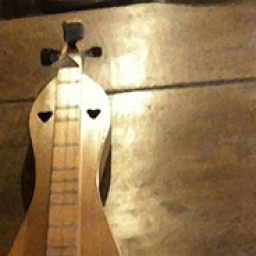
It's two sided, and will look like this:
Hi bfolkemer;
Remember that adjusting the action height is a very simple thing to do; don't reject a dulcimer because the action is a bit high. Buy a dulcimer by the quality of the sound, not the wood, action height or any other factors. Wood choice is fairly far down the list of things that affect the volume and quality of sound -- walnut or cherry or cedar does not necessarily make a dulcimer more mellow or sharp. Relatively larger soundholes (more square area of holes) on two dulcimer with the same size body will give you more volume. Larger internal volume gives you more external volume as well, but you generally lose the 'high silvery' sound.
Oh yes we do. I'll give it at least week or so.
Well, we know what the solution to that dilemma is, then. 
Lisa, while I wish for a 9 inch model, I like the 12 too much to return it.
Maybe you'd only have to pay 1 way shipping to exchange it for the 9" model?
My personal advice is not to buy an instrument from Ebay unless you both know what you're doing and can make minor adjustments to your instrument.
There are lots of reputable luthiers out there who make wonderful instruments. And a lot of this comes down to personal preference. I am tempted to go through my dulcimers and tell you what I like about each one, but that might take a while.
However, I would advise those who are new to the dulcimer to be patient. You don't know how your personal preferences may evolve. It took me perhaps three years of playing the dulcimer to understand what I want in a dulcimer. I like the big, round, bassy sound of modern dulcimers. I also like a fretboard that is wider than most (like Blue Lions, not like McSpaddens). I prefer ebony or some similar type of very hard wood as a fretboard overlay. Given the way I play I can comfortably work with dulicmers whose vibrating string length is 28.5" or less, but 29" becomes a stretch. I would like the 6+ and 1+ frets added. I now know that I want an internal pickup since that occasionally comes in handy. I could go on, of course.
My point is that before you know what dulcimers might be good choices for you, you have to play a while. So be patient. Save your dulcimer money in a little stash somewhere, adding to it whenever you can. Whenever you meet somone (or even see a video of someone) whose dulcimer you think sounds nice, ask them who made it and what they like about it. Ask if you can play it for a moment. Over time you will develop a wish list of dulcimers you really like, but at the same time you will be developing your own preferences so you'll have a better idea of what you are looking for in a dulcimer. Perhaps you already have discovered that you really like the low action of the Modern Mountain Dulcimers (I do, too), so you have already begun the process of developing your personal preferences.
Today I received a EMS Tabor Drum 12" with 2 sticks.
The drum is of excellent quality, and has a wonderful sound.
However, if I had it to do over again, I would choose a 10" drum. At least to learn on.. I should have considered weight and size to begin with. It's difficult enough just learning to hold the pipe with one hand.
I'll not be returning the 12". A little inconvenience might be a good thing.
I am posting this message just in case someone else is out there thinking of diving in.



 I Just Got A Dulcimer 2016.pdf - 1.1MB