Free Tabs: "Der Heiland ist geboren" - An Austrian & German Christmas Carol
Dulcimer Resources:TABS/Books/websites/DVDs
Thanks, Peter, for the tab. What software did you use to create it?
Thanks, Peter, for the tab. What software did you use to create it?
Hey Dusty, thanks for all the great info. I'm looking forward to checking this out when it gets here. supposed to be delivered on Saturday.
And yes Ozark Lady, that is a picture of the one I'm getting, I like finding the older harder to find dulcimers, over Christmas I actually found 3 Warren Mays!
From 1982, 1986 and a much newer one, the two later ones look to be virtually unplayed and came with case, noter and pick, the hang tags were still attached even.
Thanks for listening John!
Wow, thanks Joy!
Still listening to it, and still lovin' it! Great stuff!
Thank you for playing this carol and for the tab. I had not come across it before, you made it sound really good.
I just tabbed my arrangement of this old Austrian Christmas Carol that has become popular in Germany also.
You may use these tabs freely for personal, non-commercial use. Enjoy!
You can find the video recording of this song here on FOTMD: http://fotmd.com/peter-w/youtube/1961
EDIT:
German text:
Der Heiland ist geboren,
Freu dich, o Christenheit!
Sonst wär’n wir gar verloren
In alle Ewigkeit!
Freut euch von Herzen, ihr Christen all!
Kommt her zum Kindlein in dem Stall!
Translation:
The Savio(u)r is born,
rejoice, Christianity!
If not, we'd all be forlorn
to all eternity.
Rejoice with all your heart, all you Christians!
Come here to the child in the stable!
Howard Rugg, who has started building again and even has a website now, is a member here at FOTMD . You might consider contacting him directly with any questions.
The History page of Howard's website provides a broad outline. He and his brother Michael formed Capritaurus dulcimers in 1969 and Steve Jackel started working for them in 1972. Over the next few years, they developed a second line of dulcimers called Folkroots which were produced more efficiently (I won't say mass produced since they were still handmade by a small number of people) whereas Capritaurus concentrated on custom builds. In 1975, Howard and Steve formed Rugg and Jackel Music and made the Folkroots dulcimers while Michael stuck with Capritaurus. By the late 1980s, it all came apart. Howard and Steve sold the Folkroots brand to Folkcraft Instruments and all three of them moved on to different professional and personal endeavors, but about three years ago Howard began building dulcimers again and has incorporated some new innovations into his craft.
Nice playing, Robert. It makes sense that the larger box and longer VSL of a baritone would produce a richer, deeper sound with more sustain. I think that was Strumelia's point above. I know Blue Lion has a model called "Acoustic Jam" which is a standard dulcimer put on the same size box as their baritone and bass models.
Hello ozark Lady, Mine just shipped out, hoping to get it by the weekend, real curious to get an up close look, I have no details about it and virtually no info on line as to materials used, date and so on. I'll let you know when it gets here!
Dulcinina, you ask several questions here, and you might consider posting them separately as their own discussion.
I am not sure what you mean by "scrunching to reach the 9th and 10th frets." Are you having trouble reaching from one fret to another, or are you having trouble just playing up the fretboard? If it is the latter, the issue is how the dulcimer is positioned on your lap. Sit with your lap flat but you legs apart (you can't be "ladylike" and play the dulcimer!). Assuming you are a righty, Put the head of the dulcimer out over your left knee and the bottom of the dulcimer in tight on your right thigh. The dulcimer should be angled out towards your left, so that you can reach the low frets and the high frets equally easily. The exact angle of the dulcimer will be influenced by factors such as the length of your arm and whether you use your pinky or thumb, but you will want to angle the dulcimer at least as much as Mark Gilston does and perhaps as much as Guy Babusek does . Most likely, you'll be somewhere in the middle.
A beginner or starter or student dulcimer is just a less expensive dulcimer intended for someone who might be interested in playing but is not yet ready to commit to buying a more expensive instrument. I don't know what dulcimer Jane has, but I bought a student dulcimer made by David "Harpmaker" Lynch. It cost a mere $125. To make an instrument in that price range, David uses birch ply instead of more expensive tonewoods, spends only a minimal amount of time putting an easy curve into the side instead of more elaborate hourglass shapes, only uses simple circles for soundholes instead of fancier shapes, uses plastic instead of bone for the nut and bridge, only offers a flat head instead of an elaborate scroll head, and so forth. Because David is a master luthier, the intonation is dead on and the dulcimer has a lot of volume. The action is also very good. As I said above, I have one which I keep on the east to play when I visit there. Here is a video I posted a few years ago , if you can excuse my vocals.
A compensated bridge is merely a bridge that has been adjusted for the specific strings. Without getting into the physics, basically the distance between the nut and the bridge should be slightly different for strings tuned to different pitches. If you buy a dulcimer from McSpadden or Blue Lion or whoever, it is good to indicate if you will tune primarily in DAA or DAd, for they can adjust the bridge to compensate for that tuning. To be honest, I change tunings on my dulcimers and don't notice the change in intonation, so the difference is probably only noticeable to the most discerning ears.
As I stated above, I strongly recommend playing for a few years before making a big investment in an expensive instrument. While I personally don't believe the type of wood to be a major factor in the tone of an instrument, I do prefer softwoods such as spruce or cedar for the soundboard rather than an all-hardwood instrument. I also really like an ebony overlay on the fretboard to allow for easy fingering and resist damage by my sometimes careless flatpicking. I prefer a flat head for ease of stringing. Although shorter VSLs are more comfortable, longer ones usually mean more sustain. Now that I sometimes play in public, I want an internal pickup on any new dulcimer I get. I could go on, but the list of my personal preferences is no guide to anyone else except for the general principle that there are a lot of variables in dulcimer building and you have to play a while to discover what your preferences are.
By all means, try out as many instruments as you can and see how they feel and how they sound. Also pay attention to the videos of dulcimer players you enjoy and whose dulcimers sound nice to you and ask about them. Be patient. The longer you wait the more you will know exactly what kinds of variables matter to you, and the more your next dulcimer will really be the ideal dulcimer for you.
I've been enjoying the Hearts of the Dulcimer podcasts and look forward to each episode. Thank you for compiling historical pieces and preserving the present for the future. The dulcimer community is enriched by your efforts.

Singer and multi-instrumentalist Bing Futch has embraced the mountain dulcimer as his first and foremost instrument. Known for touring around the US in his RV, Bing plays many diverse styles from traditional folk to rock to original compositions to the blues -- all on the dulcimer.
For episode resources: http://dulcimuse.com/podcast/resource/009.html
The advice to Jane was just what I needed to read because I'm champing at the bit to get a new dulcimer and was ready to call a builder in my area to set up an appointment to try out his instruments. My dulcimer was made in '87 by someone who built as a hobby. The action is high and probably is meant to be played with a noter, which is how I started. I belong to a group in Berea, KY and the leader has brought 3 of her dulcimers for me to play--Folkcraft, Blue Lion and McSpadden. I, too, want a warmer, mellower sound and so far found it in the McSpadden. But I want to buy an instrument I can try out before I buy.
The length on my dulcimer from nut to bridge is 27" and I feel like I'm scrunching to reach the 9th and 10th frets. I am an average size woman with small hands. I know what I want in sound but am confused by some of the language when I've done research. What is considered a starter or beginner dulcimer? McSpadden's website refers to "bridge compensation option" if you want to play in DAD. What's that?
I was planning to wait until the Ohio Valley Gathering in Feb. in hopes of trying out several instruments. What other things should I look for? Dulcinina from the Beginner Group.
Here comes a "minority report"! I don't like the various "squeakless" varieties at all. I'm with Linda Brockinton in thinking that they sound dull or muffled. I'm happy to accept a bit of squeak if that's the price I have to pay to achieve a lively sound. (Guy is quite right about taking care to lift off the pressure when sliding on a wound string so as not to squeak too much, however.)
I like the elixirs too! They don't seem to muffle like some of the others that I have tried. Sometimes I just use regular "non squeakless" strings and try to take more care on my wound strings to lift off the pressure when I slide so I don't squeak too much.
Hi Anne,
There are a lot of different sets of lyrics for this song, and a bit of variation in the tunes.
'Whip Jamboree' has a similar tune.
This one is pretty standard :
Let me know if a sound clip would help.
Jane, you've gotten lots of good replies so far.
I notice you say it's a 'student sized' 26" with DAd tuning. I assume that along with the shorter scale length, the "student' means it's also a smaller shallower body. Though small tweaks can indeed change an instrument's sound a little bit, changing strings in my opinion is not likely to make a small soundbox entry-level short scale dulcimer sound "very warm and rich". More than any other factor, I would say that dulcimers with larger or deeper (taller) bodies/soundboxes will sound deeper, richer, and warmer. Think about the difference in tone between a smaller tenor guitar and a large dreadnaught guitar. Or between different sized wooden recorders. Perhaps an extreme example, but- you can't make a viola sound like a cello by changing strings.
The good news?- you may have to have more than one dulcimer for different sounds. 
If you are going to be playing mostly in DAA instead of DAD, I find that changing the treble string to a heavier gauge which matches the middle string gives a better sound. Otherwise that upper string can sound kind of floppy and lifeless IMO.
I like CGC a lot. Especially if I am playing a tune that hangs out lot in the upper range of the instrument. The upper notes in DAD don't have the same ring to them IMO.
Jane. Every dulcimer like every person has its own voice. People can change, dulcimers can't.. There is a tyranry of tuning when in a group that says everybody must tune to Dad... But at home alone find the key that sound best. At some point you want to try different tuning / modes.. Daa will definitely sound a bit more warmer. The dulcimer was never intended to be tuned only to one key and one mode. This is what makes this seemingly simple instrument so complex and exciting.. Robert.
Yes, I've heard Santiano on Youtube. It's so rollicking .... I'm not sure if it was a version by Tri Yann, a group I like very much. I found them at the same time as I discovered Malicorne..., as well as the talented Denez Prigent. Such a wealth of music that we miss out on if we stick solely to English language songs....
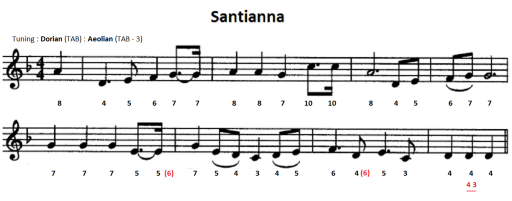
Anne, Santiano is a French version of the English sea shanty Santy Anno (or Santy Anna). You can hear it on Youtube by the Kingston Trio. Sorry, no dulcimer tab.
Any dulcimer tabs/music for Santiano? ...
Marc.mathieu, connaissez-vous cette chanson ?
I agree with Dusty. There are so many factors that affect the sound of a dulcimer tha wood selection plays a very tiny part. Volume of the body -- length without head x width x depth will affect the sound more -- larger volumes give a more 'mellow' sound. Buy what looks good to you, and most importantly what sounds the way you want.
Jane, You have gotten some excellent responses from the great people and players on this board.
I agree with Dusty, that while wood can definitely affect the timbre of your instrument, it has much more to do with how the instrument is built, and how it is played.
I find that paying great attention to my technique, using as little pressure as possible when I fret, and using a light touch on my picking hand. Regardless of whether I'm finger picking or using a pick to strum I have to be careful of how I'm playing... not digging into the strings very hard to play them, but getting a nice brush on top of the strings to set them vibrating.
I have personally found that the longest VSL my body can manage seems to also help me as far as sustain goes... so while you don't want an instrument that is too long for your body, you don't want to go too short either.
Size, build, materials and technique all play their own part in the tonal quality of your sound.
Jane, some woods do indeed create a slightly warmer sound than others, but many other aspects of dulcimer design have an even greater effect. A Blue Lion dulcimer will always sound bigger and warmer than a Pritchard replica no matter what woods are chosen.
I suggest you listen to other dulcimer players and when you hear a tone you like, inquire about who made the dulcimer. Then you can talk further with the luthier.
But as Dan says above, take your time. There are a lot of variables of dulcimer construction and you need to develop your preferences before you know what your ideal dulcimer would be. It took me about 3 years of playing before I knew the kinds of attributes I want on a dulcimer.
I think that you will find that walnut will fit you're needs very well. In the meantime, don't be in a big hurry. Ask questions, listen and watch the sound files and videos here on FOTMD. We are all willing to share our experiences and knowledge with our newer players. Several of our members are builders as well as good players. I've been on my own dulcimer journey for six years and have enjoyed every moment (aside from a few ill advised purchases on Ebay). We all enjoy sharing our adventures during our journey and welcome you and look forward to hearing yours too.
Jane, you've received good advice so far. Try CGc tuning and see what you think. The deeper sound might please you.
You might also increase the gauge of your bass string to .024 or even .026, but your melody and middle string should probably not be increased much.
Also, if you angle the dulcimer up a tiny bit so that it is not sitting flat on your lap, you will likely get more vibration from the bottom, which should open up the sound a bit. You could also place your dulcimer on a wooden table and see if the increased resonance and sustain is something you like. If so, you might play with a possom board, or at least a wooden plank under your dulcimer.
I don't know if any of these changes would really produce a warmer, richer sound, but they will make slight changes and perhaps you'll like what you hear.
Jane, CGC is one step lower than DAD and may suit you needs. "Warm Rich" sound is a very subjective phrase. What sounds warm and rich to you're ears may not sound that way to mine. You are presently using larger guage strings on you're melody and middle strings than I have used on my dulcimers with the same VSL. What woods were used on your dulcimer and who built it? If that person is still building and has a website they may be able to give you better information.
"
I have a sneaking suspicion that you've maxed out the amount of 'warm rich' sound that simply changing strings can give you.
Have you tried dropping down and playing in C -- CGG or CGc? You say you have a "student size" instrument, and I don't know what that means -- who made the instrument? What is the max width, length and depth? Dulcimers with more cubic inches of internal volume generally have a more 'mellow' sound, than small instruments. As do dulcimers with VSLs longer than 26" or even 27".
You can certainly try nylon/gut strings, but to work best you may need to change out the nut and bridge for ones with wider notches. Start with nylon gauges about the same as your steel strings.
Joe, you're right! This is an american dulcimer, not an epinette.


 DerHeilandIstGeboren.pdf - 55KB