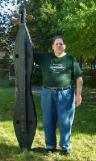
Introducing Ol' Hickory
OFF TOPIC discussions
That is beautiful Phil !
I just received my New Dulcimer this morning From Jack Ferguson. Jack has out did himself with this one. I started this build almost two years ago but we all know the string of bad luck I had. I was never able get much done on it. so it sit as a pail of wood. Bobby was going to take a shot at finishing it for me. The bad luck followed with it and bad health kept him from doing the build. Then Jack stepped up and was able to bring my dream to life. Along the way things changed and the ideal grew. one reason for the sound holes of the Phoenix is a sign of rebirth. My life and the life of the Dulcimer Have both been given that 2nd chance.
The reason for the name Ol' Hickory, is that it is mad from 99 percent Indiana Hickory The finger broad is Purple hart, witch just sits it off. The on-board electronics provide under-bridge pickup with 4-band Equalizer, and a convenient LCD Tuner.
10313311_795439613824319_7957196491532473264_n.jpg
Folkfan, your example of Brother John may be EXACTLY where I need to start. Really, I'm pretty happy with DAA, might should leave well enough alone. Sure appreciate the help from you folks.
If you've got your instrument now tuned in DAd, then the tunes you played in DAA can be played by subtracting 3. If I play Brother John (in DAA) as 3453, 3453, 567, 567, 787653, 787653, 303, 303. In DAd it's 0120, 0120, 234, 234, 454320 454320, 0 0middle 0, 0 0middle 0. The one advantage to staying in DAA for noter/drone or melody/drone style is that you have notes below the starting note of the scale (3) to play on the melody string, but in DAd you have to hop over to the middle string for the lower notes as in the ding, dong, ding in Brother John. I find hopping over to the middle string awkward. If DAd strikes the right note with you, though, then play on. Oh, and one more item, the 9th fret note in DAA becomes the 6+ in DAd.
Glad to see you on again, Sam! Robin's told you about all you'd need to know to start.
Well you just told my what I needed to know. Straight, simple and my head doesn't hurt from pages and pages of (well meant) explanation that I would not have a clue about.
Thanks Robin ... you da cats!
Love DAC, just don't know that many simple tunes to strum out. A lot of tunes in DAA start out on the first or third fret ... where do I commence in DAd ... heh, heh ... never thought of that did ya :)
Oh, an' I have one of them little bitty Mac's tuned at CGGG (ggg?) ... talk about wound tight!
... well ... maybe a little. Finally getting up enough nerve to try DAd ... so, which d? One octave above the D? I have Snark tuners.
Any tips on making the transition from DAA? I thump stuff out noter/drone. Should I leave well enough alone? I have more than one dulcimer and am mostly just interested in trying that tuning.
Sam
You'll occasionally see a Mize listed on ebay. They are pretty. Yours is too. I hope you post more pictures. Mize seems to like those carved figureheads for the peg head. Personally, I think I would get nervous knowing something is staring at me but that's jut me LOL. Congratulations on your acquisition!!! I hope you'll post some videos soon
Actually, Gene Griner started a thread last year about a Mize he has which has a swan peghead.
Gene's dulcimer thread
John C. Knopf said:
Just thought I'd comment that I've never seen a Mize dulcimer with a carved figure on the peghead.
You may have a rarity there. Or, somebody glued a Mize fingerboard to another dulcimer...
Dusty, I certainly have changed strings in the last 40 years - last time was about 20 years ago and they're sounding fine, though the ones I kept as spares have long since crumbled to dust.
Dusty Turtle said:
John, I'm not sure there is a reason to change that setup. In the first response above I described the standard way dulcimers are strung, but I don't know if there is a reason for that other than the benefits of standardization.
However, if you haven't changed strings in 40 years, I would definitely suggest doing so.
![]()
john if im reading this correctly your dulcimer may be strung for a left handed player.
the dulcimer in the pic probably was just strung by someone who didn't know the strings should feed from the top
of the shaft on the tuners.
I knew bob mize. among his achivements was an article in one of the fox fire books on how to make a dulcimer.
joe sanguinette
John, I'm not sure there is a reason to change that setup. In the first response above I described the standard way dulcimers are strung, but I don't know if there is a reason for that other than the benefits of standardization.
However, if you haven't changed strings in 40 years, I would definitely suggest doing so.
After reading all the above I thought I'd better get my old MD out and check my own stringing layout. Phew...turns out my stings wind on over the top of the pegs like they're supposed to. Unfortunately, the stringing pattern is even odder than the one here. On the nearside of the dulcimer, tuner nearest the nut is the bass string, the tuner furthest from the nut is the middle string. On the farside of the dulcimer the tuner nearest the nut is for the first melody string, the tuner furthest from the nut is the second melody string. In my defense all the strings have nice straight runs to their tuners !
At least I've got the tuners fitted the right way round.
It's been strung this way for over 40 years now so I'm not about to change it !
First a comment, the 'Mize' printed on the fretboard may be the name maker.
Second, looking at the slots in the nut make it look like the 2 melody strings may be right, the bass and middle may be reversed, but not necessarily so. That may be a result of the narrow width of the tuning machine recess. The shown pattern has a straighter pull on the strings.
Edit: Just looked at a photo of a Mize dulcimer and that looks like the same stringing pattern.
Salty, if you're new to dulcimers you may not know you probably have quite a treasure there. Robert Mize made about 3800 dulcimers, starting in 1967 and ending with his death in 2003. You might want to do a search on his name to find out more about him, as he's considered one of the seminal builders in the mountain dulcimer revival.
Ain't it the truth! Just a few years ago I was asking questions like would my fretboard get warped if I put on slightly heavier gauge strings. Now I'm an old timer tellin' the youguns you much tougher it was in my day.

Dan Goad said:
there ain't no "betters" around here. Some of us have just been playing around with them for a tad longer than you have. You'll be giving out advice before you know it.
![]()
![]()
![]()
Cute toes.
You are correct. That is not right.
The strings should feed over the top of the pins.
Additionally, the pin on the top right in the picture should be for the bass string. The pin on the top left in the picture should be for the middle string. The pin on the bottom left should be for the melody string furthest from you, and the pin on the bottom right should be for the melody string closest to you.
I suggest getting on new strings. But replace one at a time in case the bridge is moveable. Otherwise you'll have to post a question about how to position a bridge, and then we all have to learn physics together.
(Actually, it's not that hard, but it does take a few minutes working with a tuner.)
I used to sing in a choir and still do some harmony singing Christmas times. In my experience the melody is generally the soprano line in modern arrangements ( though in older `West Gallery' arrangements the melody is often the tenor, so beware !), the alto is often written for the section of the choir who can't sing and so it has a very limited range of notes, the tenor is often a good strong harmony part while the bass gives roots to the chordal structure. It's not always like this though and the melody can actually be spread across the four parts so watch out for that. In the case of west Gallery - approximately 1700 through to about 1850 in England, the roles of the sopranos & tenors are often, though not always reversed, so the tenors are the melody and the sopranos do a good strong harmony. Presumably this is because of the likely make-up of the choirs they were written for, with men being dominant at the time in public activities.
My suggestion would be to change the way you think about the question itself. When folks sing in harmony, they are singing the notes of a chord. One of those notes is the melody part. So instead of thinking in terms of harmony parts, why not think in terms of melody and chord. If your wife is figuring out the chords that back up the melody, then all you have to do is find the right voicing for that chord on your dulcimer so that you are playing the melody note.
What I mean by that is best explained by an example. Let's say your melody note is the F# that is round on the second fret of your dulcimer tuned DAd, and the chord is a D. You might choose to play 0-0-2, for that gives you the melody note and two notes of harmony. But you might also choose 4-3-2, or 032, or 232. And those chords are D chords (or 2-note approximations of D chords) and you should play around with your arrangement and see which one sounds best.
Or if the melody note is the A on the fourth fret of your DAd dulcimer and the chord is a D, you might try 0-0-4, 2-3-4, 4-4-4, 6+-4-4, and so forth. Play around with those different chord voicings and you will find the harmony notes that you think sound best. And then maybe the second time through you could change chord voicings for a different arrangement.
I don't think it is a bad idea to study harmony arrangements, but I know that those arrangements are based on the chord structures of the songs. To me it makes more sense to learn those chord structures themselves rather than learning one or more harmony parts that stem from those chords.
I am coming late to this discussion, but hope I can offer a little help.
First, I think it is important to clarify the language. "To transpose" means to change keys, that is, move a piece from, say, the key of F (F, G, A Bb, C, etc) to the key of D (D, E, F#, G, A, etc). What you are doing is transcribing and arranging.
Back when I was a college music major, one of the exercises we had in the first year of Harmony was to fill in the notes of of hymns, creating 4-part harmony, given only the melody (soprano) and bass parts. The interesting thing was there was often enough implied harmony that the inner ear would fill in the "missing" notes. The alto and tenor voices often weren't necessary.
If I were working on a project like yours, I would first try working with the outside voices (soprano and bass) first, then decide which, if any, of the other harmony notes you need for a musically pleasing sound.
Interesting question! Can you play soprano plus another part on thepiano to see how they sound together?
Generally it would be alto or tenor probably that would go well with the soprano. Often,a lot of bass parts don't have amuch movement in them. This may or may not be a good thing.
Even when you decide on which is going to be the 2nd harmony, you may end up tweaking some individual harmonies in the tune. For eg, do you want any sections to be in unison, or 100% in harmony? Where the harmony is created byan interval of a 3rd for eg, you may likeusing a5th better in some places.
I'd also pay attention to long sustained notes - what notes are being played and whether you want an open chord or a triad.
Thank you, Lisa.
Life has been very kind to me during 50 years lifetime up to now. I am grateful for that.
So I just try to give something back and share things (or ideas) from time to time.
I am happy if the book is useful for someone.
Peter it's so generous of you to offer all this for free.
Vielen Dank! Ich glaube dass ist Wahr! I really appreciate your input here. Love your site - especially the yellow one, fantastisch! Wenn I got into dulcimers I didn't know if I would like it or not ( was ein Dumkopff nicht, what's not to like?), so I got the cheapest thing I could find, a cardboard kit. Had I known then what I know now, I would have simply mortgaged the house! I had a lot of fun living in Germany teaching guitar and doing lots of concerts. It was the best musical time of my life, well wait, these dulcimers are pretty fun too...Glad you're on here. Oh, I was in Oppenum am Rhoi.
Hi Cynthia,
thank you for your feedback. Glad you like it.
Yes! You're right! I should avoid exclamation points! Definitely!
Sorry, only joking... I was not aware of that, Cynthia, but you are perfectly right with your observation. I'll change that when I go over it again. It was not my intention to shout at the reader - I guess, exclamation points are more common in German punctuation than in English.
In the meantime, several different kanteles have found the way to our home.
For chord playing, I'd rather recommend a 10-string kantele (which misses the c# in the higher octave). If your intention is melody playing, an 11- or even 15-string kantele will be perfect.
If you're interested in some more pictures of my kanteles, you may like to look at my little kantele blog (in German):
http://finnischekantele.blogspot.de
In the US, you can contact www.kantele.com . There's lots of information on Gerry Henkel's site - and he builds 5- and 10-string kanteles.
If you like to order decent instruments at a reasonable price from Finland, I can recommend Melodia Soitin and Lovikka. The most famous maker in Finland is Koistinen, but I don't own one of theirs (yet...).
In the UK, there's also Michael J. King who builds custom kanteles.