Why would this be any different to playing noter drone on a 3 stringer ? In any case you get very little volume advantage from double strings. Just more tuning to do all the time !
updated by @john-tose: 02/14/16 05:58:23PM
Why would this be any different to playing noter drone on a 3 stringer ? In any case you get very little volume advantage from double strings. Just more tuning to do all the time !
As I re-read the first post, I wondered if the scollops were on the fretting surface, or underneath, where the fretboard makes contact with the instrument top. The latter is a fairly common design, the idea being the top would be able to vibrate more freely glued contact with the fretboard.
I have played guitars and banjos with scolloped fingerboards. The idea is they are faster and more easy to play because finger placement is less critical. There is also the idea that it is easier to bend notes.
Sometimes the metal frets are set flush to the top of the flat fingerboard, then the wood between the frets is scooped out.
I didn't care for them, but some people like them.
Very nice, Phil. As a native hoosier myself, I sure appreciate that hickory.
Wow, Phil--this is a beauty! Great choice of woods, great workmanship, great artistry--and choosing the Phoenix bird rising from the fire, that is genius! You've both brought something very special into creation.
Phil, as a favour I'll take it off your hands for $10 hard cash !!!, lol its a beauty.
John
Absolutely exquisite! That is a real treasure. Enjoy the dulcimer.
Ken
"The dulcimer sings a sweet song."
I just received my New Dulcimer this morning From Jack Ferguson. Jack has out did himself with this one. I started this build almost two years ago but we all know the string of bad luck I had. I was never able get much done on it. so it sit as a pail of wood. Bobby was going to take a shot at finishing it for me. The bad luck followed with it and bad health kept him from doing the build. Then Jack stepped up and was able to bring my dream to life. Along the way things changed and the ideal grew. one reason for the sound holes of the Phoenix is a sign of rebirth. My life and the life of the Dulcimer Have both been given that 2nd chance.
The reason for the name Ol' Hickory, is that it is mad from 99 percent Indiana Hickory The finger broad is Purple hart, witch just sits it off. The on-board electronics provide under-bridge pickup with 4-band Equalizer, and a convenient LCD Tuner.
10313311_795439613824319_7957196491532473264_n.jpg 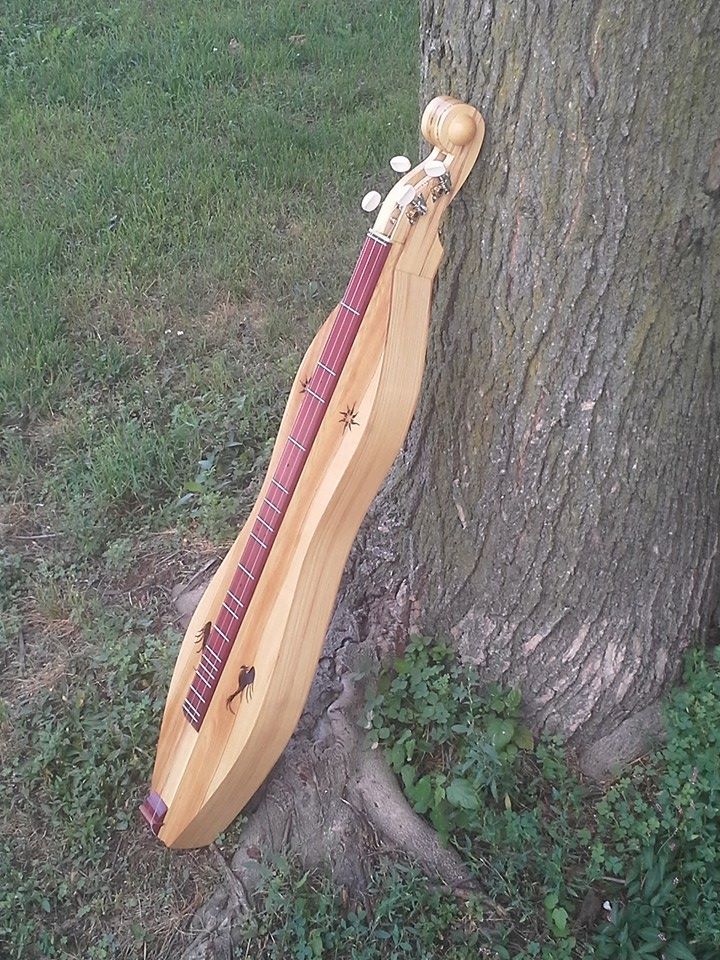
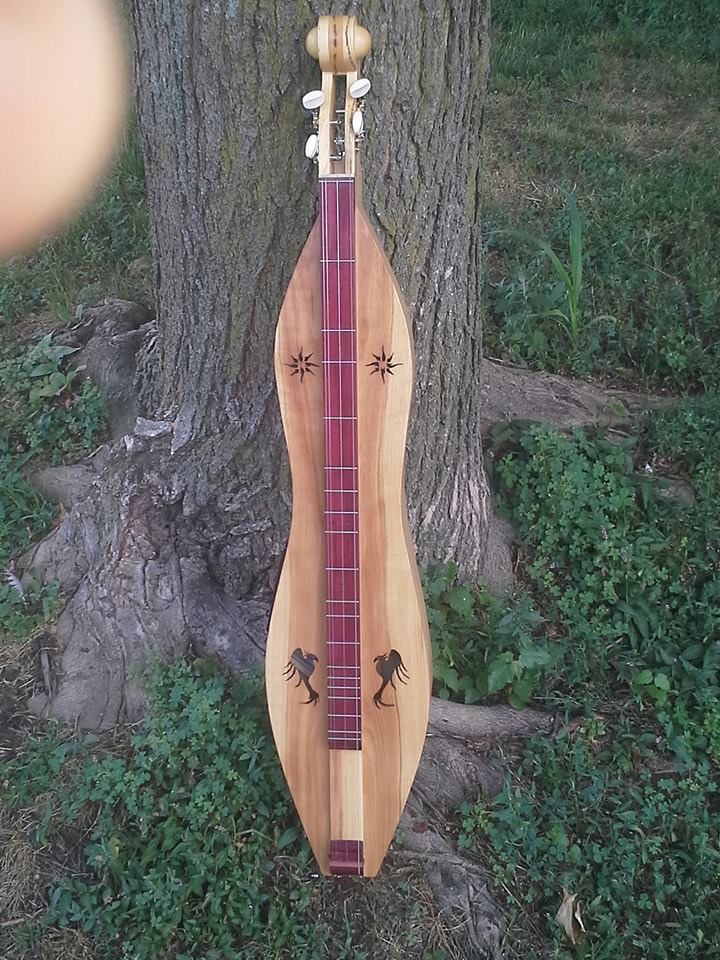
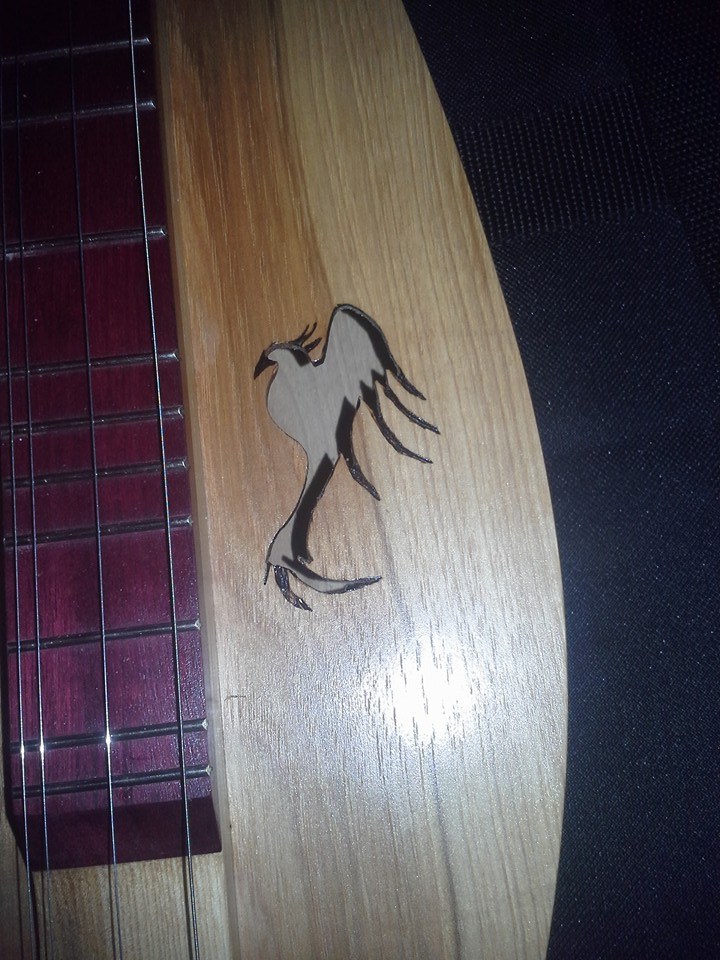
Folkfan, your example of Brother John may be EXACTLY where I need to start. Really, I'm pretty happy with DAA, might should leave well enough alone. Sure appreciate the help from you folks.
If you've got your instrument now tuned in DAd, then the tunes you played in DAA can be played by subtracting 3. If I play Brother John (in DAA) as 3453, 3453, 567, 567, 787653, 787653, 303, 303. In DAd it's 0120, 0120, 234, 234, 454320 454320, 0 0middle 0, 0 0middle 0. The one advantage to staying in DAA for noter/drone or melody/drone style is that you have notes below the starting note of the scale (3) to play on the melody string, but in DAd you have to hop over to the middle string for the lower notes as in the ding, dong, ding in Brother John. I find hopping over to the middle string awkward. If DAd strikes the right note with you, though, then play on. Oh, and one more item, the 9th fret note in DAA becomes the 6+ in DAd.
Glad to see you on again, Sam! Robin's told you about all you'd need to know to start.
Well you just told my what I needed to know. Straight, simple and my head doesn't hurt from pages and pages of (well meant) explanation that I would not have a clue about.
Thanks Robin ... you da cats!
Love DAC, just don't know that many simple tunes to strum out. A lot of tunes in DAA start out on the first or third fret ... where do I commence in DAd ... heh, heh ... never thought of that did ya :)
Oh, an' I have one of them little bitty Mac's tuned at CGGG (ggg?) ... talk about wound tight!
... well ... maybe a little. Finally getting up enough nerve to try DAd ... so, which d? One octave above the D? I have Snark tuners.
Any tips on making the transition from DAA? I thump stuff out noter/drone. Should I leave well enough alone? I have more than one dulcimer and am mostly just interested in trying that tuning.
Sam
You'll occasionally see a Mize listed on ebay. They are pretty. Yours is too. I hope you post more pictures. Mize seems to like those carved figureheads for the peg head. Personally, I think I would get nervous knowing something is staring at me but that's jut me LOL. Congratulations on your acquisition!!! I hope you'll post some videos soon
Actually, Gene Griner started a thread last year about a Mize he has which has a swan peghead.
Gene's dulcimer thread
John C. Knopf said:
Just thought I'd comment that I've never seen a Mize dulcimer with a carved figure on the peghead.
You may have a rarity there. Or, somebody glued a Mize fingerboard to another dulcimer...
Dusty, I certainly have changed strings in the last 40 years - last time was about 20 years ago and they're sounding fine, though the ones I kept as spares have long since crumbled to dust.
Dusty Turtle said:
John, I'm not sure there is a reason to change that setup. In the first response above I described the standard way dulcimers are strung, but I don't know if there is a reason for that other than the benefits of standardization.
However, if you haven't changed strings in 40 years, I would definitely suggest doing so.
john if im reading this correctly your dulcimer may be strung for a left handed player.
the dulcimer in the pic probably was just strung by someone who didn't know the strings should feed from the top
of the shaft on the tuners.
I knew bob mize. among his achivements was an article in one of the fox fire books on how to make a dulcimer.
joe sanguinette
John, I'm not sure there is a reason to change that setup. In the first response above I described the standard way dulcimers are strung, but I don't know if there is a reason for that other than the benefits of standardization.
However, if you haven't changed strings in 40 years, I would definitely suggest doing so.
After reading all the above I thought I'd better get my old MD out and check my own stringing layout. Phew...turns out my stings wind on over the top of the pegs like they're supposed to. Unfortunately, the stringing pattern is even odder than the one here. On the nearside of the dulcimer, tuner nearest the nut is the bass string, the tuner furthest from the nut is the middle string. On the farside of the dulcimer the tuner nearest the nut is for the first melody string, the tuner furthest from the nut is the second melody string. In my defense all the strings have nice straight runs to their tuners !
At least I've got the tuners fitted the right way round.
It's been strung this way for over 40 years now so I'm not about to change it !
First a comment, the 'Mize' printed on the fretboard may be the name maker.
Second, looking at the slots in the nut make it look like the 2 melody strings may be right, the bass and middle may be reversed, but not necessarily so. That may be a result of the narrow width of the tuning machine recess. The shown pattern has a straighter pull on the strings.
Edit: Just looked at a photo of a Mize dulcimer and that looks like the same stringing pattern.