Bridge placement
Instruments- discuss specific features, luthiers, instrument problems & questions
OK, 7th fret it is. Thanks again everyone!
OK, 7th fret it is. Thanks again everyone!
I plan to let my Facebook friends know a name and day to celebrate ahead of time and invite/encourage any who play Appalachian dulcimer to mark the day some way-- a still photo, a video, an audio, artwork featuring our loved instrument, etc., and just see what happens.
The end result should be that when you press the string down on the 7th fret, it will sound a note that is the same but one whole octave higher than the open string. Like in a "do re mi" scale they would be low do and high do.
Should there be a group or team of people to plan and write the news releases for The International Appalachian Dulcimer Day? Making sure that we cross a few T’s and at least dot an “i” or two. Otherwise, we might of just of had a nice discussion but we could easily just forget to follow through. That is if you all feel strong enough about this.
Oh, I understood, @ken-longfield -- many of us who were teenagers long ago understand joking about teenagers.
No, Steven. You measure the distance to the 7th fret (actually the center of the top of the 7th fret) and double that distance.
Ken
"The dulcimer sings a sweet song."
I hope I'm not giving the wrong impression. I spent 40 years working with teenagers and enjoy them. I was being facetious in my first post about our teenage years here on FOTMD.
Ken
"The dulcimer sings a sweet song."
I'm thinking about making a video for our day of celebration of the Appalachian dulcimer. Springtime will soon be upon us. 
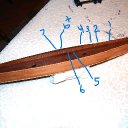
Thanks again to everyone for your welcoming comments and kind assistance! Ken, based on your numbering of the frets, I have a 6 1/2 fret. So, do I double the distance to the 6 1/2 fret to determine the location of the bridge? Also, thanks for the helpful woodworking tips. (I seem to be using "thanks" a lot on this site!)
@ken-longfield I know the teenage years can be difficult, at times, for all yet there'll be a lot of fun times, too. Young people give me hope!
Best wishes on getting a playable dulcimer, Steven!
Stephen -- I numbered the frets for you on the attached version of your photo.
A good trick when doing glue up -- to avoid a lot of staining from squeeze out -- is to cover both sides of the joint with blue painters tape before applying the glue. That's saved me hours of sanding!
FYI -- our glue of choice for all this is Titebond II or III. They can be un-glued if necessary by the application of a heatgun/hair dryer to the glued joints for a few minutes.
It may be a fair bit of work, but you're learning a lot about how the dulcimer goes together, and what to do -- or not do -- when you decide to build one from scratch, or from your own kit.
Good job getting the photos here, btw!
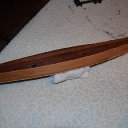
This doesn't really represent what I started with. On one side the glue failed and the side "blew out", leaving a gap of about 1/4"between the side and the bottom. I clamped and re-glued the side to the bottom and you can see I've sanded the side. The dark area along the top/side glue joint is the remnants of the squeeze-out. Also, the glue job on the fret board failed and about 1/2 of the fret board was loose from the top. So, I also glued and clamped the fret board to the top. The previous owner stained about 1/2 of the peg head a redwood color. I've tried to darken the peg head and obscure the line where the red stain ended and the unstained wood began. Maybe it's more work than it's worth to repair this instrument but it's a fun challenge. In any case, I just have to re-stain the repaired side, apply a clear finish and re-install the tuners before stringing it up. But which fret do I use to calculate the bridge position?
For sure Robin. My oldest grandson just turned 13 last week. Hence my comment.
Ken
"The dulcimer sings a sweet song."
Thanks everyone for sharing your knowledge of "dulcimology". I'll try to attach a photo to you so you can see what I have. But, give me a little time...
Oh, no! Another teenager.
Ken
"The dulcimer sings a sweet song."
Oh, yes! 
Oh, no! Another teenager.
Ken
"The dulcimer sings a sweet song."
I love cake!  And I remember when FOTMD was just a baby.
So July 29 will be FOTMD day around the world, Cake and goodies and lots of dulcimer music. Is it here yet?
Coincidentally, @lisa-golladay, I recently asked Strumelia that very question. FOTMD first went live on July 29, 2009. So this summer will be lucky 13 years!
We can make as many holidays as we want 
While we iron out the details of International Day of the Appalachian Dulcimer, let's start another celebration while we're at it. When did the FOTMD site go live?
I propose we celebrate FOTMD's Birthday! Cake for everybody!!
As an aside, Michael Rugg told me in an email that he'd rather have the 0+ than any other 1/2 fret. Indeed he said he preferred his instruments without a 6 1/2
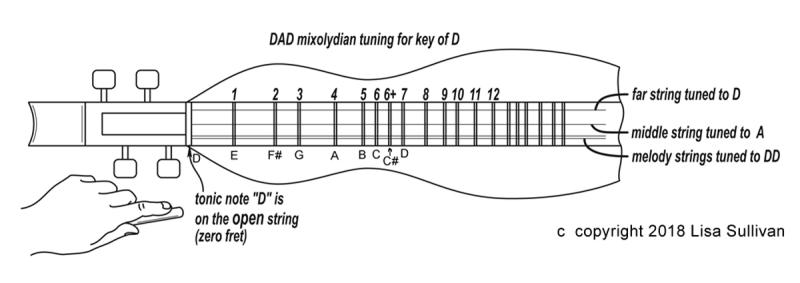
Don't just count the frets to find "the seventh fret". Do you know whether your dulcimer had a 6.5 fret or not? Not knowing can lead to a grave error when determining which fret is actually the 7th fret, in order to correctly place the bridge. Many older dulcimer kits like from the 1970s-80s did not have 6.5 frets added. More recent kits usually do have a 6.5 fret included.
If a total beginner is told to 'count your frets' then they'd likely be including both the 6 and the 6.5 fret when counting- thus thinking that the repeat octave is the C#. Most beginners don't yet know that they should count EITHER the 6 OR the 6.5 fret when 'counting frets'.. but not count both. I think it really helps to look at a picture:
Yeah, from that description it is what you called "a very low-end instrument". The peghead as an extension of the fretboard is a dead giveaway.
The reason photos are good is that you mentioned some "minor damage", which might be hard for us to help with if we can't see the extent of the injury. Do you have a 10-12 year old child/grandchild/neighbor kid who can help up upload a couple photos?
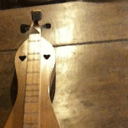
Sorry, my tech skills are non-existent so it would take me a week to figure out how to send a photo. The instrument is 3 strings, teardrop shape, looks like maple bottom, spruce top with two sound holes on either side of the fret board, mahogany (I think) sides. Peg head is just an extension of the fret board. Three guitar style tuners along one side of the peg head with the tuner shafts traversing three holes (3/4"?) drilled in line with the fret board, no nut, outside strings are guided by small brass nails just above the brass zero fret, strings secured to three brass nails at the end of the fret board.
I think I’m over thinking all of this…lol..maybe I am thinking on a festival mentality and not thinking of just a day to say Hooray for our Dulcimer!
I like your suggestion, Steve, when you wrote, "So we can skip the formal recognition if you all like and just promote the weekend ourselves."
Also, it is still important to me that folks from all over are part of this day of celebration just as folks from all over are part of FOTMD.
Just checked and we cannot register a national day by designating a “last weekend.” It has to be a date for it to be a “day.” So we can skip the formal recognition if you all like and just promote the weekend ourselves. But we could see someone down the road establish a date as “Mountain Dulcimer Day” or something similar. But if we do a really good job of promoting our day we can diminish the possibility of that happening. The more we circulate this among all dulcimer circles, the better. What would you say as to the criteria for the weekend? Would we go with the beginning of the festival season?
I’ll check to see if we can schedule something like the last Saturday of March and register it on the national calendar.
Dan is correct, as always. It is a fret usually found on chromatic fretboards, placed between the nut (which is sometimes called the 0 fret) and the 1st fret. As a term, 0+ is less confusing than "1/2 fret"
As to name, I do not feel strongly about 'American dulcimer,' and Strumelia is correct that it's really too broad. I'm good with either 'mountain' or 'Appalachian' (regardless of pronunciation, lol). I think the terms 'lap' and 'fretted,' while accurate, are dry and descriptive, while 'mountain' and 'Appalachian' are evocative and descriptive.
I was feeling enthusiastic about MD and the banjo being the only two instruments indigenous to the US. I was also thinking of the large contingent of folks playing the 'Persian dulcimer' (lol) who might be inclined to say "Hey what about us?" so we need to be specific - and it seems like folks were thinking that way anyway.
Even so, many clubs and the Dulcimer Players News itself include both dulcimers, and I can well imagine some hammer-folks saying "Hey it should be about both dulcimers!" So, at least some of us will have to answer not just the question of 'why-that-date?' but also 'why-weren't-we-included?' To that, the native roots of our dulcimer seems a diplomatic and compelling comment. More compelling than "because the idea started on FotMD"! More diplomatic than "b/c you drown us out," lol.
Now, as to date: Speaking to Dusty's concern, it often happens that 'celebrations' for an important date are moved to the closest weekend. So there's always the possibility of a set date falling where it might, but the subsequent weekend being the time for a local festival or jam or a special Zoom thing or etc. [Note this raises the separate question of what exactly to do to mark it. I say best to leave that to local communities and whatever folks want to make of it. But that thought argues for something in nice weather - versus, say, Dec 12, which I otherwise like.]
As for timing it to something less specific/more general - eg, first Saturday of Spring - I think that's still easy enough to remember, and let's look at the specifics: First, 'vernal equinox' = spring equinox = first day of spring, and it is virtually always on March 20, 21, or 22 (Farmer's Almanac, almanac.com). This year it's Sunday, 3/20, and MD-Day would be the next Saturday, March 26. Similarly, it's usually going to be the last Saturday of March - another easy way to remember it 'roughly' and then be able to look up. Next year, 2023 (a possible 'first annual'), it would be Saturday, March 25.
Did you know that April 8 is National Banjo Day?? Rather nice that it would be close!
Oh, but would we have some other competition in late March?? Well, surprise or not, yes - but not significant: 3/26 is National Nougat and National Spinach Day. March 26 is National Lobster Newburg Day, Natl Medal of Honor Day, Natl Tolkien Reading Day and Natl Manatee Appreciation Day. So we can celebrate by taking a manatee out for lobster Newburg...
Somehow I think we're okay with regard to that!! And obviously there are National Days for almost anything, so it's high time we get one for the mountain dulcimer!!
Why anybody would want a left-handed dulcimer is beyond me. I've built one recently, though, by special request.
Yes, but most nuts and bridges have a high ridge with the notches filed in it, sio flipping really isn't an option. Easiest to make a new nut and bridge, and then put new string on the other way around.
Turn them over and make new notches. If it uses a 0 fret just open the slots so he bass string fits will usually work since the nut is for lateral string positioning. Or, you could just play the bass string as the melody [DAd] like a friend did.
You guys were so helpful with my last query, I hope you don't mind if I burden you with another question:
I see dulcimers advertised as "right handed" and "left handed". Could a left handed dulcimer be converted to a right handed dulcimer by simply flipping over the nut and bridge?
WOW, I'm impressed with all the responses. Good luck with the end result.
I think I’m over thinking all of this…lol..maybe I am thinking on a festival mentality and not thinking of just a day to say Hooray for our Dulcimer!
What is a 0+ fret? Sounds like an "odd fret"! 
Chromatic fret between the nut and the Traditional 1st fret.
What is a 0+ fret? Sounds like an "odd fret"!