If I Had a Hammer (dulcimer) but no left-hand
Adventures with 'other' instruments...
A few lessons probably wouldn't be a bad thing...
A few lessons probably wouldn't be a bad thing...
Hi. Those are tough choices to make, aren't they. I don't think there would be a huge tone difference between the cherry and walnut. They both tend towards a warmer tone than maple. I suspect the body shape would have a greater effect. I've seen here advice to others to buy the wood you find more attractive to look at. Walnut might be a little more interesting, but cherry darkens nicely with age.
The two I play most often are both walnut. One is an all-walnut hourglass and the other, a teardrop, has a cedar top. The teardrop is the sweeter, more "mellow" instrument. Neither are McSpadden. The McSpadden website has sound samples of their different models. They also have a liberal return/exchang policy.
One other thought. It often takes a bit of time to "make friends" with a new instrument, to find its sweet spots and how to get the tone you like out of it.
What Matt said. Wood is only one of a hundred factors that goes into making a dulcimer "mellow" and guitar-like, or "high and silvery" the way traditional instruments sound, including how the player plays the instrument.
All you can do is pick walnut or cherry to go with the redwood top. Since you can't even see what the particular pieces of walnut and cherry *look like* , just look at instruments that have those woods in combination.
I always recommend that unless you are working directly with a luthier to produce your "ultimate dulcimer", that you play as many as you can and pick the one that sounds best. Sound is, to most people, more important than wood. If it isn't, then I'm sorry for them. A competent luthier can make any combination of woods sound mellow or high-silvery.
One day I visited the Folkcraft showroom and played two all walnut instruments fresh off the workshop floor. Both were beautiful instruments. One had a distinctly more bass sound than the other. Simply choosing a wood for an instrument is not enough. Each sample of wood, even from the same tree, will produce different sounds. Yes, McSpadden has great quality control. Even so, two instruments made from the same species of wood will sound different.
For anyone truly interested in the sound of their instrument, I suggest going to a showroom and playing as many instruments as appeal to you. Purchase the one that vibrates to the tune of your body.
That topic about 'what wood' is best or perfect etc, has come down to this for me. I am being given a McSpadden as a gift. I haven't played consistently for long, almost 70 and probably too late to develop a passion for collecting dulcimers. Oh yeah... the top will be redwood, no choice there. But I am allowed to choose walnut back and sides or cherry. It seems like such a simple choice but.... Never having a dulcimer I really liked, I 'guess' I like a warmer sound, less 'tinny', maybe like the the sound of Jessica Comeau on her redwood top, walnut McSpadden. Wish I could try a few, but can't. I listened to Lee Cagle's video of several dulcimer examples (including the two I am choosing from) and I'm still in the dark. Heard a few others on YouTube. So, the question trying to keep it simple given many considerations, is, if you have or played redwood top, walnut or cherry McSpadden or those woods, or you just want to offer an opinion, please let me know which you would choose. Thanks.
"Here among the fidlers I first saw a dulcimere played on with sticks knocking of the strings, and is very pretty."
I've had my hammered dulcimer from the time I made my first harp in 1988. I tole painted beautiful birds on it. I play a few tunes on it and that's it. NOW is the time for me to learn more and be serious about it. Thanks for this part of the discussion. I've sent for Kendra Ward's book on playing the H.D. and that also should be a start. I'm thinking that maybe I'll sign up for lessons on line somewhere. aloha, irene
I built a HD in 2006. I keep it in my dining room and play it rarely. But I love the sound. If your right handed, learning the left hand isn't too hard. I found by only using the left hand gave me a degree of coordination. Still it comes down to practice. Changing to lighter hammers helps as does adding felt edges to soften the tone. One thing I would do if I built another is color the soundboard dark with walnut stain. It makes seeing the strings easier... Robert
@don-grundy, there were a few small fires about 75 miles away, but they were easily put out. Since I live in the Central Valley rather than the hills, the fires usually affect us less as a direct threat than by clouding our air with smoke. I actually have a bunch of masks in the garage for when the air gets really bad. Unfortunately, those are different masks than we need to halt the spread of viruses. Perhaps I'll have to double up on the masks soon. Yikes!
@ken-longfield, the rolling blackouts have indeed affected a lot of people. Luckily, our house is on the same little portion of the grid as a police station (and maybe a fire station, too), so we're exempt from those purposeful blackouts.
But folks along the coast, where it never gets above 80 are really suffering since their homes don't have adequate A/C.
I just read an article that questioned the rolling blackouts since although power usage was as high as expected, the state still had plenty of electricity in reserve. The conclusion was that over the last several years since the last major heat wave, so many people have added solar panels to their homes that the drain on the grid is significantly less than it used to be. A sign of progress, I suppose.
A tip. Try not to cross your hands/hammers on alternate strokes. If you do a D scale on the treble bridge, for instance, start with the left on the D, which lets your right hand do the G [right side of the bridge] and the left hand can then do the A on the left side of the bridge.
I'm not a HD instructor but this is what I would do. Since you're probably looking at muscle memory instead of strength, I would practice with the weak hand only, then add the other hand occasionally to add coordination. Using your fingers to move the hammers should help as they move more accurately than your arms. Start by learning the finger motion one hand at a time until it feels more or less natural with both hands. Then alternate notes between hands as you move up/down a scale. Just do one note and alternate between hands if necessary. D[left ]-D[right] up/down the scale. Go slow at first to compare hands. Scales for awhile then a really easy tune like Mary had a little lamb, or whatever. Alternate hands/notes.
I hope the rolling black outs don't cause your AC to go out or do you have a back up generator. Our son and his family live way south of you in Van Nuys and they've been having this heat as well. Stay cool inside and play dulcimer.
Ken
"The dulcimer sings a sweet song."
Well in the middle of this pandemic here on the west coast we're also dealing with a massive heat wave. The worst in about 75 years, I just heard. It will be over 100 for most of the day, even staying in the 90s well into the evening. I'm so grateful that we installed a new HVAC unit in May; I feel bad for all those folks with no air conditioning. At least the county lifted the water rationing restrictions so I can water the lawn more often than twice a week. But I don't think I'll be doing much work outside the next several days.
Thanks, @Pondoro and @Skip. I am expecting to practice. My question, though is how to practice. Since I have been playing fretted instruments my whole life, when I decided to work on my weak little pinky, I knew how to develop exercises for that. It still took 4 years to get my pinky up to the same strength as my other fingers, but at least I knew how to work on it. I designed some exercise specifically for my pinky and kept at it. I have no experience with the hammered dulcimer, and it just seems that my dominant hand is pretty good but my weak hand, well, is decidedly not. I have been doing some scales and some arpeggios, so maybe I just need to keep at it and perhaps in 4 years I'll see some improvement. But I wonder if certain exercises might speed things along.
Does 'practice, practice, practice', sound familiar? 
I took an intense 3 day class many years ago. We did scales, a lot! Both on each side if the treble bridge and across both bridges. Rick also tried to get us to use our fingers to power the hammers instead of wrist/arm movement. That is done with the hammers held between the thumb and pads of the first 2[or 3] fingers [no death grip]. The thumb pushes down over the pointer finger while the middle/ring lift towards the palm. It's kind of a flicking movement.
The ugly reality for me is that I have to practice my weakest areas obsessively. I’ve never tried the hammered dulcimer though.
Just got a hammered dulcimer a few days ago and am now in full frustration mode. Boy, the instrument is unforgiving; you hit one wrong note today and it rings until next weekend! I can see why people have dampers installed.
I have horrible technique right now and my left hand is especially lame. Does anyone have suggestions for how to increase the coordination of a left hand for playing the hammered dulcimer. I wonder if some percussionists out there have recommendations.
Thanks in advance.
Welcome to the family, Shelley!
 See how infectious the folk instrument world can be?!?
Oh I can see that! Love it!
Hi Shelley!
I did things in the opposite direction. Made a cardboard dulcimer as an art project a couple of years ago, fell in love with playing it. Then I "had" to build a black walnut one from a kit (a little over a year ago). Then I got tempted by a Fender acoustic guitar bundle on Amazon last December. Fell in love with that, too. And got a shell pink Fender Strat in April. Love my dulcimers (well, I rarely play the cardboard one now--it sounds really good, but no 6+ fret, alas) and my guitars, but in different ways and for different reasons! It is starting to look like a musical instrument zoo around here. They all have little stands. Some day when I retire, I want to get back into the recorder...I have several of those...
I'm going to need to see a photo of that cardboard dulcimer, I think. And the shell pink Strat!
Hi Shelley!
Like you, my introduction to folk music was guitar & I still sometimes go that way, but really am delighted to have found the MD. Since you're currently pretty much stuck indoors, you'll find lots to learn through prowling FOTMD. Be warned though, you show traces of the disease I have . . . developing a musical petting zoo. Even being stuck inside can't protect you. I blame my infection all the way back to Girl Scout days when I earned the Dabbler badge. For those with a specialized form of the disease, it's Dulcimer Acquisition Disease to match the common tuning of DAd. My husband has been fighting his own form of this with banjos. It's not fatal and is fun whether you succumb to it or not.
Oh, the zoo is overflowing. I recently added up all the instruments I have and it's embarrassing. Time to prune. Thank you for the welcome!
Hey Nate, there are LOTS of dulcimer players in Oregon. but then again, I don't know where you live. yep, a didly bow is a very cool thing for sure. I like your creativity and I hope you do keep experimenting. This song was played very nicely. thank you. aloha, irene
I like it! Any stringed instrument with resonator(s) attached gets my interest!
Hey Nate, there are LOTS of dulcimer players in Oregon. but then again, I don't know where you live. yep, a didly bow is a very cool thing for sure. I like your creativity and I hope you do keep experimenting. This song was played very nicely. thank you. aloha, irene
I applaud your creativity. I would never have thought of a concept like this. Keep up the good work.
I applaud your creativity. I would never have thought of a concept like this. Keep up the good work.
So very good. It's nice played on not-a-cello.
See how infectious the folk instrument world can be?!?
Hi Shelley!
I did things in the opposite direction. Made a cardboard dulcimer as an art project a couple of years ago, fell in love with playing it. Then I "had" to build a black walnut one from a kit (a little over a year ago). Then I got tempted by a Fender acoustic guitar bundle on Amazon last December. Fell in love with that, too. And got a shell pink Fender Strat in April. Love my dulcimers (well, I rarely play the cardboard one now--it sounds really good, but no 6+ fret, alas) and my guitars, but in different ways and for different reasons! It is starting to look like a musical instrument zoo around here. They all have little stands. Some day when I retire, I want to get back into the recorder...I have several of those...
Hi Shelley!
Like you, my introduction to folk music was guitar & I still sometimes go that way, but really am delighted to have found the MD. Since you're currently pretty much stuck indoors, you'll find lots to learn through prowling FOTMD. Be warned though, you show traces of the disease I have . . . developing a musical petting zoo. Even being stuck inside can't protect you. I blame my infection all the way back to Girl Scout days when I earned the Dabbler badge. For those with a specialized form of the disease, it's Dulcimer Acquisition Disease to match the common tuning of DAd. My husband has been fighting his own form of this with banjos. It's not fatal and is fun whether you succumb to it or not.
@shelley1 Great to have you here! There's lots to see on the site-- enjoy poking around!
Hi! My name is Shelley and I'm new to the dulcimer world and this site. I started playing about two weeks ago and love it! I'm played guitar since I was 13, and am learning to play a couple of other instruments, but nothing has grabbed my interest the way the dulcimer has. (With the exception of the guitar—LOVE my guitars.) I'm looking forward to learning what I can and hanging out with you!
Funny, I showed my instruments to Butch a couple years ago at Evart. I guess he remembered.
That is interesting. Butch Ross mentioned the concept in our last meeting and I have it on my list of things to learn more about. My latest steel string design seemed to sound best with no soundhole and I have been wondering if the rounded back would still work. I guess I will have to try it with and without a soundhjoe and see how it turns out.
Yes, the rounded bottom seems to focus the sound back to the soundboard.
Your bracing is very similar to the Taylor V bracing. I have attached a photo of the bracing used on the dulcimer that Butch Ross is getting. I refer to it as parallel bracing. It is used with strings terminating at the bridge like a guitar. On my dulcimer it yields a rich tone with a strong bass response.
The next photo is of the dulcimer for Aaron O'Rourke. It is a modified X-braced pattern that has more attack and is less bass focused. I would say it is closer to a traditional dulcimer sound.
The remaining photos are of my newest design with strings that terminate at the end block. Very close to the prior X- braced design with one small addition. This is the loudest dulcimer I have produced (the one with the 0.100 soundboard).
Are you using a rounded bottom for more projection?
I use fan bracing that comes together at the head and spread all the way to the tailpiece. With a double neck design, you need to have a more or less wide and flat tail piece . With a single neck, generally just two braces. With double necks I find four braces emphasize the treble, three helps the bass. Similarly, straight bracing emphasizes higher pitches, scalloped bracing lower. Haven't tried mixing them in one instrument. Pick your poison.
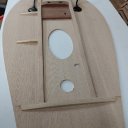
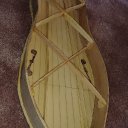
The picture shows a build in progress from a couple years ago. You can see the fan bracing on the soundboard. The X-bracing on the bottom is used so the bottom can be rounded.