Dale Ward, dulcimer builder - Pigeon Forge, TN
General mountain dulcimer or music discussions
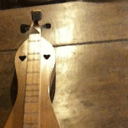
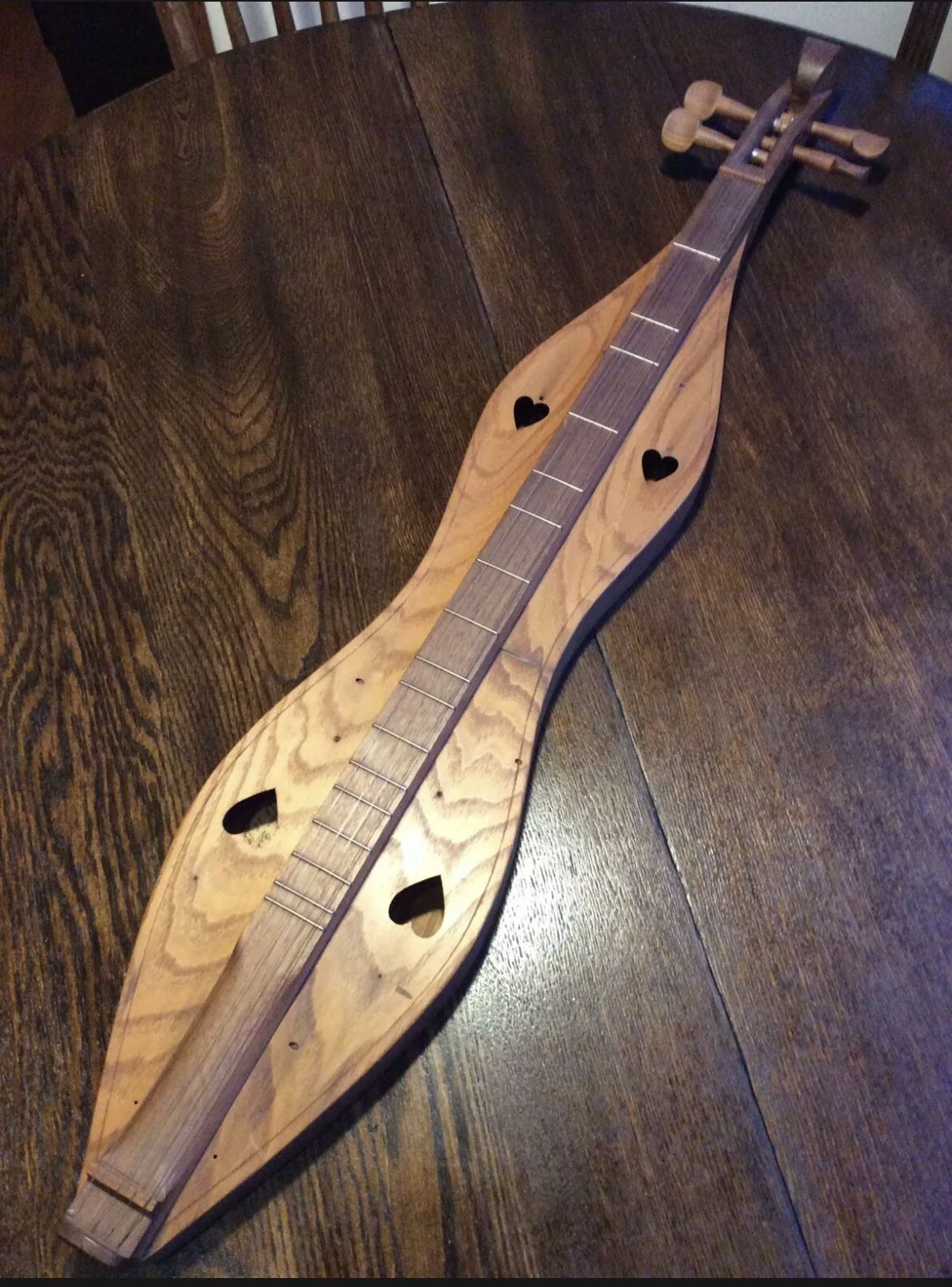
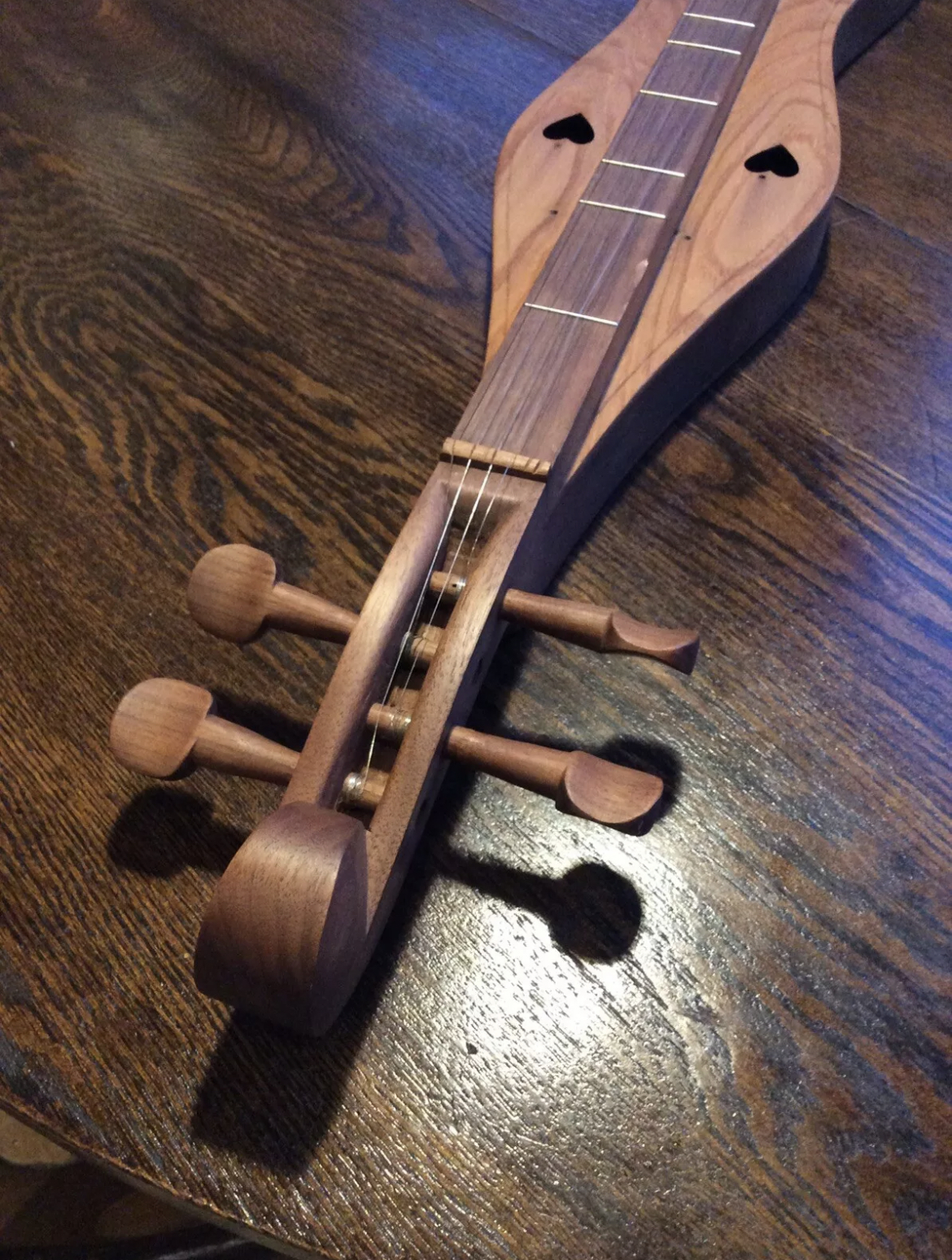
Does this 6 string look like a Rippled Sycamore & what type of tone wood would that make
updated by @marg: 01/22/22 10:24:02PM
Does this 6 string look like a Rippled Sycamore & what type of tone wood would that make
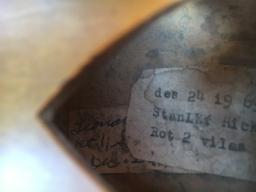
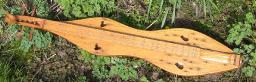
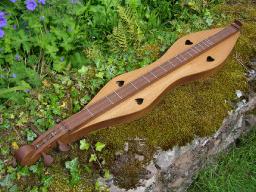
Does anyone own or know anything about Dale Ward's, dulcimers? It's a 6 string Pigeon River String Instrument, handcrafted by Dale Ward 9/24/97
That is a song still under copyright. You may need to purchase the sheet music and then get someone to do the tab for you. It is available here
https://www.musicnotes.com/sheetmusic/mtd.asp?ppn=MN0152332
in the key of C which should be fairly easy to create tab for.
If you can't find someone to tab it for you, pm to me.
That is a song still under copyright. You may need to purchase the sheet music and then get someone to do the tab for you. It is available here
https://www.musicnotes.com/sheetmusic/mtd.asp?ppn=MN0152332
in the key of C which should be fairly easy to create tab for.
If you can't find someone to tab it for you, pm to me.
I play dulcimer for residents in assisted living/memory care, and one of the residents loves to sing You'll never walk alone. I would love to be able to play this song for him; I'm hoping he'll remember the rest of it (now he just gets the first 2 lines). I'm sure I can get the lyrics. Does anyone have tablature for this song that I may have? I've checked all the free tab sites that I know of with no luck. I'm afraid I don't know how to write a tab or read music. Thanks for your help with this!
If you google "Don Pedi Youtube" you'll find at least 8 recordings of Don's playing. Notparticularly "instructional videos". The folks who make their living with dulcimer don't tend to give away a lot. But you'll also find links to Don's website with all of his available materials.
The David Schnaufer instructional video may not be available on YouTube. I think I bought a DVD of it years ago. My memory is that it was put out by Homespun Tapes. You can find a few videos of him playing though, and lots of videos of Don Pedi playing.
For one example, here is Don Pedi playing Sally's God Mud Between Her Toes . As Dan and Ken have said, he is the absolute master of the fingerdancing approach and is a font of information about traditional tunes. His website is http://donpedi.com/ .
Thanks all who responded! Dusty, I tried to review the David Schaufner video you suggested, but my attempts at searching got me nowhere. Same for the Don Pedi reference. If they are all on YouTube, could one of you guide me to find both of them, please.
Yep -- what Dan said. Don Pedi is probably THE current master of traditional Fingerdancing. Check out his videoes, how-tos, classes and festival appearances.
I say go to the master, Don Pedi.
If you are Fingerdancing on just the melody string, use whatever combination of fingers in any order that doesn't tie your fingers in knots as you move up and down the fretboard!
If you change over to Chord-Melody style playing, then which finger get usedon which string is more important.
Dusty has pretty well laid it all out for you there...
Jimmy, there is no single way to do this. What works best for you is what's best.
And I think you are right to work on one thing at a time. Don't think about adding chord strums until you have figured out the left-hand fingering.
In David Schnaufer's instructional video, he demonstrates how he uses three fingers (no pinky or thumb) to move up and down the fretboard. As he moves higher than his hand position he uses his index finger, and as he moves lower, he uses his ring finger.
Personally, I use all my fingers since I need all the help I can get! Most of the time I approach the fretboard the way guitarists and violin players do, where you try to minimize hand movement and keep your hand in one position as long as you can, with each finger assigned a fret position. Each position is named for the lowest fret. So if you use your pinky on the first fret and your ring finger on the second fret and so forth, that would be called first position. If you use your pinky on the second fret and your ring finger on the third fret and so forth, that would be second position.
However, whereas on the guitar or mandolin, each fret is of equal size, the dulcimer is missing some frets, so you might sometimes skip a fret. In second position, I might use my pinky on 1 and my ring finger on 2, but then my index finger on 3, skipping my middle finger. Find what is comfortable for you.
Some people use their thumb a lot on the melody string, turning the thumb to the side a bit to be able to use the edge of the nail and slide around like a noter. I do that occasionally out of chord positions, but not most of the time, since using your thumb comfortably means the other fingers don't line up on the melody string as easily.
However . . . and you may not want to do this . . . once you are using your fingers you are no longer limited to the melody string, and "My Bonnie Lies over the Ocean" is a good example of why. The song begins with a big jump from 4 to 9, and even goes down to 2 on a couple of occasions. That's a big jump. It's fun with a noter, but not so fun with your fingers.
But if you are tuned DAd, then any note on the melody string is also found on the middle string three frets higher. So the first note of the song could be the 7 on the middle string. That 2 on the melody is also the 5 on the middle string. The whole song can be played between 5 and 9, which is a much easier stretch, isn't it? Attached you'll find the melody of the tune using both melody and middle strings. Give it a try and see what you think.
I’m learning how to play the MD again after many years. I’d like to stop using a noter for the melody and use my fingers as a noter substitute instead. I need suggestions about how to approach assigning my L, R, M, I, T fingers to playing a piece. I’ve attached a score sample that id like to work on. Are there general guidelines to do what I want to accomplish. (I think it might be easier to add chord strums later if I get my fingers trained to work with intervals‘ now. Right?) Thanks to any help anyone can give me. 🤓
The “possum board” is sometimes an enhancement to the volume of a possum fiddle.
Picture! Picture! Picture!
Thanks to all who responded. I finally got things right. I was missing the .15" allowance for compensation. When I
took that into consideration and ran it on a fret calculator, I ended up with a 25.5" VSL, so from the nut to octave is 12.75" but octave to bridge is + or - 12.9"
Bill R
The width of nuts/bridges, and the depth of the notches aren't terribly important. The distance between the inside edges is. the VSL. If the nut & bridge are that bad, it would probably behoove you to make new ones.
Still would like to see pictures -- overall plus closeups of the places where the nut/bridge ought to be.
Sorry, I forgot to say to set the bridge to the same measurement as fret 1 to fret 8.
Hey Dusty! Many thanks for your detailed reply. You nailed it! The slide is what I’m trying to execute and the video cemented it all together. I’m going to keep it handy when I’m ready for those techniques. Jimmy
@jimmy-g, there are three left-hand techniques that can be used: hammer-on, pull-off, or slide. They all involve moving between notes on the same string.
A hammer-on is used to move from one note to a note that is higher. Strum or pick while fingering the first note and then push another finger down cleanly and deliberately to get the second note.
A pull-off is used to move from one note to a note that is lower. You have to have both fingers in place first first, but then you strum or pluck while fingering the first note and then you pull off that string, plucking it slightly with the fretting finger as you let go.
A slide is used to move from a note to another note higher or lower. Fingering that first note, you strum or pluck and then literally slide your fretting finger from the first position to the second, holding your finger against the fretboard the whole time.
I think I once made a quick video explaining these techniques. If I can find it, I'll edit this post and add the link.
Edit: here is a video demo I made some years ago:
Obviously, my camcorder was not up to today's standards, but hopefully the video still has some value.
By the way, I consider these "legato" techniques rather than "slurs," but I think we are both talking about the same thing: how to smooth the transition between notes rather than rely on a new strum or pluck with the picking hand.
If you are playing with a noter, you can obviously employ the slide. You can also employ the other techniques, too, if you rely for one of the notes on an open string.
You could try tuning the bass string to C on the 7th fret, position a nut, then tune the melody open to the bass 7th.
Hello Ken and Jost…. Thanks for your replies! The slur is between different 8th notes. (Tuning DAD)
Playing on the cello, a slur between different notes means I continue to bow in the same direction while changing notes. A tie is between two of the same notes and just continues the time value and there is no interruption in the sound.
So I don’t know how to get two different pitches out of 1 strum. The music I’m working on is from Thomas Ballinger’s "Dulcimer Songbook."
Also, replying to your posts was a bit confusing and I’m not sure how I got to this place. So if you could please guide me in that again, that would be really helpful.
Thanks,
Jimmy
There are 18 Dulcimer frets, no real marks showing the locations. I sketched it out in CAD and it appears to be 25 3/8 " VSL . When set up I tuned it to C, checked at first Octave, OK Checked second Octave ,Very close but when I note it at the first fret, it is Sharp. The original bridge and nuts were included, they were 1/4 to 3/8 wide and deeply notched, looks like they were an after an alteration
Slur between two of the same pitch -- d-d? Or different pitches d-g?
Do you have a sheet for the tune? Which Mode / Tuning do you try?
There are several 8th note slurs in the MD piece I’m working on. Haven't got a clue how to play them. Help, please. Thanks, Jimmy
Thanks again Ken and Ken. Yes, I had searched for info on a Wizard dulci.... nothing. No label can be seen thru the f holes. Nice to know it might be fairly decent. I have been keeping it as close to 40% RH. Not easy here in the high mountain/desert of western NV.
Thanks kindly. That explains a lot. Thanks for the link to string info too.
Twain (Sagebum)
Offhand I'd say it looks like someone's attempt to have an Everything Dulcimer. Something that could be set up with a wide range of string setups from 3 to 8 strings. Which begs the question, "why not nine?" A nine string dulcimer could at least have 3 courses of 3 strings. Unless this was someone's attempt at a dulci-mandolin".
The body looks to have been made by someone who really knew what they were doing. The quality looks top shelf.
But that chicken-scratch "Wizard" and date looks more like someone's poor attempt to individualize the instrument rather than a professional ID. The old time dulcimer builders who hand carved their names into their products did a MUCH more professional signature than that!
No search I could make found any "wizard dulcimer" maker or company.
No maker's label visible through the soundholes, on the inside bottom?
To tell you what gauge strings you need, you need to tell us what the Vibrating String Length is (what a guitar player calls the Scale Length) -- the distance between nut and bridge. Then, assuming you want to tune to D like most dulcimers (the bass string is D the others are tuned relative to that), we can tell you string guages.
Sagebum, the dulcimer is really a four string dulcimer with doubled courses. There are a variety of ways this dulcimer could be tuned; DD aa aa dd, GG, DD, AA, EE ( like a mandolin), etc. It is hard to give you answer on string gauges without knowing the vibrating string length. For the notes you have, you can just duplicate those strings. If you know the VSL you can use Strothers' string calculator to determine what gauges you need. http://www.strothers.com/string_choice.html
Ken
"The dulcimer sings a sweet song."
Yep -- what Ken said -- photos of where the nuts/bridges "should" be would be a big help. There should be wear marks, if nothing, else to show where the errant nuts and bridges were originally placed.
Bill, can you provide a photo of the dulcimer? The most important thing is to determine where the the nuts were located. Once that is determined, you can measure from the fret board side of the nut to the middle of the seventh fret. Double that measurement and that should be where the strings contact the bridge. A little fine adjustment may be necessary for better intonation.
Ken
"The dulcimer sings a sweet song."
How many, what frets does it have?
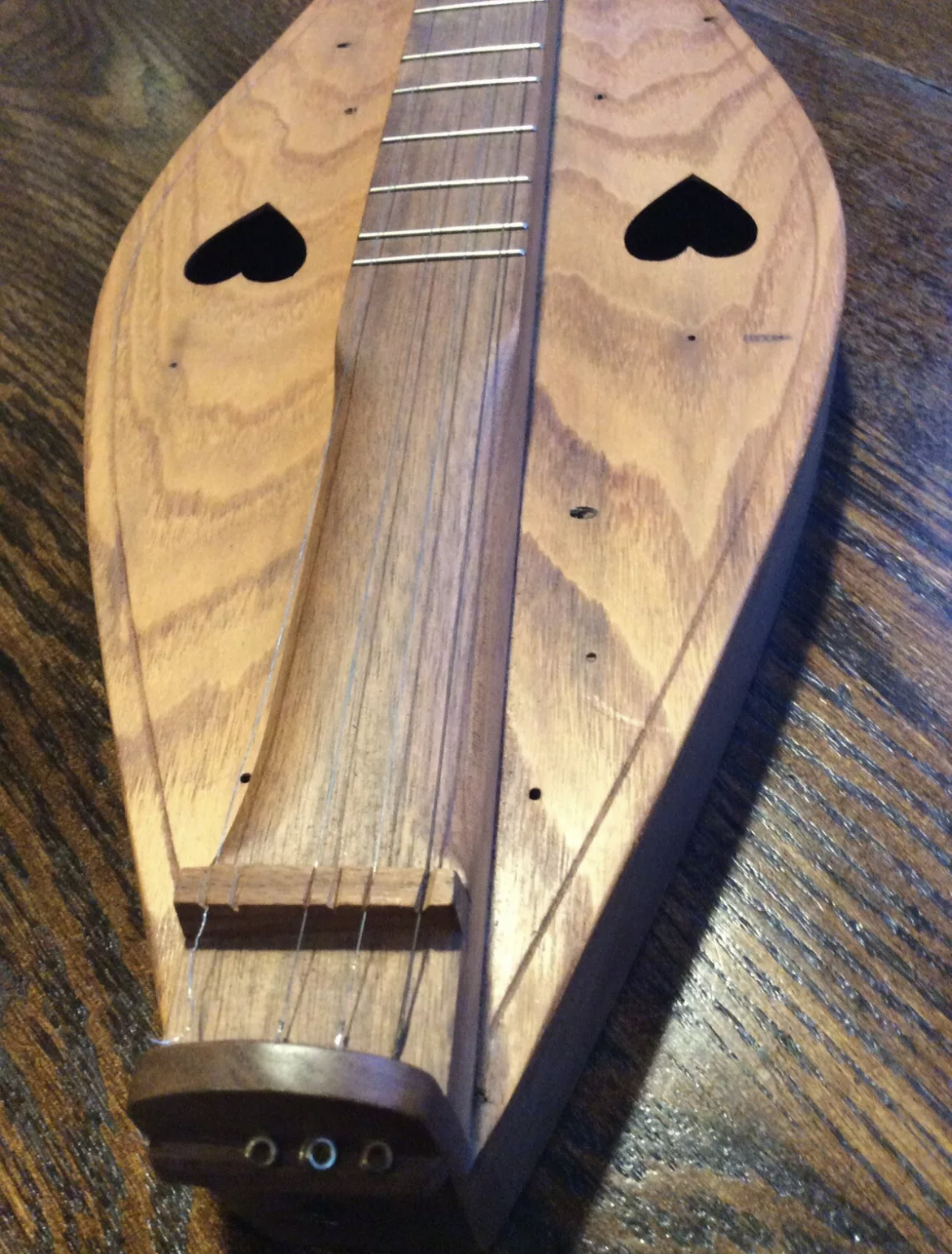
I am new to the dulcimer and have been given one. It has 5 strings but looks like it should have 8.
1st Question: How do I string this up properly with 8 strings and in terms of gauges.
2nd Question: Does anyone know anything about this dulcimer? Attached pics. Also, lightly stamped on the back of the headstock Is WIZARD 030177. I assume the number is the date it was made, Is Wizard dulcimer maker? I live in somewhat of a folk instrument wasteland, so nobody has a clue about it.
I play banjo, guitar, and bass fiddle so I don't know how far I will get with another instrument but even with just 5 strings it sounds very pleasant.
Thanks for any help that can be offered.
Situation, old hand made courting dulcimer with no bridge, bridge reference or nuts. What is the most accurate way to determine VSL?
Thanks, Bill R
@AMaiorano , thank you SO much for your generous and thoughtful FOTMD 'Patron' donation! It is deeply appreciated and i use it to pay the monthly costs to keep this site running.
Thank you! Donation to follow. You all maintain an extraordinary site. Well done and thanks
When I click the donate button it comes to a screen that says Lisa Sullivan. Is that the correct recipient for a donation to maintain the website? Thanks
Yes, Lisa is the wonderful young lady who coordinates all this.
When I click the donate button it comes to a screen that says Lisa Sullivan. Is that the correct recipient for a donation to maintain the website? Thanks
Thanks Dusty. I’ve been enjoying your videos, those with your Probst as well as all the others. Got your songs of old Albion book which I’m enjoying/using a lot. I’m keeping my fingers crossed that Rick can build one for me. No rush!!