Final Hearts of the Dulcimer Podcast Episode
General mountain dulcimer or music discussions
Hooray!!!
I know nothing about Mr. Burton yet I love the wood! Osage Orange wood?
Well done and best wishes for '22.
Jim, sounds like your friend Teilhard is skilled at restoring an old banjo. I love to see that! A happy new life for a lovely old banjer... and joy for you to play!
That's lovely to hear Patricia!
If the instrument seems very muted to you, you could -- with some careful and judicious work with a fine toothed jewelers saw -- open up those holes.
Now that you've really got DAd -- Dulcimer Acquisition disease -- when you're ready, we can talk you through making your own dulcimer similar to that teardrop -- from less than $100 worth of materials and simple hand tools. I've attached a picture of a simple conversion one of my students made using the fretboard from the cardboard dulcimer he started with...
Just this weekend my friend Teilhard Frost, a wonderful gourd banjo builder (and player) paid us a visit toreturn my R.S. Williams banjo which had been in terrible, unplayable condition since I bought it for $20 at a yard sale in 2018(?). I could see that it had promise and when Teilhard saw it, he said that he could bring it back to playable condition. Well he sure did that. It was made prior to 1879 (when the company was renamed R.S. Williams & Son) and has been restored with rosewood pegs and nylon strings. I have been playing it constantly since I got it back.
One photo before Teilhard got hold of it and one after he worked his magic.
Good to know, thanks. I won an auction for this on ebay so when it gets here I'll be able to inspect and photograph it up close. Not surprised about the hole size: they did look quite small to me.
I recognize the risks in buying this, but at least at last I'll have an actual wooden dulcimer at a fraction of what I expected to have to spend.
A Winter Miracle!
We have great news for the Hearts of the Dulcimer Podcast listeners! Due to not reaching our fundraising goal, the last episode we released in November was supposed to be our final episode. Well, since then, a miracle happened. An anonymous donor gave us a generous donation that helped us reach our fundraising goal. This has enabled us to continue the podcast for one more year. This means we’ll bring you 5 new episodes in 2022.
Thank you to everyone who generously donated, especially to the one anonymous donor who provided the majority of funds to keep the podcast alive in 2022. Your outpouring of generosity has warmed our hearts. We’re happy to be able to bring you new dulcimer stories in 2022.
You can listen to this either in your podcast app or on our website: https://dulcimuse.com/podcast
Jumping ?? Jumping ?? We don't jump--we levitate --why do you think we get paid the big bucks for concerts ?? We spend hours meditating & considerable yoga hours for that :) We are training to ascend :)
My bass string was out of tune--so I walked away from the mic to tune. Then back again to play. Cameron is my favorite fiddler & he knew my string was out--so he just held the tune and the stage. Happy Holidays :)
That jumping was fun, Mary.
I'm curious as to why you left the stage for a while- ?
Here's a little banjo from Saturday night with Boston fiddler, Cameron Freer. This is our levitation verson of dance tunes Black Eyed Susie/Forked Deer. :)
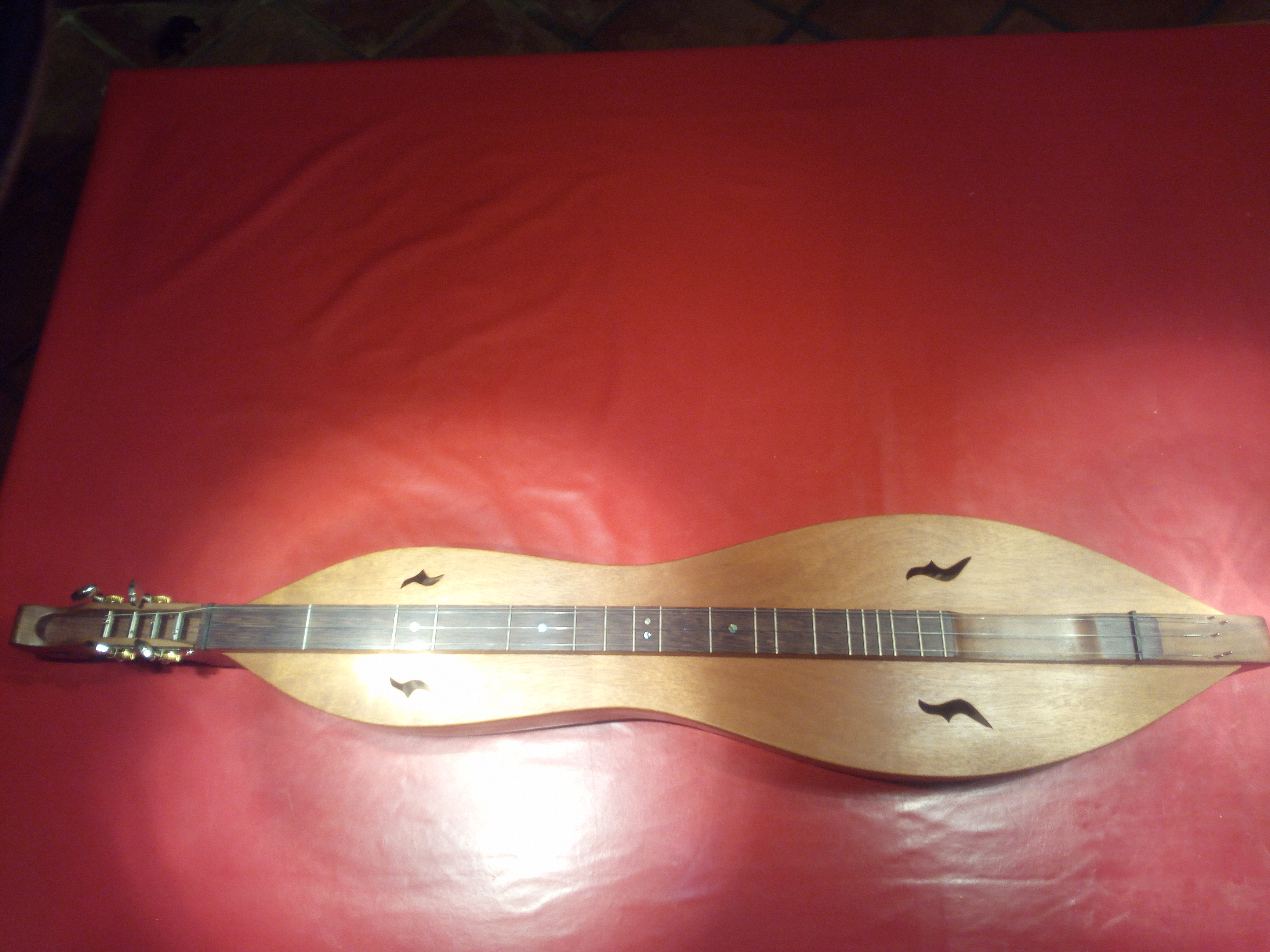
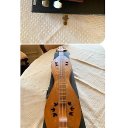
Nope. Never heard of him. Looks like a simple kit build. Needs more sound hole area to get the best sound from it -- there are complex formulas to calculate the optimum area, but it's roughly 4-5 square inches for most dulcimers...
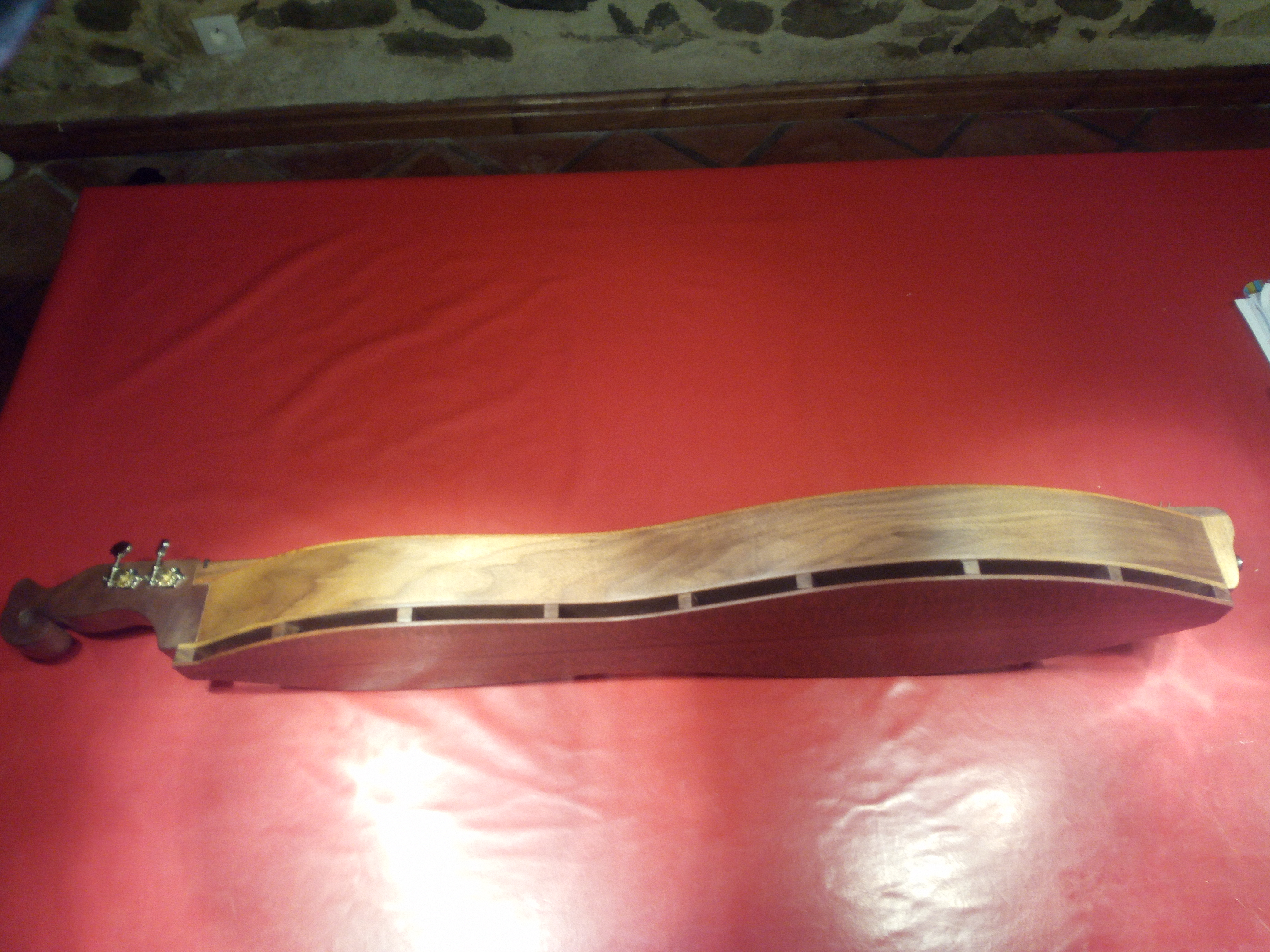
Close up photos of construction details and scroll head would be nice.
Anybody heard of him? Located in Robbins, NC, built this instrument:
That's good news SoR. Glad to hear that some of this discussion was helpful to you. Keep on strumming.
Ken
"The dulcimer sings a sweet song."
When I put the thin string on the bass it wouldn't hold a pitch lower than the G below middle C but if I tuned it to the D above middle C the other strings would pull their pins and/or break. When I put the thicker string on I just tuned it up to the same pitch - like, how did it not occur to me to just try the lower D again? Well, now that's done with.
The DAC I'm playing in now is the D and A below middle C and then middle C itself. That tuning I got from my old book and the old Jean Ritchie record, if I'm remembering right. I just strummed out "God Rest Ye Merry, Gentleman," "Noel Nouvelet" and "Douce Dame Jolie."
Onward and upward!
In any case, it appears you and I don't really disagree on the appropriate string gauges; we are just not sure how studentofrhythm has his dulcimer set up.
I agree that we don't really disagree. I was trying to find the appropriate strings for the first tuning he mentioned which was GDD. As I understand the pattern for identifying the notes by letters in the system we use, middle C is designated by a lower case "c". The octave below that is capital letters. The next octave lower is a capital letter followed by an apostrophe. The octave with middle c is lower case and the next octave above is lower case followed by an apostrophe.In American Standard Pitch Notation notes are designated by letter and octave; middle c being C4.
The original poster wants to tune his dulcimer "up to minor tuning." If that is D minor those notes would be D, F, A. I don't know whether one would tune those strings in the same octave giving a open minor when the dulcimer is strummed. I guess I need a more information and a better knowledge of music theory.
Ken
"The dulcimer sings a sweet song."
Well, heck it if I didn't get the thing tuned right finally! I've got me a DAD tuned dulcimer at last, and it's now a cinch to get it down to DAC and play in minor! I see I was making very silly n00b mistakes, and after paying more careful attention to octaves and gauges I've got it sorted out. Thanks all for your discussion and your patience!
Ken, maybe I am misunderstanding something. @studentofrhythm appears to be tuning to a G ionian, which would either put him in the baritone range or in the ginger range. Ken H concluded that studentofrhythm was tuning to a "high Gdd," meaning the G below middle C and the D above middle C. I could obviously be wrong. It has happened before. 
In any case, it appears you and I don't really disagree on the appropriate string gauges; we are just not sure how studentofrhythm has his dulcimer set up.
Dusty, if the string VSL is 24 inches and the tuning is the D below middle C, according the the Strothers string calculator the string should be a 0.022. If you were tuning the "d" an octave higher the recommended string is a 0.011 but I think you could use a 0.012. I based my calculation on G and D as I thought that was what the original poster was going for in his question.
Ken
"The dulcimer sings a sweet song."
@ken-longfield, I think you mean .012 and not .022 for the D strings. Is that correct?
And GDD would be a 0.016 for G and 0.022 for the D strings. String companies market dulcimer string sets mostly for two tunings, DAA and DAd and a VSL of about 26 to 28 inches. Dulcimer players need to learn that if they choose to explore other tunings and VSLs they need to find the right size strings. That's what is good about FOTMD. People can ask questions and folks here help them find the correct information. I trust that has been helpful to you StudentofRhythm.
Ken
"The dulcimer sings a sweet song.
To be clear; The notes for DAd are D3A3d4, much higher the strings break.
Sounds like you're trying to tune UP to the "high" Gdd. Optimum string for the G, based on 24" VSL would be a 16 or 18 plain, not wound as they can be hard to find. For the high ds you'll want an 11 or 12 gauge.
VSL is 24" and the string gauges are 20 wound for the bass, 12 for the others. I bought a pack of GHS dulcimer strings and broke the bass string immediately, then one of the 12 gauge. That was when I gave up on the fourth string. I tuned it as low as I could while still sounding clear and then compared notes with the piano and found it to be GDD. Recently I bought another 20 wound and put it on the bass again and it sounds much better, even on that low G. I paid more attention to how I put the string on to avoid stressing it like I did the last one. I've been thinking about all the discussions here about how to put strings on and I'll probably try starting over with the melody string one more time.
As Dusty says, the string gauges you are using for the tuning you want may be the issue.
First the VSL -- What is the distance betwen the nut and bridge (Dusty calls it the "scale length). This is one of two pieces of information you need to have in order to get the right strings for a given tuning.
Second, the Tuning... which GDD are you trying to tune to? There are two common tunings which can be called GDD -- one higher in pitch than the conventional DAA, and one lower in pitch.
Is your bass string G three notes higher in pitch than the bass string D of a 'regular' dulcimer tuned DAA?
Are the Ds in your GDD tuning the same pitch as the bass string D of a 'regular' dulcimer tuned DAA; or are they an octave higher like the d in DAd tuning?
In either case you probably cannot achieve a GDD tuning using "regular" dulcimer strings without either breaking strings or having them be uselessly floppy...
Hey @studentofrhythm, the first thing I would ask is what gauge strings you are using and what the scale length (measurement of the bridge to the nut) is. Tuning GDD is common for baritones and some 3/4-size instruments such as the Ginger. But it's not common for standard dulcimers. So let's make sure the string gauges are right for the scale length and tuning. Longer brad nails might be OK, but let's figure out string gauges first.
If I may revive this thread with a slightly different problem:
I have a cardboard-body dulcimer, like the backyard models but from a different maker. I've had problems with the strings pulling the pins and detuning, especially the melody string. Recently I drove a little nail in right by that pin and it doesn't pull as bad, but it still seems to pull a little bit: I can tune it to D in a GDD tuning, but if I try to tune it up to minor it seems to stop at about E and then I keep turning the peg but the pitch won't rise any. I've broken several melody strings trying to tune it up to minor tuning before (let alone DAD) so I've always quit at this point.
You can maybe see that even the middle drone string is pulling the pin a bit, but it stays in tune so far - again, keeping it at GDD. I'm not sure if I'm winding the string on wrong or if there's anything else I could do with the pin - replace all three with even longer nails? These pins seem short and flimsy.
It's supposed to be a four-string, but I don't dare put any more strain on that one pin.
On the bright side, it does GDD and GDC just fine and I have a lot of fun playing medieval songs in Dorian mode.
I actually made the instrument and the bow. This is the second jouhikko I’ve built. It takes inspiration from my teacher’s Karelian style instrument. The body is yellow birch, the soundboard is cedar, and the strings are horsehair.
There are loads of makers out there now, but relatively few seem able to actually play their own instruments, which makes me fear that I’d be fighting the instrument more than playing it. I know that Michael King has an excellent reputation as a builder and would enjoy trying one of his. Rauno Nieminen built my teacher’s jouhikko and I’d love to play one of his some day. But for now I can’t justify the cost of buying one from either maker. So I built my own.
And yes, I do play the outer string fairly often in this tune. It is the first Melody note. (I’ve tried typing that M repeatedly in lower case, but my phone thinks I’m wrong and keeps capitalizing it, which is the sort of behavior that makes me want to trade it in for a flip phone!)
The tuning is D4 A4 E4. So the drone string is a fourth below the D, which is the key note.
The principal distinction between the jouhikko and the talharpa, as I understand it, is that the jouhikko has an arched bridge so I can engage only two strings at a time. The talharpa has a flat bridge and the bow gets all the strings at once.
I’m clearly still a raw beginner. This is after 4 lessons. But I’m working on posture and bowing technique and left finger positions. There’s a lot that has to come together to play this thing!
I’ll try to post pics of just the instrument. After I finish my chores for the day. Saturday is always so full of catching up on things I don’t have time for during the week.
Patrick
Patrick- I watched your video- very cool!
So- who made the instrument in your video? (and the bow).
What are your strings tuned to in the video?- and are you sometimes playing the far string?- I seem to only be hearing the melody and middle strings. ?
Since this thread started 10 years ago, I sold the less nice of the two jouhikkos/tagelharpas that I had. I kept the nicer custom one I had made. Sadly, I'm not currently playing it. Perhaps one day I will get inspired again!
I have many cool instruments and little time to play them. I hope once I retire I can play with my 'children' again and have fun. :)
It's nice to see that you are enjoying your lovely jouhikko! Please keep me updated on your progress.
I know this is a decade-old topic, sorry if it is bad form to resurrect a thread that is resting peacefully.
Strumelia, if you are still around, do you still play?
I started learning jouhikko about a month ago. I had made one about 9 years prior, but just couldn’t make heads or tails of it. Then I recently started getting into the music on Lassi Logren’s YouTube channel. I approached him about lessons and he agreed to try doing lessons over Skype.
So now I finally am starting to make actual music on this beast. I’ve also upgraded my instrument and bow to match some suggestions from my teacher, which has really helped.
Just wanted to tell you that you aren’t alone in the love for a fairly obscure bowed lyre. Unless you’ve quit, in which case, perhaps I’m the lonely one.
Melody from Vest-Agnen - YouTube
Patrick
Yay frame drums! Dang those are some nice ones you've all shown. How have you all been coming along with your playing?
I started playing frame drums toward the end of my college days, looking to find more portable drums than my full kit. I've got a few of the Remo models. My mainstay is the 16" with the Fiberskyn head. Lately I've been teaching myself some tambourine techniques too. I don't know if I'll ever be as good as the Italian and Spanish women I've seen playing, but I can make some kinds of sense with them.
It was around 2000 actually when I first started and I had no idea what I was doing. When I had regular internet access and youtube was up and running my technique took a great leap forward because there were a few Glen Velez and Layne Redmond videos. I also have benefitted from David Kukchermann, and more recently I've found Dede Alder, who is really good, I highly recommend her channel.
I posted some really rough demo recordings of me singing and playing my 16" on Soundcloud a while back. Some of the recordings are kind of old - in particular I'd like to re-do "Little Drummer Boy."
https://soundcloud.com/studentofrhythm/sets/solo-voice-and-frame-drum?si=765c80706c80491cbe5ebefc856739a3
I bought a flute tuned in A at a gift shop in Torrey, UT a few summers ago. Good basic solid flute with a nice tone. I have fun with it. A while ago I did a demo recording of a song I wrote with it: flute, voice and percussion:
https://soundcloud.com/studentofrhythm/to-hazel-2021-04-01?si=fdb7bb7bb9b04c258772511108d3a362
Hi all,
I found this group after a few days of looking around the web for dulcimer stuff and practicing mine after taking it up again after - well, a few years, really. Nine years ago I went to a yard sale and saw a cardboard-bodied dulcimer (the label on it says Double Eagle, Arkansas). I forget how much they were selling it for but it wasn't very much. I had seen one many years before, when someone came to my school and demonstrated folk instruments. So I bought it.
Well, I soon found out that my dulcimer had some peculiarities: mainly, a tendency to break strings. I went through several replacement strings trying to tune it right, and then I noticed that the pin for the melody strings was pulling up and not letting the string keep its tune. So the poor old thing sat unused for years until recently I got it out again, replaced the pin, got new strings, broke a few, and realized that as long as I tune it 1-5-5 or 1-5-4 it'll be fine. Currently I've got it tuned to GDD, which seems to be about as much tension as it can take. It works for me. I like the "Ionian" tuning and starting the scale on the 3rd fret, even though this one does have the extra 6th. I also really really like the "Dorian" tuning - I love Dorian mode.
After fixing it up and looking at the book that it came with (Albert Gamse's Best Dulcimer Method Yet) I found Jean Ritchie's 1964 instructional record and when she started strumming and singing I felt like my soul was being welcomed back to a home it had lost. I've been picking out hymn tunes and Christmas songs for the past couple of weeks; recently I started picking out some tunes that I've come up with on my own. I'm excited about using it for composition and integrating it into playing in groups.
About groups: I started playing drums in 1994 and have played kit in several bands. Recently I've joined an odd little acoustic jam band with anachronistic aspirations, playing frame drum and tambourine, and I want to work the dulcimer into it too. I see a lot of possibilities - I particularly like Jessica Comeau's arrangements of medieval tunes. I'm interested in learning to do chords and I'm playing around with them, but I like doing the drone style too. I like strumming with a feather.
One of these days I'll get myself a good instrument; I'm also gonna get a strumstick.
I'm glad to find this site, I've been enjoying the recordings and pictures and discussions so far!
This has been an interesting discussion. I have one of those "Perepelochka" (transliterated from Cyrillic) models - actually it belongs to my daughter but I like to play it a lot. Has kind of that "toy" quality for being so small and high-pitched but I enjoy the delicacy of the timbre. It's fun to pick out songs in different modes.
I've met Tom Fellenbaum several times over the years, and I know that he build excellent instruments. I bought one of his bowed psalteries years ago, and it was wonderful in craftsmanship and in sound. I don't know what he's up to now.
If my information is correct Fellenbaum is a builder in Black Mountain NC. He has slowed down on building dulcimers to keep in stock, but does build to order. His dulcimers are well crafted and typically have a bit wider and deeper body. There is no standard for dulcimer dimensions and builders have their own preferences. Like Ken said, tone is influenced by volume of the sound box.
The woods the instrument are made from won't make any discernable difference in the pitch of the sound. The overall body dimensions (internal cubic inches) do. How big is the body compared to your other "low tone" instruments?
I haven't heard of Fellenbaum dulcimers ina quite some time. My memory of them is that he builds a fairly deep/wide dulcimer for a 26-27" VSL.