Forum Activity for @dulcinina

dulcinina
@dulcinina
01/06/21 06:17:30PM
88 posts

Short film on luthier Charlie Glenn


General mountain dulcimer or music discussions

Thanks for posting this, Robin.  That was so interesting and adds so much to the history of the culture of building folk instruments.  Dulcinina

Robin Thompson
@robin-thompson
01/06/21 08:58:50AM
1,546 posts

Short film on luthier Charlie Glenn


General mountain dulcimer or music discussions

robert schuler
@robert-schuler
01/05/21 06:05:31PM
257 posts

"Floating" Fretboards


Instruments- discuss specific features, luthiers, instrument problems & questions

A Fingerboard can easily account for 25% of the soundboard. So raising it has to make a difference. You only need to raise it a couple millimeters. I prefer to hollow out under the Fingerboard and leave 4 mm. on each side glued to the top. I add a soundhole on the fingerboard like I've seen on some Galax dulcimers, that might help tone a bit and looks cool too.

I think restraining the top with a glued fingerboard can actually help in making that very  intimate tone that is unique to dulcimers. Although I welcome those who push the envelope we better be careful not to end up with dulcimers that sound like skinny guitars....Robert

Matt Berg
@matt-berg
01/05/21 08:28:26AM
105 posts

"Floating" Fretboards


Instruments- discuss specific features, luthiers, instrument problems & questions

Sorry about the "Eww". sometime my fingers work faster than my brain.

Matt Berg
@matt-berg
01/05/21 08:26:57AM
105 posts

"Floating" Fretboards


Instruments- discuss specific features, luthiers, instrument problems & questions

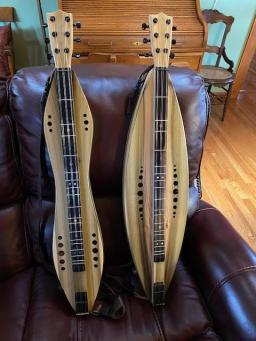
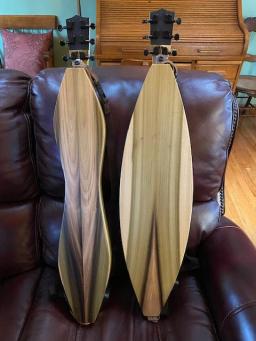
These photos are a recent build so you see a little of what I am talking about.


smaller2.jpg smaller2.jpg - 63KB
Matt Berg
@matt-berg
01/05/21 08:20:40AM
105 posts

"Floating" Fretboards


Instruments- discuss specific features, luthiers, instrument problems & questions

Eww, metal dowels?  I use a wooden dowel at the head and a true bridge placed so that the fret board is properly tensioned and does not warp, takes some practice.  The fretboard floats about a 1/4 inch above the soundboard.  The fretboard becomes part of the vibrating part of the instrument and adds (or detracts) from the sound.  This is different from the neck of a guitar.

As far as the soundboard goes, yes, you need to practice bracing so that you emphasize the sound you are looking for. If you are building a standard (treble) dulcimer, try thicker and more bracing.  This will dampen the bass and give you clearer melody notes.  For a bass (my favorite), try longer thinner bracing so that the bass can vibrate.  (The shape of a MD allows for much longer bracing than most other instruments, a difference that can be used.)

If you have difficulty placing the bridge properly, try a second bridge under the seven fret.  A wooden bridge still transfers vibration to the soundboard.  I prefer lighter wood like cedar for my bridges, but like everything a luthier does, whatever works for you is best.

If you are going to try this, you might want to subscribe to American Lutherie.  This magazine focuses on the guitar, but you will find lots of articles by people who have been shaping bracing for years.

Art S
@art-s
01/04/21 08:47:49PM
24 posts

Recommendations on capos


Dulcimer Resources:TABS/Books/websites/DVDs

That would work, Dusty. I am working on a version of Ken's plans as soon as the lockdown ends and I can get into the hardware store to buy a 4" bolt. I had already checked out the listing on Amazon and was not impressed with the customer comments. 

I'll post a photo of my creation once I get it made.

Thanks everyone!

Bill Robison
@bill-robison
01/04/21 07:46:17PM
36 posts

"Floating" Fretboards


Instruments- discuss specific features, luthiers, instrument problems & questions

Thank you all for the response on floating fretboard.  I am going to attempt one

Strumelia
@strumelia
01/04/21 07:13:59PM
2,401 posts

Blue Lion Dulcimers why so Special?


Instruments- discuss specific features, luthiers, instrument problems & questions


Starfire, if you are talking about comments left on your profile page, then there should be a link under their comment that says "comment back", which takes you to their profile page- you can then leave them a responding comment on their profile page in their comment wall section.   :)
Anytime you click on someone's namelink here, it will take you to their personal page.

If you have other questions about how to use the site, you may find answers HERE (look through the threads of commonly asked questions) or start a new thread to ask a new question there about how to use the site.  :)


updated by @strumelia: 01/04/21 07:21:23PM
star2fire
@star2fire
01/04/21 07:04:35PM
2 posts

Blue Lion Dulcimers why so Special?


Instruments- discuss specific features, luthiers, instrument problems & questions

Thank you to all the beautiful people who have post kind welcome messages. I have been trying to answer with a comment but I’m struggling to figure out how to use this site. I guess it’s gonna take me awhile to figure out how this works.

Bob Stephens
@bob-stephens
01/04/21 03:40:05PM
19 posts

"Floating" Fretboards


Instruments- discuss specific features, luthiers, instrument problems & questions

Dusty is correct in that my Fingerstyle, the recent parallel braced dulcimer being played by Butch Ross and the latest X-braced dulcimer supplied to Aaron O'Rourke all have bolt on fretboards that are raised above the soundboard on posts.  The entire soundboard is free to vibrate.  Although I have never done a direct comparison, with and without gluing the fretboard to the top with everything else being equal, the instruments with an elevated fretboard are clearly more responsive and have more volume potential.  The overall character of the tone is also altered because of the large vibrating plate that results.  There is a shift to enhance the mids and lows relative to the high end.  The resulting sound will not be what everyone is looking for.  As we build more of these dulcimers we are learning more about how to alter the sound profile to achieve a particular desired response.  Adding braces in particular patterns and using different top thicknesses is opening up a world of new possibilities.  I expect that over the next few years, a lot will be learned about how to reach the full potential of these instruments.  Aaron, Butch and I are attempting to learn all we can and push the envelope as far as possible.  The results of our efforts will be detailed in the blog section of my website, stephenslutherie.com.  

I am currently in the process of relocating my shop from South Carolina to Wisconsin, so there will be a gap in progress for the next four or five months.  The new shop will be focused solely on instrument production and should be much more efficient once it is up and running.  Between Aaron, Butch and I we have plenty of ideas to keep the new shop busy.

Bob Reinsel
@bob-reinsel
01/04/21 03:35:32PM
80 posts

"Floating" Fretboards


Instruments- discuss specific features, luthiers, instrument problems & questions

This is an example of an arched fretboard that I built with only one pier between the nut and tail end.


arched.jpeg arched.jpeg - 232KB

updated by @bob-reinsel: 01/04/21 03:37:13PM
Dusty Turtle
@dusty
01/04/21 03:04:33PM
1,844 posts

"Floating" Fretboards


Instruments- discuss specific features, luthiers, instrument problems & questions

There are at least a couple of builders who do not glue the fretboard to the soundboard at all. My octave dulcimer by David Beede has the fretboard screwed into the dulcimer with three metal dowels, but it sits entirely about 1/4 inch above the soundboard. His logic is that the top is free to vibrate that way. And I think FOTMD member @bob-stephens also makes dulcimers with floating fretboards.  In this discussion he specifically says that his "fretboards don't touch the top."  I think he also uses metal bolts to attach the fretboard to the dulcimer and allow it to sit above the soundboard.


updated by @dusty: 01/04/21 08:20:14PM
Dusty Turtle
@dusty
01/04/21 02:39:18PM
1,844 posts

Recommendations on capos


Dulcimer Resources:TABS/Books/websites/DVDs

Terry's capo is a modification of the Spider capo. And he offers a version with a D'Addario tuner attached to it.  It's a nice idea, especially if you have room left of the nut to leave it attached when you're not using it.  That way you have a tuner and capo always available.  If I didn't already have a bunch of capos and a bunch of tuners I would probably get one.

Ken Longfield
@ken-longfield
01/04/21 11:47:23AM
1,314 posts

Blue Lion Dulcimers why so Special?


Instruments- discuss specific features, luthiers, instrument problems & questions

That's really nice inlay on that Blue Lion. Enjoy.

Ken

"The dulcimer sings a sweet song." (and I'm sure this one will)

Joseph Besse
@joseph-besse
01/04/21 11:02:27AM
52 posts

Recommendations on capos


Dulcimer Resources:TABS/Books/websites/DVDs

I think Terry's Capo is the best out there.  I have the Ron Ewing and the original Dudley and like Terry's the best.

Joe Besse

Nathina
@nathina
01/04/21 10:58:32AM
188 posts

Fret Markers


Instruments- discuss specific features, luthiers, instrument problems & questions

Matt Berg:

Why not try indented markers that are slightly below the surface.  They would be tactile and not interfere with a noter!

I don't know why that is not done. It would work equally well.

Bill Robison
@bill-robison
01/04/21 10:17:55AM
36 posts

"Floating" Fretboards


Instruments- discuss specific features, luthiers, instrument problems & questions

Ken,

 I realize the fretboard is glued to top somewhere, I was thinking along the lines of gluing the fretboard only at the head and tail blocks and making the top a braced single unit  with just a fraction of clearance between it and the fretboard  and setting the bridge on the top instead of on the fretboard

Robin Thompson
@robin-thompson
01/04/21 09:31:46AM
1,546 posts

Blue Lion Dulcimers why so Special?


Instruments- discuss specific features, luthiers, instrument problems & questions

Wow, @sgarrity!  You're in for a treat.  In addition to being beautiful, your Blue Lion will be smooth to play and will, I imagine, will sound as great as it looks.

Bob Reinsel
@bob-reinsel
01/04/21 08:57:11AM
80 posts

Fret Markers


Instruments- discuss specific features, luthiers, instrument problems & questions

As a player, and builder, I think the fretboard should be a smooth as possible.  I don't install fret markers on dulcimers, but if I did, they would be inlaid, and planed, or scraped, level with the surface.

I just measured the crown of the fret wire that I use for dulcimers (very light) which is about 1.25 mm.  Anything sticking up on the fretboard would be felt under the fingers, which might be intentional, but could also unintentionally cause a buzz, or work as a fret itself.

If a tactile guide was needed I would probably add it to the edge of the fretboard.

Ken Hulme
@ken-hulme
01/04/21 06:55:34AM
2,157 posts

"Floating" Fretboards


Instruments- discuss specific features, luthiers, instrument problems & questions

Bill -- they're all glued to the top.  It's just that floating FBs have the area under the bridge separated.  IIRC floating a dulcimer fretboard does not have "significant" effect.  Whatever "significant" means;  almost no one builds floaters these days.  That was one of the post-revival ideas of Howie Mitchell I think.  These days many builders offer arched fretboards which significantly reduce the amount of FB-to-top contact while still supporting the fretboard for its entire length.

If you can find the archives of EverythingDulcimer, I believe that Richard Troughear, from Australia -- who for years had an on-going series of Experiments which he posted there -- did an experiment with the same body with different FBs including a floater.  Almost no other builders conduct true scientific investigations into various aspects of dulcimer construction; rather they give us quantitative, not qualitative comparisons -- feelings not numbers.


updated by @ken-hulme: 01/04/21 06:55:55AM
Bill Robison
@bill-robison
01/04/21 06:43:35AM
36 posts

"Floating" Fretboards


Instruments- discuss specific features, luthiers, instrument problems & questions


I know there are builders who "float" their fretboards. I am sure there are discussions on methods and pros and cons for this.  Have  any builders made a comparison of floating versus glued to top? Thanks 

Bill R

Matt Berg
@matt-berg
01/04/21 06:29:00AM
105 posts

Fret Markers


Instruments- discuss specific features, luthiers, instrument problems & questions

Why not try indented markers that are slightly below the surface.  They would be tactile and not interfere with a noter!

Nathina
@nathina
01/03/21 08:08:44PM
188 posts

Fret Markers


Instruments- discuss specific features, luthiers, instrument problems & questions


Dusty Turtle:

I've heard of tactile position markers on the back or top of the neck on guitars, so that you can feel with your hand where you are on the fretboard, but I've never seen anything like that on the fingerboard itself.

But we don't wrap our hands around the finger board /fret board on a dulcimer. There is no back. The markers I have come across are unobtrusive, you can feel them, they don't interfere with a noter, either they are just outside the proper position for a noter, or they are too "slippery" to be a problem. We are not talking a square wall and less than a 2mm rise, enough to feel, not enough to interfere. In fact they are usually not higher than the string itself.


updated by @nathina: 01/03/21 08:13:19PM
Dusty Turtle
@dusty
01/03/21 08:05:14PM
1,844 posts

Fret Markers


Instruments- discuss specific features, luthiers, instrument problems & questions

I've heard of tactile position markers on the back or top of the neck on guitars, so that you can feel with your hand where you are on the fretboard, but I've never seen anything like that on the fingerboard itself.

Nathina
@nathina
01/03/21 07:54:04PM
188 posts

Fret Markers


Instruments- discuss specific features, luthiers, instrument problems & questions


They can be fancier, rubies, sapphires. depends who the dulcimer is being given too or was given too. There are some interesting instruments among European royalty. I haven't seen them added to really narrow fret boards that were specifically for noters. Rubys are not expensive, used for jeweled watches and clocks. Same with sapphires. Low grade diamonds are even cheap enough to use as fret markers.


updated by @nathina: 01/03/21 07:57:31PM
Strumelia
@strumelia
01/03/21 07:43:25PM
2,401 posts

Fret Markers


Instruments- discuss specific features, luthiers, instrument problems & questions

My noter tip would crash into anything closer than the middle string. You mean like those little stick-on circular plastic jewels kids put on their faces? I'd think they'd get in the way of any smooth sliding by either fingers or noters. I suppose a very gentle slow player might not have a problem with them.

Nathina
@nathina
01/03/21 06:22:29PM
188 posts

Fret Markers


Instruments- discuss specific features, luthiers, instrument problems & questions

Strumelia:

I would think that raised fret markers could interfere badly especially with noter playing, particularly if they were located between the melody string(s) and the middle string. That'd be bad!

Besides, on any dulcimer other than a chromatic one, if you're not looking while playing anyway then raised fret markers are already there... they're called frets.  ;)

Actually those for the blind are placed just outside of proper noter placement for the melody. They are sloped on all sides and do not create an obstruction to fingers.

Strumelia
@strumelia
01/03/21 06:06:12PM
2,401 posts

Fret Markers


Instruments- discuss specific features, luthiers, instrument problems & questions


I would think that raised fret markers could interfere badly especially with noter playing, particularly if they were located between the melody string(s) and the middle string. That'd be bad!

Besides, on any dulcimer other than a chromatic one, if you're not looking while playing anyway then raised fret markers are already there... they're called frets.  ;)


updated by @strumelia: 01/03/21 06:08:21PM
Bob
@bob
01/03/21 05:04:23PM
87 posts

Fret Markers


Instruments- discuss specific features, luthiers, instrument problems & questions

And then there's the Chromatic Dulcimer with fret markers on EVERY Diatonic fret dohh and an inlay at the second octave ...  (I named this one "Dotty")


Chromatic.jpg Chromatic.jpg - 230KB

updated by @bob: 01/03/21 05:08:44PM
Susie
@susie
01/03/21 04:28:09PM
515 posts

Recommendations on capos


Dulcimer Resources:TABS/Books/websites/DVDs

Like Dusty said, the Ewing capos are a good value.

Terry McCafferty now makes some really nice capos for a little more. I have since purchased 2 of his. Nice mechanism, perfect pressure.....my new favorite dulcimer capo. 

https://www.mccaffertydulcimers.com/capos

Dusty Turtle
@dusty
01/03/21 03:29:04PM
1,844 posts

Fret Markers


Instruments- discuss specific features, luthiers, instrument problems & questions

Yes, you can have fancy decorative inlay work on a fretboard.  And you can also have fret markers.  Those are clearly two different things. 

Obviously, decorative fretboards are pretty.  (Don't we all love that long-stem red rose on the Blue Lions?)  And if the decoration varies up and down the fretboard, then it might serve the purpose of fret marks, but only for the owner.  Anyone else grabbing that instrument for the first time would have no idea what's going on.  That's why there are standards.  The standard fret marking pattern of 3, 5, and 7, means that I can borrow anyone's instrument--or switch among the several that I own--and know at a glance where I am on the fretboard, even if there are one or two extra frets.  That obvious advantage cannot be overstated.  If one of my instruments were marked at 3, 5, and 7 and another at 2, 4, and 6, and another at 1+, 3, and 4, those fret markers would lose their purpose and would have to be ignored altogether.  They would confuse rather than clarify.

So that brings us back to the original post, which was about the proper placement of fret markers, not decorative inlay.  An individual player can request fret markers anywhere s/he wishes.  Fret markers do not change the sound of an instrument.  But anything other than the standard pattern would confuse anyone else.  I would strongly urge luthiers to either use no fret markers or use the standard pattern, unless, of course, they are responding to a specific request for a custom dulcimer.  And again, for a diatonic fretboard, there is no need for fret markers anyway since the pattern of whole and half steps tells you exactly where you are on the fretboard.

I personally would not be able to play with raised fret markers at all.  As you slide from one chord position to another, you need the fretboard to be as smooth as possible.  And even when not sliding, you want your touch on one fret to be identical to the touch on another fret.  There would be no way to play with any speed with an inconsistent touch on the fretboard.  There is a reason why everyone uses inlay both for fret markers and for decoration.

Nathina
@nathina
01/03/21 02:28:59PM
188 posts

Fret Markers


Instruments- discuss specific features, luthiers, instrument problems & questions

I'll add something else. What about raised fret markers. The purpose is to allow the player to know what fret they are on without looking. Thus eyes can be on the strum or picking, or music. These markers do not interfere with the strings. Simply provide sensory feedback.

Strumelia
@strumelia
01/03/21 02:21:43PM
2,401 posts

Fret Markers


Instruments- discuss specific features, luthiers, instrument problems & questions

Interesting discussion!  nod

Yes we all agree that 'fret markers' or fret board inlays can be decorative or utilitarian, or a combination of the two.

But just for the sake of argument-  if we put aside inlays and decorations that are for decoration only.... then does the very term 'fret markers' imply that they are marking frets in some purposeful utilitarian way?  Is the purpose and definition of a 'fret marker' by its very nature to mark/differentiate a fret so as to enable the player to more easily tell one fret from its neighbor frets?

--------

I mean, you could have the standard of a simple dot inlay on certain frets (say 3, 5, 7, 10). Some might say that was all practical purpose without any decorative intent. If they were inlaid abalone of something you could say they were practical makers that were decorative as well.

But if you had those exact same dots on every fret they would not differentiate any fret from the others. They would have no practical purpose to differentiate certain frets, only a decorative purpose. You could have fancy leaves or vines on every fret and if they were all the same visually for every fret then they would be only decorative.

OR, you could have inlays on every fret but maybe on the 3, 5, 7 etc they could be larger or fancier. Then they'd fall back into having the practical purpose and maybe decorative as well.

I would put forth the thought that a 'marker' implies marking something so that it is recognized and stands out. And 'decorative' implies simply visual embellishment. But you could have 'markers' that are also decorative. But if they are all the same on every fret then they are simply decorations and not 'markers'.

What do you think?

Dusty Turtle
@dusty
01/03/21 01:45:12PM
1,844 posts

Recommendations on capos


Dulcimer Resources:TABS/Books/websites/DVDs

I once spent over $60 on a fancy brass capo that works almost as well as the $20 ones Ron Ewing has been selling for decades. No one said logic was my strongest attribute. shrugger


updated by @dusty: 01/03/21 01:45:56PM
Skip
@skip
01/03/21 09:40:23AM
388 posts

Fret Markers


Instruments- discuss specific features, luthiers, instrument problems & questions

Strumelia:

Which brings up the existential question... if one were to put a fret marker on every fret- what purpose would it serve?


Could be both decorative and/or useful, depending on the design. winker


  184