The Dulcimer
General mountain dulcimer or music discussions
Yes the term "dulcimer" was used in the KJV, it was a very popular instrument when that translation was written. (Hammer dulcimer)
DAN
Yes the term "dulcimer" was used in the KJV, it was a very popular instrument when that translation was written. (Hammer dulcimer)
DAN
The dulcimer. One of the world's oldest instruments.
I have read or heard several times that the dulcimer is written about in the Bible. But never could find it, as the NKJ only uses the word harp. However, I got my hands on my wife's deceased brother's very old KJV.
Sure enough,in Daniel, chapter 3, tis written 3 times the word dulcimer. It doesn't say mountain or lap dulcimer, just dulcimer.
It tickled me to discover this today. Now, with authority, I can state, "I play one of the world's oldest music instruments known to humankind."
Just thought I would share this very special information.
Strumelia, - Many, many thanks for the banner on the home page that encourages adoption of rescue animals from local shelters! I’m so pleased to see that and maybe some lucky dog or cat will be adopted because of it!
Awwww, Dulcicat you made my day! 
Strumelia, - Many, many thanks for the banner on the home page that encourages adoption of rescue animals from local shelters! I’m so pleased to see that and maybe some lucky dog or cat will be adopted because of it!
Thanks Dusty!
I'd just like to add as well that once you have the chat pane open and the four buttons visible, the bottom one minimizes the chat pane a gain... but the other buttons widen/narrow the width and the top button pops the chat out into its own new browser window.
And... don't be afraid to hover your mouse over 'mystery' buttons or icons- often you'll get a little 'help explanation' popup telling what the button will do!
Jimmy, when the chat is open, there are four controls on the lower left. The bottom one will minimize the chat.

Once it's minimized it stays on the screen off on the lower right-hand corner.

I clicked on the chat button out of curiousity, and now I can't get rid of it, and it comes up every time I sign on.
I'm not a new guy, but in a way I am. I joined several years ago, but took a long hiatus.
Jimmy, you get the same speech bubble icon on your phone or tablet.
I just use Copy and Paste.
I might try copy and paste with my phone, because 90% of the time I use my phone for the internet.
Thanks Ken!
Like Dusty said! :)
Here's a picture in case you need more detail:

Thanks Strummy!
You use the speech bubble icon that appears in the upper right-hand corner of message you want to copy when you move your cursor over it.
Thanks. Got it. It wasn't working because I was using my phone, and I guess phones don't have that ability.
Like Dusty said! :)
Here's a picture in case you need more detail:
In other words, how do I copy someone’s post, so that I can comment about it?
You use the speech bubble icon that appears in the upper right-hand corner of message you want to copy when you move your cursor over it.
I quoted someone a couple weeks ago, but now I forget how I did it.
In other words, how do I copy someone’s post, so that I can comment about it?
Many dulcimers are made with hardwoods rather than the softwood soundboard in guitars. Hardwoods tend to shrink and expand less with changes in humidity. That is why many people get away with not humidifying their dulcimers.
With a spruce top, well, consider whether how much the air dries in winter. People who live further north here in Michigan get more dry winters and may need humidifiers. Not so much here in Detroit.
I believe Foldcraft used to sell dulcimer humidifiers. Haven't looked for a while.
I have nothing to add that Ken and Ken have not already stated, except to point you to our group here on Dulcimer Care and Maintenance .
A basic rule of thumb is "if you are comfortable, your instrument will be comfortable." I find that my mountain dulcimers are not as sensitive to humidity as my guitars and banjos. I keep the latter in their cases to help maintain humidity. I also use humidifiers in the cases. Only once have I found the need to humidify my mountain dulcimers which was during a particularly cold winter here in Pennsylvania. I notices the fret ends stick out from the fret board. I stuck a wet sponge in soap dish in which I drilled a few holes in dulcimer's case. That solved the problem. What Ken said about the strings.
Ken
"The dulcimer sings a sweet song."
It does not matter whether your instruments are solid wood, or cheap doorskin plywood... IF it gets dry enough wherever it is that you live, such that you get static shocks when you walk across a carpet sock-footed; then YES you need the house/room humidified. Not just for the instrument but for you! Bowls of water set out with a sponge in them will help -- as long as they are kept replenished. Damp towel(s) over heater vents will help too.
Where I live in South Florida, however, that is never an issue.
Those miniscule (and I do mean miniscule) increases in string diameter will NEVER harm your instrument! You can re-string it as a baritone using much heavier strings and it won't hurt anything.
What a beautiful piece of craftsmanship!
Thanks for the responses! In answer to your question, Ken, it's number 1296. There's no description in the Master List, just the name of the first owner. I got it recently from the third owner. The label just has "1296" and "SPECIAL" written by hand, and the writing is quite faded. I think the scroll is walnut, not cherry. It's definitely fretted for just intonation. I play both DAD and DAA, but my screen name is a rather poor attempt at a pun, as I am the father of a wonderful 16 year old young lady of whom I'm very proud! Anyway, I've attached some pictures of #1296, including a picture of the fuzzy area on the back. To be honest, it looks much worse in the picture than it really is. It definitely is an issue with the finish and does not go down to the wood. I would love to do something about it if it can be done correctly. If not, I could live with it.
Homer used Sherwin-Williams Sherwood Dull Lacquer.
DAN
www.dulcimore.com
Send a PM to John Knopf. He's our Homer replicator. He should know what finish was used.
If there was a photo to see the spots you are concerned about it may be easier to give a suggestion.
That being said, however, if it's just a cosmetic rather than a functioning issue, I would lean towards letting it be and keeping it in its current condition.
If you have ever watched "the Antiques Roadshow" you can see what appraisers think of 'cosmetic restoration' done on historic pieces, which is what I think you have.
Steel strings are the norm for mountain dulcimer. Never, ever trim the first set of strings on an instrument until they've been played in for a few days. If adjusting the nut/bridge you don't take the string off, just slack them enough to move the strings off to the side.
Personally, I would tune DAA. That way your scale starts at the 3rd fret and you have a few notes below that "low do".
There seems to be something amiss with the graphics. Every time I try to download them the period before jpg is ignored and it tries to open them as a text file. Just give the files common names, you don't need .jpg or .jpeg....
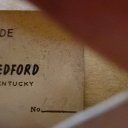
What number is your Ledford? Look inside. There is a Master List of the known Ledford builds, which contains a variety of information.
I have to say, if you really are "dedicated (to) DAd", you may not be happy with that classic instrument. Homer didn't build them with DAd or other Mixolydian tunings in mind, and didn't always use a Mean Tone intonation so his dulcimers would "played well with others"...
I'm fairly new to FOTMD and this is my first discussion post. I recently acquired an older Homer Ledford 3-string dulcimer with staple frets (for all you "Homer heads" out there - 1967, birdseye maple back, butternut top, quilted mahogany sides, cherry scroll, pegs, and tail block). It's in excellent condition and sounds great. My question is about the finish on the birdseye maple back. There are two 2" spots where the finish is a little dull and cloudy looking. It's very minor, but it's the the only real flaw and I wanted to know if there is a way to even out the finish on the back so those two dull spots disappear. I've used lemon oil on furniture with good results, but I'm hesitant to use it on my dulcimer. Any suggestions? Or is it better to leave it as is, to keep it "all original" even with small flaws? Thanks in advance for your input.
@John-Dunn, have you tried asking @Ken-Hulme for a copy? It used to be publicly accessible at Everything Dulcimer, but I'm sure Ken can post a copy.
Trying to locate Ken Hulmes article "I Just Got A Dulcimer, Now What?"
Would greatly appreciate help locating it. Many thanks and Best wishes from Oz. John
How did you decide to anchor the ball-end guitar strings? With pins? With small nails with the heads snipped off? By creating loops from the ball-end strings? By drilling holes through the fretboard (like a guitar bridge) and anchoring with guitar bridge pins? Some other method? Inquiring minds want to know?
I've made 106 bowed psalteries. I do put fancy letters on the right hand side....I iron these on before I put the finish on. I have a decoration that I add as well, making the bowed psaltery more mellow. All of my psalteries are altos. It's too late at night to see if I can post photos....and yes, I'd love to make some little bowed psalteries to go with Dulcimers...that would be fun. That's a great suggestion. aloha, irene
Use painters tape ..little bits andvwrite the notes..after you realize it is cdefgabc over and over and then a strong colired diff for the g and c will give u the geography of the psaltery...also mark the c and f sharps and the b flats as those are the most used
I have 3 bowed psalteries. The first is a used Unicorn Strings chromatic. I liked the idea of the plastic guide they use. It is just a piece of plastic with areas cut out at the top and bottom so the guide hooks around the top and bottom zither pin. Since I am dyslexic, I need all the help I can get to know where the notes are! For me color coding is just one more translation my brain has to make so give me the note names!
I also got 2 Rich Long diatonic in the key of D psalteries. He said that he had a friend who jammed with dulcimers and asked him to design a psaltery limited to the key of D that would be quicker to use with dulcimer jams. I also jam with dulcimers so not having to saw back and forth for the C# and F# really helps me. I made my own guide for the notes. I just found a report cover in the office supply section at Walmart (nothing but the best for my musical friends!) and cut it to shape. Probably sharpies would have worked to write the notes on the strip but I was wanted something looking more uniform. At Guitar Center they have strips called Guitar Buddies or something like that that have the names of the notes to help people learn the fretboard. Unfortunately, they are on a strip so you have to cut out the individual notes and stick them on the guide--I'm willing to do this for a more finished look. I sometimes use a small piece of gaffer's tape (supposed to be a tape with very little residue that is used to set up stuff for exhibitions) to stabilize my strip if it wants to wander around. I cannot say it will not mark your instrument. I only use them temporarily and have never had a problem. I store little strips of the tape on the handle of my tuning wrench.
Hope this helps, I think many more psalteries would be out of their cases making music if the notes were marked.
Mine does, too, it's just in and out in temperature changes and my own ear tends to be more "forgiving" ( a.k.a. lazy) than some with perfect pitch.
Lois..it is worth tuning the strings..the sound is amazing and has a different ambiance ..mine stays in tune pretty well..
Years ago I bought a very nice 2 octave +1 psaltery made by Harbor Town Dulcimer Shoppe. The tag says P.O. Box 48, Rockaway Beach, MO 65740 with a phone number of 417-561-2728. It has the notes on one side with the accidentals on the opposite side unnamed.
Without the notation I would never have tried it. I have used it in my programs, but tuning 28 notes can be a pain. It was before I fell in love with the dulcimer. My husband tries to get me to return to it, but it's very low on my priorities. Haven't tried to sell it, but admit it's possible.








 I Just Got A.pdf - 1MB