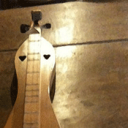

Salty, if you're new to dulcimers you may not know you probably have quite a treasure there. Robert Mize made about 3800 dulcimers, starting in 1967 and ending with his death in 2003. You might want to do a search on his name to find out more about him, as he's considered one of the seminal builders in the mountain dulcimer revival.
Forum Activity for @ivan-bradley

Ain't it the truth! Just a few years ago I was asking questions like would my fretboard get warped if I put on slightly heavier gauge strings. Now I'm an old timer tellin' the youguns you much tougher it was in my day.

Dan Goad said:
there ain't no "betters" around here. Some of us have just been playing around with them for a tad longer than you have. You'll be giving out advice before you know it.


Cute toes.
You are correct. That is not right.
The strings should feed over the top of the pins.
Additionally, the pin on the top right in the picture should be for the bass string. The pin on the top left in the picture should be for the middle string. The pin on the bottom left should be for the melody string furthest from you, and the pin on the bottom right should be for the melody string closest to you.
I suggest getting on new strings. But replace one at a time in case the bridge is moveable. Otherwise you'll have to post a question about how to position a bridge, and then we all have to learn physics together. (Actually, it's not that hard, but it does take a few minutes working with a tuner.)
updated by @dusty: 02/17/16 09:30:30AM
I used to sing in a choir and still do some harmony singing Christmas times. In my experience the melody is generally the soprano line in modern arrangements ( though in older `West Gallery' arrangements the melody is often the tenor, so beware !), the alto is often written for the section of the choir who can't sing and so it has a very limited range of notes, the tenor is often a good strong harmony part while the bass gives roots to the chordal structure. It's not always like this though and the melody can actually be spread across the four parts so watch out for that. In the case of west Gallery - approximately 1700 through to about 1850 in England, the roles of the sopranos & tenors are often, though not always reversed, so the tenors are the melody and the sopranos do a good strong harmony. Presumably this is because of the likely make-up of the choirs they were written for, with men being dominant at the time in public activities.
My suggestion would be to change the way you think about the question itself. When folks sing in harmony, they are singing the notes of a chord. One of those notes is the melody part. So instead of thinking in terms of harmony parts, why not think in terms of melody and chord. If your wife is figuring out the chords that back up the melody, then all you have to do is find the right voicing for that chord on your dulcimer so that you are playing the melody note.
What I mean by that is best explained by an example. Let's say your melody note is the F# that is round on the second fret of your dulcimer tuned DAd, and the chord is a D. You might choose to play 0-0-2, for that gives you the melody note and two notes of harmony. But you might also choose 4-3-2, or 032, or 232. And those chords are D chords (or 2-note approximations of D chords) and you should play around with your arrangement and see which one sounds best.
Or if the melody note is the A on the fourth fret of your DAd dulcimer and the chord is a D, you might try 0-0-4, 2-3-4, 4-4-4, 6+-4-4, and so forth. Play around with those different chord voicings and you will find the harmony notes that you think sound best. And then maybe the second time through you could change chord voicings for a different arrangement.
I don't think it is a bad idea to study harmony arrangements, but I know that those arrangements are based on the chord structures of the songs. To me it makes more sense to learn those chord structures themselves rather than learning one or more harmony parts that stem from those chords.

I am coming late to this discussion, but hope I can offer a little help.
First, I think it is important to clarify the language. "To transpose" means to change keys, that is, move a piece from, say, the key of F (F, G, A Bb, C, etc) to the key of D (D, E, F#, G, A, etc). What you are doing is transcribing and arranging.
Back when I was a college music major, one of the exercises we had in the first year of Harmony was to fill in the notes of of hymns, creating 4-part harmony, given only the melody (soprano) and bass parts. The interesting thing was there was often enough implied harmony that the inner ear would fill in the "missing" notes. The alto and tenor voices often weren't necessary.
If I were working on a project like yours, I would first try working with the outside voices (soprano and bass) first, then decide which, if any, of the other harmony notes you need for a musically pleasing sound.

What is the hymn? Perhaps I can help you the parts. Do you mind adding the link?Something else to think about is that if you only play on the melody string, then that naturally fits into soprano part. To play another part would require playing on the middle and even the bass string. That's a little learning curve in itself. As an experiment, you could try playing the soprano on the bass string. It would be lower (obviously) but give a little extra variety to your playing. Best of all, you 've already done the work translating the sheet music notes to your dulcimer's fretboard.
Interesting question! Can you play soprano plus another part on thepiano to see how they sound together?
Generally it would be alto or tenor probably that would go well with the soprano. Often,a lot of bass parts don't have amuch movement in them. This may or may not be a good thing.
Even when you decide on which is going to be the 2nd harmony, you may end up tweaking some individual harmonies in the tune. For eg, do you want any sections to be in unison, or 100% in harmony? Where the harmony is created byan interval of a 3rd for eg, you may likeusing a5th better in some places.
I'd also pay attention to long sustained notes - what notes are being played and whether you want an open chord or a triad.

Free Kantele method book - asking for feedback!
Adventures with 'other' instruments...
Thank you, Lisa.
Life has been very kind to me during 50 years lifetime up to now. I am grateful for that.
So I just try to give something back and share things (or ideas) from time to time.
I am happy if the book is useful for someone.

Free Kantele method book - asking for feedback!
Adventures with 'other' instruments...
Peter it's so generous of you to offer all this for free.

Free Kantele method book - asking for feedback!
Adventures with 'other' instruments...
Vielen Dank! Ich glaube dass ist Wahr! I really appreciate your input here. Love your site - especially the yellow one, fantastisch! Wenn I got into dulcimers I didn't know if I would like it or not ( was ein Dumkopff nicht, what's not to like?), so I got the cheapest thing I could find, a cardboard kit. Had I known then what I know now, I would have simply mortgaged the house! I had a lot of fun living in Germany teaching guitar and doing lots of concerts. It was the best musical time of my life, well wait, these dulcimers are pretty fun too...Glad you're on here. Oh, I was in Oppenum am Rhoi.
Free Kantele method book - asking for feedback!
Adventures with 'other' instruments...
Hi Cynthia,
thank you for your feedback. Glad you like it.
Yes! You're right! I should avoid exclamation points! Definitely!
Sorry, only joking... I was not aware of that, Cynthia, but you are perfectly right with your observation. I'll change that when I go over it again. It was not my intention to shout at the reader - I guess, exclamation points are more common in German punctuation than in English.
In the meantime, several different kanteles have found the way to our home. For chord playing, I'd rather recommend a 10-string kantele (which misses the c# in the higher octave). If your intention is melody playing, an 11- or even 15-string kantele will be perfect.
If you're interested in some more pictures of my kanteles, you may like to look at my little kantele blog (in German):
http://finnischekantele.blogspot.de
In the US, you can contact www.kantele.com . There's lots of information on Gerry Henkel's site - and he builds 5- and 10-string kanteles.
If you like to order decent instruments at a reasonable price from Finland, I can recommend Melodia Soitin and Lovikka. The most famous maker in Finland is Koistinen, but I don't own one of theirs (yet...).
In the UK, there's also Michael J. King who builds custom kanteles.
Free Kantele method book - asking for feedback!
Adventures with 'other' instruments...
Peter, the book looks very precise, German-like, and well done. The only change I would make is getting rid of all the exclamation points. I'm hoping to acquire one of these someday. The old Finnish music really intrigues me. I'm thinking an 11 string is what I want. I don't want to jump like I did with the dulcimer, but wait until I know a little more about it. Thanks for doing the book, especially the chord charts are helpful, very thorough, very nice.
Free Kantele method book - asking for feedback!
Adventures with 'other' instruments...
Peter dass interessiert mich sehr, ich werde dich gern feedback geben als ich dass tue. Vielen dank, ich brauche zuerst ein Instrument. Du bist etwas, menschens Kind.
Free Kantele method book - asking for feedback!
Adventures with 'other' instruments...
Thank you all for your replies! )
And thank you for for the tab of "Suomi", Steve. I'll try that - seems to be a cheerful song! :)

Free Kantele method book - asking for feedback!
Adventures with 'other' instruments...
Thanks for casting the net a bit wider Peter.
One of my all time favourite Finnish songs is :
Great singer, great tune , plays really well in N/D.
Free Kantele method book - asking for feedback!
Adventures with 'other' instruments...
One of our club members has at least one kantele, but it doesn't look like she's commented here in four years. I'll send her a link to your post.
I've been listening to lots of Finnish and other Scandinavian music the past few years, and included a kantele piece as one of our dulcimer club tunes last year. The tune, Suomi , is from Finland. In fact, the name is Finnish for Finland! I heard it played on the 5-string kantele on Poul Lendals album nskebarn . (Although in one section of the recording there's a harmony note that makes me think he's playing it on a 10-string kantele.)
Free Kantele method book - asking for feedback!
Adventures with 'other' instruments...
After a holiday in Finnland during the first two weeks of August, I have now added some Finnish songs. I've already modified the links in the first entry of this threat - so if you download the files from there, you'll have the latest version.
Enjoy!
Free Kantele method book - asking for feedback!
Adventures with 'other' instruments...
Yes they do sound good together. Your starting to make me want one of these. Love the look of the Dulcimer in the Video, Haven't seen one shaped like that pretty cool.
Peter W. said:
Free Kantele method book - asking for feedback!
Adventures with 'other' instruments...
Yes, it is fun, Phil! :)
And as both instruments are diatonic and usually tuned to "D", they go together well, as you can see here:
Free Kantele method book - asking for feedback!
Adventures with 'other' instruments...
HI Peter, Inserting interment ya have there. After hearing your videos' I may have to get one. looks like it fun to play.
Free Kantele method book - asking for feedback!
Adventures with 'other' instruments...
I don't know how to thank you for the time and effort you put into the revision of my kantele book, Dusty!
Thank you, Dusty!
Your corrections have been very, very useful and made it easy for me to understand all proposed modifications. Especially the prepositions are always a challenge for me when writing in English! :)
At the moment, the only thing I can do to compensate your work is mention your website in the epilogue of the book.
If you ever need help with German, I'd be happy to give back something to you!
@All kantele players: I already replaced the pdf-file on my webspace, so if you download from the link given in the first post of this topic, you'll get the revised version.
I also added some songs to the spirituals song book: now there are 25 songs in D-major and 5 in D-minor.
Enjoy!
Free Kantele method book - asking for feedback!
Adventures with 'other' instruments...
I've started to record 11 of the 29 songs (if you have downloaded the songbook when I started the discussion, make sure you already have the version with 29 songs).
I put the videos on a new Youtube channel and made a playlist of the Spirituals / Gospels. I'll add some more recordings as soon as I find the time to do so.
All recordings are straightforward, just my voice and five string kantele accompaniment. It is not high art, there are some small mistakes and so on... I just wanted to show that it's easy to play chords with the small kantele - and it's fun!
https://www.youtube.com/playlist?list=PLwtxl27mBeeCX9jz_nJIUfsyeKtQ...
NB: I still also play my MD, for example last Saturday at my brother's 50th birthday party...
Free Kantele method book - asking for feedback!
Adventures with 'other' instruments...
Thank you very much, Dusty!
Free Kantele method book - asking for feedback!
Adventures with 'other' instruments...
Peter, the book looks very informative and well organized. I just sent you a personal message, too.
Free Kantele method book - asking for feedback!
Adventures with 'other' instruments...
I had some days off and spent them on completing a project I have had in mind for several months. Sorry to say that again it is not related to MD, but to the five string kantele. Anyway - I know you all are open-minded. :)
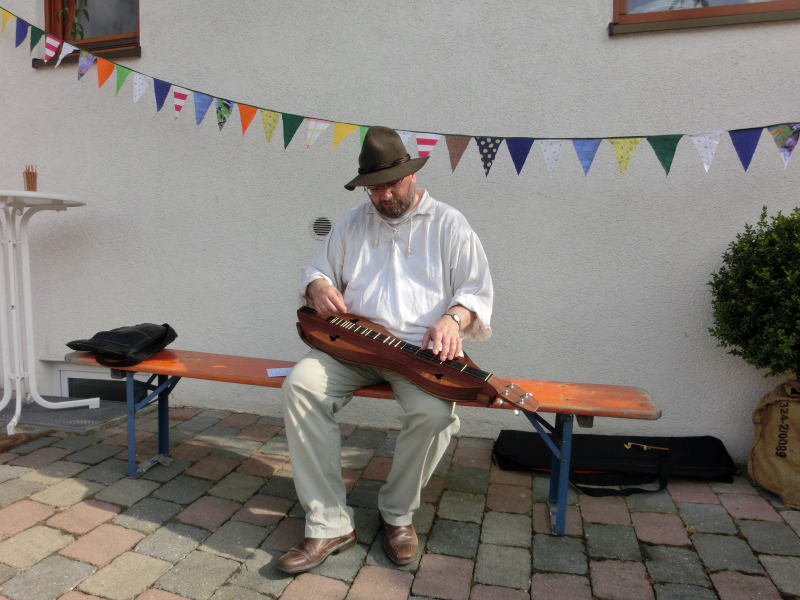
 Today I finished a free course / method for the five string kantele as an accompaniment instrument (that is: playing chords). This is the little kantele I designed. It appears from time to time in the book next to the exercises...
In addition, I have made a free songbook of Spirituals and Gospels . I have arranged all songs in D major (and four of them in D minor). Like the MD, the kantele is a diatonic instrument often tuned to D major nowadays. Maybe it is also useful for some Dulcimerplayers... :)
Now I know there are some kantele players around here. I'd be very happy and grateful to receive some feedback! As English is a foreign language to me, please let me know when you find typos or peculiar expressions or grammatical errors!
Here is the download source (directly from my own webspace):
http://www.finnischekantele.de/Be_different_Play_Kantele.pdf (ca. 3 MB)
http://www.finnischekantele.de/Spirituals_Kantele_Revised_2015.pdf (ca. 10 MB!)
Thanks for taking the time to look it over!
updated by @peter-w: 10/27/19 12:02:25PM

And now, the contrarian viewpoint. Traditionally, the nut and the bridge Were fixed and, on most stringed instruments still are; string gauge and height are always variables. But, to answer the original question: why measure from one end rather than the other? The answer is, like most things in life, convention (tradition and culture).
Why do we say the average man's voice is lower than the average woman's voice? Convention. Some cultures describe a man's voice as "higher" because most men are taller than most women.

This is just one of many "cans of worms" that may be opened when discussing the building of dulcimers!
Learn. Experiment. Have some fun! Sure, you'll make some mistakes along the way, but we all do.
You can make a simple dulcimer and have fun, or you can dig as deep into the technical aspects of design as you want.
There's room for all of it here.

It is all a bit of compromise anyway Brian. Measuring from the nut is the easiest option and fret calculators are usually multi-instrumental. There are a lot of instruments made where the freboard is fretted before it is attached to the instrument, such as guitars, so there is no actual bridge to measure from when the slots are cut and frets installed.
Even so, it still seems to me, that the most accurate way to set fret positions, would be from the bridge, as the length of the vibrating string determines the frequency of sound produced and whether a note played from a set fret position is in tune or not.
That's not the whole story Brian, you have missed out the string tension, which, as Ken says, gives rise to intonation difficulties. A thicker string or one tuned to a higher pitchor one set to a higher action (ie closer to the bridge) will pull sharper than a thinner string or one tuned to a lower pitch or one set to a nower action (ie further from the bridge). So, ideally, if youwere measuring froma straightbridge rather than the nutyou would need to compensate each fret. It is simpler to put in straight frets and compensate the bridge.
Even so, fretting is always going to be a compromise because it is done in equal temperamentbecause frets are sounded against each other when playing chords (every fret can become a new nut which is played against other new nuts - so each string then has a different scale length). If you were building for noter drone where just one string (or unison tuned melody pair) are fretted and played against the pure root and perfect 5th drones then you would be best off not using an equal temperament fret calculator and not measuring from the nut, or bridge for that matter, but centring your fret layout from the true 3rd fret root note position forthe melody string and the string gauge,pitch and action you will use - then you could workwith a more natural scale like quarter comma meantone, which would be more 'accurate' in this situation than equal temperament. Or, more simply, just set the frets by ear If you are going to play chords then you can't really set the frets by ear, you need an equal temperament pattern where every fret is just a little 'off' from the natural scale. Of course, according to an electronic tuner every equal temperament fret is 'true' because the tuners are also in equal temperament Natural notes themselves are not consistent, for examplethe 'B' note in the scale of A major is actually different than the 'B' note in the scale of G major by about 10 cents. A fiddle player (no frets) will naturally adjust the position of notes for each scale they play - a piano player or guitarist or dulcimer player cannot, so we use equal temperament.
Like I said - it is all a compromise!!!!!
I bet you wish you'd never asked now
Robin

Brian, Ken gave you good information, use it. All calculations are done from the nut, therefore fret position needs to be measured from the nut. Sometimes even when we use a fret calculator, the bridge placement will be given as a plus or minus measurement, therefore if you measure from the bridge your fret placement. Even if you measurement might from the bridge to your first fret may only be off by a few thousandth's of a inch, you could be off by several thousandth's by the time you place that last fret near the nut.

Compensation is to allow for stretch/tension between the frets and the bridge. Compensating at the nut would cause the distance from the frets to the bridge to be progressively off [sharper] as you fretted up the fretboard. Compensation is angling the bridge or relieving the bridge to effectively make the bass/middle string[s] longer.
The nut is a fixed position while the bridge is not. I know, the bridge is in a slot on my dulcimer's fret board so it must be a fixed position. The ideal placement of the bridge is "theoretical" in that other factors come in to play, e.g. the thickness of the strings, string height, etc. This is why some bridges are "compensated" or angled to insure proper intonation. So measure from the fixed position, not from the moveable.
Ken
"The dulcimer sings a sweet song."