Forum Activity for @rod-westerfield

Rod Westerfield
@rod-westerfield
05/13/10 06:51:15PM
109 posts


my favorite saying that I tell all my students... "What are those things on the dulcimer head called... TUNERS .... not FINE TUNERS "..so yes by all means try other tunings... you will find that some dulcimers sing better in different keys.. have fun.. and sure you will break strings.. but they are not that expensive..
Dusty Turtle
@dusty
05/13/10 06:34:55PM
1,850 posts


There are actually three migrations (I won't say transformations, for many people, as Ken H attests, still alter tunings often and play a true diatonic instrument) that have led to DAd tuning become the most common.One was the increase in playing chords on the dulcimer. Fingering chords in Mixolydian tuning is apparently easier than doing so in Ionian. That would explain the prevalence of 1-5-8 tunings.As others have pointed out, the vast majority of fiddle tunes, which form the basis of old timey and bluegrass music, are in the keys of D, G, or A. That may indeed have been a factor in favoring tunings in D rather than C.And finally, the additional frets that modern players often put on their dulcimers (the 6+ but also the 1+ and those crazy chromatic things) make a single tuning more versatile than it was in the days of a true diatonic fretboard and noter/drone style playing.To answer Dana's question, yes, the more you change the tuning of your strings the more likely they are to break, but that should not dissuade you from experimenting with different tunings. Keep in mind, though, that when you switch from DAd to CGG you are not only switching from D to C but from Mixolydian to Ionian.Having said all this, I'll confess that I am now at the end of the my first year of dulcimer playing and I have played exclusively DAdd tuning. I play chord/melody style and simply felt the need to get to know the fingerboard in that tuning before moving on. As my comfort level has increased dramatically, I am (almost) ready to start experimenting a bit with "alternate" tunings. I think we each have to approach the instrument at our own pace.Cheers,D.T.
folkfan
@folkfan
05/07/10 10:21:46PM
357 posts


Another thing to remember about the dulcimer in the olden days, which helps explain perhaps a bit about the change of key, is that the dulcimer as a solo instrument was frequently in an open tuning, not key specific. A person playing and singing to the dulcimer simply picked a tone that sounded and held well on the bass (not to tight or to mushy) and then tuned the other strings to that tone as in Ionian 1-5-5. It could have been a C or a C# or a sharped C# or any tone.When people began to play dulcimers together with other instruments then they had to be in a specific key, assuming whoever they were playing with wasn't tone deaf and could actually give them a true note to tune to. Using an open tuning for the dulcimer sort disappeared and as instruction books began to appear the key of C was frequently given to tune describe a note to tune to. Most of those books, that I've seen, will give directions on how to tune all of the most commonly used modes using the key of C as a base. A few gave directions for open tuning as well, but the idea simply of picking a "tone or note that sounds good to you" is sort of a vague way to teach the concept of tuning to people who perhaps have some musical background. Saying tune the bass string to the key of C is more concrete. One book I have gives the learner the choice between the C below Middle C and then Middle C on the middle and melody or using the Middle C for the bass and the octave C for the other strings. I guess that writer figured that the string gauges most dulcimer were strung with at the time would work either for one octave or other.Though the Cripple Creek Dulicmer by Bud and Donna Ford uses the key of G, it's a later publication than some of the ones I started with from the late 50's and early 60's. I don't know specifically when the change over to D came in to majority use. But Ken mentions the late 60's and early 70's which sounds right. Then the switch from DAA to DAd occurred.
Ken Hulme
@ken-hulme
05/07/10 09:20:10PM
2,157 posts


No. Traditionally each MODE had a specific keynote. The shift was from Ionian Mode in the key of C to Ionian Mode in the key of D.Aeolian A traditional tuning AEGLocrian B typical tuning Bb F GIonian C traditional tuning CGGDorian D traditional tuning DAGPhrygian E typical dulcimer tuning E Bb GLydian F typical dulcimer tuning F E BbMixolydian G traditional tuning GDgThe story is that back in the late 60s to mid 70s at lot of key of D Irish fiddle tunes were popular performance pieces and that caused the shift to D from C. I don't buy it, but that's one story."Almost all"???? No way Jos!!! Many of us play in a variety of keys. I have one dulcimer exclusively for the key of G. My other dulcimer retunes between C and D regularly.
folkfan
@folkfan
05/07/10 04:51:40PM
357 posts


Personally, I'm still in C, but I think it had to do with playing with other instruments in jams and such. And with the standardization of the 6+ fret on most new instruments, if someone tunes DAd they have two modal patterns (Mix and Ionian) available with one tuning.
updated by @folkfan: 02/17/16 05:52:49AM
Paul Certo
@paul-certo
12/03/10 02:12:16PM
242 posts


The 6+ gives you the ionian scale in a tuning that otherwise would have the mixolydian scale. To add any other mode to the DAD tuning would require more additional frets, or a change in thinking. It's the change in thinking that is sometimes hard to explain and to convince people to adopt. If you begin your scale on a different fret, you get a different mode, but also in a different key. Tuning a string to D, you get the mix mode of D if you play the scale from the open string through the 7th fret. Playing from the 1st fret through the 8th gives you the dorian mode of the key of E. But you need to tune your drones to this new key, or tune them to notes that give you the necessary notes to play the chords for E minor dorian. The main chords would be Em, Am, and B or B7.Players using the true diatonic instrument find this the first time they attempt to play a song outside the first tuning they learn, whatever that tuning may be. Using DAD, and the 6+ fret, players don't see this quite as early, but sooner or later you will find need for these other scales. The capo will make a lot of these possible, but there are instances where that may not be a complete answer either. The fiddle tune "Over The Waterfall" uses the mix mode for the A part, and the ionian mode for the B part. Using a diatonic dulcimer, the way to play this tune is to tune DAD, or 151 in what ever key you prefer, and play the A part on the melody string, and the B part on the middle string, allowing the melody string to become a high drone. The wrinkle here is you can't play with a noter on the middle string. You could play the A part with a noter, palm it and use a finger for the B part, or play the whole song with finger instead of the noter. Or you could play chord style the whole way through. Or swithch from drones to chords.You can teach yourself anything you make your mind up to learn on a dulcimer. There is a playing style or a tuning that will do the job. This outwardly simple instrument has amazing possibilities for those who explore them. I have no doubt that I can spend the rest of my life and not run out of new things to learn. Being a slow learner. Some of you will no doubt be faster than I. The bottom line is to have fun.Paul
john p
@john-p
12/03/10 06:18:59AM
173 posts


I'd always got the impression that asking beginners to remove one of the melody strings was to do with helping them get started without having to worry about the double course spreading or pinching under their fingers, or otherwise becoming derailed.

[Additional] DAD as a standard tuning really only applies to chord or multi string playing because of the notes available on the other strings. The 6+ fret giving an extra mode applies just as well to any tuning really if you stick to melody style.john p
Rod Westerfield
@rod-westerfield
12/02/10 11:56:50PM
109 posts


Sam said:
Dear Lisa, Rod and Paul;

Thanks for the great responses. As beginners, we search for guidance, if we're very, very lucky, we find those of you with the patience, knowledge and wisdom to offer the help and encouragement we need.

Sam
Sam that's what it is all about... helping others... one thing I tell my students and others... I have taken classes from Don Pedi, Linda Brockinton, Steve Seifert, Steve Eulberg and the list can go on.. but I'll never be another any one of these.. we must learn from all them, then develop your playing style and techniques..and become you....
Sam
@sam
12/02/10 10:34:53PM
169 posts


Dear Lisa, Rod and Paul;Thanks for the great responses. As beginners, we search for guidance, if we're very, very lucky, we find those of you with the patience, knowledge and wisdom to offer the help and encouragement we need.Sam
Strumelia
@strumelia
12/02/10 10:24:54PM
2,405 posts


Rod Westerfield said:

like wow that's heavy sister...
... so lets all play on...
right on , brother Mo! lol!
Paul Certo
@paul-certo
12/02/10 10:07:26PM
242 posts


Sam, no license is needed to try different playing styles, other tunings, modes, or even other instruments. If some saucy little teardrop turns your head, your hourglass won't run for a lawyer. Drink deep, and enjoy. The more different things you learn, the more tools you have at your disposal. I never threw away my screwdriver when I bought a pair of pliers. We all have our musical tastes to deal with. Our spirits cry out to go where our muse leads, but my muse may not be your muse. If we cross paths, we can enjoy our time together, but none should expect each other to define our tastes for us.To paraphrase Mike Gregory, who borrowed this from someone else:"Kid, it's your dulcimer. Play it any way you like."Out of all the above, the other tunings and modes may well be the most important things to experience. The modes are somewhat confusing, but you don't necessarily have to fully understand them to use them. You do need to be in the correct tuning to use them, though things like extra frets and capos can simplify that, too. I would suggest not resorting to either of those at first. The use of other tunings has much to teach you, and knowledge is always a good thing. Playing a true diatonic dulcimer for a time will teach you the use of modes and tunings first hand. Book learning is good, but experience brings it all home. For the purpose of quick mode changes in a concert situation, a capo or an extra fret or two may be smoother, but audiences aren't so restless that re tuning between songs is a problem. The problem is really more in the mind of players than audiences. We perceive the time as much larger than it really is. And for those who sing, finding a key that is comfortable for your voice may require several keys to cover a range of songs.As you learn more things, your own playing style will emerge, and you find yourself changing the songs to suit what you like. This is what separates real playing from a machine programmed to play everything exactly as written. And gives the music life.Paul
Rod Westerfield
@rod-westerfield
12/02/10 09:49:14PM
109 posts


Strumelia said:

I think people and things are all unique combinations anyway- none of us really fits perfectly into a generalization, but we can be generalized when all our 'uniquenesses' are thrown together. hmm...tricky concept to understand.
like wow that's heavy sister... but I agree with it and Randy... I'm glad for all the different styles of play because as Randy said the main thing is to your music, your style how ever you want to play... and I hope many people will be open to trying to use those things on the top of our dulcimers as "TUNERS" not "FINE" tuners for DAA or DAd try other keys and other modes find what fits you and your dulcimer... so lets all play on...
Strumelia
@strumelia
12/02/10 08:12:02PM
2,405 posts


I think the more different types of dulcimers and the more styles of dulcimer playing we try out, the better we are equipped to decide what our own favorite things are. Also the better we can understand why others like different things too! After trying out many things, we can happily settle into focusing on certain things we are attracted to most, yet still respect the stuff we are not as interested in.I think people and things are all unique combinations anyway- none of us really fits perfectly into a generalization, but we can be generalized when all our 'uniquenesses' are thrown together. hmm...tricky concept to understand.
Sam
@sam
12/02/10 06:29:39PM
169 posts


Dear Randy Adams;Your 2 cents worth are worth much more to me. Your observations are highly pragmatic and were very helpful as I have been worrying needlessly over what this person said or that person said. As a beginner, I'm at a total loss at what to do most of the time. Your post clarifies many of the questions I've had, but got no clear answers to. I've been thinking of going from DAA to DAD. It appears to me (again as a novice) that DAD is a more versitile tuning (mode, key, chord, gear ... whatever). In looking through some tab, I find more of the songs I want to try to learn are in DAD than DAA. Your very well put thoughts sort of gives me the 'license' to fool around.ThanksSamP.S. ... I LOVE elipsisessessesssessss ...

Randy Adams said:
Sorry I just can''t let this go by without offering my 2 cents worth....thinking if some of these notions aren't challenged every so often they might be taken as fact...or that there is some kind of majority agreement here.
There are legit reasons to have just one melody string....ignorance or a lack of motivation notwithstanding.....it simply sounds better with some playing styles....& not having much to do with ease of play...it ain't very hard to play with the double melody string....in fact it's easier to slide a noter over 2 strings.
And while we're on the subject....DAd is by far the most versatile tuning...& that's the reason most people use it....2 or 3 modes can be played out of it....& 3 or 4 keys....it's a good tuning to start out playing in.
Also while we're on the subject....For my playing in 2010 I don't really care about how the very 1st dulcimer was configured or the method of play of the very 1st dulcimer player or when the 1st dulcimer was invented...like anyone knows anyways....or the ability to play all the modes by tuning DAA, DAB, DAc, DAd, DAe etc.....that's all well & good f'sure.... I appreciate those who study the origins of the dulcimer and I enjoy looking at the pictures and reading the scholarly stories & speculations & I respect the history & traditions of the music....
But for me the dulcimer is a tool to play the music I want to play...however I need to strike the strings or make the notes or tune the strings or configure the instrument to be able to play the tunes I like....& I'm sure that's what the very 1st dulcimer player was after too....
Randy Adams
@randy-adams
05/09/10 08:09:54AM
125 posts


Sorry I just can''t let this go by without offering my 2 cents worth....thinking if some of these notions aren't challenged every so often they might be taken as fact...or that there is some kind of majority agreement here.There are legit reasons to have just one melody string....ignorance or a lack of motivation notwithstanding.....it simply sounds better with some playing styles....& not having much to do with ease of play...it ain't very hard to play with the double melody string....in fact it's easier to slide a noter over 2 strings.And while we're on the subject....DAd is by far the most versatile tuning...& that's the reason most people use it....2 or 3 modes can be played out of it....& 3 or 4 keys....it's a good tuning to start out playing in.Also while we're on the subject....For my playing in 2010 I don't really care about how the very 1st dulcimer was configured or the method of play of the very 1st dulcimer player or when the 1st dulcimer was invented...like anyone knows anyways....or the ability to play all the modes by tuning DAA, DAB, DAc, DAd, DAe etc.....that's all well & good f'sure.... I appreciate those who study the origins of the dulcimer and I enjoy looking at the pictures and reading the scholarly stories & speculations & I respect the history & traditions of the music....But for me the dulcimer is a tool to play the music I want to play...however I need to strike the strings or make the notes or tune the strings or configure the instrument to be able to play the tunes I like....& I'm sure that's what the very 1st dulcimer player was after too....
Ken Hulme
@ken-hulme
05/04/10 03:16:01PM
2,157 posts


Sure John...sure I know the doubled melody course was started in the 60s."I think Ken is wrong to suggest that 3 string players are in some way chickening out from the the demands of managing a double course."Maybe not, John, but I cannot tell you many hundreds of times in the last 35 years that I've heard/read one player telling another to remove one of the doubled melody strings "because it makes it easier to learn to play" or because "playing double melody strings is too hard if you play chords". Chickening-out or not, that's what is told to hundreds, if not thousands, of players every year.
John Shaw
@john-shaw
05/04/10 11:46:01AM
60 posts


I have to challenge KenH's assertion that "the dulcimer was invented/designed as a three course Instrument". The oldest dulcimers that have come down to us are probably teardrop-shaped Virginia style instruments, almost all of which have 4 strings which are in a more or less equidistant arrangement. Usually the frets ran under 2 of the strings, which probably indicates that the player depressed both strings with a noter despite their physical separation and let the other 2 sound as drones. This playing practice persists today in Galax-style, though Galax instruments are more commonly other single-bouted patterns (boat-shaped or wide diamond-ish shape) rather than teardrop. Some old-time Virginia players may have chosen to fret only one string with the noter - it's difficult to be sure of anything -and the equidistant arrangement gave them the choice.The Cumberland mountain, Huntington WV and North Carolina instruments were normally designed as 3 course instruments, with just 3 individual strings - and thanks to Jean Ritchie the Cumberland (Thomas/Amburgey) pattern became the folk revival's initial model of what a dulcimer was like.As Ralph Lee Smith makes clear in "Appalachian Dulcimer Traditions" the three course dulcimer with a doubled melody string (the pattern we are most familiar with in present day dulcimers) is an "innovation of the folk revival" which Homer Ledford started in unusual circumstances. At some point in his career (about 1960 according to Ralph) he began to make 3-course dulcimers with a doubled middle course to suit his own playing style, but started putting the double course on the outside (where we know it today) at the request of Floyd Baker (Edna Ritchie's husband). This was to suit Floyd's noter-playing style, as Floyd did not want an extra drone string, and preferred the double course to be on the melody strings to help the melody carry over the drones. The innovation caught on - for good reason, Ken would say! But it is still a dulcimer revival-era innovation.I write as a dedicated 3-course buff who has no inclination to explore 4-string equidistant playing, but 4 equidistant string dulcimers have at least as much historical justification as 3-string ones. Historically both types would have been played noter-drone style of course. I love that sound and approach, but I also love other approaches (chording;flatpicking across all strings etc.) all of which are just as much revival-era innovations as the double course melody string is!To each his/her own! Ken has a clear preference for a double melody course, but let's be clear that it is an artistic preference (to which, of course, he is perfectly entitled) rather than something with deep roots in dulcimer history. Most of the time I prefer the character of a single melody string - the sound I first fell in love with on the early Jean Ritchie records. Mine is an artistic preference too. I think Ken is wrong to suggest that 3 string players are in some way chickening out from the the demands of managing a double course. Personally I have a wonderful MD with a double course melody string in my brood which I play when that's the sound I want, but more often I choose to play dulcimers with a single melody string. Sorry Ken, but I had to get this off my chest - and I do agree with most of your other points - honest!
Ken Hulme
@ken-hulme
05/03/10 05:22:42PM
2,157 posts


No problem, DT. Different observations of "accomplished players" in different parts of the country I guess. The accomplished players I know, like Robert Force, Bonnie Carol, Steve Eulberg, Lance Frodsham and Kerry Coates don't take off a string to make it easier bends. They all just bend double strings.
Dusty Turtle
@dusty
05/02/10 06:24:58PM
1,850 posts


Sorry, Ken. I guess I misunderstood you. I had thought your point was that a lot of beginners are wrongly convinced to remove the double string believing it would be easier to learn that way. I took you to be emphasizing "beginners" and "believe," meaning you thought they were wrong. My point was simply that many players who are not beginners and who learned on 4-string instruments have switched to playing 3-string because it is easier to bend strings. Maybe you can bend double strings, but there is no doubt it is a lot harder. There may indeed be other reasons for playing 3 single strings. It seems to me that Stephen Seifert chimed in on this on ED not long ago and listed advantages and disadvantages to both single and double strings.I play a four-string dulcimer and hope to soon play a six-string dulcimer, but I think there are legitimate reasons for preferring single strings. Not everyone who plays that way was a misguided beginner.Again, if I misinterpreted your post, I'm sorry.D.T. Ken Hulme said:
Dusty'

I did say said that many folks remove the fourth string believing it is easier to play that way.

You said: That may be accurate, but a lot of accomplished players remove the double string to make it easier to bend strings.

Ummm... Hello? Isn't bending strings a method of playing them? I certainly don't go around maliciously putting bends in strings otherwise...

Personally I don't have trouble bending double strings... but then I eat my Wheaties!!
Ken Hulme
@ken-hulme
05/02/10 04:33:15PM
2,157 posts


Dusty'I did say said that many folks remove the fourth string believing it is easier to play that way.You said: That may be accurate, but a lot of accomplished players remove the double string to make it easier to bend strings. Ummm... Hello? Isn't bending strings a method of playing them? I certainly don't go around maliciously putting bends in strings otherwise... Personally I don't have trouble bending double strings... but then I eat my Wheaties!!
Dusty Turtle
@dusty
05/02/10 12:03:27AM
1,850 posts


As far as I've observed, all your observations are accurate with the sole exception, as noted by Ken H., of the 13+ fret, which is standard on most dulcimers with the 6+ fret.I just want to offer one additional comment on the double melody string. Ken H states that many folks remove the fourth string believing it is easier to play that way. That may be accurate, but a lot of accomplished players remove the double string to make it easier to bend strings. I am not one of them, for I am not accomplished, and I like the double string. In fact, my next dulcimer will be a 6-string dulcimer. But as a guitarist I can attest to the ease of bending strings when only playing a single string. I play lots of 12-string guitar, but whenever I want to play blues or even fast-paced bluegrass, I grab the six-string.And the whole justification for doubling the melody string only makes sense if you play noter/drone style, where the melody string has to compete with the volume of the bass and middle string. If you are playing cross string or chord/melody, you want all the strings to have about the same volume.I know there are many out there who lament the standardization of the DAdd tuning and the 6+ fret. I must admit that I rarely play in other tunings and will probably add a 1+ fret on my next dulcimer. Sorry, dear traditionalists, but I'll let you down again.D.T.
folkfan
@folkfan
05/02/10 12:01:56AM
357 posts


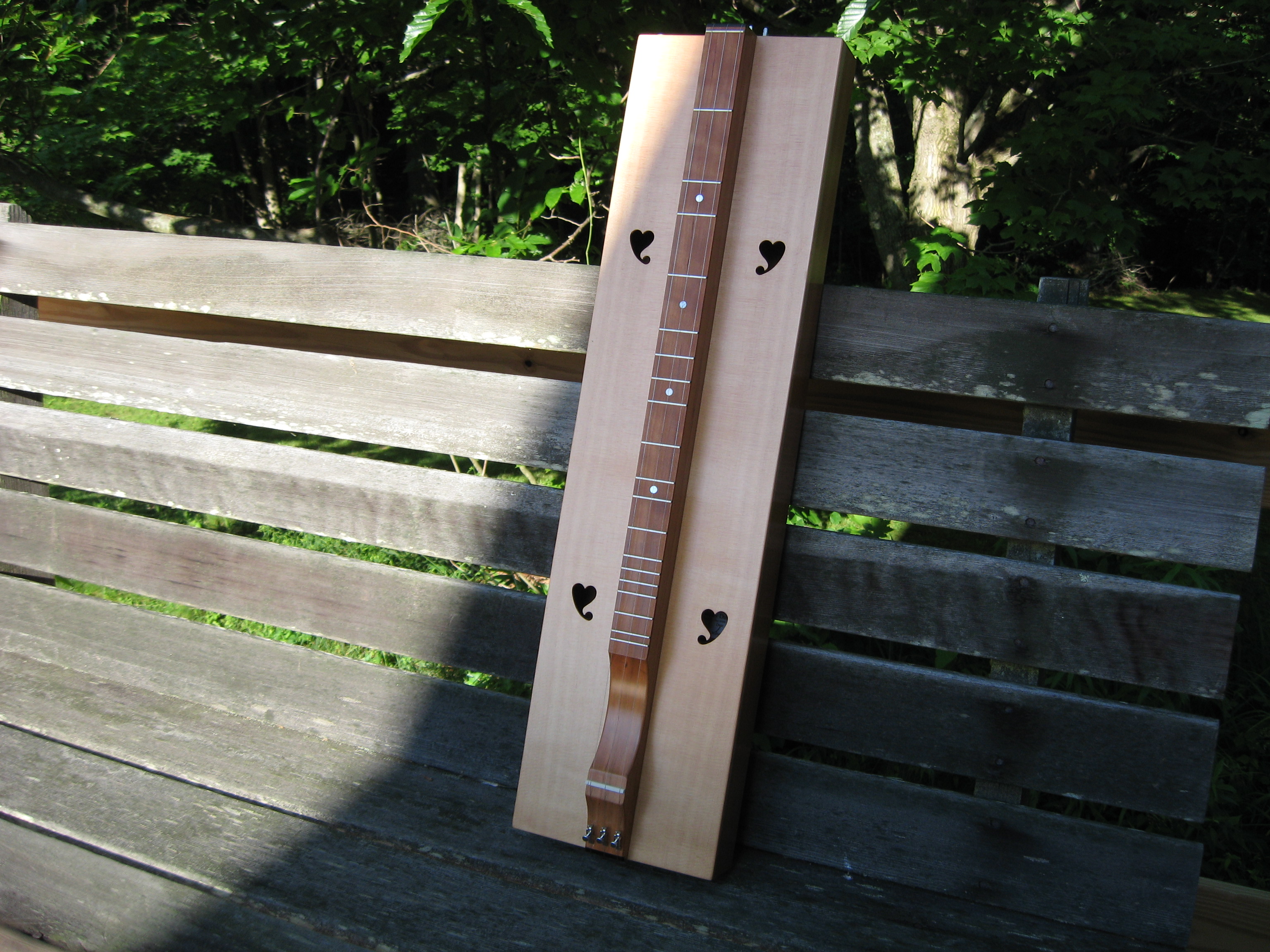
I don't know whose dulcimers you've been looking at, but I have a more diverse collection than you have described.13 dulcimers:Only 2 have heart shaped sound holes and one of those is a none standard heart shape.6 teardrops and 6 hourglass shaped, 1 box dulcimerOnly two intruments are designed for 3 string playing, the rest have 4 tuners even though one isn't used. Though I play only 3 strings, I usually buy an instrument capable of using 4 strings for resale purposes. Finding dulcimers designed for only 3 strings is not easy to do, you almost have to custom order them. So, of course, people who want to play with only 3 strings simply remove a melody string from a 4 string instrument.And, Ken, if you had the problems with your hands that I have with mine, you'd probably be playing on 3 strings too. I can't even hold a noter the way you do. And even when my hands were better, I preferred using 3 strings. Laziness has got nothing to do with it. Personally I can't understand your preference for 4 strings. :-)None of my instruments are tuned DAd, or even tuned DAA. I don't play in the key of D at all. I play Ionian and Aeolian modes predominantly in the key of C, A, B, G. But all in the lower register.All of my instruments have a 6+ fret and all but one have a 13+ fret. The only one with just the 6+ was one that wasn't built with any extra frets and I had just the 6+ added.Though I don't finger pick or flat pick I do know a number of players that use those techniques. And a number of players that use a noter. But as Ken said these are techniques for different hands.Modern Bowed Dulcimers aren't traditional mountain dulcimers, so whether they have diatonic or chromatic fret boards is purely up to the buyer. Bowing a dulcimer is an old tradition, but it was done on the standard dulcimer of the day.2 of my instruments are baritones.12 of my instruments have the same VSL. Many have the same depth and body size. The main difference is in the woods. The bodies are mostly cherry, walnut or mahogany, with aspen, WRC, redwood and wormy chestnut for tops. All the fret boards are the same width, except for one and the same depth except for 1.So Gerard, though your observations are mostly correct, you couldn't prove it by my collection of instruments.
Ken Hulme
@ken-hulme
05/01/10 08:08:19PM
2,157 posts


Most of your observations are valid - general as they are. My comments are totally my opinion only, and not particularly tongue in cheek!* hourglass shape - Comes more or less from the Kentucky building tradition and has become the de facto recognizable shape of the dulcimer. There's no accounting for taste!* most dulcimers with 4-strings have a double-melody string spacing. Yep the dulcimer was invented/designed as a 3-course Instrument - Bass, Middle, Melody. You can have more than one string on a course. The dulcimer was not invented as a 4-course instrument* The majority of dulcimer players that play with only three strings normally use a four-string double-melody string dulcimer. Yep! LOTS of people have been convinced by well meaning but lazy other players and teachers, to remove a string to make it theoretically easier to learn to play instead of taking an extra week to get used to doubled melody strings. But they get convinced of this AFTER they've already bought a 4-string instrument! You can tell what I think about this, right!* the majority of dulcimer players seem to favor and play in the DAD tuning (Mixolydian Tuning). Ive even heard that this tuning is considered to be THE DULCIMER TUNING by many. Unfortunately true. Again most often caused by well meaning but ignorant teachers who themselves were taught that DAd is "the only" tuning. They are deluded, but that's their problem. There are a lot of us who use multiple tunings.* Traditional dulcimers normally use the diatonic fret pattern and although fully chromatic dulcimers are available, the majority of dulcimers fret boards are NOT fully chromatic. TRUE. The dulcimer was not invented as a chromatic instrument. It was invented as a diatonic instrument. Only in the late 20th century have people bastardized the instrument by adding extra frets. You can tell I really don't like chromatic or added fret dulcimers, can't you...* The only dulcimer that uses a fully chromatic fret board appears to be the bowed dulcimer but even a few of these do have a diatonic fret board. The Bowed Dulcimer as you see Ken Bloom and others build it, is a totally late 20th century invention. The traditional dulcimer can be bowed, but the Bowed Dulcimer is a different cat altogether.* The majority of dulcimers fret boards have the 6+ or 6 fret added to the diatonic fret pattern. Yep - due to the observation above about people thinking DAd is "the only" tuning.* The majority of dulcimers that Ive seen DO NOT have the corresponding 13+, 13 fret added to the diatonic fret board. You've not been looking at the same dulcimers the rest of us have. Virtually every 6+ dulcimer I've seen has the corresponding 13+ fret.* You normally do not see that many bowed dulcimers, mini-dulcimers, dulcimettes, or octave-higher dulcimers, baritone dulcimers, or bass dulcimers, so the majority of dulcimers seem to be standard sized dulcimers. Duh! Yeah! Otherwise they would be the standard! Of course it all depending on which festivals you've been going to where. Those other instruments are Special Purpose instruments, generally speaking.* The majority of dulcimers seem to have heart-shaped sound holes. Maybe. I see more with round holes than hearts.* The majority of dulcimers seemed to be played using a pick and not with finger-picking or a noter. The dulcimer was invented long before finger-picking - it's a 20th century invention - and with only 3-courses of strings isn't particularly suited for it. More muisc is more suited to flat-picking than finger-picking. The Noter has nothing to do with the right hand. I've been using a Noter and a flat pick for over 35 years.* You don't have to have or spend a lot of money to purchase a good quality dulcimer like you have to do with many other instruments. You can buy a great playing cardboard dulcimer for almost nothing, build a high quality dulcimer with a reasonably priced dulcimer kit or even make your own dulcimer for almost nothing out of scrap and junk. VERY TRUE.* The widest divergence having to do with dulcimers, that Ive seen, are the materials and woods used in building the dulcimer, the dulcimer string lengths, side depths, soundboard widths, etc. Huh? What did you expect? You've just listed all the basic factors that are the dulcimer. What else is there? Shape has almost nothing to do with dulcimer sound. Wood types are actually pretty far down the list too, an generally should just be considered cosmetic. Length/width/depth of the instrument , and the VSL of the strings are the elements that most affect the sound.
updated by @ken-hulme: 02/17/16 06:12:35AM
Robin Clark
@robin-clark
06/14/10 01:06:19PM
239 posts


I've been using a goose quill noter for the past couple of weeks and I'm really impressed with the speed and tone. They are as quick and bright as a hardwood noter but kill the string vibration when moving between frets, so they give very pricise note separation for fast playing. I'm not sure how durable they will prove - I expect I'll probably get through a feather a month. But they are cheap and seem to work really well for my style of playing. I play with a finger-on-top style. A feather noter may not work so well for a thumb on top style. I think that for fast fiddle tunes in Galax style, feather noters are the very best I have tried so far.

Feather noter and strumming quill
Strumelia
@strumelia
06/14/10 12:09:24PM
2,405 posts


I have 3 noters of ironwood/hornbeam, turned for me about 9 years ago by a wood turner/burl bowl craftsman. The same wood used for axe handles. Though they are indeed nice and hard, they do still get string grooves over time, much like my maple noters do.
razyn
@razyn
06/14/10 11:36:59AM
49 posts


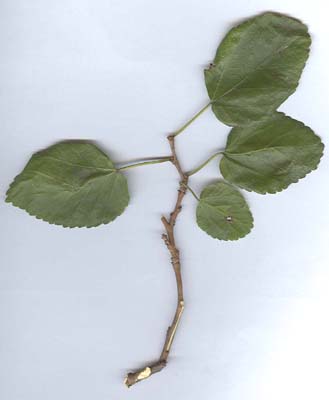
In case anybody wants to see Flint Hill's noter "on the hoof," so to speak -- I have a pretty big American hornbeam tree in my yard. Maybe 30 feet tall, and it's often more like a shrub. The post at left in this photo of it (from my deck) is 5 feet tall, or so.

John Henry
@john-henry
06/14/10 11:22:46AM
258 posts


Robin,see my reply to Dave Kirkpatrick, and contact me pm if you wish?John
John Henry
@john-henry
06/14/10 11:18:53AM
258 posts


DaveI would be quite happy to make you a couple to your spec, as near as possible without seeing what you prefer now (gratis). I have just discovered some odds and sods that were lurking in a dark corner of my workshop I have some beautiful clean and dry 'Box', which has become really hard over the last 25/30 years, a creamy yellow colour, and I also have some 'Bog Oak, (no Robin Thompson, nothing to do with your garden room!) which is very black and hard, and at a conservative estimate must be over a 1000 yrs old, it was dredged from the River Trent about 20 years ago near Shadwell, and similar timber has been carbon dated well in excess of the figure I have quoted. I can of course produce noters from other hardwoods, maple, yew, walnut ect. Just one thing, when I use a wooden noter now I tend not to use a round section, prefer either an elliptical or a just 'off square' section, they are of course, easier to makeregardsJohnH
Robin Thompson
@robin-thompson
06/14/10 10:47:50AM
1,554 posts


Got any for sale? Flint Hill said:
"Ironwood" noter, from a slab collected in East Texas, ca. 1960, by A.L Vawter.

Approximately 6 1/4 x 3/8 x 1/4 in. (15 x 1 x 0.6 cm). "D" cross section.

Dense, extremely hard wood. It sinks in water and is difficult to work.

It made a nice, slick noter that sounds a bit softer than a goose quill.

Probably Big Bend or Eastern Hophornbeam. (Ostrya virginiana var. chisosensis or Ostrya virginiana var. virginiana, 2007)
Flint Hill
@flint-hill
06/14/10 09:22:21AM
62 posts


"Ironwood" noter, from a slab collected in East Texas, ca. 1960, by A.L Vawter.

Approximately 6 1/4 x 3/8 x 1/4 in. (15 x 1 x 0.6 cm). "D" cross section.Dense, extremely hard wood. It sinks in water and is difficult to work.It made a nice, slick noter that sounds a bit softer than a goose quill.Probably Big Bend or Eastern Hophornbeam. (Ostrya virginiana var. chisosensis or Ostrya virginiana var. virginiana, 2007)
Ken Hulme
@ken-hulme
05/05/10 02:18:26PM
2,157 posts


DJ - that's what we call the Thumbelina style. Not trad, but not bad...
Ken Hulme
@ken-hulme
04/27/10 03:13:33PM
2,157 posts


Fretless dulcimers are a special order instrument. Most builders will do one. Some actually cut the fret slots and inlay wood so that you have fret markers. Others do a completely bare fretboard.
Jim Fawcett
@jim-fawcett
04/27/10 08:16:02AM
85 posts


I have three type of bone noters that I got from Randy Bretz. They are holding up rather well. I did have to sand down one of them, but it's just like new. I also made one from some old bamboo I had here at the house. It works well. I like the different sounds given between the bone and the bamboo noters.
Robin Clark
@robin-clark
04/27/10 03:19:18AM
239 posts


Hi Carson,Have a look at Randy Adams videos to see fretless dulcimers - Here's one
He makes cigar box fretless MDs and uses a 4 string set-up plus a multitude of old banjo tunings. The strings are sounded not by depressing them to the fingerboard but by placing the tip of the noter onto the fingerboard and touching the string. Like this photo of the technique on a fretted MD:

Note that the string is not touching the frets - it is vibrating against the noter and the vibrations are transfered into the fretboard and instrument by the tip of the noter.A hard noter, such as snakewood, gives a very clear sound when doing this. And I use the technique on my fretted MD to play the missing semitones and occasional accidentals that some folk tunes have, or to change key. For example, when playing in d,d,d,d galax style I can capo at the 1st fret and play in both A minor and A major by playing the G# of A major using this technique - a very handy skill at sessions! With a bit of practice you can rock the noter up onto its tip really fast. You can see me snatching the G# accidental by rocking the noter up onto its tip and sounding the string between the G and A frets in the B part of St Annes Reel (key of D) on this video.
Robin Carson Turner said:
Robin Clark said:
I also think it would be a excellent wood for a fretless set-up

Fretless dulcimer? We have that option? I'm intrigued, who makes these?
B. Ross Ashley
@b-ross-ashley
04/26/10 07:15:55PM
59 posts


I got a nice rosewood one from Carrot Creek last year when I got my dulcimer, it is showing signs of wear now but not so bad as Strumelia's maple one! Probably means I need to play more often.
Randy S. Bretz
@randy-s-bretz
04/26/10 04:13:09PM
8 posts


My bone tipped noters hold up very well and if they do get scratched from use you can sand them down to a smooth finish. The bone tip goes 2 1/2" into the handle so they are very strong.

Robin Thompson
@robin-thompson
04/26/10 01:01:05PM
1,554 posts


A toothbrush handle? Now that's something I think I haven't tried! I'm going to, though. . . My bone noters-- got from Randy Bretz-- yield clear tone on the string. For playing fast tunes, I need a noter that's forgiving, so use my homemade ones cut from a hard plastic jar that once held store-bought fruit. Photo can be seen by scrolling down the page just a bit here: http://mountaindulcimer.ning.com/forum/topics/whats-your-favorite-n...
John Henry
@john-henry
04/26/10 10:57:52AM
258 posts


Why John Shaw! I do declare, that's almost a compliment!!!! That particular butt end of a quill which I was using while you were here on Sunday last has been in use for some considerable time now (the Mason's left me some when they visited with us?) and I have that one 'setup' so as I can use either end,those ends being of different thickness, which have the capacity to produce different effects. As you commented, the action is slick and the sound good, IMHO, which is why I choose to use to use it over other noter types. BUT, I am also very fond of a noter contrived from the plastic barrel of a biro type pen, again because of the singular sound given, and I have used and still use on occassion, a wide variety of Hardwoods, not always cylindrical, try an elliptical one (never Ebony or Snakewood Ken H, just a bit beyond my pocket LOL). Ken also mention bamboo, I find this to be particularly 'slick', it fair glides over the fretboard, but , again only IMHO,I would be cautious about using this on anyones instrument except my own; there is always the chance that bad use of a 'hard' noter on a fretboard make of a 'soft' hardwood could lead to scoring of the fretboard. I have seen an example of this!. Which is why whatever the noter material I always remove the arriss from the noter tip, and try to impress on others the need (for the main part) in keeping the noter in the right plane. Long winded reply Dave, ain't it, but as many people on this site have mentioned in the past, try all and everything until you hit on just the right one. Did I ever tell you about the time that I left my bag of odds and sods at home and was forced to use the snapped off handle of my toothbrush? No,well...............regards,JohnH John Shaw said:
Our mutual friend John Henry gets the most wonderful tone from using the thick end of a turkey or goose quill as a noter. This doesn't score all that high on durability, I suppose, although they seem to last him a reasonable time, but it's a great sound and action. John started using them after learning that this is what most of the Galax-style players in Virginia use.
Strumelia
@strumelia
04/26/10 10:30:40AM
2,405 posts


Noters don't last forever if you use them a lot.Here's my noble old hard maple noter, now 'retired'...it sure made a lot of fun music!...

Ken Hulme
@ken-hulme
04/26/10 09:37:39AM
2,157 posts


The harder the wood the more longer lasting. IMHO Walnut is at the low end for hard wood noter. I never recommend Big Box Store dowels because they are Poplar, and too soft. Oak is too soft. Hickory isn't bad. Maple is good, Blue Beech, Hop hornbeam, Manzanita or whatever your local "Ironwood" is called.My all time favorites are Ebony and Snakewood both for their beauty and density. I also like certain species of bamboo, particularly Phyllostachys nigra - Black Bamboo.
  673