Intonation Problems
Instruments- discuss specific features, luthiers, instrument problems & questions
Thanks all for your generosity in sharing suggestions. Can't wait to get started!
Thanks all for your generosity in sharing suggestions. Can't wait to get started!
At the risk on being a contrarian, I have had good success with keeping my dulcimer from going sharp as you go up the frets a different way that also helps with the bass buzzing problem. Rather than focusing on the saddle height, I find adjusting the nut or zero fret slightly higher allows me to keep a more consistent and lower action across the fret board. Yes, definitely, it sounds like your saddle is too high. When you get that resolved, and if you are in the mood for even more fine tuning, try raising your nut by maybe 10% and see if you can adjust your saddle down about the same percent. As with any adjustment, your mileage will vary.
Some builders do build flat fretboards. When there are as many frets as the dulcimer has, though, the problem of getting the lowest action becomes very much like that of designing auditorium seating.
Imagine an auditorium in which the seating floor is flat: even if everyone is the same height, people will have trouble seeing over the heads of those in the next row. And in the foremost rows (that cost the most to get), you begin to see less and less of the performers!
So the answer is to make the floor a long sweeping curved surface sloping gently down, each row a little lower than the one behind. That works well until about 2/3 down toward the stage: at that point the person in the next row are no longer the issue. Now the problem is that you can't see all of what's happening on-stage. So the floor has to start to rise so each row is a bit higher than the one before. Then each person can see everything on the stage.
So think of the string's "line of sight" as it is fretted at each fret, and design your fretboard so that, at each fret position, the height above the further frets is equal. If you're good at trigonometry you can solve the problem as one of the string forming a constant angle when fretted at each angle such that the sine of the angle is just a bit greater than the top of the next fret's crown. Since the distance between frets is exponential, that fretboard surface will be very interesting mathematically. (I've never done it mathematically. I prefer the heuristic method in instrument building, not analytics —except in the matter of setting frets in equal temperament).
Every dulcimer will have its own fingerboard 'profile,' meaning a concave 'dish', though some makers prefer to build with a flat fingerboard, I hear.
Some builders do build flat fretboards. When there are as many frets as the dulcimer has, though, the problem of getting the lowest action becomes very much like that of designing auditorium seating.
Imagine an auditorium in which the seating floor is flat: even if everyone is the same height, people will have trouble seeing over the heads of those in the next row. And in the foremost rows (that cost the most to get), you begin to see less and less of the performers!
So the answer is to make the floor a long sweeping curved surface sloping gently down, each row a little lower than the one behind. That works well until about 2/3 down toward the stage: at that point the person in the next row are no longer the issue. Now the problem is that you can't see all of what's happening on-stage. So the floor has to start to rise so each row is a bit higher than the one before. Then each person can see everything on the stage.
So think of the string's "line of sight" as it is fretted at each fret, and design your fretboard so that, at each fret position, the height above the further frets is equal. If you're good at trigonometry you can solve the problem as one of the string forming a constant angle when fretted at each angle such that the sine of the angle is just a bit greater than the top of the next fret's crown. Since the distance between frets is exponential, that fretboard surface will be very interesting mathematically. (I've never done it mathematically. I prefer the heuristic method in instrument building, not analytics —except in the matter of setting frets in equal temperament).
Every dulcimer will have its own fingerboard 'profile,' meaning a concave 'dish', though some makers prefer to build with a flat fingerboard, I hear.
Thanks, Ken. The action is significantly higher than that; I could probably put 3 dimes!
This is a great place to start
I agree.
One way to finalize the optimum action height the dulcimer is capable of is to find out the minimum saddle height at which the bass string doesn't buzz, then add .005". A set of number drills (1-60) is great for this, since each drill is a very small variant of its neighboring drills' diameter. So remove the bridge and substitute a number drill. Intonation doesn't matter for this test of course, but you do want to be tuned to playing pitch.
This is genius. What about the nut? Remove that and replace with a closely sized bit, too?
That's a great idea! just remember to replace the nut with a packing piece so it is level with the fingerboard before starting.
Every dulcimer will have its own fingerboard 'profile,' meaning a concave 'dish', though some makers prefer to build with a flat fingerboard, I hear.
For what it's worth, I set the nut height at .015" higher than the fret crown I'm using. That seems about right for the way I profile the fingerboard.
Nicolas, on almost any device- a phone, laptop, desktop, or tablet... there are quick keyboard or 'tap' commands that allow one to zip right to the top or bottom of a page. You might find such shortcuts come in handy to get places more quickly.
Thanks!
Three dimes seems like a TON of extra height by the nut. I hope that isn't due to warping or bowing.
If you have a nice straight edge on a metal yardstick or something like that, you could set it along the fretboard and observe if the straight edge touches all the frets, or if some of them are lower/higher. It is possible that some frets have risen slightly out of their slots and need to be 'tapped' back into place.
It can be helpful to check each fret with a tuner and note how out of tune each fret is. If the first couple of frets are the most out of tune, the issue is most likely your nut being too high. If the frets get more out of tune as you get closer to the octave, you most likely need to move or reduce the height of your bridge.
Once the frets are all level and the action is correct, you will most likely have to readjust your bridge placement anyway.
Tune the string up to tension and get it exactly to the desired note. Use a tuner to compare the open string to the note at the 7th fret (octave) If the octave is flat, the bridge needs to be moved *closer to the nut* If the octave is sharp, the bridge needs to be moved *away from the nut*
Bob Stephens dulcimers are absurdly cool. I haven't had the privilege of playing one but the engineering is fascinating and the tone is definitely distinctive. They incorporate a lot of design elements that you won't find in any other instruments. They may look 'guitar-like' but they are very optimized dulcimers. Features like the floating neck and internal soundboard are examples of taking things that are distinctive about a dulcimer and pushing them further.
ok so it's the fret pattern, not technically the 'pegbox' or tuning mechanisms that are opposite mirrored for duet playing. I was just assuming the peghead was usually at the 'fret 1' end of the fretboard, but there's nothing saying you can't put the tuning pins at what we consider to be the tail end of the box.
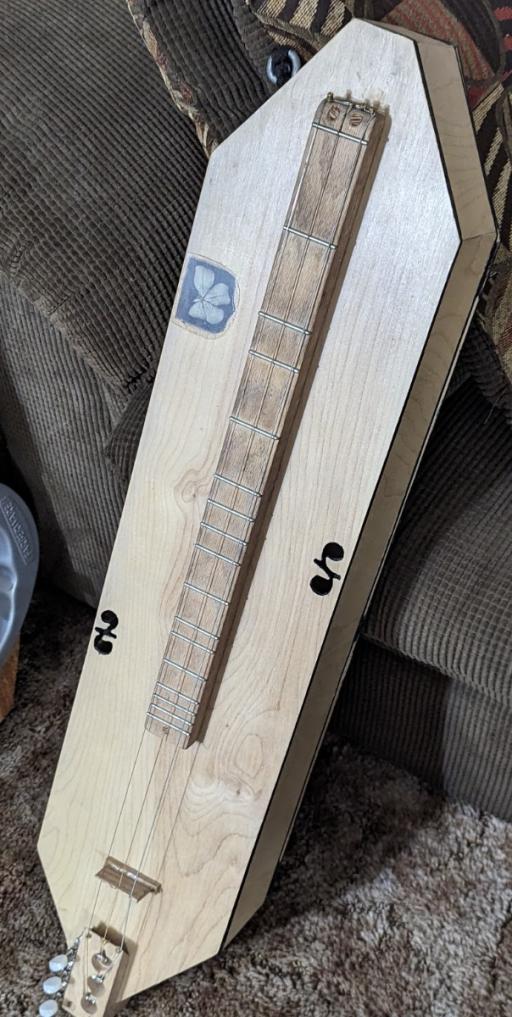
The dulcimer played by John in the video does not seem to be a courting dulcimer, like the one in the patent document. The fingerboards are both facing the same way, and don't seem to be laid out in a way that would be easy for two people to reach both fingerboards at once. The fact that it is only one octave is the main reason I am guessing that John's second fingerboard is for lower pitch notes. It would not need the second octave, since the higher notes are already on the other fretboard.
Thank you for the clarification, at least I know there is nothing to “figure out” :)
the best of both worlds would indeed be the ability to switch between most recent to a kind of chronological order.
what would be great is a “jump to bottom” option so that someone reading a post that already has a lot of replies would be able to quickly see the first message without having to scroll all the way down.
i appreciate the huge task that administrating a forum like this one can be. Thanks again to everyone dedicating time to make this happen.
have a good day everyone
nicolas
Can you specify when placing the dimes or nickels- the coins should be placed on top of the fret, right? (not on the wood of the fretboard surface between or next to the frets).
Yes, I wasn't quite clear on that was I? The dime is place on the fret board. The nickel is placed on top of the fret.
Ken
"The dulcimer sings a sweet song"
[/quote]. A set of number drills (1-60) is great for this, since each drill is a very small variant of its neighboring drills' diameter. So remove the bridge and substitute a number drill. [quote="Dwain Wilder"]
[/quote]
Thanks for reminding me of this Dwain. I think you either mentioned this to me some other time or you wrote it somewhere and I forgot all about it. I think this is a very sensible way to adjust string height. I appreciate your sharing it again.
Ken
"The dulcimer sings a sweet song."
Can you specify when placing the dimes or nickels- the coins should be placed on top of the fret, right? (not on the wood of the fretboard surface between or next to the frets).
@Bob-Stephens really does use a floating neck that does not come in contact with the soundboard. His dulcimers also have a false bottom, so both top and bottom are free to vibrate. You can see some pictures here on his website and also in some of the pictures he has posted to FOTMD . He uses a metal rod that runs the length of the neck to enhance stability and reduce the need for excessive bracing of the soundboard.
He is a member here and has explained the evolution of his design principles elsewhere, so I won't go into more details (which I don't understand, honestly). One of those discussions is Floating Fretboards .
David Beede uses the same floating fretboard principle on his octave dulcimers. (Or rather he did, until he stopped building.) The fretboard is attached to the body with two or three metal dowels that drive sound vibrations directly into the sound chamber. I have one of these little dulcimers and am constantly amazed how much volume can emerge from such a small instrument. It's like the dulcimer version of Taylor's GS-Mini. The "decoupled tailpiece" principle that David used on his full-size dulcimers is similar to a "discontinuous" fretboard to which Ken refers.
I have not yet played a dulcimer by Bob Stephens but I have a wooden, nylon-string dulcimer on order and will surely post a video or two after it arrives. (I have to specify "wooden" because he is now making dulcimers using 3-D printing for nearly everything but the top.) I ordered one because I love the idea of a dulcimer specifically designed for nylon strings and look forward to exploring the different tonal possibilities of that instrument. Bob worked with Aaron O'Rourke on the nylon-string dulcimers and has been working with Butch Ross on the steel-string dulcimers. You can find them demonstrating those models on YouTube if you search for a moment or two.
And here is Steve Eulberg demonstrating an earlier version of the nylon-string dulcimer . When he turns the dulcimer on its side with the camera from above (1:17-1:27), you can see the space in between the neck and the soundboard.
Thanks, Ken. The action is significantly higher than that; I could probably put 3 dimes!
This is a great place to start
I agree.
One way to finalize the optimum action height the dulcimer is capable of is to find out the minimum saddle height at which the bass string doesn't buzz, then add .005". A set of number drills (1-60) is great for this, since each drill is a very small variant of its neighboring drills' diameter. So remove the bridge and substitute a number drill. Intonation doesn't matter for this test of course, but you do want to be tuned to playing pitch.
This is genius. What about the nut? Remove that and replace with a closely sized bit, too?
Thanks, Ken. The action is significantly higher than that; I could probably put 3 dimes!
This is a great place to start
I agree.
One way to finalize the optimum action height the dulcimer is capable of is to find out the minimum saddle height at which the bass string doesn't buzz, then add .005". A set of number drills (1-60) is great for this, since each drill is a very small variant of its neighboring drills' diameter. So remove the bridge and substitute a number drill. Intonation doesn't matter for this test of course, but you do want to be tuned to playing pitch.
Pluck the bass string at each fret forcefully (sideways, not vertically). Substitute the next smaller or larger drill bit shank, depending on whether you find a buzzing fret. If you find a buzz on only a single fret, consider dressing that fret crown down a bit. After you've found a drill shank that represents the minimum action height on the bass, check for buzzes on the other strings. That's a check of the whole fingerboard's surface regularity, and the possibility that some frets aren't well seated or have worn or grooved crowns.
ok so it's the fret pattern, not technically the 'pegbox' or tuning mechanisms that are opposite mirrored for duet playing. I was just assuming the peghead was usually at the 'fret 1' end of the fretboard, but there's nothing saying you can't put the tuning pins at what we consider to be the tail end of the box.
Yes, they are mirrored. Somewhere in my files I have some photos of early courting dulcimers. I'll try to see if I can find one, digitize it, and share it here. It may take me a while to do so.
Ken
"The dulcimer sings a sweet song."
@ken-longfield Great info, saved for future reference, thank you
@dulcimaryland Looking for ward to hearing your results and experience. 🍿
Thanks, Ken. The action is significantly higher than that; I could probably put 3 dimes!
This is a great place to start
in John M Own words:
Of course, what everyone wants to know about is the dulcichord, the intriguing instrument pictured on the cover of Douce Amere which looks like the result of a drunken liaison between a dulcimer and a pedal-steel guitar..... “I wanted a harpsichord-kind of sound, and studied how they were made. The top is floating- it is only attached to the sides, and there is a gap at both ends. It was made from very good quality guitar tone wood and was braced on the underside using the fan-bracing system invented by Torres for Spanish guitars. It has two fingerboards, both of five single courses (DADAD) and both fully fretted. The bridges are only lightly held in place by the strings, there is no great pressure exerted. The levers pressed down to form barre chords on the furthest fingerboard. I used to play organ so was used to playing foot pedals. Unfortunately, the lever mechanism, though it worked perfectly well, was a bit noisy, and I virtually never used it, not even on the record! I still have the instrument, and in fact used it at a gig a couple of nights ago. It looks good and gives out enough volume for an audience of 70 or so, without the need to amplify it. The cover painting was a gift from a local artist, and is pretty accurate, even down to the wing-nuts (to dismantle the instrument for transport)”.
The first thing I would do is check to see that, if the bridge is moveable, it is in the right place. If it isn't moveable, checking the action is a good start. A general rule of thumb is that the strings should just touch a dime when placed next to the first fret. I place the dime on the side toward the second fret. Then place a nickel on the seventh fret and the strings should just touch the nickel. If that adjustment doesn't work, then I would calculate the proper fret spacing for the vibrating string length of the dulcimer. Some programs let you print out a template. I would use this to check the fret spacing and re-fret if necessary.
Ken
"The dulcimer sings a sweet song."
KenL- but... are those also having the frets going in the same direction? I suspect the fret pattern will be 'mirrored' if intended for couple playing on facing knees... even if the tuning mechanisms (pins, pegs) are both on the same end. Hmm, I probably should have clarified that.
@lilley-pad My experience is I play the mountain dulcimer with the sound I want to fit the repertoire(s) I want to play. Also, my experience is there is no Holy Grail. Depending on style of play and repertoire, one instrument may suit over another.
Bob Stephens is a member here at FOTMD and you can find his page by searching members. Here is a video of Aaron O'Rourke playing a prototype (so, an early model) of one of Bob's wonderful-sounding dulcimers:
https://youtu.be/EPClQt6v0Z0?si=0D_xkDv1OR9fTkH7
Strumelia, I'm glad that you wrote "in general" as there are courting dulcimers out there that do have two fret boards with the peg heads at the same end of the dulcimer but fretted for playing by two people sitting knee to knee. I think this design makes the dulcimer shorter and easier to carry because you don't have peg heads sticking out on both ends.
Ken
"The dulcimer sings a sweet song."
I paid C$129.00.(plus tax).
I have an old dulcimer, 1977, which has an intonation problem. It frets sharp. I'm handy enough that I'm willing to attempt to fix it myself. I suspect that if I lower the action, it might fix the intonation. Am I on the right track or is my only option to adjust the distance between the nut and bridge?
Like John I've not heard of Stephens Lutherie. And I also agree with John that there is no one Perfect Dulcimer, ... there is only what YOU find best for your playing style Having just googled Stephens, I see a guitar luthier trying to improve the mountain dulcimer...
The "floating fretboard" you see isn't that. That's a "discontinuous" fretboard. 99% of dulcimer have a fretboard that runs all the way from the head to the tail. The fretboard you see is 'guitar-like' -- it stops after the last fret, then there is nothing until a block for holding the bridge in its proper location and height.
Some people will try to tell you that having the fretboard stop short will increase the tops' ability to flex and produce better sound. Truth is such an arrangement requires a lot of extra bracing under the top to prevent string pressure from warping the top downward. That bracing does more to dampen sound than improve it and negates almost any advantage you might gain.
Unlike the guitar, the dulcimer simply does not have enough top area available for such a scheme to work well. I build a number of similar dulcimers 30 or more years ago, but discontinued the process because it was a lot more labor intensive for very little, if any measurable improvement in the sound quality.
As a professional patent illustrator for a living over the past 25 years and counting, i can maybe shed some light on that. 
There are utility patents and design patents. Utility patents cover the creation of a new or improved product, process, or machine- patenting its function -how it's used and how it works. (example: a new type of braking system for a bicycle or train) Design patents protect how an article looks - its shape, configuration or surface ornamentation. (example, a new designer backpack or lamp)
If a new invention contains both unique function/use AND unique shape, appearance, or decoration, one can apply for both utility and design patents for that article.
We'd have to see the 'prospectus' or description accompanying that 1880s patent in order to see what aspects were being applied for. Perhaps it was the first US patent for a double fretboard box zither to be played by two people (utility patent). OR, perhaps it was for having those shape-note like indicators for each note right on the fretboard, as a music reading aid system (design patent). Could be any combination of a number of things both functional and design-wise being applied for. The official Patent Office description accompanying the drawings would explain what exactly was being patented.
@strumelia I enjoy Bing Futch's videos.
I think that in general, older dulcimers with double fretboards were meant to be played by a couple sitting facing each other knee to knee, playing it on their laps in duet. That means the two fretboards are mirrored (one peghead being on one end of the box and the other peghead at the other end of the box). These were called 'courting dulcimers'.
Double fretboard dulcimers that are meant to be tuned and played in different keys, tunings, or octaves by one musician tend to be more modern and can be played by switching quickly between the fretboards. Those instruments will have the two fretboards facing in the same direction so the instrument does not have to be physically turned around to switch fretboards on the fly. Bing Futch's custom double dulcimer is this way.
Hi, thanks for this question.
The software used for running FOTMD does not allow individual members to re-order forum or group discussions. My choice for which order to use was based on the fact that about 50% of users now browse FOTMD from their phones or tablets, and having to scroll down through multiple pages (to check the latest post in a long discussion they are participating in) on a phone would be such an immense turnoff to many users that they might not want to remain here at all. So I'm afraid the 'newest posts on top' is the way to go these days... the same order as one finds on mobile device 'feeds' such as facebook, twitter, etc.
Sorry to disappoint you! 
Ah, the search for the elusive "perfect instrument"! It probably does not exist (just as the perfect spouse does not exist), but luthiers like me try to build the optimal dulcimer for each customer.
I have not encountered Stephens Lutherie.
Any one tried a Stephens Lutherie dulcimer? he has a floating fret-board design for lack of a better word?
I think I’m catching that disease that seems to run through the musical community. Which explains why so many people have multiple instruments. Not just dulcimer players but everyone in general. They are all looking for the Holy Grail that one instrument out there somewhere, which has everything all in one instrument. Is beautiful, and has that perfect volume, sustain, balance, tone and range. SMILE
Hi Nicolas! I’m new at this myself. I like the idea of the first comment/response being at the top of the thread. There’s a scenario I wonder if the reverse order would be of benefit. Let’s say you’re following a discussion. If you get a notification that there is a new comment in a discussion you’re following, you open the link, I think you’d initially see the title of the discussion and the oldest (first) comment/response, then have to scroll down to see the most recent response. But I think I get what you’re saying. It’s easier to follow a conversation from beginning to end and it’s less likely you’ll miss information.
I know that doesn’t help your question/comment. Maybe someone knows if there’s a toggle that reorganizes the time line.
The dulcimer in the video is very cool and relates to some ideas I've been thinking about lately (such as fingerboards that do not touch any edges of the instrument)
It's hard to imagine what aspect of that dulcimer would be patented. It is notable that the second fret board does not have strings or a bridge. My first guess would be that it is intended to have a lower register of deeper pitch strings. This seems likely, since it only has one octave worth of frets.
Another guess would be that the second fretboard is meant to play in a different key. Bing Futch has a Folkcraft dulcimer with two separate fretboards in different keys.
Either way thanks for sharing
Nate
Hello everyone,
I am fairly new on this great forum and I have not yet figure out how to order replies from a post from oldest to newest. Said differently I would love to be able to see the initial post, then just under it the first reply, then the second reply, and so on.
Today, what I am doing is scroll all the way down to the page (use load more comments if the discussion has a lot of replies) and read from bottom to top.
Did I miss something ?
Have a great day all,
nicolas
These are undeniably super cool. I am grateful that you shared these, but I would think the best person to tell you what they are would be your grandfather himself? The first instrument is very cool to me due to its fret layout. It is interesting to think about why the second string would be chromatic and not the first. Maybe it would allow the second string to be tuned to a major 3rd and still play diatonically.
Would love to know if anyone knows more about the bizarre fret layout on the first photo. It reminds me of a citera.
Thanks
Nate