Reasons NOT To Get a Chromatic
Instruments- discuss specific features, luthiers, instrument problems & questions
#1 Reason NOT To Get a Chromatic Dulcimer:
You don't have to defend or rationalize it's place as a dulcimer.

#1 Reason NOT To Get a Chromatic Dulcimer:
You don't have to defend or rationalize it's place as a dulcimer.
It's too bad that this conversation, which started with such a reasonable question (even if it demands a parallel conversation on reasons to get a chromatic) has descended into a series of diatribes in which people offer differing definitions of an instrument that has been innovative and evolving for its entire history. None of this has anything to do with the original question.
Yes, as Nate says, "qualifiers."
There are guitars, 12-string guitars, solid-body electric guitars, tenor guitars, baritone guitars, etc.
There are dulcimers, baritone dulcimers, octave dulcimers, chromatic dulcimers, electric dulcimers, etc.
No controversy needed.
The dulcimer is a young instrument. For its entire history, it has been evolving. Those first dulcimers had frets only under the melody string. Does that mean that dulcimers with strings across the fretboard are not dulcimers? Those first dulcimers also used friction tuners. Does that mean dulcimers with mechanical tuners are not dulcimers? Those first dulcimers were likely made solely of local hardwoods. Does that mean a dulcimer with a redwood top is not a real dulcimer? Any effort to define a dulcimer by a limited number of construction characteristics is random and denies the long history of creative innovation among dulcimer builders and players.
The Jean Ritchie model dulcimer (made in that great Appalachian state of California!) has a Honduras mahogany fingerboard, rosewood overlay, ebony nut and saddle, mechanical tuners, and a 6-1/2 fret. Those first dulcimers on which Jean learned had none of those elements, yet she recognized that they improved the instrument and supported them. The rest of us might do the same.
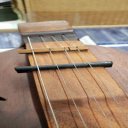
I agree that the wood piece is meant to simply space the strings at the correct distance from eachother, and the dark colored 'bar' is the actual bridge. It would explain the extra notch. That would correspond to a "course" of melody strings, it if were strung '3 string equidistant with a melody course.' From the image, the dark colored 'bridge' seems to straddle the fingerboard, with small 'legs' that go down off both sides. I assume that piece of light colored wood was added specifically to modify it to be able to play 3 string equidistant.
Out of curiousity, I'd love to know how much this dulcimer cost at an antique shop.
Look forward to you learning more about it and sharing with us
Nate
If it has more than diatonic frets, or more than 3 courses of strings, technically an instrument is no longer a dulcimer, it is a Fretted Zither. "Tomay-to tomaatoe", but diatonic fret spacing is part of what defines a dulcimer.
@shanonmilan --the vast majority of us (traditionalists and moderns) play dulcimer horizontally -- "string side up" on our laps or on a table or stand. There are a few who play it more vertically -- like a guitar...

That double bag looks pretty slick!!
@shanonmilan --the vast majority of us (traditionalists and moderns) play dulcimer horizontally -- "string side up" on our laps or on a table or stand. There are a few who play it more vertically -- like a guitar...
How do you play the dulcimer? String side up.
Thanks for the feedback everyone. You have given me confidence that I may have a playable instrument.
Btw: T and St meant Tone and Semi-tone, not Tall and Short. Sorry for the confusion.
Thank you for the additional information Art. We will all wait until you get the dulcimer and you have more of chance to examine it. It poses some interesting questions and I hope we will be able to find the answers. I'm sure you will be able to get it in to playing condition. I've seen thin pegs like that on other dulcimers.
Ken
"The dulcimer sings a sweet song."
* I'm not sure either of those bridges is 'real' -- they are both far too long and extend way past the sides of the fretboard, making it difficult to play without snagging yourself on the,
* If that first dark "bridge" is set into the fretboard I agree that is most likely the actual bridge; a simple test will prove it.
* As Strumelia says, the top & back being wider than the sides is called a "fiddle edge" and is a common feature especially on older dulcimers.
* The Wide and Narrow (not Tall and Short) fret spacing is a true Diatonic fret layout. It's your dulcimer, you can of course add a 6+ fret.. But Why would you want to? This dulcimer was obviously designed to be played in a traditional manner, not modern Chord-Melody style. Why not appreciate it for what it is?
We are at a disadvantage as I walked away from the store, then bought it over the phone. When I get the instrument I will get and share more detail. The bar is in fact grooved, and I am beginning to think that the first crude "bridge" is there to raise the strings up to level with the fretboard. Note that the board itself drops away at the tailpiece.
It should be easy enough to test on just one string to find out which of the two 'bridges' is the true bridge that allows the current frets to play in tune for scale (the distance between nut and bridge. I suspect the black one is the true bridge since it matches the nut, and the crude stick with the notches was simply put there to keep the strings at certain distances from each other (since the bridge has no notches and string spacing was likely originally just provided by the string holes at the tail). But I see that the nut provided an extra slot for making a double-course melody string pair spacing instead of 4 equidistant.
Looks like a nice dulcimer, with that fiddle edge overhang, and such nice wood!
@motormike, it looks like the black bridge is actually cut into the body.
What I'm thinking is that object by the bridge is a simple "noter" shoved under strings for storage.
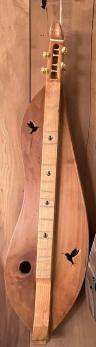
Hi Ken. I knocked the photos down to get a few into the forum. The pegs are wood. I don’t see any markings inside through the sound holes. The frets run T, T,St, T, T, St, T, T, T, ST, which I think I have seen before. Can I add a 6½ fret? The top and back are slightly wider than the sides. Again I've seen that before, but forget the term that is used. It is currently set with four equidistant strings, but the bridge and nut seem to be cut for an optional double melody, as there are five slots. Presumably as I replace them, I can do what I want. Not having played it, I have no idea how accurate the frets are. I took pictures and walked away from it, then called back the next day and bought it. So I don't have it in my hands yet.
There isn't enough clarity in the photos to really give an informed opinion. I agree that there are four equidistant strings. I have no idea what the function of the bar in the front of the bridge. It appears to be wood and fitted to the width of the fret board. It could be that what we are calling a bridge is just to space the strings apart and the bridge is that dark wood and may be moveable. I am interested in the pegs.Are they wood or metal? Is there no builder's label inside the dulcimer?
Ken
"The dulcimer sings a sweet song."
Art, that looks like a nice one. Not sure of the bridge-bar either, but it may be an adjustable bridge, with the "real" bridge there just to set the height and spacing? Like a zero-fret at the other end?
Sitting here looking at a dozen or so instruments...staples, frets, wound wire, straight wire, oak, maple, rosewood. No two are alike, yet I would call them ALL dulcimers. If I spoke in elizabethan english I may say "dulcimore", and if I was a kid in the mountains I might say "that stringy thang"... And guitars with hollow bodies, solid, whammy bars etc are ALL guitars...But as for men with only a mustache and no beard.....well...."technically".....
Nice looking instrument,4 equidistant strings.The fact that you found it in St.Jacob's got me excited,laugh-a Mennonite-Pennsylvania Dutch dulcimer...No.It's a modern dulcimer and I bet it will sound great by the look of it...all the best.
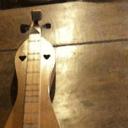
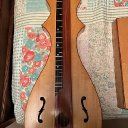
I picked this up in an antique store in St Jacob's Ont. No markings. Very nice shape other than the bridge and nut which I will replace, and some damage to the scroll head. I'm not sure what the bar in front of the bridge is all about. I've not seen that before. I hope the frets are correct.
Any information or comments would be welcome.
Let me help you with that, Ma'am! The misty dulcimore past is calling out to you...
I guess I don't have any mountain dulcimers. waaaaaahhh! 😭
@nate Your perspective was one I hadn't considered-- I'm glad you wrote of it!
Colloquially, although my newer Jean Ritchie model Blue Lion has "extra" frets, I'll still call it a mountain dulcimer. 
Happy strumming, y'all!
If it has more than diatonic frets, or more than 3 courses of strings, technically an instrument is no longer a dulcimer, it is a Fretted Zither. "Tomay-to tomaatoe", but diatonic fret spacing is part of what defines a dulcimer.
A guitar player friend once said about my dulcimer: Too bad some of the frets are missing. But then, too, are some of the strings, compared to a guitar. I wanted more strings, but instead of getting a guitar, I built a dulcimer with five separate strings. Is it a dulcimer? I would say it is 'quite' a dulcimer.
Just for fun, I added frets to a 4-string dulcimer to make it chromatic, and I can now play tunes that would otherwise be impossible. For strictly diatonic tunes, I use one of my diatonic dulcimers (well, they all have both the 6 and the 6+ fret, but I still consider them diatonic--that has become the tradition).
Those of us who have been playing for a while probably have more than one instrument. Meanwhile, I play five dulcimers with different string/fret configurations: 3 strings, 4 strings with the double melody course, 4 separate strings, 5 separate strings, some with the 1+ fret, one chromatic. Each of those instruments has its own allure, its own possibilities and restrictions. I see no reason not to get a chromatic, and no reason not to call it a dulcimer.
Great video! Thanks. I didn’t pick up on the range of that dulcichord, the basses are rich sounding. But, so it still makes me wonder what the other fretboard is for? It’s such a short scale.
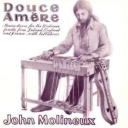
In an interview by Graham Hood, John explains that, in the original dulcichord configuration, he added a complex mechanism of pedals and levers acting on the shorter neck, but that the result was too noisy to use. This can be seen on the record sleeve.
great thanks! So maybe this was more like the 1933 patent.
Great video! Thanks. I didn’t pick up on the range of that dulcichord, the basses are rich sounding. But, so it still makes me wonder what the other fretboard is for? It’s such a short scale.
In an interview by Graham Hood, John explains that, in the original dulcichord configuration, he added a complex mechanism of pedals and levers acting on the shorter neck, but that the result was too noisy to use. This can be seen on the record sleeve.
Here is a short bio on John:
1947 Born in Los Angeles, California
1950 Family moved to England
Instrument - making
1972 - 74 Training : Newark School of Violin Making. Pass with distinction
Music and Story-telling
1963 Met traditional music through Folk Clubs
1965 Started giving concerts, solo and in groups
~~~~~~~~~~~~~~~~~~~~~~
1976 Moved to Brittany
1978 LP "Douce-Amère" : traditional songs and instrumentals
(mostly with Appalachian Dulcimers)
1978 - 82 Member of the JOHN RENBOURN GROUP (vocals, dulcimers, violin,
mandolin). Tours + 3 LPs with the group.
since 1978 Solo concert tours: U.S.A., Germany, Ireland, England,
Italy, Hungary and France.
1985 LP "Spice of Life" : personal and traditional tunes and songs
(with Dan ar Bras, the Josquin des Prés Quartet etc.)
since 1996 Tours throughout France with the story-teller Alain Le Goff
for the story and music show ‘‘Baleines, baleines’’
2000 Creation of " LEGENDARY AIRS " , a solo show of ‘Stories told by Music itself’ (for all, rec. min. age 7 yrs ).
CD compilation of «Douce-Amère» + «Spice » (Kerig KCD185) : awarded "BRAVO" label from Trad Magazine.
2002 Creation of " WOLF ? " : a one man show, where the wolf is revealed through stories, with some music (for all, rec. min. 7 yrs ).
2018 Creation of " DREAMCATCHER " :
Great video! Thanks. I didn’t pick up on the range of that dulcichord, the basses are rich sounding. But, so it still makes me wonder what the other fretboard is for? It’s such a short scale.
Thanks for that link. Although I don't speak French, I found the video interesting. I'll search among my friends to see if anyone speaks French to do some translation for me.
Ken
"The dulcimer sings a sweet song."
A link to a 1979 French TV program (in french, sorry...) in which John introduced the dulcichord (watch from 9 minutes 30 seconds)
Douce Amère : John MOLINEUX - YouTube
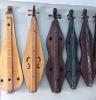
Here's my take. The triangle is, as John sez, a Russian balalaiki. The light topped round body is a bouzouki (either Greek or Irish). The light rectangle is a "cigar box" style guitar. The two hourglass instrument are indeed variations on the epinette/Applachian dulcimer. The two electric instruments are a bouzouki and a mandolin (short neck).
Dwain, thanks for the offer, but it had the fine tuners with it. I hope to buy one of your Bear Meadow concert dulcimers in the not too distant future. BTW, here are better photos of the pegs installed.
Curt
Nice job! Watch out about the string winding on the bass peg: if it gets all the way to the pegbox wall it can interfere with tuning and setting the peg.
If you ever have to do another peg setting, ease up gradually on the final reaming, then turn the reamer backwards to burnish the wood. The object is to have about 1/32" of the little end sticking outside the pegbox, so that future peg wear will give you plenty of peg left in case you need to enlarge the hole a bit. And fhen finish the peg end to a nice domed button by rubbing its end in a 1-1/2" diameter circular motion on a soft sanding pads, from 100G down thourgh the grit range to 320G. Then finish off with red rouge on a polishing wheel. (Mineral spirits clean up the rouge very well). That results in a very attractive pegbox.
I'm sort of overwhelmed with commissions now and not accepting any until I get the backlog cleared. I can refer you to one of my students, though, if and when you like. (Or who knows, maybe I'll have the backlog well on the way to completion by the time you're ready!). But as I get older I work slower and more carefully, so each instrument takes longer than the previous one.
Your method for finishing the peg end sounds meticulous and will certainly contribute to an attractive pegbox. I appreciate the detailed instructions, and I'll follow the steps you've outlined for the sanding and polishing process.
That triangular one looks like a balalaika (Bal-al-LIKE-ah), a Russian instrument like a mandolin.
Thanks for the quick response Ken! Makes total sense though, one definitely has 2 (seemingly) matching bass strings like you said!
I’ll try to get some clearer pictures tomorrow, I’m assuming there’s a better way to upload VS just attaching them to the post since I had to compress the image to 2mb.
Any earlier patents than 1880 out there?
All your comments make a lot of sense!
It appears in the first photo that there are four strings over the fret board which would be tuned to any standard dulcimer tuning where the melody string is doubled, DAdd or DAAA. I can't see the strings that off the fret board very well, but they might be drones perhaps a bass version of the melody string an octave or two lower and the other a the same of the middle string. The second photo shows a doubled melody string which four equally distant placed drone strings. Again, you could use a standard dulcimer tuning with bass octaves on the other two strings if they are thick wound strings.
This is just my guess and others may provide better information.
Ken
"The dulcimer sings a sweet song."
John is correct, and like him, I have no idea about the plexiglass strip.
Ken
"the dulcimer sings a sweet song."
Good evening everyone (or whatever time it is for you all!)
New to the forum here so a quick intro, I’ve been playing guitar and any other instrument I could get my hands on for a while now, all because of my Grandaddy, who started building instruments in the early 90s and gifted our family an acoustic guitar. Through out the years I’d get something new from him, and recently he gave me my first dulcimer.
I went to visit this Christmas and he said “Grammys complaining that we need more closet space so come and see if you want any of these instruments” and then proceeded to blow my mind. 2 of them he said are based “eppinettes” but are pretty much dulcimers…..but they both have slightly different fretboards and 6 strings! I haven’t been able to figure what they actually are, what tuning they’d need to be in, or any examples of some music played on these things.
i ended up going home with 7 new stringed instruments and only really know 3 of them well enough to play (an electric mandolin, electric 5 string banjo, and a 4 string banjo that’s built like a guitar)
I wanted to find a place where I could ask what the heck these things are and get some direction on what to do with them! Thanks everyone!!