Bowed Psaltery
Adventures with 'other' instruments...
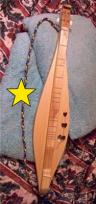
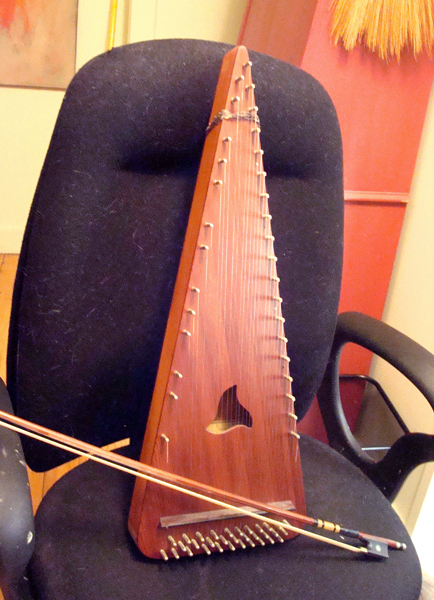
Here is mine, made by James Jones of VA, 2 2/1 octaves with a redwood top:
That "loop through the ball" system just sounds way too simple a solution to work !!!! - I've must give it try as it would make life so much easier! My only concern (untested) would be how well the string would stabalise and hold pitch. But if it does work - well, problem solved!
I've tried lots of different methods of removing the balls - twisting, cutting, smashing and not had much success. The quickest has been to simply cut the ball off and re-wind a loop (then put a plaster over the holes in my fingers!)
Wray said:Have you tried inserting the string end through the ball to make a loop end (of sorts) out of a ball end string?
Also, if you unwind the string just a smidge you can take the ball out without having to cut the ball.You might have to hold the string above the ball very lightly with a pair of needle nose pliers to be able to unwind it. It only takes a turn or two.
Have you tried inserting the string end through the ball to make a loop end (of sorts) out of a ball end string?
Also, if you unwind the string just a smidge you can take the ball out without having to cut the ball.You might have to hold the string above the ball very lightly with a pair of needle nose pliers to be able to unwind it. It only takes a turn or two.
 Roadie, our old bluetick coonhound, crossed over Monday afternoon. We had a lot of great years, and I'm sure thankful that we had that time together.Coonhounds are crazy dogs, blueticks are crazy coonhounds, and Roadie was the craziest bluetick coonhound I've ever known. My grandfather, George Washington Rice, told me, "Blueticks in the house has been the end of many a marriage", and old Roadie sure put that one to the test. I'm grateful to say that we were up to it.Roadie had never been sick a day in her life until Sunday, and she seemed only mildly ill then, just some stomach trouble. She looked OK on Monday morning, drinking water, but not hungry. She died peacefully in her sleep Monday afternoon.We'll have a good Thanksgiving, and I hope you do too. No need to feel sad about Roadie. She was all dog and she knew how to have a good time.Here's a song about a bluetick coonhound, Old Blue Ken
I'm a bit late coming in on this thread looking at how long it has been running!!!!
In my opinion, the Jeffrey's I have (standard 3 string 70s version)is a great little workhorse. It has a lovely articulated tone - and his scale is pretty sweet (and much nicer to play than the modern curse of equal temperament  )
)
There are just soooo many old dulcimers with a flattened 3rd and flattened 6th of the scale that we can no longer ignore that this fretting pattern is the sound of theearly instrument. It simply requiresus to re-learndifferent/earlier playing styles to get the best from these wonderful instruments. After all, these more natural fretting patternsproduced the sounds you would have heard ringing around those West Virginia Hills 
After a long interval I've just caught up again with this discussion. I'm another happy (UK) owner of an AWJ dulcimer, which I bought very cheaply on British eBay 3 or 4 years ago.I would counsel against changing the fret pattern to equal temperament. pristine2 is someone I greatly respect, and whose opinions are always valuable. BUT I think the plaintive qualities he loves in AWJ's dulcimers derive partly from the distinctive non-equal temperament. My advice would be to leave fretting alone, enjoy its lovely melody/drone qualities, and accept that to play more chordal music you need to turn to another dulcimer!
To the list of tunings which AWJ's dulcimers really, REALLY like I would add DAC or similar (Aeolian tuning).
A major cause of premature decay & death among vintage dulcimers is dessication. Long periods of dryness is particularly damaging. It will cause cracks, warp the fretboard and ruin the finish. Vintage mountain dulcimers sourced in the south central and southwest US usually show signs of dessication, but I've seen this damage on instruments from just about everywhere.
In the UK, dry air isn't going to be much of a factor except in winter when you have the heat on. Then you should really keep tabs with a cheap hygrometer. A relative humidity (RH) of 40%-65% is quite safe. If you're getting readings of 35% or less, your instruments ARE at risk. If they are already dry, 55% is a good number to re-hydrate them gradually over a couple of weeks.
I keep my US instrument room, which is really quite large, at between 42% and 51% during the winter using a console humidifier (placed at one side of the room, so the other side stays a bit drier). During the winter I have to add water to the tanks pretty much every day. My instruments are happy. That goes for all my wooden instruments, including my piano, which stays in tune much longer properly humidified.
Damp air can also damage your instruments, but is really less of a concern in temperate climes (unlike Hong Kong, where 95% for weeks on end is common). Dehumidification is a lot more expensive than humidification, too.
Totally agree with you Mike, with the rider that even when attending festivals, where accomodation was sometimes an oven of a tent, tho' more often one which was distinctly damp !!!, I have never felt the need to offer any special provision in the way of protecting instruments I had with me, and so far as I can see, this has in no way affected any of them adversly. (Well, perhaps sometimes just a suggestion of rust on the strings on my hammered dulcimer.............. lol)
John
I'm sure Richard's right about the environment in which you keep the dulcimer being at least as important as what you put on it. Fortunately/unfortunately, I live in a humidity uncontrolled environment, simply because the house is so old and decrepit...most of the external environment seeps in regardless! Dulcimers seem to love it....
I seem to recall my own Jeffreys having very a very matt, dry-looking finish - which I suspect is pretty typical of the era before glossy polyurethane/two pack finishes. I'm not sure I'd necessarily put anything on it...with the exception of the fingerboard, where it really ought not to be dry. I use some mysterious oily preparation invented by the guitar maker Gurian in the 70s...and there won't be any more when it's gone after 40 years! But lemon oil also seems fine...
If you want to play in DAG, I'd suggest a 013 in the melody course. It will hold its pitch much better, and will be a bit louder, too. Same gauge will do fine in DAA, but will be a bit too stiff for DAD.
For what it is worth, Jeffreys probably shipped his completed instruments in CGC or CGG. I have one 1991 Jeffreys that came in the original still-sealed box 18 years later. It was in CGC, and very nearly in tune!
To replace the fret pattern, luthiers usually plane down the board and use an overlay thinned to match the original height. You can decide to keep the original fret remnants underneath visible on the sides, or not. You can also plane down the nut and bridge in proportion to the new board surface, and skip the overlay.
R
Mike
Good to hear that you have secured an instrument you love - with all its quirks! If you open my catalogue of dulcimers on the Nonsuch site and go to p14 ( http://dulcimer.org.uk/for_sale.html ), you will see a Jeffreys, together with some text which fills out a little of the detail given by Richard above.
'Fraid it's not for sale, having gone to N Wales back in August. there are others I know in the UK. I'd echo what Richard said about the tone and about the odd intonation. Sounded lovely in DAA or DAG however.
Do get in touch if you need anything, from new tuning pegs to capos...or just a chat!
All the best.
Geoff
Hi
I still have four AWJs (maybe even five, if I can find one that I've lost track of). I've handled maybe 10 in total. The earliest I've seen (and happen to own) is from the late 1950s, with half-width frets. It is the only half-width fret Jeffreys I know of. The rest range from 1962 to 1991, all with full-width frets. I'll be selling one or two, so I'll be writing detailed descriptions over the next few weeks. I'd be tickled pink to see them move at $400, but I'll probably set the reserve in the mid-200s.
Since you have already swapped out the tuners (with something very nice, I might add), and if you're still ready to invest in the instrument, I suggest you completely replace the existing fret pattern. You might even consider adding extra frets. From what I've learnt about the builder, I think he would applaud you (though I also think it important to preserve at least a few examples of unmodified originals, too).
Your impulse to preserve the integrity of the instrument is the correct and ethical one. Invasive surgery on a vintage instrument is a drastic course of action, to be sure. But occasionally, it is the right course, provided there are very good reasons, you are conscious of what you are doing, and you are willing to write about it. Documenting a change usually legitimises it, from history's point of view. Moreover, Jeffreys built in sufficient quantities (I can only guess about 2000 pieces in total) to warrant some experimentation. They are fine musical instruments, after all, and should be used as expressively as possible. That sometimes requires a radical change.
There are three or four people in the country capable of doing this for you, and the cost would be between $100 and $200, depending on which one you use. I hope to be one of those people soon, but I don't yet have the skills developed. I had Ben Seymour re-fret a late model Jeffreys for me last year, and I am very pleased with the results. Ben was careful to match the existing fret wire, and maintain the feel of the action. There are others capable of good work, too -- PM me for some suggestions.
Best,
Richard
Just one fellow, AW Jeffreys Jr of Stauton Virginia, whose name is often misspelt.
I spoke to his son a couple of years back. He could not enlighten me about the numbering system, but Jeffreys clearly used more than one. On the AWJ instruments I own, the numbers are not in sequence with the dates on the labels.
Jeffreys started building sometime around 1958, and his last instruments are dated 1991. Very few changes during the entire period, though he added a zero fret at some point in the late 1970s.
They are wonderful, very sweet-sounding dulcimers. They are not, however, in equal temperament. He instead used a much older fret pattern, probably left over from half-width-fret dulcimers, that yields a beautifully intoned scale on the melody course but doesn't accommodate chording very well.
AWJs don't sell for a fortune, though I remember one moving on eBay for $400. Depending on age and condition (the really early ones do sell at a premium), you can still pick one up for $125.
Richard
Hi Richard
Eager to see it close up!
Thanks for giving a very thorough run down on what you see and hear. Warm and balanced is a pretty good start - and good intonation (as you say) a bonus. The fret arrangement sounds intriguing - any indication of date (presume no label, but provenance of any kind?).
The few Bonds I've seen all seem to be different designs - did he have "standard" types as such, or were they all custom made? And as for modelling them on US makers I wonder how many would have made their way over here in any quantity by the mid/late 60s?
We wait with baited breath!
Thanks again, Richard.
Well the aesthetics are not nearly as refined & elaborate as Geoff's, but my Frank Bond is a *wonderful* instrument, already up there with among the most valued vintage dulcimers I own.
It arrived in fine cosmetic condition, but it is clear that the last owner must have been frustrated. It was strung with the bass string in the middle.The ebony heal is very soft, so the strings just dig into it when you increase string tension -- the last owner probably never got it into tune.I just put a piece of felt there under the strings, which solved the problem ... eventually I will replace the ebony itself. The nut is destroyed, but there's a zero fret so it is still perfectly playable.
The sound is warm, loaded with complexity, and balanced. The intonation, totally against expectations, is just fine.
Bond must have used something like a Jess Patterson as model. It's nearly identical in shape to an Amburgey, though the top bout is a bit more slender and, like a later Patterson I own, the frets are almost full width. They aren't stapled, but fret wire cut to leave few hairs of space on either side, so they do not quite reach the edges of the fretboard.
This leaves the three courses of strings quite close together, making chording a little difficult -- my only real gripe.
I suck at photographs, but I will try to get some shots.
Had a chance to play the Bond that Geoff has and it was certainly not what I was expecting.
The only other Frank Bond I've ever seen was more than 30 years ago, so my memory of it is very sketchy. As I remember it was a typical slim hourglass style, spruce top, mahogany? body, fiddle edges, fiddle pegs, rusty strings. Far more silvery sound than to the one I had at the time(still have).
john p
Hi:
Sorry to have frustrated you! I was instantly punished with a higher price.
You've obviously got the nicer of the two Bonds, built with someone special in mind. I must have one of Frank's more pedestrian models, perhaps intended for general sale. I think it is rather less Sunhearth, and more a copy a 50s-era Jethro Amburgey -- albeit with full-width stapled frets & a North Carolina fiddle scroll.