Holiday
OFF TOPIC discussions
Glad you are safely back Kenh.
I haven't been on this site for a while, but was reminded of it today and wanted to check in to let everyone know about an online Youth Dulcimer Club I host.
Youth Dulcimer Club meets weekly on Zoom on Monday evenings. It's for kids learning to play dulcimer -- any ages and levels are welcome. We've got kids from all over the US and Canada involved! Check it out at https://www.erinmaemusic.com/dulcimer-club
Welcome home, weary traveller! Glad to hear you're back in one piece, and that you (mostly) enjoyed your time there on The Islands. Hope the hurricane skips your area.
@ken-hulme I'm glad to learn you have arrived home all in one piece! Y'all batten down the hatches and stay safe!
"It was the best of times, it was the worst of times...." Almost everything went perfect -- flight over, visiting friends and family in Sussex and Lincolnshire, Orkney and the Scottish Borders.
Our Clan chief, the 15the Earl Home passed away about 10 days before the Queen. His son, Michael succeeded as 16th Earl, and Charles succeeded a King Charles III. The Clan Gathering went really well, and our new Chief was able to attend even though he's a member of The Company of Archers -- the Royal bodyguards when in Scotland. We even saw him on TV as part of the processions and parades of the royal funeral.
Then we went down to Birmingham and ran into snags. First Sally got Covid (relatively mild), which deleted our canalboat trips and delayed our flight home. Then an Aer Lingus SNAFU has our luggage somewhere at Birmingham International (we have iTrackers on them) and cost us a $175 taxi ride from B'ham to London Heathrow airport (all good there). Caught a British Airways flight to the Dulles, near DC. Then home today to Florida.
And now.... we face the possibility of a hurricane!
Thank you, Matt! That’s a good thing to know. This isn’t the first time this has happened. Last time, I just started a whole new fret board with the intention of fixing the one that I messed up.
Cyano acrylate (super glue) is a luthier's best friend. Put down some tape around the fret slot, CAREFULLY put a small amount across the slot, press in the fret and weigh down appropriately. In this case, clamps would be messy. Stewmac sells containers of cyano with very narrow tips for just such purposes.
That's the way to do it, Molly! But if you have more money than most of us here, StewMac sells a fret tang crimping tool that puts slight crimps into the tang to make it wider, for just $111.39, plus tax. Such a deal!
Cyano acrylate (super glue) is a luthier's best friend. Put down some tape around the fret slot, CAREFULLY put a small amount across the slot, press in the fret and weigh down appropriately. In this case, clamps would be messy. Stewmac sells containers of cyano with very narrow tips for just such purposes.
Hi, Folks. I have a question. One of my fret slots is just a hair wider than the rest, and my 6.5 fret won’t stay in place. What do other luthiers do in this situation?
I hope I can still find something reasonable on the Internet. Once I saw a man playing with a similar system. I wish I had asked him where he had bought it. Anyway, I hope I can still find and buy it. Actually, it will still be earlier to find this thing than the coolest guitar accessories for my kid. I mean, he plays guitar very well. I bought him an amp a few months ago and sent him to the garage to play. But he never likes the accessories I buy for him. I guess I’d better take him out to the guitar store next time. Anyway, guys, I’d highly appreciate your advice on that system. Can I still find it somewhere?
Thanks, Matt. I'll do that. My instructor has a teardrop bass, and she wants me to try it before I jump at anything so I can make the right decision as to what I want.
Lorilee,
The "common wisdom" in dulcimers is that there is no tone difference between hourglass and teardrop. Although probably true for standard dulcimers, many luthiers who build bass dulcimer believe they get a better bass sound from a teardrop shape. They still make hourglass bass dulcimers because they sell better. If you are interested in a better bass sound, at least compare the sound of a teardrop with an hourglass for the better bass sound.
Matt
Thanks for the offer Jan. Like I said, I'm just curious and not that curious to really put you to all that work of tracing the bridge. I knew Robert Hutchinson and played many North Country dulcimers at his booth during a couple of arts festivals. I think Buzz would be more interested in a tracing of the bridge it he is going to restore the North Country dulcimer which was the beginning of this thread.
Ken
"The dulcimer sings a sweet song."
Ken, I'd be happy to make a tracing for you and send it by snail mail.
Thank you for all of your replies. They do give me a lot to think about. I'm really considering getting a bass, maybe from Blue Lion? My instructor has a bass that I'm going to "fiddle" with, but it's a teardrop which is not what I'm looking for. so I don't know... so I'll see what I think about hers, and knowing me, I'll soon be looking for one! 
I built a 30" scale dulcimer 2 inch deep with the duel purpose of tuning for bass or baritone. It sounded quite nice as a bass but I keep it tuned baritone. Having a bass in your stable can come in very handy if your going to play with others. If I build another I'll probably go to 2.5 or 3 inch deep. But I'll definitely keep the 30" scale. ..Robert
I'm happy to have Matt's respect and also to be corrected. Just don't tell my wife I was wrong. 
Of course one can play chords on a bass dulcimer, just as one can play chords on a bass guitar. But generally, the purpose of a bass is to, well, play the bass part. The fiddle weaves the melody, the guitar provides the chords, and the bass plays the bass lines. I certainly don't want anyone to be locked into those small roles, but it does seem that most of the time, that is what we'll be doing. It is more important to be comfortable playing chords on a standard dulcimer than a on bass dulcimer, but of course you can do it on both.
And by the way, if you really want to prove me wrong, send me a bass dulcimer. I promise to play lots of melody and lots of chords on it. I'll gladly admit to having been mistaken. 
With all due respect to Dusty Turtle (I play his lullaby book and enjoy it), there are many places where a bass dulcimer is great with chords. I teach a 3/4 workshop and emphasize the bass players keeping the beat by playing the chords at the start of each measure. Really adds depth to the music.
If you flat pick, the bass dulcimer can be a strong player in the melody. In Eulberg's new 50 First Songs, Proud Mary and Sitting on the Dock of the Bay are great when played on a bass dulcimer.
I prefer the 26" VSL with a bass. The heavier strings do make it more difficult to fret and the shorter scale makes it modestly easier. Yes, a bigger body gives you better projection.
Absolutely get a bass dulcimer and go crazy. Don't let people slot you into playing only the 1-3 beat.
Blue Lion also has the 5 string Acoustic Jam bass with a 26 1/4 " VSL and 1 5/8" fretboard and Folkcraft has one with a 26" VSL with a 2" wide fretboard. I have the AJ5 Blue Lion and removed 2 strings.
As far as construction goes, I believe they about the same as a standard, just deeper for the volume needed for the lower notes. The string tension is about the same so I don't see a need for heavier construction. I've converted ones I made to bass and baritone with no problems. I even converted a regular Tennessee Music Box to sound like a standup bass for kicks. Hard on the fingers to play though and not very loud because the box is too small.
Lorilee, I would think a bass dulcimer should have a pretty big box, but that could be achieved with depth, allowing the dulcimer to be on the shorter end of scale length. I believe the New Harmony baritone/bass model only has a 25" or 25-1/2" scale length.
But remember that with a bass dulcimer you are most likely going to play bass lines, not chords, so even an instrument such as Blue Lion's 27-1/2" bass should be playable even by those of us who are vertically challenged.
How does the build of a bass dulcimer differ from a standard? Is the same basic body with a different nut/bridge/strings or is there more to it? Can a person get one without a really long VSL? (short person here!)
That's a great picture, Thanks Jan!
Thanks to Dusty and Strumelia as well
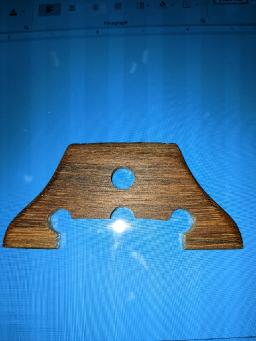
Thank you Jan. Now I want to know more. How wide is it at the base and the top? What is the diamond of the four holes drilled in it? What is the distance from the top of the bridge to the top of the center hole? What is the distance between the top center hole and bottom center hole? What is the distance from the outer edges to the middle hole to the outer holes? What is the thickness of the bridge at the top and and at the bottom? I'm just the curious sort.
Ken
"The dulcimer sings a sweet song."
For those of you who were interested, here's a close-up of the North Country Dulcimer bridge. The strings lay in shallow grooves on the top edge.
+Plus to what Dusty said, but with one added thought:
Usually hardwood bridges are preferred and give better tone. Violins and banjos most typically have maple bridges.
However, I found out that with early style banjos the best most resonant sound is achieved with softwood bridges like spruce, cedar, pine, etc. I was at an early banjo gathering once where a fellow was selling bridges made from many various woods, and it was suggested by more than one person that i try a softwood bridge. I tried many bridges that day and they were right- the evergreen ones gave a noticeably richer more resonant tone... which very much surprised me. I bought several and put them on my 3 early style banjos.
I can only guess it's a similar effect as when a dulcimer has a spruce, redwood, or cedar top- which is softer wood but gives a very mellow resonant tone. I should note that the early fretless banjos use nylgut strings rather than steel strings and this may have relevance, other things being equal.
So don't destroy that cedar bridge once you make a new hardwood one. Swap them back and forth and do a sound test! 
Good for you, @Buzz! The builders here might want to chime in, but I would guess the cigar box material is a softer wood (they were traditionally built of cedar), and you might want a harder material for a bridge. You might consider using your cigar-box bridge as a template and making another out of a harder wood or bone or a hard plastic resin or something. You will likely get a crisper sound.
That's a fine looking dulcimer, by the way. Congrats!
Thanks to all members especially Ken and Jan for your help
Just a quick update for anyone interested. I made a temporary bridge out of an old cigar box. The dulcimer sounds BEAUTIFUL and well worth the effort. Here is the size that seems to work really well for future reference.
North Country Dulcimers 38 inch hourglass dulcimer floating bridge
Height 1 and 1/4 inch height
Bottom Gap 1 and 1/2 inch
I will update as I go
Thanks, Jan.
Ken
"The dulcimer sings a sweet song."
Well, it took me a few days, but I finally logged on. I will contact Buzz and let him know I can assist him. Just in time, too. I was just coming to a decision about what to do with this dulcimer.
Hi All,
I was asked to play for a memorial service that took place yesterday. Friday morning the funeral director met with me so I could do a mic check on their sound system. He was so surprised and excited about the dulcimer! He said he had never actually seen one! He loved the sound, and before I left he asked if he could take a picture to send to a friend in North Carolina. This was certainly a bright spot in a very sad situation!
I'm just mentioning @jan-potts so perhaps she'll get the notification and join this conversation directly. Are your ears ringing, Jan?
That's a good find Skip. If you go to Paula, you can see some really good photos of the bridge. That is another person you can contact if you need someone to make a tracing of the bridge and measurements.
Ken
"The dulcimer sings a sweet song.
Thanks Susie. I might try to make my own bridge maybe even alter a cello or upright base bridge. I will let you know..
That looks like that could be the one Skip.
Thank you.
Your new dulcimer is beautiful! Keep us posted after you get it set up and are able to play. I bet it's got a nice voice too.
If you go to Jan Potts public page, there is a post by 'Paula' just below the photo [her thumb nail id icon] that looks like it is probably a photo of the bridge in question.
Thanks Ken I really appreciate your help
No problem, Buzz. Looks like you conquered it. Yep, that's a North Country Dulcimer alright. The place where the strings contact the bridge will be placed at twice the distance from the fret board side of the nut to the center of the 7th fret. Any good luthier or repair tech should know that. Jan Potts, one of our moderators has a photo of a North Country dulcimer here:
Perhaps if you send her a message here she can shed more light on the bridge shape.
To send her a message, click on "Members" above. Put "Jan Potts" in the search window. When her page comes up click on "send message" just below her profile information on the left hand side of the page..
Ken
"The dulcimer sings a sweet song."