Playing dulcimers with different VSL
General mountain dulcimer or music discussions
Short scale dulcimers are much easier to finger when playing chords. I mostly build with 26" VSL. It's a happy medium...Robert
I don't see why it would. The difference of distances between frets is pretty small. So finger placement even with a 3" difference in VSL isn't that critical, IMHO. This table compares the distance between frets on 25" VSL with 28" VSL, and there seldom more than .2 difference in fret spacing between 25" and 28" VSLs.
|
Scale Length: 25.00
Fret Dist. from Fret 1. 2.73 2. 2.43 3. 1.11 4. 2.04 5. 1.82 6. 0.83 7. 1.53 8. 1.36 9. 1.21 10. 0.56 11. 1.02 12. 0.91 13. 0.42 14. 0.77 15. 0.68 |
Scale Length: 28.00
Fret Dist. from Fret 1. 3.05 2. 2.72 3. 1.25 4. 2.29 5. 2.04 6. 0.93 7. 1.71 8. 1.53 9. 1.36 10. 0.62 11. 1.14 12. 1.02 13. 0.47 14. 0.86 15. 0.76 |
Does playing different VSL impede the learning for a beginner?
That's some mighty fine playing, Randy. It not only sounds great, it's just plain fun to watch too!
Nice, Randy. I could sit and listen to you play all day. Might need a break for pizza though.
Ken
"The dulcimer sings a sweet song."
Nice, Randy. I could sit and listen to you play all day. Might need a break for pizza though.
Ken
"The dulcimer sings a sweet song."
I've always seen CBG's and CBU's tuned in fourths. You can tune ukes and guitars in fifths but it is rare. Tenor guitars are probably tuned in fifths most of the time.
I saw a 16" VSL instrument tuned DAd once, but the strings were monsterously thick! Almost like an autoharp. Not fun to play.
You could try ADDd on the GDDd. the bass string should be ok going up one step to 'A' [give Cedar Creek a call and verify]. It should be compatible with the DAd players then, although chording may be a problem
.
The shorter you go, if you want to stay tuned to DAd you'll have to put on heavier strings so it won't start feeling floppy. Personally, if I wanted to have relatively 'normal' gauge strings for DAd tuning, I wouldn't go shorter than around a 23" scale.
I have a hard time posting pictures here. The file size is too large and I have trouble changing it. I'll try to record something soon and post it.
Don, the questions isn't as simple as you might think because VSL and string gauge both vary, so different VSLs might require different string gauges to get the same tones.
Standard size dulcimers can probably be thought of as having at least 25" VSLs. Dulcimers smaller than that, say in the 22-24" range are usually tuned up a fourth or fifth to G or A, but not always. A lot of people play the McSpadden Ginger model tuned DAd.
And Skip's suggestion of using a capo at the 7th fret demonstrates, you can also get DAd an octave above a standard dulcimer. There are a few really well-made octave dulcimers out there, Ron Ewing is probably the best known builder.
That's a pretty broad question. Commercial, for sale, is probably around 19-20". Folkcraft has a travel dulcimer with a 22" VSL. It's possible to make them very short. For example, put a capo on fret 7 on yours. You have effectively created a very short VSL, the capo making the fret a zero fret. Move the capo more towards the bridge and the VSL will get shorter. Playability/tuning not considered.
Hey Diane, here’s what I do. I play multiple instruments so this really helps me a lot. I’ll also outline a typical practice session for me and what I teach on banjo.
I first do a slow warm up. Here’s the fun part. Grab some good old index cards. Punch a hole in the corner of them and put a ring binder thing in the hole. Then write 1 song on each card that you know. When I say “know” I mean you play it by memory and no tab or sheet music. Let’s say you really know 10 songs well. Then during this 10 minute warmup (or however long you use for a warmup) you play the first card (song) once through slowly. Then flip another card and play the next song. Do this slowly and if you mess up or can’t remember any of it, continue playing it through until you get it right, but keep it slow. Next practice session you pick where you left off in the stack. Let’s say you go through 2 or 3 cards each practice session. Then over the course of the week of practicing you’ve done went through all 10 of your cards and kept those songs fresh. Continue to add cards as you learn a new song fully. Try it out, it’s fun, and you don’t have to think about it too much or worry about “losing” songs. If you decide you don’t particularly want to keep a certain song, then chuck that card out in the trash and move on. Sorry to be long winded but that’s a great warmup that will also keep your songs fresh. *Not my idea by the way, I read this years ago somewhere and started using it.
After warmup, normally I have folks work on techniques. This can be done using a song, a certain section of a song, chords, scales (if so inclined), or short pieces. I also have them drill sections here that are sticky and a little tough to complete up to speed. This would also be where we use a metronome (if we are using one at the time).
Next I have them working songs. Usually we have one we are currently on (learning) and one we start with. So we are normally working on 2 songs at a time and some technique. May or may not use a metronome here as well depending (or a drum track, or something fun like that).
Then the last bit is always reserved for FUN time. Anything goes here, anything that makes you smile! Cut loose and have a blast playing your dulcimer.
I ask people to devote at least 30 minutes per session, 4 times a week. Me personally I play a LOT more than that though, LOL because all of it makes me smile.
Blessings,
Mandy
Apologies since Don and I hijacked this discussion momentarily. It should not be about the specific scales that I play. @Diane-R's original question is about how different people practice and how they keep up the songs they have learned.
Try the video again. I just edited the settings.
@Don-Grundy, here is a quick video I just made that demonstrates the main scales I am working on now and hints at the arpeggios as well.
Here is tab for the first scale , which goes up each string individually.
Here is tab for the second scale , which really works the pinky and goes across the strings in the first position.
I have not yet put together tab for the third scale I demonstrate that starts on the open bass string and then goes up two octaves to the seventh fret of the melody string. Check back with me in a few days and I'll try to put something together.
In the video I mention a tune by @Mark-Gilston called "Time and Tide" which is a study of arpeggios. It's actually a beautiful tune and calling it a study does not do it justice. I also mention a book by @Aaron-ORourke called Faster Cleaner Better , which I have started working with for arpeggio exercises. I should probably have started with Mike Casey's book Hands-On Dulcimer which includes an enormous assortment of exercises for both right and left hands.
Regardless of how you start playing, I think it's important to end by playing something that you know pretty well. To avoid the frustration that comes from trying to improve on any musical instrument, it is essential to maintain a feeling of satisfaction and confidence. Don't put the dulcimer down when you're frustrated; rather, put it down with a feeling of joy and competence. Make sure the last tune you play is something you know well and that gives you pleasure.
Unlike Ken, I do practice. There are techniques or songs that I find challenging that I want to learn. Of course, sometimes I just play and don't care about mistakes or improving. That's important, too. But when I want to focus and consciously improve my playing I always start with some scales and arpeggios to get my technique into shape. Then I might play one song that I've learned recently, but pretty soon I start with whatever I'm working on at the moment. It might be a song or it might be a technique. Often it's a tiny section of a song, even a measure that's giving me problems, and I'll obsess on that measure, playing it over and over and over. But as I said above, while that OCD behavior does indeed lead to improvement, it can also be frustrating, so I make sure I avoid or at least minimize that feeling of frustration by switching to a tune that I know well.
Occasionally, I review lists of songs to make sure I don't "lose" any. Right now I have two different lists. One is the tunes that I play with my local dulcimer group. I don't really mind if I make mistakes with that stuff, since we play it all together, but I want to at least remember how each tune goes. The second list is my list of tunes that I might play if someone asked me to play in front of people. That list changes, as I add and drop tunes as my tastes and abilities evolve, but I try to make sure I can play those tunes with as few mistakes as possible. I don't go over these lists of tunes every day, though. Depending on how busy life gets I might only get to them once every couple of weeks.
Don, I often desire a chromatic. Problem is mine have broken reeds. I have sent them to Hohner for repair which gets a bit expensive. I always think of "someday" learning to repair reeds myself, but someday never seems to come.
This is a great time to get into harmonica since new companies are offering instruments with different tuning options, even custom tuning to order. Sometimes I think Hohner is stuck in the past and is reluctant to innovate... Robert
One way to break up any boredom is to take just one or two tunes you want to work on or want to 'refresh'- then play the tune much slower than usual, while trying to keep it sounding good. Then play it just a little faster than usual, keeping it sounding ok. Lastly, play it as your usual speed, but try to purposely put a lot of feeling into your playing. I think this is a good thing to try out when playing/practicing at home, and will benefit all your tunes. Particularly helpful is putting in the conscious effort to play with emotion and feeling... something a lot of people ignore even when playing for others.
I don't consciously "practice". I just play, stream-of-conscious from the bank of songs and tunes stuck in my head. No set number of times through. I'll go back and re-run a sticky bit perhaps. But I just play.
Thanks Bob. :) I have some other requests involving tropicals so I need to be assured of quality finishes.
Was just wondering how people practice? Do you go through your whole repertoire and then dig in to your newest song? Or do you start out with the one you're trying to learn? I notice when I play all the known songs first (three times each without mistakes) that I'm a bit tired by the time I get to the new learn. I play them all because I don't want to forget them since I memorize them. Just wanted to know what others do so maybe I can break up the monotony a little. Thanks :)
That's a beauty for sure! I imagine your customer is very happy
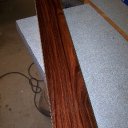
If you do want to finish Bloodwood, or any oily tropical hardwood, you can simply wipe it down with some acetone to remove the surface oils. Then apply a thin coat/swipe of Shellac. Then, you're set to go with the poly!
Hey @kjb , you should talk with fotmd member @terry-wilson .... he is a big fan of playing harmonica for fun! He plays all kinds of music on his harps, I think just about every day.
As a teenager I started playing blues on guitar and harmonica. I rarely play either now, but still love to play harmonica with other blues musicians.
Wow, really nice figured rosewood. It is a beautiful instrument.
Ken
"The dulcimer sings a sweet song."