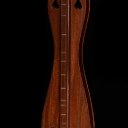
six string Dulcimer
General mountain dulcimer or music discussions
Except that mine is Dd-Aa-aa (or maybe dD-aA-aa, or aa-Aa-Dd if you prefer the reverse order)
Except that mine is Dd-Aa-aa (or maybe dD-aA-aa, or aa-Aa-Dd if you prefer the reverse order)
Thats similar to my favorite setup for 6 string Wally. dd-Aa- Dd
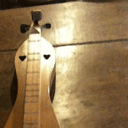
Or like an "unreal Dulcimer." On my 6-string dulcimer, tuned in DAA with 6+ fret, I have a wound string in the middle pair tuned an octave below normal and a high D on the "bass" pair. This gives a more rich sound to the drones, and not like a mandolin.
I also like the sound of 3-string DAA noter-drone cardboard instruments.
As John and others say, depends on what you like and the mood you are in.
Depends on if you want it to sound like a mandolin or a "real" dulcimer.
Just liken it to a 12 string guitar vs. a six string. I will say different but not better.
Hey John. I have a Ron Ewing baritone dulcimette made with 6 strings in three courses. Basically, each string is doubled. I love the sound. I has the pop of a good mandolin. And it was great for strumming tunes, meaning tunes that involve a lot of just strumming across all the strings. One day I restrung it without each of the double strings, so it was just a 3-stringed dulcimer. That was about 10 years ago, and I have never gone back. Without the double strings it is just much easier to play more nuanced music, sometimes picking a single string instead of strumming all the time. And certain techniques such as bending strings or even just adding some vibrato are simply not possible with the double strings.
I guess that story is evidence that I prefer 3 strings to 6. However, that double string dulcimer sounded great for certain tunes. I think my playing has just gravitated to a different style.
I have made them a couple different ways. I made one with six courses tuned DADf#ad and it sounded awesome but the melody was at times getting drowned out by the lower notes. Im not quite good enough to make full use of all 6 strings. Ive also made one that had six stings in three courses of two strings each. It sounded great but was really difficult to play. I think it would have been really good for noter drone style.
So, I was afraid to modify my dulcimer and just jammed a KNA AP-2 onto mine. It's been fairly decent. I even got to use it in my regular jam session today rather than my normal flute or tin whistle.
The one caveat is that it was a smaller group, I still have no idea how it will work when we have a full compliment of guitars plus drums (I'm guessing poorly with my concerns from the OP), but I'm happy so far.
Hi kids, just Jon Lilley here from cyberspace. I was hoping to get people's ideas and thoughts on something that I have no idea about. Never seen one, never touched one, never played one. It has to do with the five string and the sixth string dulcimers. What are your opinions and thoughts about that? It's too hard to play, love it, hate them, why bother. Well that's it, I was just hoping someone would give me their two cents. thanks.
Thanks Dan!
And thanks Ken for the suggestions on the instruction books, and the tip on the DAA scale. I'll check out those books!
Since the recommendation is to play in the DAA tuning I looked through my library of dulcimer instruction books. Some early MelBay books like Fun with the Dulcimer and Cripple Creek Dulcimer are good places to start. Another book that has lots of familiar tunes is this one: The Best Dulcimer Method - Yet! Those books can get you started. The DAA scale begins on the 3rd fret. The 10th fret is the octave of the third fret. Knowing that you should be able to start picking out some simple tunes.
Ken
"The dulcimer sings a sweet song."
Thanks Richard!
And thanks, Strumelia, for your P.S below...just saw it...I will post the video. Thanks for the suggestion and invitation!
Beautiful work. What a nice traditional sound. Thanks for sharing.
Ha! Thanks Strumelia! While I was composing that last message, you beat me to it! Thanks so much for all the great suggestions for instructional resources. I look forward to diving in to them!
Thanks, Strumelia...I appreciate all of your advice and ideas that helped me get there. The last few years of developing my post-retirement hobby of building guitars, and restoring/repairing a variety of other (sometimes oddball!) stringed instruments (banjolele, autoharp, Tranjo, Weissenborn guitar, etc.), and having a shop and materials with which to do so, certainly came in handy. But finding this community was the key to this project!
As I just asked Ken, any suggestions for instructional materials would be welcome!
Robert, I'm sure you'll get some good tips on instruction books. You may also enjoy browsing through my free blog specifically for beginner noter/drone style players. It includes lots of tips for improving strumming and rhythm, over 30 easy tabs for traditional songs, and help in understanding how to retune and play on the various common modes. DAA (the D being the low bass string) is in my opinion the best tuning to start playing in for those dulcimer players who fret only the melody string.
Here's a selection of blog posts on beginners: https://dulcimer-noter-drone.blogspot.com/search/label/beginner
And some of my posts with free tab: https://dulcimer-noter-drone.blogspot.com/search/label/noter-drone%20TAB
P.S. I'd love for you to post your video among our main video section for all to enjoy more prominently in the future here on fotmd (in addition to it being within this thread)... you just add it from your profile page to 'videos'.. look for a plus sign+ to add a video and description.
Thanks Ken...your input made all the difference. Now if you can recommend some good instruction books (or other resources) for beginners, I'll learn how to play this thing!
Oh my, I am so very impressed with the beautiful job you did in bringing that poor dulcimer back to its former 'glory'. It is indeed glorious! What a mess that peghead was, i really can't believe how well you repaired and restored this instrument.  And it sounds just lovely!
Robert, you did a fantastic job on restoring your Arthur Dixon dulcimer. It has that original mountain sound that I like so much. Thanks for sharing the video. I'm glad that you found us here and that we could offer some helpful advice.
Ken
"The dulcimer sings a sweet song."
Apologies Robert, I accidentally deleted it while trying to edit it. Thank you for reposting it
Hello all. I'm pleased to report back to you...finally...success!
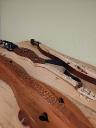
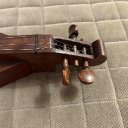
I basically followed all of your advice about the string height issue, remaking the bridge, etc., and I've strung it up, tuned it up, and it's sounding (and looking) pretty great to me! I'm very pleased with how it turned out. The action is still a little high, but still seems pretty playable to me, and the intonation is surprisingly good. Even the tuning pegs seem to be keeping it in tune, at least for now (it took a lot of futzing with them, but I finally got them working pretty well). See attached photos...I also made a little video of me telling about the dulcimer & it's restoration, and even me playing it a little bit so you can see what it sounds like. Here's the link to that: (if the link doesn't work for you, let me know).
Thanks again to all of you for your help over the past week or so...I couldn't have gotten it back in this good of a shape without your input and advice!
Yes, that makes sense. You need to make the touch point of the string on the bridge just a little higher than the tail so that the string is vibrating from the bridge and not the tail piece. So you are right that you will need to make a new bridge.
Ken
"The dulcimer sings a sweet song."
Thanks Ken. That's helpful. I'm thinking that before modifying the original wood on the tail end of the dulcimer, I may just try and string it up with all three strings up to pitch, and play it some, and see how it does. But I assume that in order to even do that I will need to replace the bridge that's now too low for the strings to even touch...right? I guess I can replace it with a bridge high enough so the strings just barely break over it (including some minimal slots). Does that make sense?
I worked on a dulcimer that has a similar problem. When I put the straight edge on the top of the fret (these were regular frets across the whole fret board) I discovered that the section after the strum hollow to the tail was 1/4 inch higher that the rest of the fret board. That back was perfectly flat. I trimmed off that quarter inch, cut a new slot for the bridge, the slots for the strings, etc. and wound up with a great playing dulcimer for the customer. You never know what idiosyncrasies you'll find on some of the these instruments. I'm not suggesting that this is your problem. You noted that the tail piece on your dulcimer is higher than the fret board so you would either need to trim it down level or live with higher action. The question is do you want to live with the historical value of the Dixon dulcimer or would you rather have a dulcimer that can be played finger picking style rather than noter style. I've found that many older dulcimers have higher action, not just for noter style playing, but also the maker doesn't have to level the frets that way.
Ken
"The dulcimer sings a sweet song."
Thanks Strumelia. That's helpful. I'll be considering the lighter strings, especially now that I've identified some bow in the fretboard (see below).
Thanks Nate, for your note that I saw by email, but for some reason isn't showing up here in the forum. I'll copy it here just to keep everything in one place...you said, "First thing is first, i would recommend detuning the instrument. It is possible that the tail end is being pulled upward by the string tension. Perhaps check with a straight edge."
So I did check with a straightedge, laid on the tops of the frets, and I do note some bow in the fretboard, such that the 7th fret is below the bottom of the string by about the thickness of the nickel plus the dime on top of it (since we're using that measuring system for now!). I didn't really need to detune, since I've only put the middle string on it so far, for the purpose of making these initial adjustments to the nut & bridge height, and I haven't even tuned it up to pitch yet. So, that being said, once I do install all three strings, and tune them up to pitch, I'm wondering what that will do to my fretboard bow. Whether or not the bow changes, what are your all's thought about how to address the problem? Thanks!
One more question for you (or for anyone)...since my dulcimer is designed with the middle string to be over the frets (along with the melody string), I assume there are times when you would fret the middle string, and perhaps play chords with those two strings, right (assuming I'm playing with my fingers, and not a noter)?
From your photos, the middle string is 'barely' over the frets... more only over the rounded ends of the frets. This is fairly common in noter-designed instruments, and is simply to allow for enough of a flat surface for the frets... but it's not intended that the middle string actually be fretted on the fret ends. I do not believe the middle string is intended to be fretted. Perhaps some other makers of traditional dulcimers can chime in on this.
Again, I might suggest slightly lighter gauge strings on this old and somewhat fragile instrument, especially if you intend to tune it to the key of D.
Hello...me again.
SO...I've been working on the dime & nickel method of setting the height of the nut & bridge. It went well starting on the nut end, and I got the height down very close to the dime beside the first fret. I stopped there to work on the bridge, and thinking I might play it some after that, knowing I could come back and work on both the nut & bridge some more, if needed.
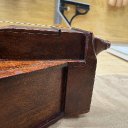
Anyway, when I proceeded to work on the bridge, I was gradually working my way down to the height of a nickel resting on the 7th fret, and before I realized it, I had taken it down below the height of the end of the dulcimer itself where the strings pass over it from where they are attached (see attached photo). When I realized that, I checked again with the nickel on the 7th fret, and saw that the string is still a good bit higher than the nickel (in fact, it's about the height of the dime stacked on top of the nickel). So, obviously, reducing the bridge any more at this point is useless.
Could this mean that the builder meant for the strings to be that high (the height of the end of the dulcimer), and so he would have perhaps built the bridge basically the same height at that?
Or some other explanation?
Other thoughts on what to do at this point?
Thanks!
Makes good sense, Nate. Thanks for clarifying that point. Being new to the dulcimer, I'm not sure what feel I like, but from what I've read, it seems that the overall goal is for the height to be low enough to play comfortably without buzzing, right?
One more question for you (or for anyone)...since my dulcimer is designed with the middle string to be over the frets (along with the melody string), I assume there are times when you would fret the middle string, and perhaps play chords with those two strings, right (assuming I'm playing with my fingers, and not a noter)?
With that said though, I think it's best to simply start with the nut and bridge too tall, and then slowly bring them lower until you get the feel you like, with the range of 0.3mm to 0.8mm between the bottom of the string and the top of the crown of the first fret being a general guideline
Thanks to all of you for the additional advice...that all makes sense to me.
Only remaining question as I thought about it a little more is, using the dime measuring method at the first fret, it seems that its usefulness would depend partly on how high your frets are, right? Or maybe all dulcimer frets are pretty much the same height (pretty low, speaking as a guitarist & guitar builder)?
Robert that is correct. Using a dime is most effective on instruments with mandolin fretwire. I use jumbo fretwire, which has a crown height that is actually taller than the thickness of a dime. Its a useful trick to avoid needing gauges, but cant be done with taller fret crowns. the actual distance between the crown of the first fret and the bottom of the string could be as low as 0.3 mm and as high as 0.8mm. If you're planning on playing your instrument at a lower string tension, you may want to consider around 0.5-0.6 mm
Thanks to all of you for the additional advice...that all makes sense to me.
Only remaining question as I thought about it a little more is, using the dime measuring method at the first fret, it seems that its usefulness would depend partly on how high your frets are, right? Or maybe all dulcimer frets are pretty much the same height (pretty low, speaking as a guitarist & guitar builder)?
The dulcimer has 3 strings, and the frets are mostly only under the melody string. This dulcimer was designed to be played noter style, with fretting only the melody string and letting the middle and bass strings ring open.
As you mentioned, the orig nut slots positioned the strings so that the melody is centered over the frets, but there is a little extra space between the melody string and the middle string. (in other words, a little more space between the melody and middle string, and a little less space between the middle and bass string). This is on purpose, in order to avoid the end of your noter (or your finger, if you are fretting with a finger) from touching or bumping into the middle string while playing. On all my noter style instruments, I ask for that extra space, rather than positioning all the strings equal distance from each other. It gives 'extra grace' allowance while fretting the melody string. I used to play pretty fast with my noter, and what with varying noter angles as I play on different parts of the fretboard (up to the 10th or 12th fret sometimes), there's a danger of touching the middle string with my noter tip and making unpleasant sounds/muting/buzzing if that happens. The tiny bit of extra spacing for the melody string allows for this and to me at least it is a big advantage having that leeway. This is a logical thing to do particularly if the frets are under the melody string only, clearly indicating the noter/drone playing intention.
I've use the method that John suggests except I've always measured with the dime on the saddle side of the first fret. I'm not sure it really makes too much difference which side of the fret it is on. For my dulcimers intended to be played noter style I usually raise the string height a little.
Ken
"The dulcimer sings a sweet song."
Correct....I can't claim credit for the "hack"....but it's nice, simple, and worth a heap more than the .15 cent investment.........
Hey, I like that approach! I've got digital calipers and all that fancy stuff, but I like this more...thanks! (But just to clarify, when you say "before the first fret" for the dime, I assume you mean not on top of the 1st fret, but on the fretboard, right before it...right?)
I've heard this before [from Skip perhaps...] but a dime just before the first fret, and a nickel on top of the 7th. Do the dime [nut] first, then attack the bridge. As you are probably aware, it's a lot easier taking off not enough than taking off too much.....
Hello all. And thanks again for all of your help so far.
I'm happy to report that I have restored the dulcimer to pretty good shape, basically taking it apart and putting it back together again (using Titebond glue), so it feels pretty sturdy. I was able to fix the cracks, which I have reinforced with cleats, etc. I have also gotten rid of the bizarre tuning system, and have found some wooden pegs that that I have been able to make work for now, and I have gotten just a basic set of D'Addario EJ64 strings to start with (which gives me two 0.012 gauge strings for the melody & middle, and a 0.022 for the bass). And finally, I was able to make a new nut & bridge out of some ebony that I had on hand.
SO...now I'm at the point of setting it up, and I have some questions about that. My main questions are about string spacing and nut & bridge (and string) height. I have found various opinions online about those subjects, but I thought I'd ask here for perhaps some more experienced voices.
Just a reminder, if you saw the photos I posted originally (of mine and the one sold by Wilcutt), this dulcimer is just 3 strings, and the frets do not extend all the way across the fretboard. As I look at the Wilcutt example (see attached photo), it looks to me like the melody & middle strings are spaced about as far as they can be on the available fret length, and that the middle string is slightly closer to the bass string. Is this about what I should be shooting for in terms of spacing?
And as for nut & bridge (and string) height, I've seen various opinions about what it should be, ranging from the string height at the nut being 0.015-0.030" above the fret crown at the first fret, to the saddle being 1/16" above the 1st fret and 1/8" above the 17th, etc., etc. What say you?
Thanks!