Looking for Info on Laurel Mountain Dulcimers
Instruments- discuss specific features, luthiers, instrument problems & questions
Yeah, the Laurel Mountain website has been taken down. I fear Mary has retired.
Yeah, the Laurel Mountain website has been taken down. I fear Mary has retired.
I see her birthday is today she's turned 65. I also see, on her Facebook page, that she lists herself as "former owner of Laurel Mountain Instruments. My best guess is that she's not building; or not building under that name anyway. I'd say query her on Facebook.
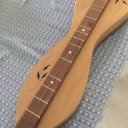
Reviving an old thread here to ask if anyone knows what has become of Laurel Mountain dulcimers. Is Mary still making dulcimers?
Well said! :-)
Stephen Seifert is the "bomb"!!! What I didn't hear in the episode was the term "environment". Stephen has the uncanny ability to create an environment in his play. His music can actually take you to places you've never been before, and maybe places you have been to! This is why in my book he is undoubtedly the number one conventional player bar none..... and he is good people!
Dulcimore Dan
Thanks for being a long time listener and contributor!
Keep the coming. I find them both educational and enjoyable. Thanks for producing these.
Ken
"The dulcimer sings a sweet song."
Thanks for sharing your stories ... it's always a hoot to be around Steve, eh?
Thanks for all the work you put into the podcasts, Patricia. You guys always do very good work. Let me share two stories.
1) I attended one of Stephen Seifert's 3-day intensives last year in Berkeley. As we went around introducing ourselves, Stephen said "You all have probably heard Dusty play and know that he's sometimes kinda fancy." If I ever record a CD, I'll put that as a blurb on back "'Sometimes kinda fancy' according to Stephen Seifert."
2) I have to admit that I often listen to podcasts at a faster than normal speed. Having grown up in the northeast, I'm just used to a faster pace of conversation than you find in most of the rest of the country. But sometimes I forget that my default speed setting is x1.5 or x2. Once I listened to your podcast on Aaron O'Rourke while on a plane and had gotten used to the faster pace, until you played a clip of one of his faster songs. I was in disbelief! I knew that he can play very fast, but the lick I heard seemed impossible. Only then did I realize that I was listening at twice the normal speed!
Keep doing what you do! We appreciate it!
Stephen Seifert is the "bomb"!!! What I didn't hear in the episode was the term "environment". Stephen has the uncanny ability to create an environment in his play. His music can actually take you to places you've never been before, and maybe places you have been to! This is why in my book he is undoubtedly the number one conventional player bar none..... and he is good people!
Dulcimore Dan
Keep the coming. I find them both educational and enjoyable. Thanks for producing these.
Ken
"The dulcimer sings a sweet song."
Thanks for all the work you put into the podcasts, Patricia. You guys always do very good work. Let me share two stories.
1) I attended one of Stephen Seifert's 3-day intensives last year in Berkeley. As we went around introducing ourselves, Stephen said "You all have probably heard Dusty play and know that he's sometimes kinda fancy." If I ever record a CD, I'll put that as a blurb on back "'Sometimes kinda fancy' according to Stephen Seifert."
2) I have to admit that I often listen to podcasts at a faster than normal speed. Having grown up in the northeast, I'm just used to a faster pace of conversation than you find in most of the rest of the country. But sometimes I forget that my default speed setting is x1.5 or x2. Once I listened to your podcast on Aaron O'Rourke while on a plane and had gotten used to the faster pace, until you played a clip of one of his faster songs. I was in disbelief! I knew that he can play very fast, but the lick I heard seemed impossible. Only then did I realize that I was listening at twice the normal speed!
Keep doing what you do! We appreciate it!
Hearts of the Dulcimer Podcast - Episode 36
The Many Modes of Stephen Seifert
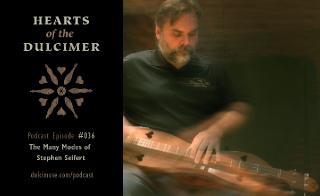
Stephen Seifert is one of the most accomplished dulcimer performers today. Possessing an impeccable command of the instrument, he’s a favorite at festivals and clubs around the country and has performed as a soloist on his mountain dulcimer with symphony orchestras.
Hearts of the Dulcimer Podcast can be found on most podcast apps.
Here's the link to Hearts of the Dulcimer on iTunes: http://bit.ly/hotdpodcast
Don't use a podcast app or iTunes? You can listen to all the podcast episodes directly on our website: http://dulcimuse.com/podcast
We also have a resource page for every episode, where you can find photos, videos, and song lists. Here's the resource page for this episode: http://dulcimuse.com/podcast/resource/036.html
Thanks for listening! :-)
Hi, My daughter has had trouble posting a video of mine that she put on You Tube to FOTMD.
I think the problem is that I have forgotten the password. Can I get a new pass word by
going to the settings and entering a new one? Can one just use numbers in the password
or if I use letters and numbers is there a certain length that they should be?

@steven-berger, for a couple of years I played a gig here during Gold Rush Days, a kind of living history festival in which we dressed in clothing dating from the mid-nineteenth century and performed music and theater and stuff. I played the character of someone from Appalachia who brought his dulcimer to the "diggins," sharing songs along the way. In one part of my act I asked the audience if they liked modern music or old traditional music. Then when the younger in the audience thought they were being bratty and said they preferred modern music, I would tell them that I agreed and I especially liked that new songwriter Stephen Foster. I then launched into a few Foster tunes.
In the nineteenth century, both Foster and the dulcimer were modern and innovative.
I enjoy playing Stephen Foster songs, which was popular music back in the day.....way back.
I have a whole set that I call Top Of The Pops -- 1650 !!
Hey Guys, When I read Dusty's post about cold brew coffee, I was intrigued since I love ice coffee in the summer. So I Googled it and chose a recipe and made some. I steeped it for 24 hours and it was good but not strong enough. So I will let my next batch go longer, maybe only 48 hours.
My husband buys 3 kinds of whole bean coffee and mixes them for our own special brew. I grind beans every morning for coffee so I feel I have that part down pat. I'm going to make ice cubes from my first batch and make my next batch stronger. I just used a qt mason jar and after 24 hrs strained the grounds through a fine sieve. Even though it wasn't as strong as I expected, it was still good. I, too, have to be careful not to drink caffeine after a certain hour. Thanks for the pictures, Dusty. This was great information for coffee lovers. Dulcinina
I was also told by one doctor to avoid coffee because it aggravated my acid reflux problem. But that's another benefit of cold brew. Although it still has the caffeine, it has no acid! Obviously, for those with acid reflux it would be best to avoid all coffee, but if you're like me, there are mental health benefits to coffee, and cold brew is a way to drink it while minimizing the acid reflux problems.
Wish i could drink strong coffee because I love the taste. Alas, I must avoid caffeine!
Well if you just want a chuckle . . .
At the jam after the Berkeley Dulcimer Gathering this past spring we played "White Rabbit" by Jefferson Airplane. It was mostly barre chords. I was cracking up the whole time.
I often play Prince's "Raspberry Beret" with a kind of honky tonk shuffle, and idea I got from a band called the Derailers.
And to please my daughter, I occasionally play Bruno Mars's "The Lazy Song."
A couple of years ago Stephen Seifert was the guest instructor at the Redwood Dulcimer Day in Santa Cruz. I was invited to the after-party and was really excited to jam informally with Stephen, Neal Hellman, and others of my dulcimer heroes. I had been learning so many fiddle tunes and Celtic tunes and I couldn't wait to show them. And what do you know? They all wanted to play 70s pop. The same stuff I played guitar to my whole life. Can we just put "Hotel California" away? I wish I could stab that song with a steely knife!
I took a dulcimer to Uke Club last week. It was one of our 3-chord-song nights... although we are fast and loose with the number 3. The songs were in several keys. I tuned Ginger to D-A-d-d (it would have worked just as well with a three-string setup) and made extensive use of the 1.5 fret.
I played every chord in every song with no capo and no retuning. With one exception. I could not find a true G-minor chord (no B-flat in this tuning) so I substituted a G power chord barring the 3rd fret. Since this was a proof of concept, I made extensive notes. The setlist (in alphabetical order from the song packet, although we did not play them in this order):
All Shook Up (key of A)
Big Yellow Taxi (C)
Brown-Eyed Girl (G)
Chapel of Love (D)
Feeling Alright (D)
Get Back (A) -- try these barre chords...
4th fret for 8 counts (Jojo was a man who thought he was a loner...)
0 (open) for 4 counts (but he knew it couldn't...)
4th fret for 2 counts (last...)
3rd fret for 1 count
2nd fret for 1 count
Hound Dog (D)
Jambalaya (G)
The Lion Sleeps Tonight (C)
Love Me Do (G)
Memphis (A) -- A chord 101 and walk the bass string 1-2-3-2-1
E7 chord 111 and walk the middle string 1-2-3-2-1
Moonlight Bay (C)
Old Time Rock and Roll (C)
On Top of Spaghetti (G)
Pink Cadillac (G) -- Play G 013 and walk the bass between 0 and 1.5 frets
Spooky (Gm) -- Cheat the Gm as 333, play Am 446 and C-diminished is 656
Takin' Care of Business (A)
Twenty Flight Rock (A)
When Will I Be Loved? (D)
You Are My Sunshine (C)
The uke club theme song is basically Movin' On Over (G)
I did put in a few hours' practice on the days before the club meeting. I consulted two chord books (Neal Hellman's little one and the gigantic Mel Bay spiral-bound one). And I very deliberately chose a night when the setlist was manageable. Tin pan alley night would require a chromatic fretboard... or the patience of a saint.
Sandi, under the circumstances, I don't have any business judging you too harshly! 

And... once you've made your jar and put it in the fridge, how long is it good for would you say?
The mason jar I use came with the conical filter. It holds 6 cups, so it's like a quart + a pint. The cafe owner who turned me on to this stuff makes her cold brew with a big cheesecloth bag and a 5-gallon bucket. If you search online you can find all sorts of devices for making cold brew, most much smaller than my 6-cup jar. But you don't really need fancy equipment. A container and some kind of filtering system is all you need. You could even use one of those French press coffee makers. The only question would then be the ratio of coffee grinds to water, and I'm sure that information is available online.
And remember to use coarsely ground beans. Pre-ground beans are way too fine. Also, apparently, those cheap coffee grinders that actually cut the beans up are no good. The beans have to be actually ground (don't ask me why), which is why I got a cheap hand-grinder.
How long will the coffee last in the fridge? Good question. I don't know for sure. I usually pour the coffee out of the big mason jar into smaller mason jars so that my wife can take one to work if she wishes. My sense is that they could last a long time sealed in those jars in the fridge. When I pour the coffee from the big mason jar there is some sediment at the bottom that makes the last 1/2 inch or so unusable. I just dump that.
@dusty-turtle , is that a quart sized mason jar or a pint?
And... once you've made your jar and put it in the fridge, how long is it good for would you say?
Acouple of weeks ago I was at a business meeting at a hotel whose bar advertised cold brew coffee. Just after lunch I left the meeting to order some. They poured a few ounces in the bottom of a large glass, filled the glass with ice, and then poured in a bunch of water. They were treating the cold brew as a coffee concentrate. That's probably a safe way to consume it, though you lose some of that strong flavor, obviously.
Hey @strumelia.
Yes, the grounds sit in the water for 48 hours. The contraption that I have came with a recipe book that suggests 12 hours is enough, but the first 12-hour brew I made was not nearly as strong as the original stuff I had from that cafe, so the next batch I increased the "brewing" time. I eventually settled on a minimum of 36 hours. The cafe owner that converted me claims that more than 24 hours will create a bitter taste, but that has not been my experience. I think that dynamic is determined by how coarsely the beans are ground. I hand grind my beans in a very unscientific manner so my exact method may not be reproducible.
The water is not hot to begin with. In fact, the brewing process can take place in the refrigerator, but I start with cool water and leave it out on the counter, not refrigerating until after I remove the coffee grounds.
My headache yesterday was from a sleep deficit. But you are right about watching out for the strength of the coffee. I usually dole it out in very small doses, which is why I can say for certain that I had 2 ounces yesterday. I never pour a whole bunch in a big glass as you would if you were serving iced tea. And it sometimes "hits" you as much as an hour after consumption, so it's easy to overdo it.
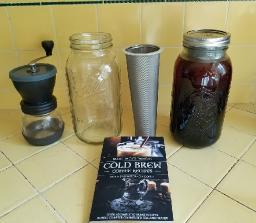
From left to right: a manual coffee grinder, an empty mason jar eager to start brewing, a conical strainer, and a batch of cold brew that will be ready this afternoon. In the foreground, a cold brew recipe book which I never use because almost all the recipes involve something sugary, and I just enjoy the taste of plain coffee.
Yes, I am well acquainted with that watery coffee every cafe and diner served us for decades. It was not only the brewing method that made that coffee so bad; it was a different kind of coffee. For some reason, after WWII, Americans stopped using Arabica beans and switched to some other lesser coffee bean. The coffee renaissance that we associate with Starbucks has involved a return to the Arabica bean. Yum! 
Dusty you are making me want to try that stuff now. 
Brian usually drinks like 4 cups of regular brewed coffee per day, and me 2-3 cups. (I try to stop by 1 or 2pm, otherwise it keeps me from sleeping deeply.) We use the paper filter hand-pouring method. Coffee is one of our favorite indulgences! Over the past two years there have been quite a few articles about coffee (in reasonable amounts) being GOOD for one's health. Yay!!
Do you mean your grounds sit in thier cone filter immersed in the water for 48 hours? And... is the water you pour in hot to begin with? Hmm..I think I may need to turn to Youtube for some tutorials here. 
I don't want to ingest 'too' much caffeine however- I've found too much does make me feel icky, and definitely interferes with my getting deep sleep cycles.
Dusty do keep an eye on whether you might overindulge and then experience any caffeine-withdrawal headaches- which of course get 'cured' by.. another shot of caffeine! 'Hair of the dog' kind of thing, but you don't want headaches to begin with. 
I'm thinking that maybe cold-brewed coffee is powerful in the same 'visionary out-of-body experience' way as when Americans try Turkish coffee. There's a reason the Turkish drink their coffee in those tiny little cups. 
Some of us are old enough to remember pre-starbucks times in America when everyone just drank watery Bunn-o-matic Maxwell House diner counter type coffee that you could practically read a newspaper through. (what's a newspaper, some might now ask). American coffee used to be real watery from when I was a kid in the late 1950s all the way up to maybe the past 25 or 30 years it seems to me. Back then only weirdo beatniks drank espresso(aka 'foreign' coffee) in subversive coffee houses.
It's great to have a 'vice' that might actually improve one's health.  Thanks for your 'uplifting' post, Dusty!
Well, how healthy it is depends on what doctor you ask. I read an article today that reported on a recent study concluding that four cups of coffee per day is ideal to keep an aging heart young.
That's my excuse to claim that this post relates to "healthy living."
I recently discovered cold brewed coffee. Last summer I asked for an iced coffee at a new cafe across from the Strum Shop which hosts our monthly dulcimer gathering. I was asked if I wanted regular iced coffee or cold brewed. When I asked what the difference was, I was told merely that cold brewed coffee is "a little stronger." Yeah, and Everest is "a little" hard to climb.
I had a near religious experience with that first cup of cold brewed coffee, drinking only an inch or so off the top and feeling happy and energized for hours.  (That must be how Elvis felt when he first got hooked on liquid methamphetamine.) I brought the rest home for my wife, who had a similar experience.
Now we make it ourselves. I have a cone-shaped mesh filter that sits in a large mason jar. I hand grind dark roast coffee beans, put them in the filter, and pour in water. I then let that sit for 48 hours, remove the grounds, and refrigerate the coffee. About every other day I make a batch. The stuff is delicious. And strong. And it makes me happy.
Earlier this afternoon I had a headache. I took an ibuprofen and drank about 2 ounces of cold brewed coffee. I then sat in a dark room for about 15 minutes. And now I feel great. Life is good.
Love, LOVE that sharing, Dusty. Don't know how I missed it, but GOOD STUFF. We will all get there, won't we? 
I'm not asking for TAB, I just wanted to chuckle over some ideas that might seem very unlikely. I.e. right now I'd love to have a go at "I Like That" (with language edits) by Janelle Monae, LOL. Please don't judge me too harshly... 
My way of looking at it is he is saying "Alright, Mr. DeMille, I'm ready for my close-up." He does so well in having his picture taken. My daughter is forever taking snaps of him and she seems to catch his good side.
@folkfan , Tigger has got a mischievous look in his eye! 
He's about 10 years old, but he almost as bouncy now as he was as a kitten.
Thank you, Strumelia. I have actually had my closest melody string go very wonky out-of-tune while noter playing several times, like in the middle of a song! I still think that is still at play here still... And I would still do it again! LOL!