Happiness in a new song
General mountain dulcimer or music discussions
I just saw this post Terry. GOOD STUFF! 
I just saw this post Terry. GOOD STUFF!
@yeahsureok, you've gotten great advice so far, and I'm going to do my best not to repeat it. I just have two points to add.
First, bending strings is very difficult if not impossible with a double string. There is a reason guitarists bend strings all the time and mandolin players almost never do. You might consider playing with a single melody string. It makes bending strings as well as hammer-ons and pull-offs much easier. And I think you get a cleaner sound all around.
But keep in mind that you don't always have to play the string as you are bending it. As you improve your touch, you can bend a string and then pluck it, so you don't hear that bend up but merely the note you are trying to get. That technique takes some practice, but you can get good enough that no one would know you are bending a string to get a particular accidental.
Second, accidentals are not, . . . uh, . . . accidental. That is, they are notes purposely included in a melody. Not all music is diatonic. If you can retune to get a song, then the song might still be diatonic but in a different mode. In that case, we are not talking about accidentals at all. But some music does indeed have more than the seven notes of the diatonic scale. If there are only one or two chromatic notes that appear occasionally in a song, you can employ the techniques others have laid out here. But if there are a lot of accidentals, perhaps that song is not really good for the dulcimer. I tried to learn a tune from a Carolina Chocolate Drops album a while back and realized that there were 4 half tones in a row in an important part of the melody. That was my clue that my dulcimer efforts were better spent on a different piece. Right now I am arranging tunes for a tab book on lullabies of the world. I found a few tunes from Israel and Russia that I really wanted to include, but there were too many accidentals, so I just left them out. In another case, a tune had a single accidental, which I get by bending the melody string at the 4th fret. That one I included, with a note that the melody works fine with the straight 4th fret, but adding that bend gets closer to the original melody. So a little extra effort might be worth it, but if a tune is defined by too many chromatic notes, perhaps its better to leave that one for chromatic instruments.
Having said all that, let me add that I now use dulcimers with the 1+ and 6+ frets, and I find that with those two extra frets, I can get almost all the tunes I want to play. It took some time to get used to the 1+ fret, but I wouldn't want to go without it now.
With a noter, the slant thing like John said.
Without a noter, I pinch the string between my thumb and forefinger in the place where I wish I had a fret. This works well if you've got fingernails that are neither too long nor too short (experiment).
As Ken said, you can skip the note or substitute another. Try a note that harmonizes with the missing accidental -- often two frets up or down. Whatever sounds good is good.
When in doubt, strum the chord and sing. Your voice is chromatic :-)
If your dulcimer has high-enough action, get a metal or glass slide and play without letting the strings touch the frets -- now it doesn't matter how many frets you've got!
If you can set your dulcimer up with 4 equi-distant strings, you can try a chromatic tuning. I use D-A-d-c#. This works like a piano: the white keys are on the "d" string and the black keys on the "c#." The disadvantage is you can no longer simply strum across all the strings. My solution is to make the chromatic string the one closest to me, so I can mute it with the heel of my thumb while fretting the other strings. Or fingerpick without touching the chromatic string except on the accidentals. I have done this successfully, but it is a bother and my preferred solution is...
Play a chromatically-fretted dulcimer. Not the cheapest option and maybe not possible for you right now, but long-term it SOLVES the problem while all these other techniques are just work-arounds. If your favorite music includes a lot of accidentals, it makes sense to use the right tool for the job.
If you're playing noter style and the chromatic note passes pretty quickly, you can use the noter like a guitar slide. You can get the "in-between" note this way.
Leave the tip of the noter on the fretboard. Lift the noter on a slant, tipping it downward so that the string is off the fret, but still making contact with the noter. You want to have the noter where the chromatic fret would be. The tone isn't the same as a fretted note, but most people won't notice. It is a little tricky with a doubled melody string, though. That can get buzzy.
Temporary frets are another option. Fret wire is around .040 high [crown height]. Tape them in place, tape between the strings. These could be partials, just under select strings.
Hi Yep,
Folks who play mostly chord/melody style like yourself can often find the accidentals on another string- usually the middle string. Try that first.
There's also a way of slanting your noter so the tip touches the wood fingerboard in the place where your missing fret would be- giving you the half note accidental. Others could maybe point you to videos and discussions here on FOTMD that describe this technique.
Retuning into a different mode (but staying in the same key) can solve the missing accidental in most cases, but not all.
Some tunes can be altered just a bit in order to skip or avoid the accidental. Not everyone can figure out how to do that but if you can, then great! It can make for a more 'personalized' tune version.
If you find that in your playing, if you frequently need a particular accidental or note that always seems to be on a particular 'missing' fret location, then in my opinion there's no reason not to have the new fret added there if it enables you to play more enjoyably. As to extra fret 'acceptance'- you're not playing dulcimer in order to gain approval from others . My mtn dulcimers have the 6.5 and the 1.5 frets added- and I've never regretted it. I have an epinette with only the diatonic frets and I would never add extra frets to it- i love that it was built strictly traditionally, and playing it without extra frets is very enjoyable. If you decide you want a chromatic dulcimer, you can save for it and then look for a used one to buy- you can always resell it later if you decide it's not for you.
You don't mention the KIND of music you typically play that has accidentals. Certain genres of music have more accidentals than others. Interestingly, I find that both Modern music and very early Renaissance/Medieval music seem to present the most accidentals to me- which is amusing since they are at complete opposite ends of the spectrum in terms of time periods. Traditional and rural folk music from 1830-1940 or so presents me with the fewest accidentals... and (not coincidentally) the American mountain dulcimer was developed around playing that kind of music.
I enjoy several genres of simple music to play at home on a few different instruments. The medieval type music seems to have enough accidentals in it to make it problematic for a non-professional musician to play on a non-chromatic fretted dulcimer or instrument. I will be getting a langspil with chromatic fretting in order to have a traditional instrument that enables accidentals and mode changes easily, 'on the fly'. 
Some folks do find that adding one or two extra frets is confusing... but the confusion will fade if they stick with it. After all, most dulcimers have the 6.5 fret and nobody finds that extra fret terribly confusing. ;) Going from a 'normal' mtn dulcimer to a chromatic has its own learning curve as well. My banjos are split between totally fretless banjos and chromatically fretted... if I play them all fairly regularly, the differences only take about 30 seconds to get used to when I switch from one to another.
I don't buy new instruments that often, but when I do there's usually a very specific function I'm looking for.
Handling Accidentals
1. Skip them entirely with sustain of the previous note occupying the measure. Or play either the note before, or the note after, for the same measure as the 'missing' note. Most of the time, if the audience knows the song, they will 'hear' the missing accidental. If they don't know the song it doesn't matter. This was a very common traditional approach, as many players seem to have used an Octave tuning (Ddd, Ccc, etc) rather than Modal tunings like Ionian (DAA), Mixolydian (DAd), Dorian (DAG) or Aeolian (DAC)
2. Re-tune -- it's only one string and should take less than a minute while you're introducing the next number! Create sets of tunes in each tuning that you use; rather than playing one song in this tuning, the next in something different. It's easy find half a dozen songs in each of the common Modal Tunings.
3. Bend the melody string. Try removing (permanently or temporarily) one of the doubled melody strings until you learn to bend a pair.
As a 99.5% N&D or Fingerdance traditional player, numbers 1 & 2 are my options of choice, and my choice depends on the missing note(s) in which tuning
I was wondering, some of the songs I like to play have accidentals in them, and I was wondering what different peoples approaches to getting around that.
I am familiar with different modes of tuning to get the specific notes you want. I have tried a few that have served me well, but I'm not a big fan of retuning my dulcimer so often for different songs.
I have also experimented with string bending, which I really enjoy and I love the twangy sound effect it can make. It is more difficult on the melody string, being double coursed, but I'm working on it. Anyway, I'm just curious about other people's approaches.
I like the idea of buying a fully chromatic instrument, but it isn't in my budget at the moment.....and many people condemn them, which I don't understand. I have read some people say they tried one but the extra frets caused problems. So.....?
Also, if it's useful info, my playing style is about 25% noter drone and 75% chord melody. I also just started trying out fingerstyle.
Richard, what lovely instrument. I love the snowflakes and love your description. Maybe one day we will get treated to a little demo from you playing it. 
It's a wonderful thing to own an instrument that is a joy when we strum it. 
Thanks for the great explanation, Dusty!
JP, I'm just curious- did you not look over the other threads in this Site Questions forum to see if the solution to your problem had already been asked about and answered? I hope you now understand why you were not seeing the whole discussion.
Dusty mentions the main site links along the TOP navigation bar on every page of FOTMD (Home, Forums, Photos, Videos, etc). When one is very confused about how the site is laid out, it really does help to click those links to gain a better understanding of the areas of main function and content. Not everything is immediately accessible from the Main Page... or else it would have to be five miles long. 
I'm glad you were able to post a new thread here in the Site Questions forum in order to ask your new question, though! I'm going to edit this thread's title to be more descriptive of the thread subject now- in order to help others in the future looking for answers to similar questions as yours. :)
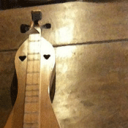
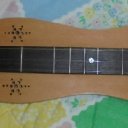
Richard, I'm glad you are happy with the sound of your June Apple model dulcimer. Mine is similar to the one you have with the following exceptions: Mine has traditional heart-shaped soundholes and only three planetary pegs at my request. Carl and his staff are great. They are very accommodating in meeting requests for minor changes like number of strings and soundhole design. I haven't checked the website lately, but their prices are a bargain compared to many new dulcimers out there.
I have a June Apple dulcimer. It doesn't have the light silvery sound of the J.E. Thomas reproductions that I own. Nor does it have the resonant sound of the larger bodied dulcimers. The sound falls somewhere in between. You could probably describe it as a balance between the two. Keep in mind that Carl and his staff at June Apple Dulcimers manufacture several different models of dulcimers and dulcimer ancestors. The June Apple model has a somewhat smaller size than other models made by June Apple, so it's not surprising that the sound is somewhat closer to traditional than it is to guitar-like. June Apple also makes a larger-bodied dulcimer. I don't have personal experience with the larger model, but I would assume that its sound is more resonant and similar to other dulcimers with wider, deeper soundboxes. In short, the difference in sound is more a combination of volume and resonance. Everything else being equal, smaller-bodied dulcimers have less volume and less resonance. Larger-bodied dulcimers have more volume and more resonance. Other factors to consider are the type of wood used, particularly the soundboard (top), and the thickness of the top, back, and sides. I'm not a builder. A builder would be more qualified than I to describe the various factors affecting the sound of any given dulcimer.
The dreaded malady DAD is currently in remission. So glad my bank account was not quarantined. I have recently come into possession of June Apple model dulcimer from June Apple Dulcimers. This model is copied from the shape and size of the Huntington dulcimers. It sports book-matched walnut back with decorative stripe, walnut sides, book-matched top of Western Red Cedar, Wenge fretboard overlay. It has snowflake design sound holes as well as snowflake position dots. As @banjimer notes in his post the sound is not as silvery as the Thomas reproductions but it is not as resonant and mellow as the larger bodied modern dulcimers. The tone is in a word "sweet". It is not an overly loud instrument with its tone quite well balanced across the spectrum. Craftsmanship is superb. I have it strung with 3 strings since I prefer a single melody for noter style playing. It has notches for double melody and for 4 equidistant. Fretboard is taller for noter playing. It sounds so good I can't imagine a lot of change after it "plays in" some more.
Jack and Pippi at speed on the sand dunes. Jack, the spaniel X a rehomed pooch, and Pippi, the chihuahua a rescued pup.
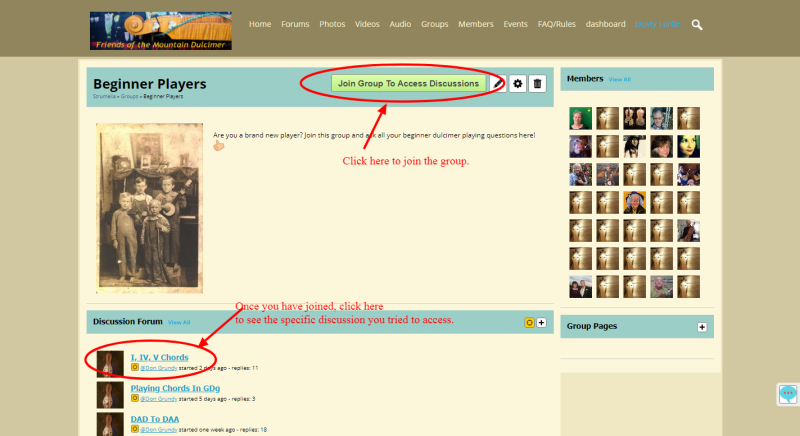
@jp. there are two main areas for discussion at FOTMD. One are the Forums, which are open to everyone. But there are also special interest Groups.
If you look at the tool bar on the very top of your screen, you will see "Forums" as the second item from the left and " Groups " as the sixth. I encourage you to peruse the Groups and join those you are interested in. There is a group dedicated to traditional noter/drone players, a group for players from Indiana, a group for builders, a group on dulcimer history, a group for fingerpickers, and so forth.
If you are not a member of a group, you will be able to see the most recent or sometimes the very first post in a discussion, but you will not see all the other posts. However, if you simply click the big green button that says "Join Group to Access Discussions" which can be found to the right of the group's name, then you will see all the activity.
i am so confused... *sigh*
That post by Lois is indeed in a Group discussion, not a general public discussion. The Group is called Beginner Players, and the thread is about I, IV and V Chords. As Dusty sez -- to see everything you have to join the Group.
@jp, you might be clicking into a discussion within a group. You have to join the group to see all the content, or to post in that group's discussions. In the example you provided, that is the Beginner's Group.
often as i go to a post on the home page and click on it even if it says 11 comments all i get is the original question there is nothing else there.
this post is an example.

I like to sit outside early in the morning to quietly play some slow airs and hymns on my whistle. This Spring the Doves and Robins come to the fountain and sit and appear to be listening. They stay within a flew feet of me as long as the music lasts. They seem indifferent to the dulcimer.
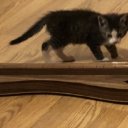
My cat runs out of the room if I so much as touch an instrument. Maybe it is a comment on my playing ability? They say cats can hear an octave higher than dogs even.
San Francisco Bay Blues, Bird on a Wire, any country song before 1970, Peaceful Easy Feeling was one of the 1st songs I learned on the dulcimer, Desperados Waiting for a Train, Lulu's Back in Town, Ain't Misbehaving (including all the dim and minor chords on a dulcimer with no extra frets.) So many songs.... so little time!
Country: Someday Soon, Pancho & Lefty, Louise, I'm So Lonesome I Could Cry, When You Say Nothing At All, May You Never Be Alone Like Me
Pop/Folk: Both Sides Now, Time After Time, Circle Game, End of the World, Let It Be Me, I Will, My Immortal, Up On the Roof, You Belong to Me
Cabaret/Show Tunes: La Vie en Rose, Lili Marlene, If I Only Had a Brain, Over the Rainbow, Goodnight My Someone, When I Fall In Love
Calypso: Brown Skin Girl, Jamaica Farewell, I'd Reveal How I do Adore Her
Always maintain a list of popular songs and tunes to work out.....
My dogs sleep. My one bird loves it...boogies the entire time...
Did a little experiment to test his reaction
Hi Susie. Sheba is a pretty average sized girl cat. We got her from the local Humane Society... we get all our cats from there. 
Must be the way she is laying that makes her look like a larger cat. She is a beauty!
Hi Susie. Sheba is a pretty average sized girl cat. We got her from the local Humane Society... we get all our cats from there.
Sheba (aka Boo Boo) likes to lie on the backs of chairs and along the tops of open doors.
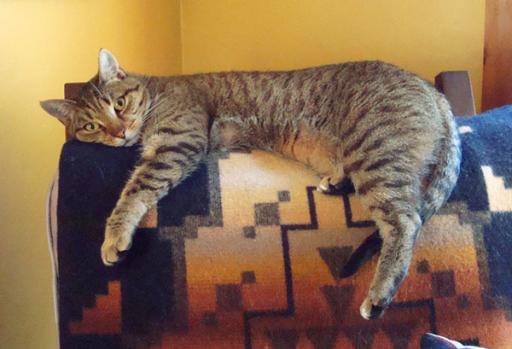
She looks like a good sized cat....how much does she weigh? Very pretty!
Sally Ann has filled out very nicely. Looks like she grew a sleek new coat, too. 
and- my oh my, those are two beautiful dulcimers!
Our 3 cats seem to like it when Brian and I play tunes... as we begin to play they casually* saunter into the room (*so we won't know they actually approve of something we do) ...and they take up positions in various chairs. As though their appearance was all accidental.
However, our red cat Rufus detests my pennywhistle playing... at the very first note he races out of the room. I can't really blame him. 
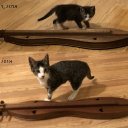
Here's a side by side comparison of Sally Ann from 11 May and today (I have this in the correct forum today).
In the top photo Sally is checking out my 1931 Uncle Ed Thomas reproduction made by Kevin Messenger and in the bottom one she is looking at my 1915 Uncle Ed Thomas reproduction made by John Knopf.
Our previous furball, Peachy, really enjoyed it when I'd play my dulcimer and would contentedly watch me play for the longest time she'd even ask me to play. So far Sally Ann doesn't have a lot of interest in the instrument or listening to it much, though she did the other night. I think right now for Sally Ann everything in the world is too new and interesting to sit around and listen to me play music. My guess is when she becomes an adult cat she won't have so much energy and have a more contemplative. And if not, that's ok too!
Sally Ann will be four months in a few days. For some reason she thinks she's the boss.
So, David, Sally Ann is a cat. If she is like our cat, she IS the boss. Tis the nature of house cats.
Sheba (aka Boo Boo) likes to lie on the backs of chairs and along the tops of open doors.
It's hard to imagine that she's not this size anymore. The good thing is we don't have to treat her like something very fragile (she's pretty tough, in a nice way, now). This pic is about two months old.
Sally Ann will be four months in a few days. For some reason she thinks she's the boss.
Gary Sager is a friend of mine! He and his wife, Toni, own and operate Prussia Valley Dulcimers and are fine folks! Gary builds a nice instrument-- I own two of his Prussia Valley mountain dulcimers, the box was a custom build and my teardrop I came by used. You're fortunate to have one of Gary's instruments-- enjoy!
My new baritone has what I think is called a Weeping Heart? Robin 8 years ago posted a photo with the same type of sound hole. I never heard of this type, so I went looking on the Sound Hole discussion.
Just one more thing in my getting to know my Bari. It has a lovely tone, but I am having to adjust to extra frets. Joined the Extra Fret group. Nothing like an addition to the family to get you involved in more and learning more.
not that it is important... i have bluebirds on my tc obrien.... i hate them.
( if it had been any other of his birds or animal sound holes I would not have bought it)
they came with the machine which i picked up used for a great price in NC when i
visited.
i prefer traditional holes... except hearts are over used.... i like C holes a lot....f holes are fine... if i could choose i would like the crescent-moon and star as David Schnaufer had on his .... kind of a stylized C hole.... but never animals or birds. jmho
Hi everyone! I recently found a little dulcimer on Reverb for $55 that I intended to use as a beater for kids to try at demos. It has arrived and it is far better than I thought it would be. It needs a clean up and new strings (the ones on it look like they date from 1981, the date written inside!) but has a nice sound despite it's small size due to it's surprizing depth (2.5") and it can be standardly tuned. The label inside says Loran Harmon, Pensacola, FL 848 B 12/81. I googled him and I guess he sold at the Gulf Coast Arts Festivals. He is now deceased.
Please let me know if you are familiar with his work, I enjoy having stories to tell about my instruments.
Barb